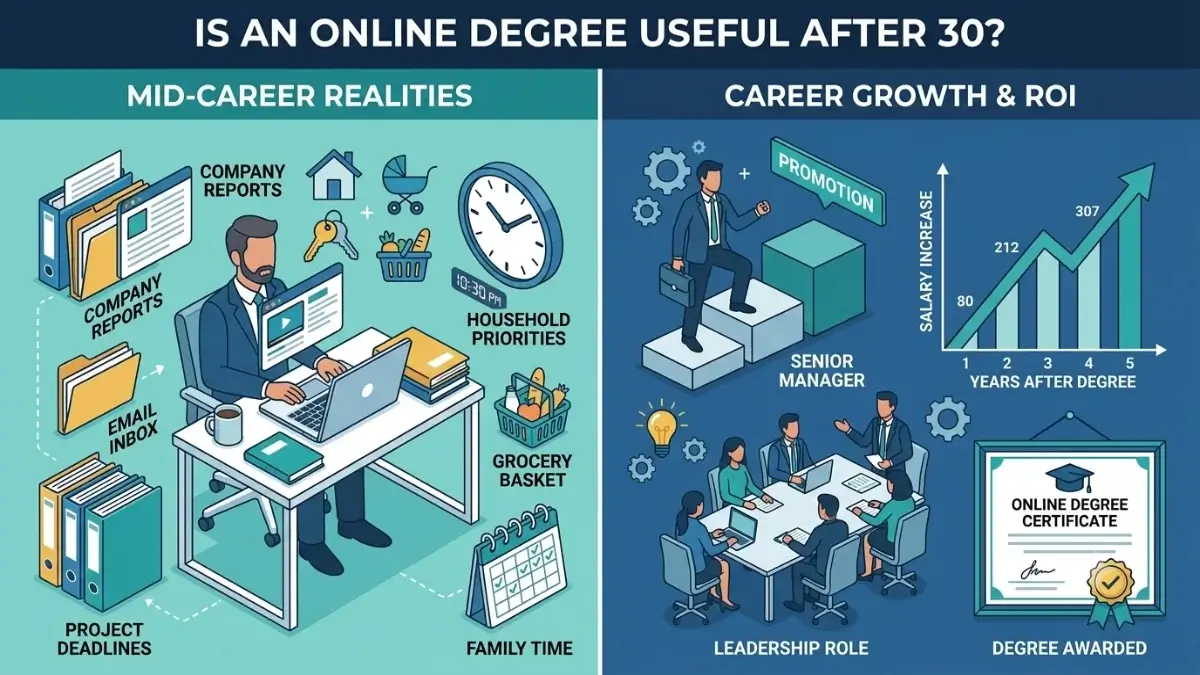
Is an Online Degree Useful After 30? What Changes When You Study Mid-Career?
Does your career feel stuck despite having a stable job and years of experience?
Perhaps you want to switch industries, qualify for a promotion, or gain the skills needed for your next role. An online degree may seem like a good option, but is it worth pursuing after 30? Will employers value it, and can you balance studying with work and family responsibilities?
Studying in your 30s comes with different priorities, including financial commitments, limited time, and clearer career goals.
An online degree can be useful after 30, but its value depends on your career goals, the recognition of the qualification, and how you apply it alongside your existing experience.
Here’s what changes when you study mid-career and how to decide whether an online degree is right for you.
Why Do People Consider an Online Degree After 30?
By their 30s, many people have a clearer understanding of their professional strengths, limitations, long-term goals, and the opportunities they may be missing.
Common reasons for considering an online degree at this stage include:
- Career advancement: Meeting the qualification requirements for a promotion or new role.
- A career change: Gaining formal knowledge in a different field.
- Skill development: Building technical, analytical, or management skills as industries evolve.
- Completing unfinished education: Finishing a qualification left incomplete while entering the workforce.
- Returning after a career break: Updating knowledge and strengthening qualifications before re-entering the workforce.
- Greater career flexibility: Preparing for different roles rather than relying on a single career path.
Workplace changes make continued learning increasingly relevant. The World Economic Forum’s Future of Jobs Report 2025 found that 63% of surveyed employers identified skill gaps as a major barrier to business transformation, while 85% expected to prioritise workforce upskilling between 2025 and 2030.
Although these figures reflect global employers rather than every Indian industry or worker, they highlight the importance of continued learning. For someone in their 30s, an online degree may be less about adding another qualification and more about preparing for a specific career change.
What Changes When You Study After 30?
The biggest difference is that education becomes part of an already established life. You may be working full-time, supporting family members, managing household expenses, or handling existing financial commitments.
These responsibilities change how you should evaluate an online degree.
1. Your Career Goals May Be More Specific
At 20, you might choose a course out of interest or while exploring different career options. By 30, work experience may have helped you identify specific gaps.
For example, a sales professional aiming for a management role may benefit from management education, while an accounts executive interested in financial analysis may need stronger analytical skills.
Instead of asking, “Which degree should I pursue?” consider, “Which qualification or skills would help me qualify for my target role?”
A degree is valuable when it addresses your actual career requirements, not just because it looks impressive on your CV.
2. Your Existing Experience Becomes Part of Your Learning
One advantage of studying mid-career is that you can connect academic concepts with real workplace situations.
Someone pursuing an MBA may relate leadership and operations concepts to their professional experience, while a person studying human resource management may draw on their understanding of team coordination and employee relations.
Your experience can also strengthen assignments, projects, and interviews through examples of problem-solving, communication, and decision-making.
However, experience cannot replace every academic or technical requirement. Moving into a new field may still require learning unfamiliar concepts, using specialised tools, or gaining practical experience.
The goal is to build on what you already know while developing the skills you lack.
3. Time Becomes a More Important Consideration
Online programmes can reduce commuting and offer recorded lectures, digital learning materials, and flexible study schedules, depending on the university.
This can help you continue working while studying. However, you still need time for lectures, assignments, examinations, projects, and revision. Some classes and assessments may also follow fixed schedules.
Before enrolling, estimate how many hours you can realistically study each week. Account for work deadlines, family responsibilities, and rest.
A programme that fits your routine is more practical than one that demands more time than you can consistently manage.
4. The Financial Decision Carries More Weight
At 30 or older, tuition fees may compete with household expenses, loan payments, savings, and other financial priorities.
While an online degree lets you continue earning in many cases, the total cost may include registration, examination, project, and other programme fees.
You should also consider the time invested and any income you might lose if you leave your job to study full-time.
Compare the total cost with the expected career benefit. If a short professional course meets your immediate needs, a full degree may not be necessary. But if a recognised qualification is essential for your target role, a longer programme may be the better investment.
Can an Online Degree Help You Change Careers After 30?
Yes, an online degree can support a career change by providing relevant knowledge or qualifications. However, it does not guarantee entry into a new industry.
For example, someone with six years of customer service experience who wants to move into human resources could pursue an online HR management programme to learn about recruitment, employee relations, and performance management. Their communication and conflict-resolution skills may also be transferable, though practical HR experience or knowledge of HR software may still be necessary.
Other possible career transitions include:
- A sales executive moving into marketing or business development.
- A commerce graduate exploring financial analysis after developing analytical and technical skills.
- A technical support professional moving into information systems or project management.
- A teacher exploring education management or instructional design.
- An operations employee moving into supply-chain management or business analytics.
These pathways depend on your qualifications, experience, and target role’s requirements.
Before enrolling, review job descriptions for the positions you want. Identify whether employers require a specific degree, technical skills, certifications, or practical experience. This will help you decide whether a full degree, a shorter course, or a combination of qualifications and hands-on learning is the right choice.
Which Online Degrees May Be Useful After 30?
The right degree depends on your career objective rather than your age. Use the following table as a starting point, then verify the eligibility criteria and skills required for the specific roles you want.
| Career objective | Possible study direction | What else may be needed |
| Move into management | Online MBA or management programme | Leadership experience, business projects, communication skills |
| Enter business analytics | Business analytics, data analytics, statistics, or a related programme | Excel, SQL, visualisation tools, practical projects |
| Move into technology | Computer applications, IT, or a relevant postgraduate programme | Programming practice, portfolio projects, technical interviews |
| Develop finance expertise | M.Com, finance, accounting, or financial management | Financial analysis, relevant software, professional certifications where required |
| Shift to human resources | MBA or master’s programme in HR | HR systems, recruitment or employee-relations experience |
| Build an education-sector career | Education, academic administration, or instructional design | Teaching or training experience and role-specific eligibility |
| Move into project or operations roles | Management, operations, or information systems | Project tools, documentation, stakeholder-management skills |
This table is not a universal recommendation. Some roles require specific qualifications or regulated credentials, while others place greater emphasis on practical skills and experience.
Before choosing a programme, compare its actual curriculum with the requirements of your target role. A degree is more useful when it addresses a real qualification or knowledge gap.
Online Degree or Short Course: Which Makes More Sense?
A full online degree isn’t always necessary. The right choice depends on whether your career goal requires a formal qualification or specific skills.
A full online degree may be suitable if:
- Your target role requires a bachelor’s or postgraduate qualification.
- Your current qualification limits promotion or further study.
- You need structured learning to enter a new field.
- You’ve identified a recognised programme aligned with your career goals.
A short course or certification may be better if:
- You already have the required degree.
- You need to learn a specific tool or technical skill.
- Employers prioritise practical skills over additional qualifications.
- You want to explore a career direction before making a larger investment.
For example, someone who meets the educational requirements for a marketing role may benefit more from learning an analytics tool than pursuing another degree. However, a role requiring a postgraduate qualification may demand a recognised degree.
You can also combine both approaches by pursuing a degree while developing practical skills through projects or short certifications.
Is an Online Degree Recognised After 30?
Age is not the main factor in degree recognition. What matters is whether the university and programme are recognised for the relevant admission session and whether the qualification meets your career goals.
In India, the University Grants Commission (UGC) regulates higher education delivered through online and Open and Distance Learning (ODL) modes. Under its applicable regulations, eligible degrees and postgraduate diplomas from recognised online or ODL programmes are treated as equivalent to their conventional-mode counterparts, subject to the relevant rules.
However, not every course advertised as an online degree is automatically recognised. Check the university, specific programme, delivery mode, and admission session through the UGC Distance Education Bureau.
Beyond recognition, consider the curriculum, faculty support, assessment methods, and practical learning opportunities. If you’re entering a regulated profession, verify its specific eligibility or licensing requirements before enrolling.
What Are the Limitations of Studying Online Mid-Career?
Online education offers flexibility, but it also requires self-discipline and realistic expectations.
1. You Need to Manage Your Study Schedule
Recorded lectures are convenient, but postponing them after a demanding workday can lead to backlogs. Set fixed weekly study hours and check whether the university offers academic advising, live sessions, and help when you fall behind.
2. Networking May Require More Initiative
Online learners may have fewer opportunities for informal interactions with classmates and faculty. Virtual events, group projects, alumni communities, and professional networking platforms can help you build connections. If networking is important to your career goals, check what opportunities the university provides.
3. A Degree May Not Replace Practical Experience
A qualification demonstrates subject knowledge, but employers may also expect practical skills. Complement your studies with relevant projects, professional certifications, or additional responsibilities at work, especially if you are changing industries.
4. Career Outcomes Are Not Guaranteed
An online degree does not automatically lead to a promotion, a new job, or a higher salary. Outcomes depend on your experience, skills, programme relevance, and available opportunities. Treat the degree as part of a broader career plan.
How to Manage an Online Degree Alongside Work and Family
Balancing study with existing responsibilities requires a routine you can sustain over several semesters.
Build a Realistic Study Schedule
Plan around your actual work hours and family commitments rather than an ideal routine. A practical schedule could include:
- Two or three short weekday study sessions.
- One longer weekend session.
- Weekly assignment reviews and extra time before examinations.
Consistent study is often easier to maintain than last-minute catch-up sessions.
Discuss Arrangements with Your Employer and Family
Check whether your employer offers flexible hours, examination leave, or education assistance. Discuss your study commitments with family members, too, so you can protect regular study time while accommodating shared responsibilities.
Check the University’s Support System
Before enrolling, ask about faculty interaction, mentoring, doubt-clearing sessions, technical assistance, and academic advising. These services can help you manage coursework alongside work and family.
How Should You Evaluate the Career Value of an Online Degree?
Before enrolling, assess the programme against your career goals, not just its popularity or convenience.
1. Define Your Career Goal
Decide whether you want a promotion, a career change, a completed qualification, or deeper expertise in your current field.
2. Check the Qualification Requirements
Review job descriptions to determine whether your target roles require a specific degree or prioritise skills, experience, and certifications.
3. Review the Curriculum
Compare subjects, electives, projects, and practical assignments. Identify whether the programme addresses the skills you need.
4. Calculate the Total Cost
Include tuition, registration, examination, project, and other fees. If you’re considering a loan, factor in interest and repayment obligations. Compare the investment with realistic career benefits rather than advertised salary increases.
5. Examine Placement Claims
Placement assistance does not guarantee employment. Check whether published placement data specifically covers online learners and whether details about eligible students, job offers, salaries, and roles are available.
6. Plan How to Apply Your Learning
Think about how you’ll demonstrate your new skills through projects, a portfolio, additional responsibilities, or relevant professional experience. This can help you show employers the practical value of your qualification.
Who Should Consider an Online Degree After 30?
An online degree may suit you if you have a clear career goal, need a recognised qualification, and can manage the workload alongside existing responsibilities.
It may be particularly useful if you:
- Need a degree for a target role or promotion.
- Want structured knowledge to enter a related field.
- Can build on your existing professional experience.
- Have the time and financial capacity to complete the programme.
However, a full degree may not be the best immediate choice if you only need a specific technical skill, are uncertain about your career direction, or cannot accommodate the workload.
In such cases, reviewing job requirements, speaking with industry professionals, or trying a short course can help you decide your next step. The goal is not simply to earn another qualification, but to choose an educational path that supports your career plans.
So, Is an Online Degree Useful After 30?
An online degree can be useful after 30 if it helps you meet a specific academic or career goal. It can provide structured learning, support career progression, or help you transition into a new field while continuing to work.
However, its value depends on the programme’s recognition, curriculum, and relevance to your professional goals, as well as how you apply what you learn.
Before enrolling, consider your time, finances, and existing responsibilities, along with the practical steps needed to turn your qualification into a career opportunity.
The real question is not whether you are too old to study again, but whether the degree you choose will help you move towards a clearly defined goal.