ISB vs IIM in 2026: The MBA Recruiters Actually Pay More For
Admission alerts for this course will appear here as official notifications are published.
Choosing between the Indian School of Business (ISB) and the Indian Institutes of Management (IIMs) for an MBA in 2026 is a pivotal decision for aspiring business leaders. While ISB offers a fast-track, experience-driven one-year PGP, ideal for professionals with significant work experience seeking rapid career acceleration, the flagship two-year PGP programs at top IIMs (A, B, C) cater to a broader range of candidates, including those with less experience, offering a more traditional, in-depth management education with a strong emphasis on foundational learning and internships.
ISB vs IIM: Quick Comparison (2026)
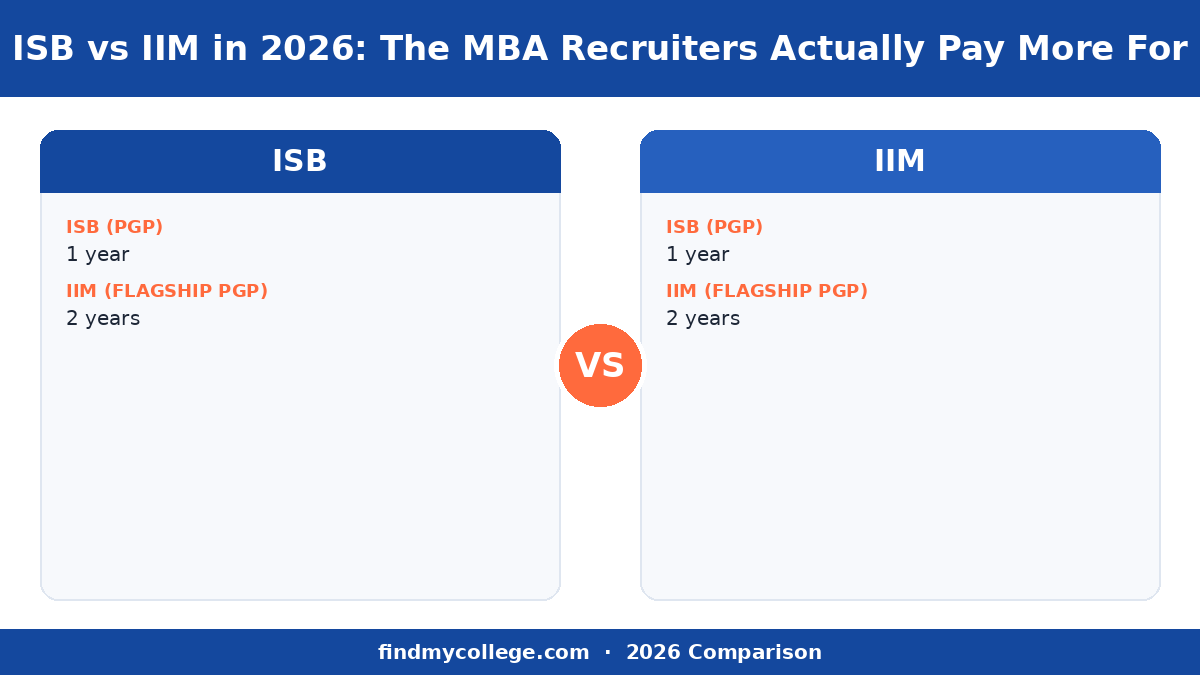
| ISB (PGP) | IIM (Flagship PGP) | |
|---|---|---|
| Duration | 1 year | 2 years |
| Eligibility | Bachelor’s degree, GMAT/GRE, 2+ years work experience (average 4-6 years) | Bachelor’s degree, CAT (or GMAT for some programs/quotas), typically 0-5 years work experience |
| Admission / Entrance | GMAT/GRE, Essays, Interview, Recommendation Letters | CAT (Common Admission Test), Written Ability Test (WAT), Personal Interview (PI) |
| Avg Fees (range) | ₹40-45 lakhs (excluding living costs) | ₹20-30 lakhs (excluding living costs) |
| Top Careers | Consulting, Product Management, Tech Leadership, Senior Management, Entrepreneurship | Consulting, Finance, Marketing, General Management, Product Management |
| Avg Starting Salary | ₹30-35 LPA | ₹28-32 LPA |
| Best For | Experienced professionals seeking career acceleration, industry switch, or entrepreneurship | Freshers to mid-experience professionals seeking foundational management skills, internships, and diverse career paths |
Curriculum & focus
ISB’s one-year Post Graduate Program (PGP) is designed for experienced professionals, offering an intensive, fast-paced curriculum that leverages prior work experience. Its focus is on advanced management concepts and immediate application, with a strong emphasis on peer learning and case studies. In contrast, the two-year flagship PGP programs at top IIMs provide a more comprehensive and foundational management education, including a mandatory summer internship that allows students to explore different industries and roles. Verdict: ISB for accelerated, experience-driven learning; IIMs for foundational, in-depth education with internship exposure.
Difficulty & workload
Both ISB and top IIMs are known for their rigorous academic environments and demanding workloads. ISB’s one-year program compresses a significant amount of learning into a shorter timeframe, requiring intense dedication and time management from its experienced cohort. IIMs, while also challenging, spread their curriculum over two years, allowing for a more gradual learning curve and the opportunity for internships. Verdict: ISB for high-intensity, compressed learning; IIMs for sustained rigor over a longer period.
Fees & ROI
ISB’s fees are generally higher than those of the flagship PGP programs at most IIMs, reflecting its premium, one-year accelerated model. However, the shorter duration means a quicker return to the workforce and only one year of foregone salary, potentially leading to a faster Return on Investment (ROI) for some. IIMs, while having lower direct fees, involve two years of tuition and living expenses, plus two years of foregone salary, though their strong placement records ensure a solid ROI over the long term. Verdict: ISB offers a potentially faster ROI due to shorter duration; IIMs offer strong long-term ROI with lower upfront costs.
Placements & salary
Both ISB and top IIMs boast excellent placement records, attracting top-tier recruiters across various sectors. ISB often sees a higher average starting salary, particularly for its experienced cohort moving into senior roles in consulting, technology, and product management. IIMs also command impressive salaries, especially in consulting, finance, and marketing, with their two-year structure allowing for internships that often convert into pre-placement offers. The choice often boils down to the type of roles and industries targeted, with ISB excelling in roles requiring prior experience and IIMs offering a broader entry point. Verdict: ISB often leads in average starting salary for experienced hires; IIMs offer strong, diverse placements across industries.
Higher studies & abroad scope
While both institutions primarily focus on career placement, opportunities for higher studies or international exposure exist. ISB has strong international tie-ups and exchange programs, and its global recognition can facilitate opportunities abroad, though most graduates seek immediate employment. IIMs also offer exchange programs and their strong academic foundation can be a stepping stone for further academic pursuits, though it’s less common for PGP graduates to immediately pursue higher studies. For those looking to work abroad, the brand value of both can be beneficial, but direct recruitment for international roles is competitive. Verdict: Both offer international exposure through exchanges; ISB’s global recognition might slightly edge out for direct international career aspirations.
Government-job scope
Neither ISB nor the top IIMs are primarily geared towards preparing students for government jobs in India. Their curricula and placement drives are focused on the private sector, public sector undertakings (PSUs), and entrepreneurship. While an MBA from these institutions can certainly enhance a candidate’s profile for certain administrative or policy-making roles, it is not their core objective, and specific government job preparation is not provided. Verdict: Limited direct scope for government jobs; both are primarily private-sector focused.
What students actually say (community insights)
- Many prospective students with 4+ years of work experience often lean towards ISB’s one-year program, citing the benefit of a quicker return to the workforce and a curriculum tailored for experienced professionals, rather than spending two years at an IIM.
- There’s a strong sentiment that while ISB has a good brand, the top IIMs (A, B, C) hold a distinct advantage in certain sectors like Venture Capital/Private Equity and traditional finance roles, with some arguing IIM-A, B, C are in a league of their own.
- The debate around ISB’s acceptance rate (~20-25%) versus IIM-A, B, C’s (<1%) often comes up, with some suggesting this impacts the perceived exclusivity and peer quality, though ISB's cohort is typically more experienced.
- For those with less than 2-3 years of work experience, the consensus often points towards IIMs due to their two-year structure, which includes an internship crucial for career exploration and building foundational skills.
- While ISB is frequently highlighted for consulting and product management roles, especially for those with prior tech experience, IIMs are seen as strong across a broader spectrum including marketing, general management, and traditional finance.
- The cost difference, often around ₹10-15 lakhs more for ISB, is a significant factor, though many acknowledge that the median and average salaries at both institutions are often comparable, leading to discussions about the true long-term ROI.
Which one should you choose?
Your choice between ISB and an IIM in 2026 should align with your career stage, aspirations, and financial considerations.
- Choose ISB if: You have 2-8 years of significant work experience, are looking for a rapid career acceleration or a pivot into senior management, consulting, or product leadership roles, and prefer an intensive one-year program with a strong peer network of experienced professionals. You are comfortable with a higher upfront fee for a potentially faster ROI.
- Choose an IIM (A, B, C) if: You have 0-5 years of work experience, seek a comprehensive, foundational management education, value the opportunity of a summer internship to explore different industries, and prefer a more traditional two-year MBA structure. You are looking for strong placements across diverse sectors like finance, marketing, and general management, and are sensitive to overall program cost.
- For specific career goals: If your goal is primarily consulting or product management with prior tech experience, ISB is a strong contender. If you aim for finance, marketing, or general management, especially with less experience, the top IIMs offer excellent pathways.
Frequently Asked Questions
Is ISB truly on par with IIM A, B, C?
While both are top-tier institutions, they cater to different segments. ISB’s one-year PGP for experienced professionals is often considered comparable to the executive MBA programs or the one-year PGPX programs at IIMs, rather than their flagship two-year PGP programs for younger cohorts. For experienced professionals, ISB is highly competitive, but for freshers, IIM A, B, C generally hold a stronger traditional MBA brand.
Which program offers better international exposure?
Both ISB and top IIMs offer international exchange programs and have global alumni networks. ISB’s curriculum often has a more global outlook given its international faculty and diverse cohort, potentially offering a slight edge in direct international career aspirations for some, though IIMs also have strong international recognition.
Is the GMAT/GRE score requirement higher for ISB or IIMs?
ISB primarily accepts GMAT/GRE, with competitive scores typically in the 700+ range. Top IIMs primarily require a high CAT score for their flagship PGP, which is considered one of the toughest entrance exams in India. Some IIMs also accept GMAT for specific quotas or their one-year executive programs.
How does the alumni network compare between ISB and IIMs?
Both institutions boast incredibly strong and influential alumni networks. ISB’s network is known for its strong presence in entrepreneurship, consulting, and tech leadership, often leveraging the collective experience of its cohort. IIMs have vast, decades-old alumni networks spanning every industry and leadership position in India and globally, offering deep connections across various sectors.
What are the chances of switching careers after an MBA from ISB or IIM?
Both institutions are excellent for career switching. ISB’s program is particularly effective for experienced professionals looking to transition industries or functions due to its intensive nature and focus on immediate application. IIMs, with their two-year structure and internship opportunities, provide a robust platform for career changers, allowing them to gain new skills and test out new roles before final placements.
Are there significant differences in faculty quality?
Both ISB and top IIMs attract highly qualified faculty, often with international experience and strong research backgrounds. ISB frequently brings in visiting faculty from top global business schools, offering a diverse pedagogical approach. IIMs have a strong core faculty base, known for their academic rigor and industry relevance.
Which one is better for entrepreneurship?
Both ISB and IIMs have strong entrepreneurship ecosystems, incubators, and alumni who have founded successful ventures. ISB’s cohort, with its higher average work experience, often has a greater inclination towards entrepreneurship, and its curriculum supports this. IIMs also foster entrepreneurship through dedicated centers and courses, providing a strong foundation for aspiring founders.