M.Tech vs MBA After B.Tech: Which One Doubles Your Salary Faster?
Admission alerts for this course will appear here as official notifications are published.
Choosing between an M.Tech and an MBA after completing your B.Tech is a pivotal decision that can significantly shape your career trajectory and earning potential in India by 2026. An M.Tech is ideal for those passionate about deepening their technical expertise and pursuing specialized roles or research, while an MBA is suited for individuals aspiring to leadership, management, or entrepreneurial ventures, leveraging their technical background with business acumen.
M.Tech vs MBA: Quick Comparison (2026)
| M.Tech | MBA | |
|---|---|---|
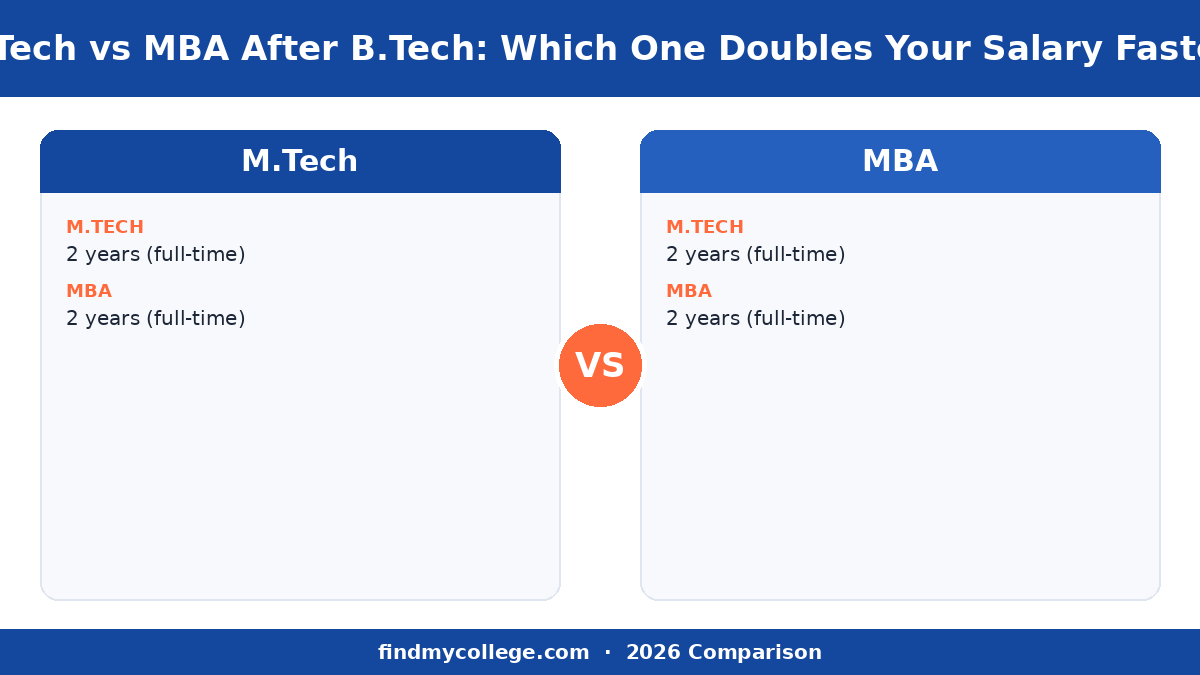
| Duration | 2 years (full-time) | 2 years (full-time) |
| Eligibility | B.Tech/BE in relevant discipline, often with GATE score | Bachelor’s degree (any discipline), often with CAT/XAT/GMAT score; work experience preferred by top institutes |
| Admission / Entrance | GATE (primary), sometimes institute-specific tests/interviews | CAT, XAT, GMAT, NMAT, SNAP, CMAT (followed by GD/PI) |
| Avg Fees (range) | ₹50,000 – ₹4 Lakhs (Govt. institutes); ₹2 Lakhs – ₹10 Lakhs (Private) | ₹5 Lakhs – ₹15 Lakhs (Tier 2/3); ₹20 Lakhs – ₹30 Lakhs+ (Tier 1 IIMs/XLRI) |
| Top Careers | Senior Engineer, R&D Specialist, Data Scientist, AI/ML Engineer, Technical Consultant, Academia | Management Consultant, Investment Banker, Product Manager, Marketing Manager, Operations Manager, Business Analyst |
| Avg Starting Salary | ₹6 LPA – ₹15 LPA (IITs/NITs); ₹4 LPA – ₹8 LPA (others) | ₹10 LPA – ₹20 LPA (Tier 2/3); ₹25 LPA – ₹40 LPA+ (Tier 1 IIMs/XLRI) |
| Best For | Deep technical specialization, research, core engineering roles, academia | Leadership, business strategy, cross-functional roles, entrepreneurship, high-growth management careers |
Curriculum & Focus
An M.Tech curriculum delves deep into a specific engineering discipline, focusing on advanced theoretical concepts, practical applications, research methodologies, and project work. It aims to create subject matter experts and innovators. In contrast, an MBA curriculum provides a broad understanding of business functions like finance, marketing, operations, and strategy, emphasizing leadership, decision-making, and problem-solving skills. The M.Tech builds technical depth, while the MBA cultivates managerial breadth.
Difficulty & Workload
Both programs are rigorous, but their challenges differ. An M.Tech demands strong analytical skills, a passion for problem-solving, and often involves extensive coding, simulations, or lab work, culminating in a thesis or major project. An MBA, especially from top institutes, is known for its intense schedule, case study method, group projects, presentations, and networking, requiring excellent communication and interpersonal skills. M.Tech tests your technical prowess, while MBA tests your strategic thinking and collaborative abilities.
Fees & ROI
The financial investment for an M.Tech, particularly from government-funded institutions like IITs and NITs, is significantly lower, often subsidized, making its Return on Investment (ROI) exceptionally high due to lower fees and decent starting salaries. An MBA, especially from premier IIMs or private universities, involves a substantial financial outlay, with fees ranging from ₹20-30 lakhs or more. While the initial investment is higher, top-tier MBA programs often offer a faster and more significant salary jump, potentially doubling your B.Tech salary quicker, especially in consulting or finance roles, leading to a strong ROI over the long term despite the higher upfront cost.
Placements & Salary
M.Tech placements from top IITs/NITs offer competitive salaries, particularly in specialized tech roles like AI/ML, Data Science, and R&D, with packages often ranging from ₹10-20 LPA. However, the average M.Tech salary from other colleges might be lower. MBA placements from top-tier institutes (IIMs, XLRI) consistently command higher starting salaries, often ₹25-40 LPA+, especially in consulting, investment banking, and product management, making it a quicker path to a high initial salary. While M.Tech salaries scale well with experience in niche technical domains, MBA often provides a higher immediate jump into management roles.
Higher Studies & Abroad Scope
An M.Tech is an excellent stepping stone for further academic pursuits like a Ph.D., particularly if you aspire to research, academia, or highly specialized technical roles. It also enhances your profile for pursuing higher studies or specialized technical jobs abroad, especially in countries with strong R&D sectors. An MBA, while not typically a direct path to a Ph.D. in a technical field, can lead to a Doctorate in Business Administration (DBA) or management-focused Ph.D. programs. It also opens doors to global management careers and international business opportunities, with many top MBA programs having strong international alumni networks.
Government-Job Scope
An M.Tech significantly boosts your eligibility and competitiveness for various government jobs, particularly in Public Sector Undertakings (PSUs) that require specialized technical expertise (e.g., ISRO, DRDO, BHEL, NTPC). Many PSUs recruit directly through GATE scores, making M.Tech graduates highly sought after for engineering and R&D positions. An MBA, while less directly aligned with core technical government roles, can be beneficial for administrative, managerial, or policy-making positions in government organizations, though the direct recruitment channels are fewer compared to M.Tech for technical roles.
What students actually say (community insights)
- Many students are drawn to M.Tech due to its significantly lower cost, especially from government institutions, leading to an excellent ROI, while MBA is perceived as a much more expensive investment.
- There’s a strong sentiment that while M.Tech builds crucial technical capability, which is increasingly rewarded, top-tier MBA programs generally offer higher immediate salaries, particularly in consulting and investment banking.
- A common debate revolves around the long-term vs. short-term returns; some believe MBA provides quicker initial returns, but M.Tech salaries, especially in core CS/AI/ML, can scale very well with experience, potentially matching or exceeding MBA salaries over time.
- Students often consider M.Tech if they enjoy deep technical work, research, or want to specialize further, whereas MBA appeals to those who prefer decision-making, presentations, and management roles, even if it means moving away from core tech.
- While some argue that work experience is mandatory for a good MBA, a sizeable group believes that freshers with strong B.Tech backgrounds from reputable colleges can still secure good placements from top MBA institutes.
- There’s a recognition that M.Tech can lead to techno-managerial roles, offering a blend of technical and management responsibilities, while an MBA typically steers one towards purely managerial career paths.
Which one should you choose?
- Choose M.Tech if: You have a strong passion for a specific engineering domain, enjoy problem-solving, want to delve into research or development, aspire to become a subject matter expert, or prefer a career in core engineering, R&D, or academia. It’s also ideal if budget is a significant constraint and you’re aiming for a high ROI from a government institution.
- Choose MBA if: You are keen on leadership, management, business strategy, or entrepreneurship. You enjoy working with people, making decisions, and have strong communication skills. You are looking for a quicker transition into high-paying managerial roles, consulting, or finance, and are prepared for a substantial financial investment.
- Consider your B.Tech background: If you’re from a non-CS background but want to pivot into high-demand tech roles like AI/ML, an M.Tech in a relevant specialization could be more valuable than an MBA.
- Consider your career goals: If you envision yourself as a CTO or a technical lead, M.Tech might be more direct. If you see yourself as a CEO or a business head, MBA is the clear path.
Frequently Asked Questions
Is an MBA after B.Tech better than M.Tech for salary?
Generally, an MBA from a top-tier institute (IIMs, XLRI) often leads to a higher immediate starting salary compared to an M.Tech, especially in consulting, finance, and product management roles. However, M.Tech salaries from premier IITs in specialized fields like AI/ML can be highly competitive and scale significantly with experience.
Can I pursue an MBA immediately after B.Tech without work experience?
While many top MBA programs prefer candidates with some work experience (typically 2-5 years), several reputable institutes do admit freshers with exceptional academic records and strong entrance exam scores. However, having work experience can significantly enhance your profile and placement opportunities.
Which degree offers better international career opportunities?
Both degrees offer international opportunities. An M.Tech can open doors to specialized technical roles and research positions abroad, particularly in countries with strong tech industries. An MBA from a globally recognized institution provides excellent pathways to international management, consulting, and business development roles.
Is M.Tech only for research-oriented individuals?
While M.Tech is excellent for research, it’s not exclusively for it. Many M.Tech graduates pursue senior engineering roles, technical consulting, product development, and specialized positions in industries, applying their advanced technical knowledge to solve complex problems.
What is the typical ROI period for M.Tech vs MBA?
Due to lower fees, the ROI period for an M.Tech from a government institute can be relatively short, often within 1-3 years. For an MBA from a top institute, despite higher fees, the significantly higher starting salaries can also lead to a relatively quick ROI, often within 3-5 years, depending on individual spending and career progression.
Can an M.Tech lead to managerial roles?
Yes, an M.Tech can lead to techno-managerial roles, where you manage technical teams or projects, leveraging both your technical depth and emerging leadership skills. Over time, with experience, M.Tech graduates can transition into senior management or even executive positions within technical organizations.
Which entrance exam is tougher, GATE or CAT?
Both GATE and CAT are highly competitive, but they test different skill sets. GATE focuses on engineering subjects and analytical aptitude, requiring deep technical knowledge. CAT focuses on verbal ability, logical reasoning, and quantitative aptitude, assessing general management potential. The ‘tougher’ one depends on an individual’s strengths and academic background.