B.Tech vs B.E. in 2026: Does the Difference Even Affect Your Placement?
Admission alerts for this course will appear here as official notifications are published.
In 2026, the distinction between a Bachelor of Technology (B.Tech) and a Bachelor of Engineering (B.E.) in India remains a perennial point of discussion for aspiring engineers and their parents. While often perceived as interchangeable, subtle differences in their historical origins, curriculum emphasis, and institutional affiliations can influence a student’s academic journey and initial career trajectory. Broadly, B.Tech degrees often lean towards a more practical, application-oriented approach, while B.E. degrees traditionally emphasize foundational theoretical knowledge, though this distinction has significantly blurred over time.
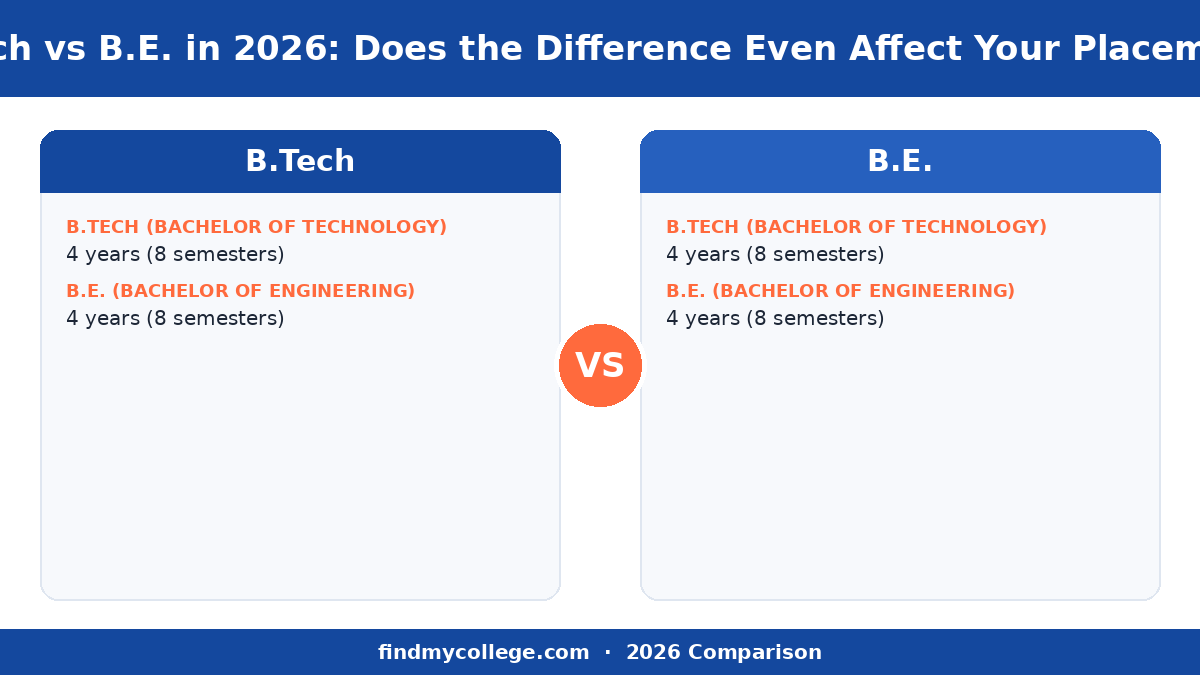
B.Tech vs B.E.: Quick Comparison (2026)
| B.Tech (Bachelor of Technology) | B.E. (Bachelor of Engineering) | |
|---|---|---|
| Duration | 4 years (8 semesters) | 4 years (8 semesters) |
| Eligibility | 10+2 with Physics, Chemistry, Maths (PCM) from a recognized board, minimum 45-60% aggregate. | 10+2 with Physics, Chemistry, Maths (PCM) from a recognized board, minimum 45-60% aggregate. |
| Admission / Entrance | JEE Main, JEE Advanced, State-level CETs (e.g., MHT CET, KCET), COMEDK, VITEEE, BITSAT, etc. | JEE Main, JEE Advanced, State-level CETs (e.g., MHT CET, KCET), COMEDK, VITEEE, BITSAT, etc. |
| Avg Fees (range) | ₹1.5 Lakhs – ₹10 Lakhs per annum (depending on institution type and branch) | ₹1.5 Lakhs – ₹10 Lakhs per annum (depending on institution type and branch) |
| Top Careers | Software Developer, Data Scientist, AI/ML Engineer, Core Engineer (Mechanical, Civil, Electrical), Consultant, Product Manager. | Software Developer, Data Scientist, AI/ML Engineer, Core Engineer (Mechanical, Civil, Electrical), Research Engineer, Academician. |
| Avg Starting Salary | ₹3.5 LPA – ₹12 LPA (highly dependent on college tier, branch, and individual skills) | ₹3.5 LPA – ₹12 LPA (highly dependent on college tier, branch, and individual skills) |
| Best For | Students seeking a more application-focused, industry-ready curriculum with emphasis on practical skills and project work. | Students preferring a strong theoretical foundation, in-depth understanding of engineering principles, and potential for research or higher academics. |
Curriculum & Focus
Historically, B.Tech programs were designed with a greater emphasis on practical application, industry relevance, and hands-on training, often incorporating more lab work, internships, and project-based learning. B.E. degrees, conversely, traditionally focused on the fundamental scientific and mathematical principles underpinning engineering disciplines, with a stronger theoretical bent. However, in 2026, this distinction has largely blurred. Most reputable universities and institutions offering either degree have integrated practical components into B.E. and theoretical depth into B.Tech, driven by AICTE guidelines and industry demands. The actual curriculum variation is now more dependent on the specific institution and its faculty’s expertise than on the degree nomenclature itself. Verdict: Minimal practical difference in curriculum focus across top institutions.
Difficulty & Workload
The perceived difficulty and workload for both B.Tech and B.E. programs are largely identical. Both are rigorous four-year undergraduate engineering degrees demanding strong analytical skills, problem-solving abilities, and consistent effort. The workload typically involves extensive coursework, laboratory sessions, assignments, projects, and examinations. Any difference in perceived difficulty usually stems from the specific college’s academic standards, faculty expectations, and the chosen engineering branch, rather than the B.Tech or B.E. label. Students in both programs face similar academic pressures and require dedication to succeed. Verdict: No inherent difference in difficulty or workload.
Fees & ROI
The fee structures for B.Tech and B.E. programs are virtually indistinguishable and primarily depend on the type of institution (government, private, deemed university) and its ranking, rather than the degree type. Premier institutions like IITs and NITs (mostly B.Tech) or top state universities (often B.E.) will have varying fee scales. The Return on Investment (ROI) is also not dictated by the B.Tech or B.E. tag but by the college’s reputation, the student’s skills, and the chosen specialization. A B.Tech from a Tier-1 college will almost always yield a better ROI than a B.E. from a Tier-3 college, and vice-versa. Verdict: Fees and ROI are college-dependent, not degree-dependent.
Placements & Salary
This is perhaps the most critical concern for students and parents, and the good news is that in 2026, the degree nomenclature (B.Tech vs B.E.) has almost no bearing on placement opportunities or starting salaries. Employers, especially in the private sector, prioritize a candidate’s skills, knowledge, project experience, problem-solving abilities, and the reputation of their alma mater. A B.Tech in Computer Science from an IIT or NIT will command significantly higher packages than a B.E. in the same field from a lesser-known private college, and the reverse is also true. What truly matters is the quality of education, the relevance of the curriculum to industry needs, and the individual’s aptitude. Verdict: No significant difference in placement prospects or salary based solely on B.Tech vs B.E.
Higher Studies & Abroad Scope
Both B.Tech and B.E. degrees are equally recognized and accepted for pursuing higher studies, both in India and abroad. Whether you aim for an M.Tech/M.E. in India, an MS in the USA, an MBA, or a PhD, universities globally treat both degrees as equivalent undergraduate engineering qualifications. Admission to postgraduate programs depends on factors like academic performance (GPA/CGPA), GRE/GATE scores, research experience, letters of recommendation, and statement of purpose. The degree title itself does not confer any advantage or disadvantage in this regard. Verdict: Both degrees offer equal scope for higher studies globally.
Government-Job Scope
For government jobs in India, particularly those requiring an engineering degree (e.g., through UPSC ESE, PSUs, state engineering services), both B.Tech and B.E. degrees are considered equivalent and valid qualifications. Recruitment notifications typically specify a ‘Bachelor’s degree in Engineering/Technology’ from a recognized university. There is no preferential treatment given to one over the other. Eligibility criteria focus on the engineering discipline (e.g., Civil, Mechanical, Electrical) and the recognition of the awarding institution. Verdict: Both degrees are equally valid for government job applications.
What students actually say (community insights)
- Many students and recent graduates widely agree that the practical difference between B.Tech and B.E. has largely diminished, with the terms often used interchangeably by employers and even some institutions.
- A common sentiment is that B.Tech is perceived as a more modern term, while B.E. is seen as traditional, particularly in older, established universities. However, this is largely a historical artifact rather than a functional distinction in 2026.
- There’s a strong consensus that the reputation of the college (Tier 1 vs. Tier 2 vs. Tier 3) and the individual’s skills, projects, and internships are far more critical for placements and career success than whether the degree is a B.Tech or B.E.
- Some discussions highlight that while B.Tech was traditionally seen as more practical and B.E. more theoretical, most curricula have evolved to incorporate elements of both, making the distinction negligible in terms of actual learning outcomes.
- A recurring theme is that students should prioritize the quality of the institution, the specific branch of engineering, and their personal interest in the subject matter, rather than getting caught up in the B.Tech vs. B.E. debate.
- While some anecdotal evidence suggests minor differences in specific university structures (e.g., government-registered universities often use B.E., while institutes use B.Tech), this doesn’t translate into a significant impact on career prospects.
Which one should you choose?
Given the minimal functional differences in 2026, your choice between B.Tech and B.E. should primarily be guided by the institution, the specific engineering branch, and your career aspirations:
- If you prioritize a strong brand name and established academic rigor: Focus on securing admission to top-tier institutions like IITs, NITs, or reputable state universities, regardless of whether they offer a B.Tech or B.E. degree. Their reputation and placement records are paramount.
- If you are keen on a specific engineering discipline: Choose the college that offers the best faculty, labs, and research opportunities in your desired branch (e.g., Computer Science, Mechanical, Electrical), irrespective of the degree title.
- If you are looking for immediate industry readiness: While both degrees prepare you, some B.Tech programs might still have a slight edge in industry collaborations and project-based learning. However, a B.E. from a college with strong industry ties will be equally effective.
- If you aspire for higher studies or research: Both degrees provide an equally strong foundation. Focus on maintaining a high academic record and engaging in research projects during your undergraduate years.
- Ultimately, choose the best college you can get into for your preferred engineering branch. The quality of education, faculty, infrastructure, and peer group at a good institution will far outweigh any perceived difference between B.Tech and B.E.
Frequently Asked Questions
Is B.Tech better than B.E. for IT jobs?
No, for IT jobs, both B.Tech and B.E. degrees are considered equivalent. Employers in the IT sector prioritize coding skills, problem-solving abilities, knowledge of relevant technologies, and project experience over the specific degree nomenclature. A B.Tech or B.E. in Computer Science, Information Technology, or related fields from a reputable college will open similar doors.
Do companies differentiate between B.Tech and B.E. during campus placements?
Generally, no. Most companies, especially major recruiters, do not differentiate between B.Tech and B.E. degrees during campus placements. Their eligibility criteria typically state ‘Bachelor’s degree in Engineering/Technology’. What matters more is the college’s reputation, the student’s academic performance, and their demonstrated skills and aptitude.
Can I pursue an M.Tech after a B.E. degree?
Yes, absolutely. A B.E. degree is a recognized undergraduate engineering qualification and makes you fully eligible to pursue an M.Tech (Master of Technology) or M.E. (Master of Engineering) degree in India, provided you meet the specific entrance exam (like GATE) and academic criteria of the chosen institution.
Is a B.E. degree from Mumbai University equivalent to a B.Tech from an IIT?
While both are valid engineering degrees, an IIT (Indian Institute of Technology) holds a significantly higher national and international ranking and reputation compared to most colleges affiliated with Mumbai University. This difference in institutional prestige often translates to better placement opportunities, higher average salaries, and a more competitive peer group, regardless of the B.Tech or B.E. label.
Does the B.Tech vs B.E. distinction affect visa applications for studying abroad?
No, the distinction between B.Tech and B.E. does not affect visa applications for studying abroad. International universities and immigration authorities recognize both as valid four-year undergraduate engineering degrees. The focus will be on the accreditation of your awarding institution and your academic credentials.
Which degree is more theoretical, B.Tech or B.E.?
Historically, B.E. was considered more theoretical, while B.Tech was more practical. However, in 2026, this distinction has largely blurred. Most modern curricula for both degrees integrate theoretical foundations with practical applications. The actual balance depends more on the specific institution and its course design than on the degree title itself.
Is it true that government universities offer B.E. and private institutes offer B.Tech?
This is a common observation but not a strict rule. Many older, established government universities and state technical boards traditionally awarded B.E. degrees. Newer private institutions and deemed universities often opt for B.Tech. However, there are exceptions, and many government-funded institutions also offer B.Tech degrees (e.g., IITs, NITs). The degree nomenclature is often a legacy choice or an institutional preference.
If I have a B.Tech, can I be called an ‘Engineer’?
Yes, absolutely. Both B.Tech and B.E. are professional engineering degrees. Graduates of both programs are recognized as engineers and are eligible for engineering roles in industry, government, and further academic pursuits. The title ‘Engineer’ is not exclusive to one degree over the other.