BCA vs B.Sc IT vs B.Sc CS: The Tech Degree Worth Your Money in 2026
Nishit Kumar is a senior EdTech industry leader with over a decade of experience in building and scaling education platforms, shaping their product, content, and growth strategy. At…
Admission alerts for this course will appear here as official notifications are published.
Navigating the myriad of tech degrees after 12th grade can be daunting, especially with the rapidly evolving Indian job market. In 2026, the choice between a Bachelor of Computer Applications (BCA), a Bachelor of Science in Information Technology (B.Sc IT), and a Bachelor of Science in Computer Science (B.Sc CS) hinges on your career aspirations, academic strengths, and budget. BCA is ideal for those seeking a direct application-oriented path into software development, B.Sc IT suits individuals interested in managing IT infrastructure and services, while B.Sc CS is best for students with a strong theoretical bent aiming for core computer science roles or research.
BCA vs B.Sc IT vs B.Sc CS: Quick Comparison (2026)
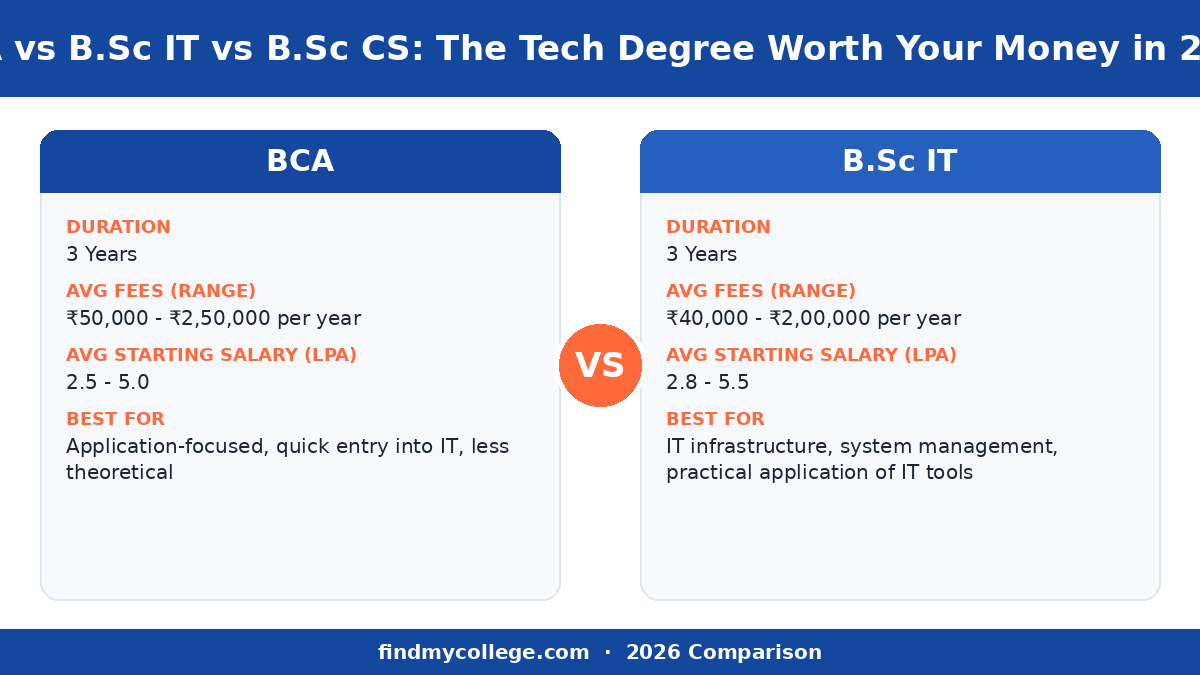
| Option | Duration | Eligibility | Admission / Entrance | Avg Fees (range) | Top Careers | Avg Starting Salary (LPA) | Best For |
|---|---|---|---|---|---|---|---|
| BCA | 3 Years | 10+2 (any stream, often with Maths as optional) | Merit-based / University-specific tests (e.g., IPU CET, SET) | ₹50,000 – ₹2,50,000 per year | Web Developer, Software Tester, Junior Programmer, Database Administrator | 2.5 – 5.0 | Application-focused, quick entry into IT, less theoretical |
| B.Sc IT | 3 Years | 10+2 (Science stream preferred, Maths often compulsory) | Merit-based / University-specific tests | ₹40,000 – ₹2,00,000 per year | IT Support Analyst, Network Administrator, System Analyst, IT Consultant | 2.8 – 5.5 | IT infrastructure, system management, practical application of IT tools |
| B.Sc CS | 3 Years | 10+2 (Science stream with Maths compulsory) | Merit-based / University-specific tests | ₹30,000 – ₹1,80,000 per year | Software Developer, Data Analyst, Research Assistant, Algorithm Developer | 3.0 – 6.0 | Strong theoretical foundation, core CS concepts, higher studies, research |
Curriculum & Focus
BCA programs are heavily geared towards practical application and software development tools. The curriculum typically covers programming languages (Java, Python, C++), web development, database management, and basic networking. It’s designed for direct entry into the IT industry. B.Sc IT, while also practical, focuses more on the management and implementation of information systems, network administration, cybersecurity, and IT service management. It bridges the gap between technology and business needs. B.Sc CS, in contrast, delves deep into the theoretical underpinnings of computing, including data structures, algorithms, operating systems, computer architecture, and discrete mathematics. It provides a robust foundation for advanced computer science concepts. Verdict: BCA for application, B.Sc IT for IT management, B.Sc CS for core theory.
Difficulty & Workload
The perceived difficulty often correlates with the mathematical and theoretical rigor. BCA generally has a moderate workload, emphasizing hands-on coding and project work, making it accessible for students from diverse academic backgrounds. B.Sc IT involves a similar practical workload but with an added focus on system design and management principles, which can be challenging for those without an aptitude for logical problem-solving. B.Sc CS is often considered the most academically demanding, requiring strong analytical skills and a solid grasp of mathematics due to its emphasis on algorithms, data structures, and theoretical computer science. Verdict: BCA is generally less demanding, B.Sc CS is the most rigorous.
Fees & ROI
In India, B.Sc CS often has the lowest average fees, especially in government universities, making it a highly cost-effective option for a strong academic foundation. B.Sc IT fees are typically in a similar range, varying by institution. BCA programs, particularly in private colleges, can sometimes have higher fees due to their market-oriented curriculum and infrastructure. However, the ROI for all three can be excellent, especially if followed by a relevant Master’s degree (MCA or M.Sc CS/IT). The key is to choose a reputable institution. Verdict: B.Sc CS often offers the best value for money, especially in public institutions.
Placements & Salary
Placement scenarios for all three degrees are heavily influenced by the institution’s reputation, student skills, and market demand. Historically, B.Sc CS graduates from top-tier colleges often secure roles with higher starting salaries due to their strong theoretical base, making them suitable for core development and analytical roles. BCA graduates typically find roles as junior developers, testers, or support staff, with salaries that can grow significantly with experience and upskilling. B.Sc IT graduates are well-suited for IT support, network administration, and system analysis roles. While B.Tech CSE often has an edge in initial placements, skilled graduates from all three can achieve competitive salaries, especially with a strong portfolio and relevant certifications. Verdict: B.Sc CS often leads to higher starting salaries in core tech, BCA and B.Sc IT offer solid entry points.
Higher Studies & Abroad Scope
All three degrees serve as stepping stones for higher education. A BCA is a direct feeder into an MCA (Master of Computer Applications), which is highly valued in India for career progression. B.Sc IT and B.Sc CS graduates can pursue an M.Sc IT or M.Sc CS, respectively, or also opt for an MCA. For studying abroad, a B.Sc CS degree is often viewed favorably by international universities for Master’s programs in Computer Science due to its strong theoretical foundation. While BCA and B.Sc IT graduates can also pursue international Master’s, they might need to demonstrate additional foundational knowledge or choose more application-specific programs. Verdict: B.Sc CS offers the broadest and most direct path for international Master’s in Computer Science.
Government-Job Scope
All three degrees open doors to various government jobs, particularly in IT departments, public sector banks, and various ministries. Roles include IT Officer, Data Entry Operator, Programmer, and System Analyst. The eligibility criteria for many government exams (like SSC CGL, IBPS SO IT Officer) often require a Bachelor’s degree in any discipline or specifically in Computer Science/IT. A B.Sc CS or B.Sc IT might provide a slight edge in roles requiring deeper technical knowledge, while BCA graduates are equally eligible for many general IT-related government positions. The focus should be on preparing for competitive exams rather than the specific degree. Verdict: All three degrees are generally suitable for government IT jobs, with B.Sc CS/IT potentially offering a slight advantage in specialized roles.
What students actually say (community insights)
- Many students perceive B.Tech CSE as the default and most prestigious path into the tech industry, often citing better industry value and placement opportunities compared to BCA or B.Sc CS/IT.
- There’s a strong sentiment that BCA is more application-based and practical, making it suitable for direct entry into programming and web development roles, while B.Sc CS is seen as more theory-focused, sometimes even leaning towards research.
- A significant number of discussions highlight concerns that companies might prefer B.Tech graduates over B.Sc CS or BCA, leading to perceived difficulties in off-campus placements for non-engineering graduates. However, many counter this by emphasizing that skills, projects, and networking are ultimately more crucial than the degree type.
- Some students note that B.Sc IT curricula can be more extensive than BCA in certain colleges, sometimes including emerging fields like AI/ML and Python programming as core subjects, which might be electives or absent in BCA.
- There’s a consensus that for those with a limited budget, B.Sc CS or B.Sc IT can be excellent alternatives to B.Tech, providing a solid foundation without the higher fees, and also keeping options open for pedagogical careers or government exams.
- A recurring piece of advice for BCA and B.Sc graduates is to focus heavily on building projects, mastering a specific programming language, and acquiring additional skills to enhance employability and overcome any perceived degree-based biases.
Which one should you choose?
- Choose BCA if: You want a direct, application-oriented path into software development, web design, or database management. You prefer hands-on coding over deep theoretical concepts and are eager to enter the job market quickly. You might not have a strong science or math background from 12th grade.
- Choose B.Sc IT if: You are interested in the broader aspects of information technology, including network administration, cybersecurity, system analysis, and managing IT infrastructure. You enjoy problem-solving related to IT systems and want to bridge technology with business needs.
- Choose B.Sc CS if: You have a strong aptitude for mathematics and logical reasoning, and a keen interest in the fundamental principles of computing, algorithms, and data structures. You aspire to roles in core software development, data science, research, or plan to pursue higher studies (M.Sc CS, PhD) in computer science.
Frequently Asked Questions
Is a BCA degree considered less valuable than B.Sc CS or B.Sc IT?
Not necessarily. While B.Sc CS provides a deeper theoretical foundation and B.Sc IT focuses on IT systems, BCA is highly valued for its practical, application-oriented approach. Its value largely depends on the institution, your skills, and subsequent upskilling or higher education (like an MCA).
Can I switch from BCA to a core CS role like a Data Scientist?
Yes, but it will require significant self-study, certifications, and potentially a Master’s degree (like an M.Sc Data Science or MCA with a data science specialization). BCA provides a foundational understanding, but core CS roles often demand the deeper mathematical and algorithmic knowledge typically covered in B.Sc CS or B.Tech CSE.
Are B.Sc CS graduates preferred over BCA for government jobs?
For many general IT-related government positions, both BCA and B.Sc CS graduates are eligible. However, for roles requiring specialized technical knowledge or a strong theoretical background in computer science, a B.Sc CS degree might be marginally preferred. The key is to meet the eligibility criteria and excel in competitive exams.
What are the career prospects after B.Sc IT compared to BCA?
B.Sc IT typically leads to roles focused on IT infrastructure, network management, system analysis, and IT support. BCA often leads to roles in software development, web development, and testing. Both have strong career prospects, but in different domains within the IT industry.
Is it possible to get a high-paying job with just a BCA or B.Sc degree?
Yes, it is absolutely possible. While initial salaries might sometimes be lower than B.Tech graduates, strong programming skills, a robust project portfolio, continuous learning, and relevant certifications can lead to competitive salaries. Many successful professionals in the tech industry hold BCA or B.Sc degrees.
Do I need to have Maths in 12th grade for BCA, B.Sc IT, or B.Sc CS?
For B.Sc CS, Maths in 12th grade is almost always compulsory due to the theoretical and algorithmic nature of the course. For B.Sc IT, Maths is often compulsory or highly preferred. For BCA, while some universities may require Maths, many accept students from any stream, making it a more accessible option for non-science backgrounds.
Which degree is better for pursuing an MCA?
A BCA degree is specifically designed as a direct feeder for an MCA, making it a very common and straightforward path. However, B.Sc IT and B.Sc CS graduates are also eligible for MCA programs, often requiring them to clear specific entrance exams or bridge courses depending on the university.