
IIT vs IIIT vs NIT: Where Will Your JoSAA 2026 Rank Actually Take You?
Admission alerts for this course will appear here as official notifications are published.
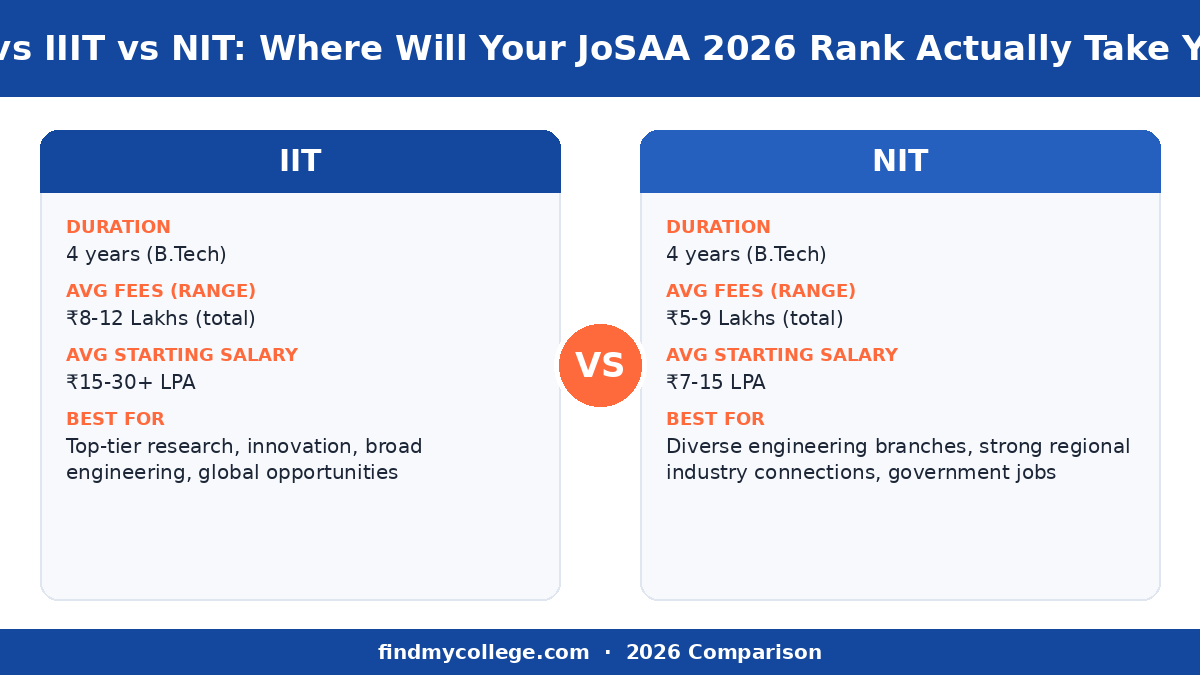
For aspiring engineers in India, the journey through JoSAA 2026 culminates in a pivotal choice: an Indian Institute of Technology (IIT), an Indian Institute of Information Technology (IIIT), or a National Institute of Technology (NIT). Each offers a distinct pathway – IITs are the pinnacle for broad engineering excellence and research, IIITs specialize in IT and computer science, while NITs provide robust engineering education across diverse disciplines with strong regional ties.
IIT vs IIIT vs NIT: Quick Comparison (2026)
| Duration | Eligibility | Admission / Entrance | Avg Fees (range) | Top Careers | Avg Starting Salary | Best For | |
|---|---|---|---|---|---|---|---|
| IIT | 4 years (B.Tech) | 10+2 with Physics, Chemistry, Maths; JEE Advanced qualified | JEE Advanced (after JEE Main) | ₹8-12 Lakhs (total) | Software Dev, Data Science, Core Engg, Research, Management | ₹15-30+ LPA | Top-tier research, innovation, broad engineering, global opportunities |
| IIIT | 4 years (B.Tech) | 10+2 with Physics, Chemistry, Maths; JEE Main qualified | JEE Main | ₹6-10 Lakhs (total) | Software Dev, AI/ML Engg, Cybersecurity, Data Analytics | ₹10-20 LPA | Specialized IT/CS focus, strong coding culture, tech industry roles |
| NIT | 4 years (B.Tech) | 10+2 with Physics, Chemistry, Maths; JEE Main qualified | JEE Main | ₹5-9 Lakhs (total) | Core Engg, IT Services, Manufacturing, PSU roles | ₹7-15 LPA | Diverse engineering branches, strong regional industry connections, government jobs |
Curriculum & focus
IITs are renowned for their rigorous, research-oriented curriculum, often offering greater academic flexibility and interdisciplinary studies. They emphasize foundational knowledge, problem-solving, and theoretical depth, preparing students for diverse roles including academia and R&D. IIITs, by contrast, have a highly specialized curriculum focused almost exclusively on Information Technology, Computer Science, and related fields like AI, Machine Learning, and Data Science. Their programs are often industry-aligned and project-heavy. NITs offer a broader range of engineering disciplines, from Civil and Mechanical to Computer Science, with a curriculum that balances theoretical knowledge with practical application, often catering to regional industrial needs. Verdict: IITs for broad, deep engineering; IIITs for specialized IT; NITs for diverse, practical engineering.
Difficulty & workload
Admission to IITs is the most challenging, requiring qualification through JEE Advanced, which is considered one of the toughest exams globally. The academic workload within IITs is also notoriously demanding, fostering intense competition and a culture of continuous learning. IIITs, while requiring JEE Main, still have competitive cut-offs, especially for top branches. Their specialized curriculum can be intense, particularly in coding and project work. NITs also admit through JEE Main, with varying cut-offs depending on the institute and branch. The academic rigor is high, but generally perceived as slightly less intense than IITs, though still demanding. Verdict: IITs have the highest entry and academic difficulty; IIITs are challenging in their niche; NITs offer strong academic rigor.
Fees & ROI
The average fees for IITs are generally higher than NITs and IIITs, reflecting their premium infrastructure and faculty. However, the return on investment (ROI) is often exceptional due to higher average placements and global opportunities. IIITs have fees comparable to or slightly lower than IITs, with a strong ROI driven by high demand for IT professionals and competitive salaries in tech. NITs typically have the most affordable fee structure among the three, offering a very good ROI, especially for students aiming for stable careers in core engineering or IT services within India. Verdict: IITs offer premium ROI despite higher fees; IIITs provide excellent tech-focused ROI; NITs are highly cost-effective with good returns.
Placements & salary
IITs consistently boast the highest average placement packages and a wider array of recruiters, including top-tier international firms, investment banks, and leading tech companies. The ‘IIT tag’ often opens doors to opportunities not easily accessible otherwise. IIITs excel in placements for IT and computer science roles, with many students securing positions in product-based companies, startups, and specialized tech firms, often with packages competitive with top NITs and even some IITs for specific roles. NITs have strong placement records across various engineering disciplines, with a good mix of core engineering companies, IT services, and PSUs. While average packages might be lower than IITs, top NITs often rival new IITs in placements. Verdict: IITs lead in overall package and diversity; IIITs dominate in tech-specific roles; NITs offer solid, diverse placements.
Higher studies & abroad scope
IITs are a strong launchpad for higher studies, both in India and abroad. Their strong research focus, academic reputation, and robust alumni networks make it easier for graduates to secure admissions to top global universities for Masters and PhD programs. IIITs also offer good prospects for higher studies, particularly in specialized computer science fields. Their strong technical foundation is highly valued by international universities for advanced degrees in AI, ML, and data science. NITs provide a solid base for higher education, with many graduates pursuing M.Tech in India or MS abroad. While the ‘NIT tag’ might not carry the same global weight as an ‘IIT tag,’ strong academic performance and research projects can still lead to excellent opportunities. Verdict: IITs offer the clearest path to global higher education; IIITs are strong for tech-specific advanced degrees; NITs provide a good foundation for further studies.
Government-job scope
All three institutions provide a strong foundation for government jobs, particularly through competitive exams like UPSC, ESE (Engineering Services Examination), and various PSU recruitments. The rigorous curriculum and problem-solving skills honed at IITs are highly beneficial for these exams. NITs have a particularly strong tradition of students pursuing government jobs and PSUs, often due to their diverse engineering branches and regional presence. Many PSUs actively recruit from NIT campuses. IIITs, while primarily focused on the private tech sector, also produce graduates who successfully clear government exams, especially for IT-related government roles. Verdict: NITs have a strong historical connection to government jobs; IITs provide a strong academic base; IIITs are suitable for tech-focused government roles.
What students actually say (community insights)
- Many students acknowledge the undeniable prestige and faster growth trajectory of IITs, often citing better peer groups and more engaging academic environments compared to other institutions.
- There’s a common sentiment that the ‘IIT tag’ provides a significant advantage in placements and career progression, often leading to higher compensation for similar work compared to non-IIT graduates.
- A recurring debate centers on whether newer IITs outperform top NITs. While some argue that new IITs like Hyderabad and Indore are rapidly growing in research and rankings, others maintain that established NITs like Trichy, Surathkal, and Warangal offer comparable or even superior academic and placement reputations to some mid-tier or newer IITs.
- While IIITs are recognized for their specialized focus and strong performance in IT placements, there’s a perceived lack of public ‘craze’ for them compared to the traditional IIT-NIT narrative, especially among parents.
- A significant portion of the student community emphasizes that while getting into a Tier 1 college (IIT/NIT/IIIT) is highly beneficial, it’s not the sole determinant of a successful life. However, many also concede that the brand value and network from these institutions are difficult to replicate through off-campus efforts.
- Concerns exist regarding placement percentages, even in top colleges, with some students from older NITs reporting abysmal placement rates in recent years, particularly for non-CSE branches, highlighting that a ‘tag’ doesn’t guarantee a job.
Which one should you choose?
- Choose IIT if: You aspire for cutting-edge research, global opportunities, a broad and deep engineering education, and are prepared for intense academic rigor. You value the highest prestige and a strong alumni network.
- Choose IIIT if: Your passion lies specifically in Computer Science, Information Technology, AI, or related fields. You thrive in a specialized, project-oriented environment and aim for product-based tech roles or startups.
- Choose NIT if: You seek a robust engineering education across diverse branches, value strong regional industry connections, and are considering both private sector and government job opportunities. You prefer a balance of academic rigor and practical application.
Frequently Asked Questions
Is an IIT tag always better than an NIT or IIIT tag?
While the IIT tag generally carries the highest prestige and opens more doors, especially for global opportunities and top-tier research, the performance of individual IITs, NITs, and IIITs varies. A top branch in a legacy NIT or a specialized IIIT can often offer better career prospects and learning experiences than a less sought-after branch in a newer IIT.
Are new IITs better than old NITs?
This is a nuanced debate. Newer IITs like IIT Hyderabad and IIT Indore are rapidly developing in terms of research and infrastructure. However, established, top-tier NITs (e.g., NIT Trichy, NIT Surathkal, NIT Warangal) often have a longer history, stronger alumni networks, and comparable or even superior placement records for certain branches compared to some of the newer IITs. The choice often depends on the specific branch and individual priorities.
Do IIITs only focus on Computer Science?
Predominantly, yes. IIITs are specialized institutions focusing on Information Technology, Computer Science, and related interdisciplinary areas like Electronics and Communication Engineering with a strong IT bent, Data Science, AI, and Machine Learning. They generally do not offer traditional core engineering branches like Civil or Mechanical.
Is it true that IIT/NIT/IIIT graduates get paid more for the same work?
Often, yes. While individual performance is key, graduates from these institutions, particularly IITs, frequently command higher starting salaries and faster career progression due to the perceived quality of education, problem-solving skills, and the brand value associated with their degrees. This ‘tag’ can provide an initial advantage in the job market.
What if I don’t get into an IIT, NIT, or IIIT? Is my career over?
Absolutely not. While these institutions offer significant advantages, a successful career is built on skills, dedication, and continuous learning, not just the college tag. Many graduates from other reputable private and state engineering colleges achieve great success. Focus on developing strong technical skills, building a portfolio, and networking, regardless of your institution.
How important is the branch vs. the college tag?
This is a critical decision point. For many, especially those prioritizing placements and specific career paths, choosing a desirable branch (e.g., Computer Science, AI) in a top NIT or IIIT might be more beneficial than taking a less preferred core branch (e.g., Civil, Mining) in a lower-ranked IIT. The ‘paisa’ (salary) factor often drives this choice, especially for circuital branches.
Do IITs, NITs, and IIITs guarantee good peer groups?
While these institutions attract some of the brightest minds, a ‘good peer group’ is subjective. While you’ll find highly motivated and intelligent individuals, it doesn’t guarantee a universally positive social experience. Some students report encountering introverted or even arrogant peers, emphasizing that individual effort in building relationships is still crucial.