DTU vs NSUT 2026: Delhi’s Two Top Engineering Colleges, Decoded
Admission alerts for this course will appear here as official notifications are published.
For aspiring engineers in Delhi, the choice between Delhi Technological University (DTU) and Netaji Subhas University of Technology (NSUT) is a perennial dilemma. Both institutions stand as pillars of technical education, offering robust engineering programs. While DTU often appeals to those seeking a vibrant campus life and a strong alumni network, NSUT typically attracts students prioritising a more academically focused environment with rigorous curricula. This guide decodes the nuances of each, helping you make an informed decision for 2026 and beyond.
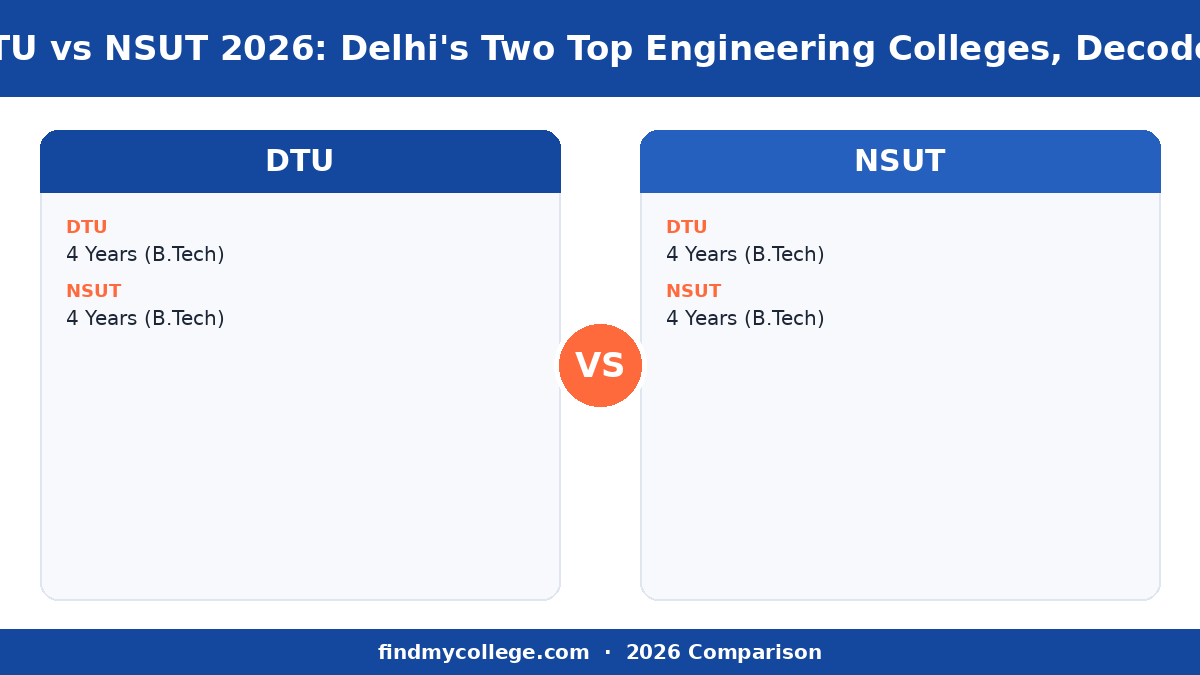
DTU vs NSUT: Quick Comparison (2026)
| DTU | NSUT | |
|---|---|---|
| Duration | 4 Years (B.Tech) | 4 Years (B.Tech) |
| Eligibility | 10+2 with Physics, Chemistry, Maths; JEE Main Rank | 10+2 with Physics, Chemistry, Maths; JEE Main Rank |
| Admission / Entrance | JEE Main Rank via JAC Delhi Counselling | JEE Main Rank via JAC Delhi Counselling |
| Avg Fees (range) | ₹1.9 – ₹2.2 Lakhs per annum | ₹1.9 – ₹2.2 Lakhs per annum |
| Top Careers | Software Development, Data Science, Core Engineering, Management | Software Development, Data Science, Core Engineering, Research |
| Avg Starting Salary | ₹10 – ₹18 LPA | ₹9 – ₹17 LPA |
| Best For | Holistic college experience, strong startup culture, diverse opportunities | Academic rigor, focused learning, strong technical foundation |
Curriculum & focus
DTU’s curriculum is often perceived as more flexible, allowing students greater scope for electives and extracurricular engagement. It encourages a broader exploration of interests beyond core academics, fostering innovation and entrepreneurial spirit. NSUT, on the other hand, is known for its more structured and academically intensive curriculum, with a strong emphasis on foundational engineering principles and theoretical depth. This often translates to a higher workload but can provide a more robust technical grounding. Verdict: DTU for breadth and flexibility, NSUT for academic depth and structure.
Difficulty & workload
While both colleges demand dedication, NSUT is generally considered to have a more rigorous academic environment with stricter attendance policies and a higher perceived workload. Students at NSUT often report spending more time on coursework and assignments. DTU, while challenging, is often described as having a more lenient approach to attendance and a comparatively relaxed academic pace, allowing more time for fests, clubs, and personal development. Verdict: NSUT for a demanding academic challenge, DTU for a more balanced college life.
Fees & ROI
The fee structures for B.Tech programs at both DTU and NSUT are largely comparable, falling within a similar range for Delhi residents. Both institutions offer excellent Return on Investment (ROI) given their strong placement records and relatively affordable fees compared to private universities. The slight differences in average starting salaries might marginally tilt the ROI in DTU’s favour for some, but both remain highly cost-effective options for quality engineering education. Verdict: Both offer excellent ROI, with comparable fee structures.
Placements & salary
Both DTU and NSUT boast impressive placement statistics, attracting top-tier companies across various sectors, especially in IT and core engineering. DTU often reports slightly higher average and median packages, particularly for its Computer Science and allied branches, and is known for its vibrant startup culture which can lead to diverse opportunities. NSUT’s placements are also very strong, with a consistent track record of high packages, especially for its top branches. The difference, if any, is often marginal and branch-dependent. Verdict: DTU has a slight edge in overall placements and startup opportunities, but NSUT is highly competitive.
Higher studies & abroad scope
Both DTU and NSUT provide a strong foundation for students aspiring for higher studies, both in India and abroad. Their curricula are well-regarded, and a significant number of graduates pursue Master’s or PhD programs at prestigious universities worldwide. DTU’s broader exposure and emphasis on research projects can be beneficial for building a strong profile for international applications. NSUT’s academic rigor also prepares students well for competitive entrance exams and demanding graduate programs. Verdict: Both offer excellent pathways for higher studies, with DTU potentially offering more diverse research exposure.
Government-job scope
Graduates from both DTU and NSUT are highly sought after in various government sectors, including PSUs (Public Sector Undertakings) and civil services. The strong technical foundation and problem-solving skills imparted by both institutions are highly valued in these roles. While neither college specifically tailors its curriculum for government jobs, the quality of education and the competitive environment prepare students well for the rigorous selection processes. Many alumni from both institutions successfully clear exams like GATE, ESE, and UPSC. Verdict: Both provide an equally strong foundation for pursuing government jobs.
What students actually say (community insights)
- Many students highlight DTU’s significantly larger and more aesthetically pleasing campus, often describing NSUT’s campus as smaller and less developed in comparison.
- There’s a strong consensus that DTU offers a more vibrant and ‘chill’ college life, with more fests, clubs, and a generally more lenient approach to attendance, fostering a better work-life balance.
- Conversely, NSUT is frequently described as being more academically focused and stricter, with a higher workload and more stringent attendance policies, which some students appreciate for a disciplined learning environment.
- While both are considered top-tier colleges comparable to good NITs, some discussions suggest that DTU might have a slight edge in terms of overall exposure and startup culture, attracting a slightly more diverse crowd.
- Regarding placements, the general sentiment is that both are highly comparable, especially for core tech branches, though DTU is sometimes perceived to have a marginal advantage in average packages and the sheer volume of opportunities.
- A recurring theme is the commute; students often weigh the proximity of either campus to their homes as a significant factor in their decision-making process.
Which one should you choose?
- Choose DTU if: You are looking for a holistic college experience with a vibrant campus life, numerous extracurricular activities, a strong startup ecosystem, and a slightly more flexible academic environment. You value a large alumni network and diverse opportunities beyond just academics.
- Choose NSUT if: You prioritise a rigorous academic curriculum, a disciplined learning environment, and a strong focus on foundational engineering principles. You are comfortable with a higher academic workload and seek a more academically intense college experience.
- For Computer Science/IT branches: Both are excellent choices. DTU might offer a slight edge in startup exposure and a more relaxed environment, while NSUT provides a very strong academic foundation. The decision often comes down to personal preference for college culture.
- For Core Engineering branches (Mechanical, Electrical, Civil, etc.): Both institutions offer strong programs. Consider faculty expertise, lab facilities, and specific research opportunities within your chosen branch at each college.
Frequently Asked Questions
Is DTU or NSUT better for placements in 2026?
Both DTU and NSUT have excellent placement records, attracting top companies. DTU often reports slightly higher average packages and has a more pronounced startup culture, while NSUT also consistently achieves high placements, especially in its top branches. The difference is often marginal and depends on the specific branch and individual performance.
Which college has a better campus life: DTU or NSUT?
DTU is widely regarded for its vibrant and extensive campus life, offering a larger campus, more fests, clubs, and a generally more relaxed atmosphere. NSUT, while having a good campus, is often described as more academically focused with a comparatively less bustling social scene.
Are DTU and NSUT considered equal to NITs?
Yes, both DTU and NSUT are highly regarded state universities in India, often considered comparable to or even better than many Tier-1 NITs, especially for students seeking opportunities within the Delhi-NCR region. Their strong placements and academic standards place them among the top engineering institutions.
What are the main differences in academic rigor between DTU and NSUT?
NSUT is generally perceived to have a more rigorous and structured academic curriculum with stricter attendance policies and a higher workload. DTU, while academically strong, is often described as having a more lenient approach, allowing students more flexibility and time for extracurriculars.
Which college is better for pursuing higher studies abroad?
Both DTU and NSUT provide a strong academic foundation suitable for higher studies abroad. DTU’s emphasis on diverse projects and a broader exposure might slightly aid in building a comprehensive profile, while NSUT’s academic depth prepares students well for demanding graduate programs.
How do the cutoffs for DTU and NSUT compare for 2026 admissions?
The cutoffs for DTU, especially for its most sought-after branches like Computer Science Engineering, are generally slightly higher than those for NSUT. However, both colleges require very competitive JEE Main ranks for admission, particularly for Delhi region candidates.
Is the faculty quality similar at DTU and NSUT?
Both DTU and NSUT boast highly qualified and experienced faculty members. While individual experiences may vary, both institutions maintain high standards in teaching and research, contributing significantly to their academic reputation.
Which college is better for entrepreneurship and startups?
DTU is often cited for its stronger startup culture and entrepreneurial ecosystem. Its larger campus, diverse student body, and numerous clubs and societies often foster a more conducive environment for innovation and venture creation compared to NSUT.