

GNM vs B.Sc Nursing in 2026: Which Route Gets You Abroad Faster?
Nishit Kumar is a senior EdTech industry leader with over a decade of experience in building and scaling education platforms, shaping their product, content, and growth strategy. At…
Admission alerts for this course will appear here as official notifications are published.
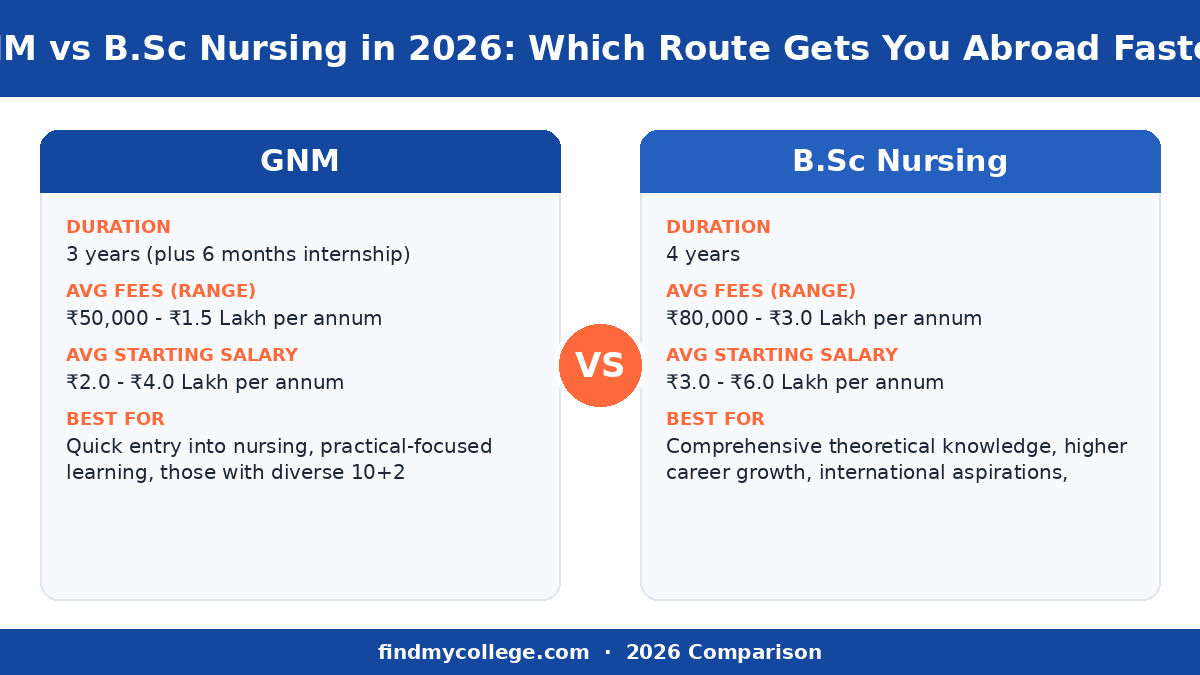
Choosing between a GNM (General Nursing and Midwifery) diploma and a B.Sc Nursing degree in 2026 is a pivotal decision for aspiring nurses in India, with significant implications for career trajectory, earning potential, and especially, international mobility. While GNM offers a quicker entry into the healthcare sector for those seeking immediate employment, B.Sc Nursing provides a more comprehensive, globally recognized qualification, often preferred for advanced roles and faster pathways to working abroad.
GNM vs B.Sc Nursing: Quick Comparison (2026)
| Duration | Eligibility | Admission / Entrance | Avg Fees (range) | Top Careers | Avg Starting Salary | Best For | |
|---|---|---|---|---|---|---|---|
| GNM (General Nursing and Midwifery) | 3 years (plus 6 months internship) | 10+2 with Science (Physics, Chemistry, Biology) or Arts/Commerce with English, minimum 40-50% aggregate. Age 17-35. | Merit-based (10+2 scores) or state-level entrance exams (e.g., UP GNM, MP GNM). | ₹50,000 – ₹1.5 Lakh per annum | Staff Nurse, Community Health Nurse, Home Nurse, Rural Health Worker. | ₹2.0 – ₹4.0 Lakh per annum | Quick entry into nursing, practical-focused learning, those with diverse 10+2 backgrounds. |
| B.Sc Nursing (Bachelor of Science in Nursing) | 4 years | 10+2 with Science (Physics, Chemistry, Biology) and English, minimum 45-50% aggregate. Age 17-35. | National/State-level entrance exams (e.g., NEET, AIIMS Nursing, JIPMER, CETs). | ₹80,000 – ₹3.0 Lakh per annum | Staff Nurse, Clinical Instructor, Nurse Educator, Public Health Nurse, Military Nurse, Specialist Nurse (after post-grad). | ₹3.0 – ₹6.0 Lakh per annum | Comprehensive theoretical knowledge, higher career growth, international aspirations, academic progression. |
Curriculum & Focus
The GNM curriculum is highly practical and patient-care oriented, focusing on fundamental nursing skills, midwifery, and community health. It prepares students for direct patient care roles with a strong emphasis on hands-on training. In contrast, B.Sc Nursing offers a broader, more academic curriculum, encompassing advanced medical-surgical nursing, research methodology, nursing administration, and leadership. This degree provides a deeper theoretical foundation alongside clinical practice, preparing graduates for a wider range of roles, including supervisory and educational positions. The B.Sc degree is generally considered more comprehensive and academically rigorous.
Difficulty & Workload
Both programs demand dedication, but B.Sc Nursing is generally perceived as more academically challenging due to its extensive theoretical component, research projects, and higher-level scientific subjects. The workload includes rigorous coursework, extensive clinical rotations, and often, research assignments. GNM, while intensive in its practical training, might be considered less demanding academically, focusing more on skill acquisition and direct application. However, both require significant commitment to clinical hours and patient interaction.
People Also Read
Fees & ROI
GNM programs typically have lower tuition fees compared to B.Sc Nursing, making them a more accessible option for many students. The quicker completion time also means a faster entry into the workforce, leading to an earlier return on investment. However, while B.Sc Nursing has higher upfront costs and a longer duration, its graduates generally command higher starting salaries and have greater potential for career advancement and salary growth in the long term, leading to a potentially higher overall ROI over a career span.
Placements & Salary
GNM graduates find placements primarily as staff nurses in hospitals, clinics, and community health centers, with average starting salaries ranging from ₹2.0 to ₹4.0 Lakh per annum. While demand is consistent, career progression can be slower without further education. B.Sc Nursing graduates, on the other hand, often secure positions in larger corporate hospitals, specialized units, and even academic institutions, with starting salaries typically between ₹3.0 and ₹6.0 Lakh per annum. Their broader skill set and degree qualification open doors to more diverse and higher-paying roles, including clinical instructor or public health nurse positions.
Higher Studies & Abroad Scope
This is where B.Sc Nursing holds a significant advantage. It is a bachelor’s degree, making it the standard entry qualification for most postgraduate nursing programs (M.Sc Nursing, Nurse Practitioner courses) both in India and internationally. For those aspiring to work abroad, a B.Sc Nursing degree is often a mandatory requirement for licensure and immigration in countries like the USA, UK, Canada, Australia, and New Zealand. While GNM nurses can pursue bridging courses or post-basic B.Sc Nursing to achieve degree equivalence, this adds significant time and cost. Therefore, for a faster and more direct route to working abroad, B.Sc Nursing is unequivocally the preferred option.
Government-Job Scope
Both GNM and B.Sc Nursing graduates are eligible for various government nursing positions, including those in central and state government hospitals, railways, ESIC, and military nursing services. However, for many higher-level or supervisory government roles, a B.Sc Nursing degree is increasingly becoming a preferred or even mandatory qualification. While GNM nurses can apply for staff nurse positions, B.Sc graduates often have an edge in competitive exams and for promotions, reflecting the government’s push for a more educated nursing workforce.
What students actually say (community insights)
- Many students and professionals strongly advocate for B.Sc Nursing, viewing it as the superior qualification that offers more opportunities, better salaries, and greater respect in the healthcare hierarchy. They often highlight that hospitals increasingly prefer degree holders.
- A common sentiment is that GNM is a good entry point for those who need to start working sooner or have financial constraints, but it’s often seen as a stepping stone rather than a terminal qualification, with many suggesting a post-basic B.Sc Nursing later.
- There’s a general consensus that while both paths lead to nursing, the academic depth and comprehensive training of B.Sc Nursing prepare graduates for a wider array of roles, including teaching and administrative positions, which are less accessible with a GNM diploma alone.
- Concerns are sometimes raised about the potential for overpopulation in the nursing field, but most agree that qualified nurses, especially those with a B.Sc, will always find stable employment due to global demand.
- Some students who initially considered GNM due to lower NEET scores or eligibility issues often express a desire to pursue B.Sc Nursing later, recognizing its long-term benefits for career progression and international aspirations.
Which one should you choose?
- Choose GNM if: You are looking for a quicker entry into the nursing profession, prefer a more practical-focused curriculum, have financial constraints, or did not meet the stringent eligibility criteria for B.Sc Nursing. It’s ideal for those who want to start earning and gain experience relatively fast, with the option to pursue higher education later.
- Choose B.Sc Nursing if: You aspire for a comprehensive education, higher career growth, better salary prospects, and a strong foundation for higher studies (M.Sc Nursing, Ph.D.). This is the definitive choice if your goal is to work abroad, pursue specialized nursing roles, or enter academia and leadership positions. It’s an investment in a globally recognized qualification.
Frequently Asked Questions
Is GNM recognized abroad?
While GNM is recognized in some countries, it often requires additional bridging courses, licensure exams, or a Post-Basic B.Sc Nursing degree to meet the educational standards for registration as a Registered Nurse (RN) in countries like the USA, UK, Canada, and Australia. B.Sc Nursing offers a more direct and widely accepted pathway.
Can GNM nurses become specialists?
GNM nurses can gain experience in specialized units, but formal specialization (e.g., Critical Care Nurse, Pediatric Nurse) typically requires a B.Sc Nursing degree followed by a Post-Basic B.Sc Nursing or M.Sc Nursing in a specialized field. The degree provides the academic foundation for advanced practice.
Is NEET compulsory for B.Sc Nursing in 2026?
While not universally compulsory for all B.Sc Nursing admissions, NEET scores are increasingly being accepted or mandated by many top institutions like AIIMS and JIPMER, and several state-level colleges. It’s advisable to check the specific requirements of your target institutions for 2026, as the trend is towards centralized entrance exams.
Which offers better job security, GNM or B.Sc Nursing?
Both offer good job security due to the consistent demand for nurses. However, B.Sc Nursing graduates generally have an edge in securing positions in premier hospitals, specialized departments, and government roles, and are better positioned for career advancement, which can translate to greater long-term job stability and growth.
Can I switch from GNM to B.Sc Nursing?
Yes, GNM graduates can pursue a Post-Basic B.Sc Nursing (PB B.Sc Nursing) program, which is typically a 2-year degree course designed to provide GNM-qualified nurses with a bachelor’s degree. This allows them to upgrade their qualification and gain the benefits of a B.Sc Nursing degree.
What is the salary difference between GNM and B.Sc Nursing in government jobs?
In many government organizations, the starting pay scale for GNM and B.Sc Nursing graduates for entry-level staff nurse positions might be similar. However, B.Sc Nursing graduates often have better opportunities for faster promotions to higher pay grades and supervisory roles, leading to a significant salary difference over time.
Is nursing a good career option in India for 2026?
Yes, nursing remains a robust and in-demand career option in India for 2026. With an expanding healthcare sector, increasing health awareness, and a global shortage of nurses, both GNM and B.Sc Nursing graduates will find ample employment opportunities, offering stability and a chance to make a significant societal contribution.