
Lucknow University Ph.D. Admission 2026: RET Pattern and Rules
Nishit Kumar is a senior EdTech industry leader with over a decade of experience in building and scaling education platforms, shaping their product, content, and growth strategy. At…
- 7 Aug 2026LU Ph.D. application window closes with revised seat matrix
The third and final application deadline ended, releasing a revised seat list declaring 1,114 full-time and 468 part-time doctoral vacancies. - 27 May 2026Lucknow University opens online Ph.D. admission portal 2026-27
The university released the Ph.D. Admission Notification 2026-27 alongside guidelines and Ph.D. Ordinance 2026 on the Samarth portal.
admissions across 51 departments with 1,114 full-time and 468 part-time vacant seats for the 2026-27 academic session. Admission for non-NET/JRF candidates relies on Phase 3 selection comprising 70% weightage for the Research Entrance Test (RET) and 30% for the Departmental Research Committee (DRC) interview.
| Parameter | Details |
|---|---|
| Application Portal | Samarth Portal (lkounivadm.samarth.edu.in) |
| Total Full-Time Vacancies | 1,114 seats (597 university campus, 526 affiliated colleges) |
| Total Part-Time Vacancies | 468 seats |
| Application Fee | INR 2,000 (General/OBC/EWS) | INR 1,000 (SC/ST/PwD) |
| Phase 3 Selection Weightage | 70% RET score + 30% Interview score |
| Full-Time Ph.D. Annual Fee | INR 10,126 (plus lab fee where applicable) |
| Part-Time Annual Fee (Employed with NOC) | INR 52,580 per year |
Ph.D. Eligibility
| Qualification Route | Minimum Aggregate Marks | Special Conditions / Relaxation |
|---|---|---|
| 2-Year Master’s (after 3-Year Bachelor’s) | 55% | 5% relaxation for SC/ST/OBC (NCL)/EWS/PwD |
| 1-Year Master’s (after 4-Year Bachelor’s) | 55% | 5% relaxation for SC/ST/OBC (NCL)/EWS/PwD |
| 4-Year / 8-Semester Bachelor’s Degree | 75% | Must have published at least 1 paper in a peer-reviewed/refereed journal; 5% relaxation for reserved categories |
| M.Phil Degree | 55% | None |
Candidates seeking doctoral admission at Lucknow University must fulfill specific academic qualifications based on their educational route. A 5% relaxation in minimum aggregate marks is extended to candidates belonging to SC, ST, OBC (non-creamy layer), EWS, and PwD categories.
Ph.D. Entrance Exams
Lucknow University organizes Ph.D. candidates into three distinct selection phases to allocate departmental seats systematically.
- Phase 1: Reserved for applicants holding national research fellowships such as UGC-JRF, CSIR-JRF, ICAR, ICMR, DBT-JRF, or AICTE doctoral fellowships. These candidates are exempt from the RET and undergo direct evaluation by the Departmental Research Committee (DRC).
- Phase 2: Reserved for UGC-NET or CSIR-NET qualified applicants without fellowship funding. Candidates in this phase skip the RET written exam and report directly for the DRC interview.
- Phase 3: Open to all remaining non-NET/JRF candidates competing for left-over vacant seats. Candidates must clear the written RET to qualify for the DRC interview stage.
The RET written test is conducted over a duration of 90 minutes. The question paper consists of 50% Research Methodology and 50% Subject-Specific content strictly based on Lucknow University’s postgraduate syllabus. To pass the test and qualify for the DRC interview, General category candidates must score at least 50% aggregate marks, while SC, ST, OBC (NCL), EWS, and PwBD applicants require a minimum of 45% aggregate marks. Final selection under Phase 3 calculates merit by assigning 70% weightage to RET marks and 30% weightage to the DRC interview performance.
Ph.D. Application Process
| Fee Component / Category | Amount (INR) |
|---|---|
| Application Fee (General / OBC / EWS) | INR 2,000 |
| Application Fee (SC / ST / PwD) | INR 1,000 |
| Full-Time Ph.D. Annual Course Fee | INR 10,126 (plus department lab fees where applicable) |
| Part-Time Ph.D. Fee (Employed with Employer NOC) | INR 52,580 per year |
| Part-Time Ph.D. Fee (Working Professional Route) | INR 1,52,830 per year |
Lucknow University Ph.D. applications are submitted online through the Samarth portal by registering with an email ID and mobile number. Applicants select their program mode, upload a scanned photograph and signature in JPEG format, and pay the application fee.
Documents Required
- Active email ID and mobile number for registration on lkounivadm.samarth.edu.in
- Personal details, category details, and educational qualifications for form entry
- Scanned photograph in JPEG format
- Clear scanned signature in JPEG format
- No Objection Certificate (NOC) from employer for employed applicants
- Separate online application form for each part-time category if applying under both
- Printed copy of the submitted application form and fee receipt
Employed applicants applying for part-time Ph.D. must submit a No Objection Certificate from their employer. Candidates applying under multiple part-time categories are required to fill separate application forms.
Top Ph.D. Colleges
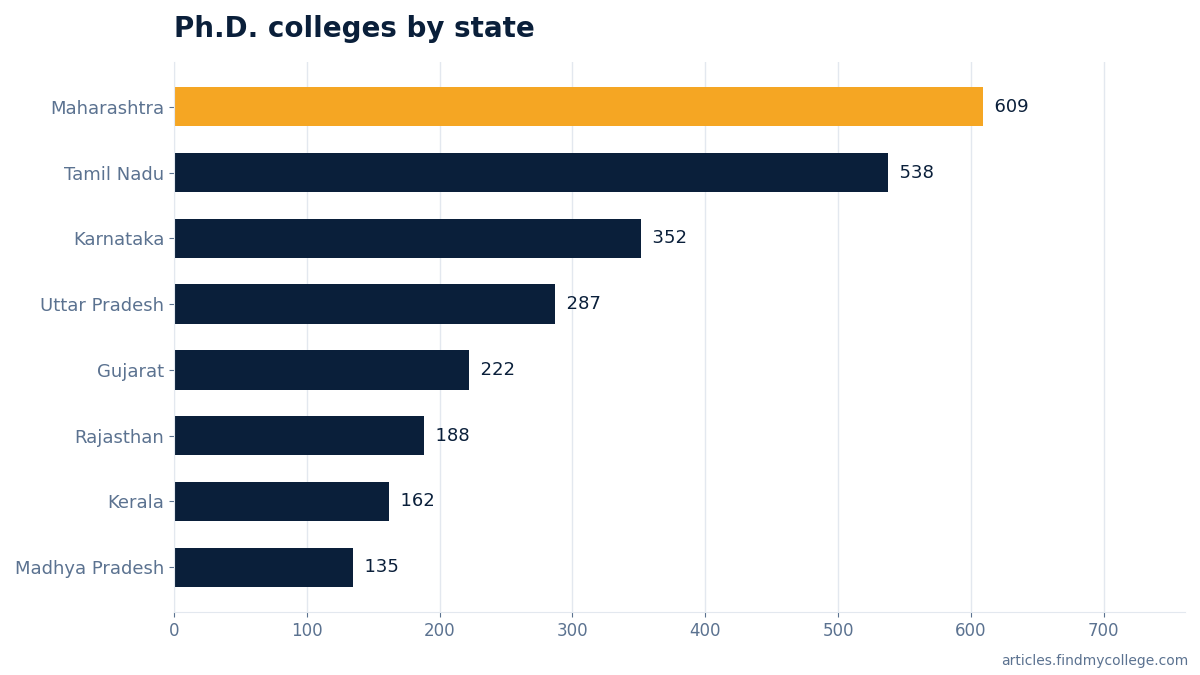
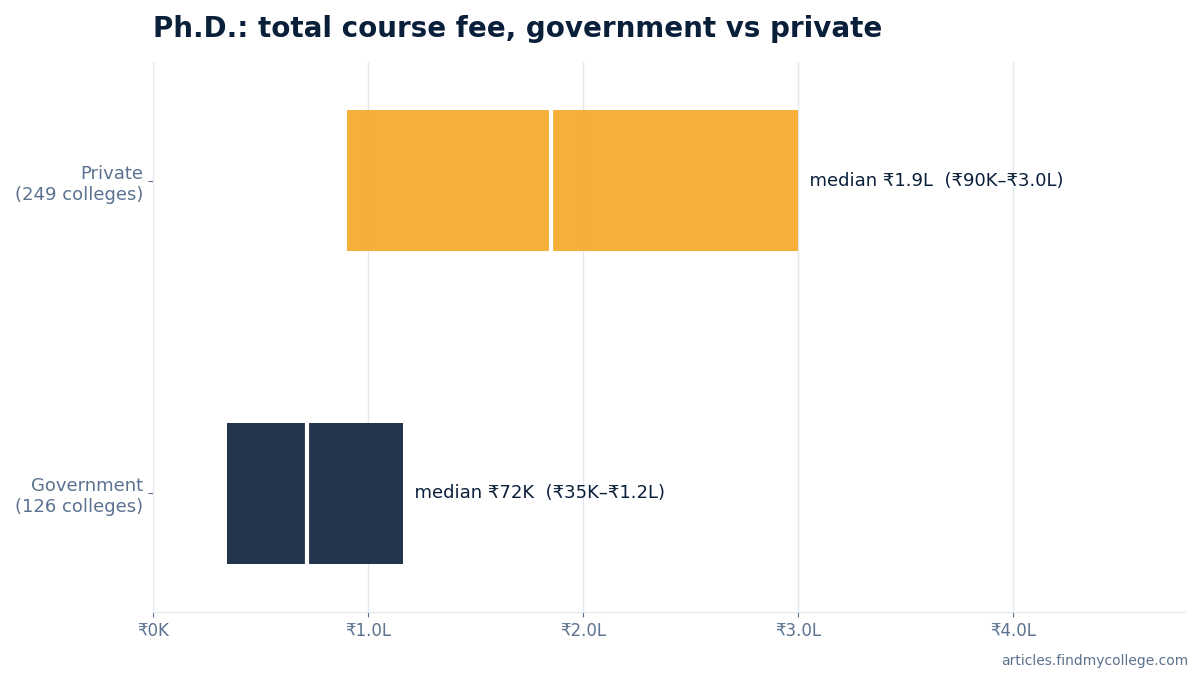
Across India, at least 3,561 colleges offer doctoral programmes, including at least 287 government institutions and 1,129 private universities. For government doctoral colleges, the median total course fee is ₹71,600, with the middle half falling between ₹34,582 and ₹1.16 lakh. Private doctoral institutions report a median total course fee of ₹1.85 lakh, with the middle half spanning ₹90,270 to ₹3.00 lakh. State distribution demonstrates strong research infrastructure in Uttar Pradesh with at least 287 colleges, alongside Maharashtra (609), Tamil Nadu (538), Karnataka (352), Gujarat (222), and Rajasthan (188).
| College | City | Ownership | Total course fee | NIRF rank |
|---|---|---|---|---|
| Indian Institute of Science | Bangalore | — | ₹89,200 | 1 (Overall, 2025) |
| Indian Institute of Technology Madras | Chennai | Government | ₹30,850 | 1 (Overall, 2025) |
| Jawaharlal Nehru University | Delhi | Government | — | 2 (Overall, 2025) |
| Indian Institute of Technology Bombay | Mumbai | Government | ₹70,200 | 3 (Overall, 2024) |
| Manipal University Manipal | Manipal | — | ₹59,000 | 3 (Overall, 2025) |
| Punjab Agricultural University | Ludhiana | — | ₹1.76 lakh | 3 (Overall, 2025) |
| Jamia Millia Islamia University | Delhi | Government | ₹27,740 | 4 (Overall, 2025) |
| Indian Institute of Technology Kanpur | Kanpur | Government | ₹52,200 | 5 (Overall, 2025) |
| Delhi University | Delhi | Government | ₹7,130 | 5 (Overall, 2025) |
| Indian Institute of Technology Roorkee | Roorkee | — | ₹85,800 | 6 (Overall, 2025) |
| College | City | Ownership | Total course fee |
|---|---|---|---|
| Indian Institute of Foreign Trade Kolkata | Kolkata | Government | ₹5,000 |
| Bharathi Women’s College | Chennai | Government | ₹5,105 |
| All India Institute of Medical Sciences New Delhi | Delhi | Government | ₹5,215 |
| Gulbarga University | Gulbarga | Government | ₹6,545 |
| Govt. Raza Post Graduate College | Rampur | Government | ₹6,810 |
| Delhi University | Delhi | Government | ₹7,130 |
| Calicut University | Calicut | Government | ₹7,130 |
| Bastar University | Bastar | Government | ₹7,170 |
| Post Graduate Institute of Medical Education & Research | Chandigarh | Government | ₹7,410 |
| Government Thakur Ranmat Singh College | Rewa | Government | ₹7,777 |
| College | City | Ownership | Total course fee |
|---|---|---|---|
| Birla Institute of Technology and Science Pilani | Pilani | Private | ₹1.84 lakh |
| Chandigarh University | Chandigarh | Private | ₹3.60 lakh |
| VIT University Chennai | Chennai | Private | ₹1.33 lakh |
| Thapar Institute of Engineering and Technology | Patiala | Private | ₹69,000 |
| Chebrolu Hanumaiah Institute of Pharmaceutical Sciences | Guntur | Private | ₹1.05 lakh |
| Indian Institute of Technology Dhanbad | Dhanbad | Private | ₹50,400 |
| Uttaranchal University | Dehradun | Private | ₹3.59 lakh |
| Marwadi University | Rajkot | Private | ₹2.25 lakh |
| SVKM’s Narsee Monjee Institute of Management Studies Navi Mumbai | Navi Mumbai | Private | ₹3.00 lakh |
| Doon Business School | Dehradun | Private | ₹3.30 lakh |
| City | Colleges | Fee range | Well-known options |
|---|---|---|---|
| Bangalore | 179 | ₹50,000 – ₹8.75 lakh | Alliance University, Christ University |
| Pune | 173 | ₹52,785 – ₹5.16 lakh | Symbiosis Law School Pune, Armed Forces Medical College |
| Mumbai | 149 | ₹7,923 – ₹33.82 lakh | Indian Institute of Technology Bombay, Jamnalal Bajaj Institute of Management Studies |
| Chennai | 135 | ₹5,105 – ₹7.50 lakh | Indian Institute of Technology Madras, Saveetha Institute of Medical and Technical Sciences |
| Coimbatore | 114 | ₹36,500 – ₹9.34 lakh | Amrita Vishwa Vidyapeetham, P.S.G College of Technology |
| Delhi | 77 | ₹5,215 – ₹7.50 lakh | All India Institute of Medical Sciences New Delhi, Jamia Millia Islamia University |
| Jaipur | 76 | ₹30,970 – ₹45.00 lakh | Manipal University Jaipur, University of Rajasthan |
| Hyderabad | 69 | ₹35,000 – ₹5.20 lakh | University of Hyderabad, Indian Institute of Technology Hyderabad |
| College | City | Total course fee |
|---|---|---|
| IIHMR University | Jaipur | ₹4.00 lakh |
| Indian School of Business Management & Administration | Kolkata | ₹69,900 |
| Indian Institute of Business Management and Studies | Mumbai | ₹75,800 |
| Indian Institute of Information Technology Sri City | Sri City | ₹1.83 lakh |
| Shyam University | Dausa | ₹3.15 lakh |
| Birla Institute of Technology Mesra | Ranchi | ₹1.99 lakh |
How to Apply for Ph.D. Admission in 2026: Step by Step
- Check Eligibility Criteria: Ensure you have a relevant Master’s degree with 55% aggregate (50% for reserved categories) or a 4-year Bachelor’s degree with 75% aggregate and at least one peer-reviewed publication.
- Register on Samarth Admission Portal: Visit lkounivadm.samarth.edu.in and register using an email ID and mobile number, then log in with the credentials sent to your mobile number and email ID.
- Fill Application Form and Choose Mode: Enter personal, category, and educational details, select Full-Time (Regular) or Part-Time mode, and upload a scanned photo and signature in JPEG format.
- Pay Application Fee Online: Preview every entry and pay INR 2,000 (General/OBC/EWS) or INR 1,000 (SC/ST/PwD) via card or net banking, then print the submitted form and fee receipt.
- Appear for Entrance Exam / DRC Interview: Phase 1 (JRF) and Phase 2 (NET) candidates attend the DRC interview directly, while Phase 3 candidates take the 90-minute RET exam and must score at least 50% (45% for reserved categories) to qualify for the DRC interview.
| What to do | Where | Link |
|---|---|---|
| application | Lucknow University Samarth Admission Portal | lkounivadm.samarth.edu.in |
Applicants applying for part-time Ph.D. courses must submit a separate online application form for each part-time category. Employed applicants are also required to provide a No Objection Certificate from their employer.
FAQs
Can candidates apply for Lucknow University PhD Admission 2026-27 without UGC-NET?
Yes. Candidates without UGC-NET or JRF can apply under Phase 3. They must qualify the Research Entrance Test (RET) with 50% marks (45% for reserved categories) followed by the DRC interview.
Is Lucknow University PhD admission application form still open for 2026-27?
No, the online portal for the May 2026 session closed on August 7, 2026. As per Ph.D. Ordinance 2026, the next admission cycle notification is scheduled to release in December 2026.
Who is exempt from the Lucknow University RET exam?
Phase 1 candidates holding national fellowships (like UGC-JRF, CSIR-JRF, ICAR, ICMR, DBT-JRF) and Phase 2 candidates holding UGC-NET or CSIR-NET qualifications are exempt from RET and go directly to DRC interview.
What is the RET exam pattern for LU Ph.D. admission?
The RET is a 90-minute written examination. 50% of the paper covers Research Methodology and 50% covers Subject-Specific topics based on the Lucknow University postgraduate syllabus.
What is the annual fee for Ph.D. at Lucknow University?
Full-time Ph.D. annual course fee is INR 10,126 (plus laboratory charges if applicable). Part-time Ph.D. for employed candidates with NOC costs INR 52,580 per year, while the working professional route costs INR 1,52,830 per year.
Can a candidate apply for both full-time and part-time Ph.D. at Lucknow University?
Yes. Candidates are permitted to apply for both full-time and part-time Ph.D. courses at Lucknow University.