MA English Syllabus 2026: Key Subjects, Semester-wise Breakdown, Entrance Syllabus & More
Aayush is a writer and content strategist who turns personal stories into brand narratives. With an experience spanning diverse industries, rely on his writing for simplifying complex subjects…
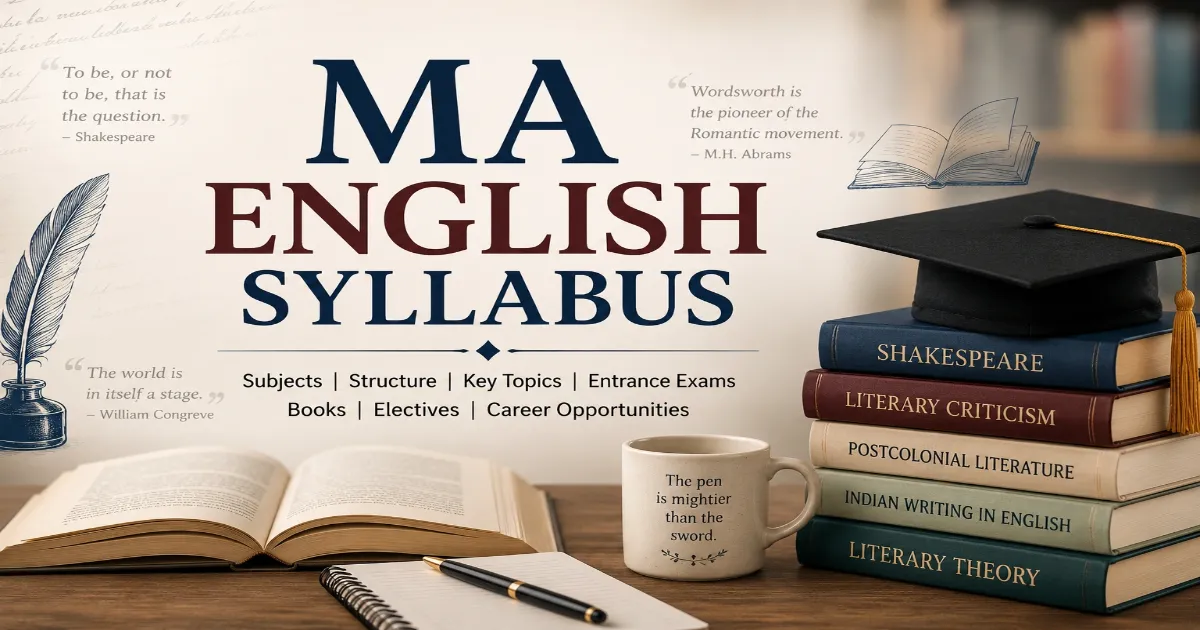
Discover the complete MA English syllabus 2026 with subjects, structure, key books, electives, and entrance exam details in one comprehensive guide.
The MA English syllabus for 2026 offers a comprehensive and in-depth exploration of advanced literary studies, designed to equip students with critical analytical skills across diverse periods and genres. This rigorous curriculum typically covers foundational theories, major literary movements from classical to postcolonial eras, and contemporary critical approaches. Here, you’ll find a detailed breakdown of core subjects, semester-wise structure, key topics, and preparation strategies for the entrance exam.
MA English Syllabus 2026: Core Subjects and Semester-Wise Structure
The MA English syllabus spans two years, divided into four semesters, offering a comprehensive study of literature. This program focuses on both core and elective subjects, equipping students with advanced skills in critical analysis, research, and literary production, covering diverse areas from ancient to modern ages.
| MA English Syllabus 1st Semester | MA English Syllabus 2nd Semester | MA English Syllabus 3rd Semester | MA English Syllabus 4th Semester |
| 14th-20th Century British Poetry | 20th Century British Novels | 16th-19th Century Literary Criticism | Dissertation |
| Appreciating Shakespeare | 20th Century British Drama | 20th Century Literature Theory and Criticism | Foreign Languages |
| Literature and Film | American Literature | Gender Studies | Fiction |
| Digital Content Writing | Indian Writing in English | Post Colonial Literature | Literary Criticism |
| Scholarly Writing | Classical Literary Criticism | Culture Studies | Fiction from 1900 Onwards |
| Literature Review | Postcolonial Novel | ||
| Foreign Language | Project Work/Viva |
This table outlines the semester-wise progression of subjects, demonstrating a structured academic journey through various literary periods and critical approaches within the MA English syllabus.
MA English Syllabus Structure
MA English is generally a 2-year postgraduate program spread across 4 semesters, designed under the CBCS (Choice Based Credit System) in most Indian universities. While exact marks and credits vary by university, the overall structure is quite consistent across institutions like DU, JNU, and state universities.
| Component | Typical Structure (India) |
| Total Duration | 2 Years |
| Total Semesters | 4 Semesters |
| Total Papers | ~14–20 papers (varies by university) |
| Credits per Paper | Usually 4–6 credits per paper |
| Total Credits | ~64–96 credits (approx., CBCS pattern) |
| Internal Assessment | 20–30% (assignments, presentations, class tests) |
| End-Term Exam | 70–80% (semester examination) |
| Dissertation/Project | 4th semester in some universities (6–12 credits) |
| Electives | Offered in 3rd/4th semester (varies by institution) |
| Passing Criteria | Generally 40%–50% aggregate per paper |
Key Subjects in MA English
Here is an overview of core subjects taught in MA English with key topics:
| Subject | Key Texts / Topics Covered |
| Shakespeare | Shakespeare’s plays & poetry; Elizabethan drama |
| Literary Criticism I & II | Bharata Muni (Natyashastra VI–VII), Aristotle, Anandavardhana (Dhvanyaloka I–II), G.N. Devy (After Amnesia) |
| Language and Linguistics | Phonetics, phonology, morphology, syntax, semantics, sociolinguistics |
| English Poetry from Chaucer to Milton | Chaucer, Spenser, Shakespeare, Milton |
| British Literature I: Chaucer to Milton | Chaucer, Spenser, Shakespeare, Milton |
| British Literature II: Dryden to Romantic Age | Dryden, Pope, Johnson, Romantic poets |
| British Literature III: Victorian to Modern Times | Victorian literature, modernism, postmodernism |
| Eighteenth Century English Literature | Pope, Johnson; neoclassicism, satire, Enlightenment thought |
| 19th & 20th Century Novel | Realism, modernism, postmodernism; major novels of social change |
| 20th Century Poetry and Drama | Yeats, T.S. Eliot, Samuel Beckett; modernist poetry & drama |
| Literary Criticism I (Advanced) | Aristotle, Bharata Muni, Anandavardhana, G.N. Devy |
| Indian Literature in English I | Tagore, Raja Rao (The Serpent and the Rope), Anita Desai (Voices in the City), Girish Karnad (The Fire and the Rain) |
| Fiction II | Conrad (Heart of Darkness), Joyce (A Portrait of the Artist as a Young Man), Woolf (Mrs Dalloway) |
| European Literature in Translation | Sophocles (Oedipus Rex), Brecht (Mother Courage), Flaubert (Madame Bovary), Dostoevsky (Notes from Underground) |
| Drama | Shakespeare; Johnson; Dollimore & Sinfield; Cultural Materialism; New Historicism |
Elective Subjects in MA English
MA English elective papers vary across universities, but they are generally designed to help students specialise beyond core literary periods and develop theoretical, regional, and interdisciplinary expertise in literature, culture, and language studies.
- Literature and Gender Studies – feminist theory, gender representation, queer studies in literature
- American Literature – major American poets, novelists, and literary movements from colonial to modern periods
- Postcolonial Literature / New Literatures in English – colonial discourse, identity, diaspora writing, and Commonwealth literature
- Indian Writing in English – novels, poetry, and drama by Indian English authors including postcolonial themes
- Literature and Film Studies – adaptation theory, cinema analysis, and intermedial studies
- Research Methodology in Literature – academic writing, research design, hypothesis formation, and literary research methods
- Translation Studies / Literature in Translation – theory and practice of translation; study of global texts in translation
- World / European Literature in Translation – classical and modern European texts in translation
- Contemporary Literary Theories – structuralism, post-structuralism, feminism, Marxism, deconstruction
- Modern English Drama / Theatre Studies – modern playwrights, performance studies, and dramatic theory
- Campus Novel / Genre Studies (optional electives in some universities) – study of specific literary genres like detective fiction, satire, or campus fiction
MA English Entrance Exam Syllabus 2026: Pattern and Subjects
MA English entrance exams are typically written tests lasting for 1-2 hours duration. Here is an overview of popular MA English entrances with exam patterns and date:
| Exam Name | Exam Pattern | Syllabus (Key Areas Covered) | Eligible Colleges |
| CUET PG (MA English) | 75 MCQs, 90 minutes, CBT, −1 marking | British literature (Chaucer–Modernism), Indian Writing in English, Literary Theory, Criticism, Linguistics basics, genres, comprehension | All CUET-participating universities (central/state/deemed/private) |
| Jamia Millia Islamia (JMI) | MCQs + short descriptive questions (1–2 hours) | British literature periods, poetry, drama, novel, Indian writing in English, literary criticism, language aptitude, interpretive essays | Jamia Millia Islamia (MA English program) (Testbook) |
| University of Hyderabad (UoH) | Objective + short answer (1–2 hours) | Literary theory, textual analysis, history of English literature, criticism schools, linguistics basics, close reading passages | University of Hyderabad (MA English) |
| English and Foreign Languages University (EFLU) | MCQs + comprehension-based test | English literature history, linguistics, applied language skills, literary terms, criticism, reading comprehension | EFLU Hyderabad & Lucknow campuses |
| Christ University | Written test + interview | Grammar, comprehension, essay writing, literary awareness, critical thinking, communication skills | Christ University (MA English & allied humanities) |
Banaras Hindu University MA English Syllabus 2026 Overview
BHU’s MA English program is typically structured over four semesters, offering a balanced and systematic study of literature and language. It includes 16 courses in total, with four courses per semester, each carrying 5 credits and 100 marks. The evaluation is divided into 70 marks for end-semester theory examinations and 30 marks for internal assessment.
| Semester | Course No. | Course Title | Course Code |
| I | 1 | Poetry I | ENG- 101 |
| 2 | Drama I | ENG -102 | |
| 3 | Prose | ENG- 103 | |
| 4 | Introduction to Language and Linguistics | ENG-104 | |
| II | 5 | Poetry II | ENG-201 |
| 6 | Drama II (Shakespeare) | ENG-202 | |
| 7 | Fiction I | ENG-203 | |
| 8 | Women Writing OR Indian Literature in Translation | ENG-EL-304.1/ ENG-EL-204.2 | |
| III | 9 | Poetry III | ENG-301 |
| 10 | Drama III | ENG-302 | |
| 11 | Literary Criticism I | ENG-303 | |
| 12 | Indian Literature in English I OR American Literature I | ENG-EL-304.1 / ENG-EL-304.2 | |
| IV | 13 | Fiction II | ENG-401 |
| 14 | Literary Criticism II | ENG-402 | |
| 15 | Indian Literature in English II OR American Literature II | ENG-EL-403.1 / ENG-EL-403.2 | |
| 16 | New Literatures in English OR European Literature in Translation | ENG-EL.404.1 / ENG-EL-404.2 |
Exam Pattern
Courses within the BHU MA English syllabus are categorized as follows:
- Core Courses: Nos. 1-7, 9-11, 13, 14.
- Elective Courses: Nos. 8, 12, 15, 16.
- Allied Elective Courses: Nos. 8, 16 (open to other Departments).
The examination for the MA English syllabus follows distinct question paper patterns based on the course:
| Pattern | Applicable Courses | Section A (Long Answer) | Section B (Explanation/Short Answer) | Section C (Short Answer/Objective) | Section D (Objective) | Total Marks |
| 1 | 1, 2, 3, 5, 6, 9, 10, 12, 15 | 2×12 = 24 marks | 3×6 = 18 marks (passages) | 3×6 = 18 marks (short answers) | 10×1 = 10 marks | 70 marks |
| 2 | 4, 7, 11, 13, 14 | 2×12 = 24 marks | 6×6 = 36 marks (short answers) | 10×1 = 10 marks (objective) | N/A | 70 marks |
| 3 | 8, 16 | 2×12 = 24 marks | 2×6 = 12 marks (passages) | 4×6 = 24 marks (short answers) | 10×1 = 10 marks | 70 marks |
MA English IGNOU Syllabus
The IGNOU MA English programme (MEG/MAEG) is a 2-year postgraduate degree structured into compulsory and optional courses with a 64-credit system, designed to build strong foundations in literary theory, British literature, and global literary studies.
| Year | Course Type | Course Code | Subject Title | Credits |
| 1st Year | Compulsory | MEG-01 | British Poetry | 8 |
| 1st Year | Compulsory | MEG-02 | British Drama | 8 |
| 1st Year | Compulsory | MEG-03 | British Novel | 8 |
| 1st Year | Compulsory | MEG-04 | Aspects of Language | 8 |
| 2nd Year | Compulsory | MEG-05 | Literary Criticism & Theory | 8 |
| 2nd Year | Optional (choose 3) | MEG-06/07/08 etc. | American Literature / Indian English Literature / New Literatures etc. | 24 (total) |
Key Literary Periods and Genres in MA English Syllabus 2026
The MA English syllabus covers a wide range of literary periods and genres, spanning from the early 14th to the late 20th century. This comprehensive program, divided into four semesters, includes core and elective subjects, offering students a deep exploration of literary traditions and movements.
| Semester I | Semester II |
| English Novel | Irish Literature |
| English Drama | Canadian Literature |
| English Poetry | Native-American Literature |
| English Prose and Essays | South African Literature |
| Literature in the 17th century | American Literature |
| Literature in the 18th century | African Literature |
| Literature in the 19th century | Australian Literature |
| Romanticism, Neoclassicism | Modernism and Post- Modernism |
Popular Books for MA English Syllabus
MA English syllabi across Indian universities generally include a core set of canonical literary, theoretical, and cross-cultural texts drawn from British, Indian, American, and European traditions. The following books are typically prescribes at DU, BHU, JNU and other esteemed institutions:
| Subject Area | Book / Text | Author |
| Poetry | Canterbury Tales (General Prologue) | Geoffrey Chaucer |
| Poetry | Paradise Lost (Book IX) | John Milton |
| Poetry | The Love Song of J. Alfred Prufrock | T.S. Eliot |
| Poetry | Tintern Abbey | William Wordsworth |
| Drama | Volpone | Ben Jonson |
| Drama | The Way of the World | William Congreve |
| Drama | The Spanish Tragedy | Thomas Kyd |
| Fiction | Pride and Prejudice | Jane Austen |
| Fiction | Joseph Andrews | Henry Fielding |
| Fiction | David Copperfield | Charles Dickens |
| Fiction | Heart of Darkness | Joseph Conrad |
| Fiction | Mrs Dalloway | Virginia Woolf |
| Fiction | The Sound and the Fury | William Faulkner |
| Indian Writing | The God of Small Things | Arundhati Roy |
| Indian Drama | The Fire and the Rain | Girish Karnad |
| Indian Poetry | Selected Poems | Nissim Ezekiel |
| American Literature | The Scarlet Letter / Death of a Salesman | Nathaniel Hawthorne / Arthur Miller |
| European Literature in Translation | Madame Bovary | Gustave Flaubert |
| European Literature in Translation | Notes from Underground | Fyodor Dostoevsky |
| Literary Theory | Poetics | Aristotle |
| Literary Theory | The Death of the Author | Roland Barthes |
| Literary Theory | The Archetypes of Literature | Northrop Frye |
| Literary Criticism | A Preface to Shakespeare | Samuel Johnson |
| Feminist Theory | Selected essays | Elaine Showalter |
MA English Syllabus: DU vs BHU vs JNU (Comparison Table)
| Aspect | University of Delhi (DU) | Banaras Hindu University (BHU) | Jawaharlal Nehru University (JNU) |
| Program Structure | Semester-based CBCS system | Semester-based CBCS system | Semester-based credit system with strong research orientation |
| Total Duration | 2 years (4 semesters) | 2 years (4 semesters) | 2 years (4 semesters) |
| Core Focus | British literary canon + structured periods | British literature + Indian/World literature mix | Literary theory, cultural studies, interdisciplinary humanities |
| Teaching Approach | Text- and period-based learning | Balanced between texts, history, and criticism | Theory-heavy, discussion-based, research-oriented |
| Literary Coverage | Chaucer to Postmodern literature (structured periodization) | Poetry, drama, fiction across periods with electives | Global literature + theory + postcolonial and cultural studies |
| Literary Theory Emphasis | Moderate (core papers included) | Moderate to strong (2 dedicated papers in later semesters) | Very strong focus on critical theory and philosophy |
| Electives | Limited, mostly literature-based | Wide range: American, Indian, European, New Literatures | Highly flexible interdisciplinary electives |
| Assessment Pattern | Internal + semester exams (70–30 split approx.) | 70 theory + 30 internal assessment per paper | Mix of written exams, assignments, seminars, and research work |
| Dissertation/Research Work | Optional in some cases | Available in final semester in some departments | Strong emphasis on dissertation and research writing |
| Key Strength | Strong classical British literature base | Balanced literature + structured curriculum | Theoretical depth + critical thinking + interdisciplinary focus |
Frequently Asked Questions
What are the core subjects in the MA English syllabus?
Core MA English subjects include Shakespeare, literary criticism, linguistics, British literature periods, Indian writing in English, modern poetry, fiction, drama, and postcolonial and contemporary literary theory studies.
What are the popular books for MA English students?
Popular MA English books include Canterbury Tales, Paradise Lost, Pride and Prejudice, Mrs Dalloway, Heart of Darkness, Poetics, and works by Eliot, Woolf, Conrad, and Shakespeare.
Which are the elective options available in MA English syllabus?
Electives include gender studies, American literature, postcolonial studies, film studies, translation studies, literary theory, Indian writing in English, world literature, and genre-based or interdisciplinary cultural studies.
What are the minimum eligibility requirements for MA English admission?
Candidates must hold a Bachelor’s degree in English or related humanities discipline with at least 45–50% marks. Many universities also require clearing CUET PG or entrance examinations.
What career paths can I pursue after completing an MA English degree?
MA English graduates can pursue careers in teaching, content writing, publishing, journalism, editing, civil services, research, digital marketing, and academic fields like NET-JRF and higher education.