MBA in IT: Course Details, Eligibility, Jobs and Scope
Nishit Kumar is a senior EdTech industry leader with over a decade of experience in building and scaling education platforms, shaping their product, content, and growth strategy. At…
An MBA in IT (Information Technology) is a 2-year postgraduate management course that bridges business management with technological operations. Fresh graduates earn starting packages ranging from ₹6.5–8 LPA on average, while placements at premier institutes like IIM Bangalore reach ₹35,92,000.
Prospective students will find comprehensive details below regarding eligibility criteria, national entrance exams, semester-wise subjects, college options, fee structures, and placement opportunities.
| Parameter | Details |
|---|---|
| Course Name | Master of Business Administration (MBA) in IT Management |
| Course Duration | 2 Years (4 Semesters) |
| Course Level | Postgraduate (PG) |
| Eligibility | Bachelor’s degree with minimum 50% aggregate marks |
| Entrance Exams | CAT, XAT, GMAT, CMAT, MAT, NMAT, SNAP |
| Average Course Fee | INR 50,000 to INR 20,00,000 (Up to ₹27 Lakhs at top B-Schools) |
| Average Starting Package | ₹6.5 LPA to ₹8 LPA (Freshers); ₹25 LPA to ₹36 LPA (Top Tier-1 Institutes) |
| Learning Modes | Regular (Offline), Online Learning, Open Distance Learning (ODL) |
MBA in IT Eligibility
Candidates seeking admission to a full-time MBA in IT must hold a Bachelor’s degree in any discipline from a recognized university with at least 50% aggregate marks. While graduates from all academic backgrounds can apply, candidates with a background in engineering or computer science often gain a faster technical grasp of complex coursework.
Admission to regular management programs depends on performance in national competitive entrance tests such as CAT, XAT, GMAT, CMAT, MAT, NMAT, or SNAP. Entrance exams are generally not required for candidates enrolling in an Online MBA in IT Management.
MBA in IT Admission Process
- Entrance Exams: Candidates take national entrance tests such as CAT, XAT, GMAT, CMAT, MAT, NMAT, and SNAP, though entrance exams are generally not required for Online MBA programs.
- Academic Qualifications: Applicants must hold a Bachelor’s degree in any discipline with at least 50% aggregate marks.
- Work Experience: Having prior work experience in IT or technical fields can be beneficial during evaluation.
- Selection Evaluation: Candidates complete personal interviews and written tests to assess oral and written communication, problem analysis, and applied knowledge.
Selection rounds evaluate communication capabilities, problem-solving skills, and domain knowledge.
MBA in IT Syllabus and Subjects
| Semester | Core & Elective Subjects Included |
|---|---|
| Semester 1 | Organizational Behaviour, Managerial Economics, Financial Accounting, Quantitative Methods, Marketing Management, Human Resource Management, Business Communication, Information Technology Management |
| Semester 2 | Organization Effectiveness and Change, Management Science, Economic Environment of Business, Financial Management, Management Accounting, Operation Management, Marketing Research, Management of Information System |
| Semester 3 | Business Ethics & Corporate Social Responsibility, Legal Environment of Business, Strategic Analysis, Elective Courses |
| Semester 4 | Strategic Management, International Business Environment, Project Study, Elective Courses |
The curriculum builds foundational expertise in Managerial Economics and Financial Accounting during the initial semesters. Students then progress to Strategic Analysis, International Business Environment, and Project Study in the final year.
MBA in IT Fees
Course fees for an MBA in IT vary significantly depending on institutional ownership, learning mode, and campus ranking. Overall tuition fees across Indian universities and institutes start from ₹50,000 and extend up to ₹20,00,000, with premier Tier-1 B-schools charging between ₹10 Lakh and ₹27 Lakh.
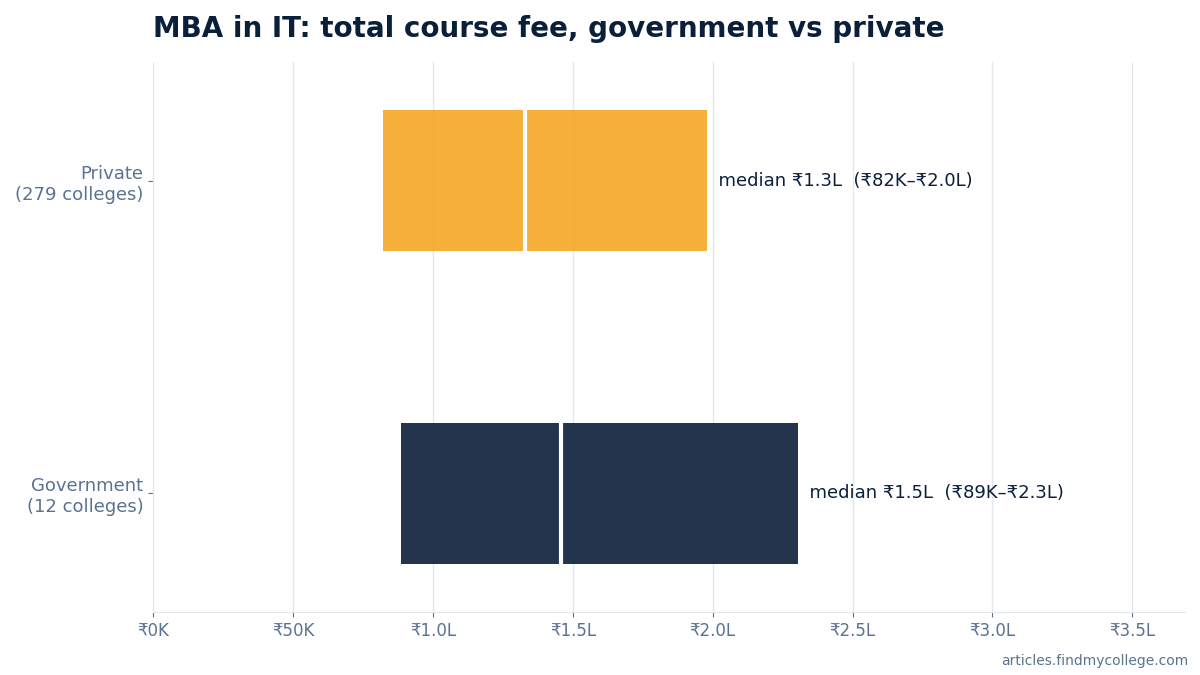
Students can choose from government institutions, private colleges, or distance education models. Government colleges report a median total course fee of ₹1.46 lakh, with the middle half falling between ₹88,606 and ₹2.31 lakh. Private colleges reflect a median total course fee of ₹1.33 lakh, with the middle half ranging from ₹82,000 to ₹1.98 lakh.
| College | City | Ownership | Total course fee |
|---|---|---|---|
| Calicut University | Calicut | Government | ₹5,755 |
| Gujarat Technological University | Ahmedabad | Government | ₹50,000 |
| Shri Atal Bihari Vajpai Govt. Arts and Commerce College | Indore | Government | ₹83,142 |
| Jamshedpur Workers College | Jamshedpur | Government | ₹1.05 lakh |
| Dr. A.P.J. Abdul Kalam Technical University | Lucknow | Government | ₹1.19 lakh |
| Rajasthan Institute of Engineering and Technology Jaipur | Jaipur | Government | ₹1.44 lakh |
| Institute of Cooperative Management | Madurai | Government | ₹1.48 lakh |
| Bundelkhand Institute of Engineering & Technology | Jhansi | Government | ₹1.56 lakh |
| Magadh University | Gaya | Government | ₹1.60 lakh |
| Centre for Development of Advanced Computing | Noida | Government | ₹2.54 lakh |
For working professionals seeking flexible modes, distance and online learning programs offer lower overall tuition structures.
| College | City | Total course fee |
|---|---|---|
| School of Distance Learning, Jagan Nath University | Jaipur | ₹58,500 |
| Bharati Vidyapeeth University | Pune | ₹1.78 lakh |
| Lovely Faculty of Distance Education, Lovely Professional University | Jalandhar | ₹62,000 |
| Fakir Mohan University, Directorate of Distance and Continuing Education | Balasore | ₹40,000 |
Top MBA in IT Colleges
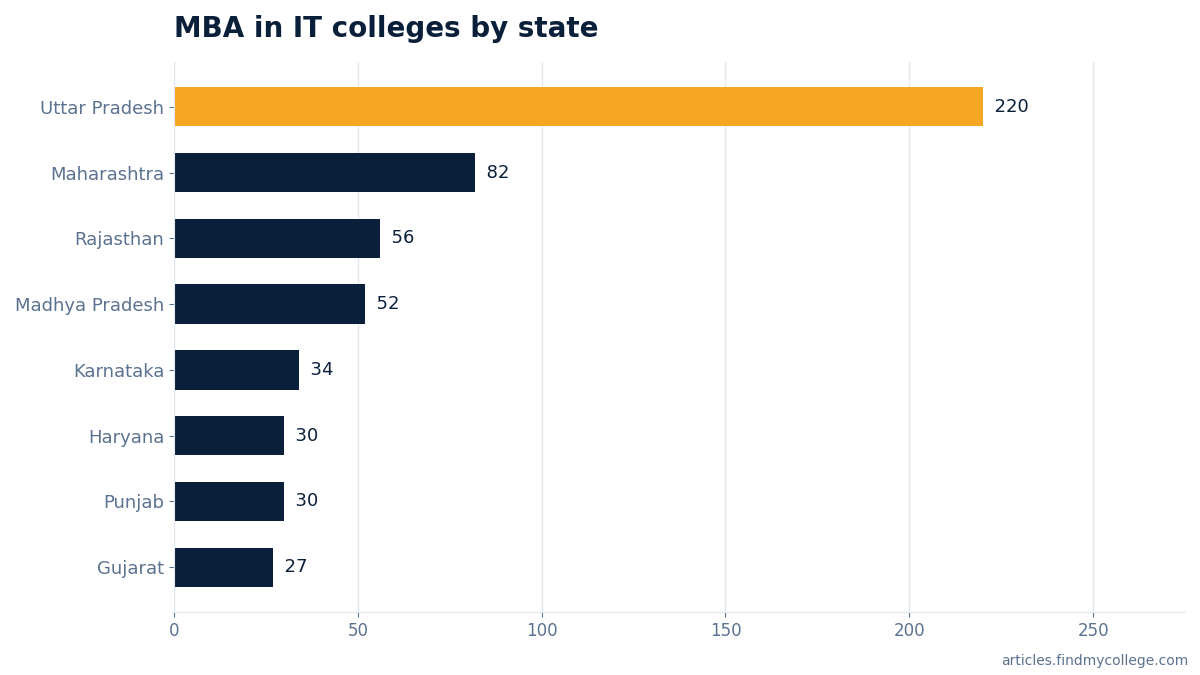
Multiple options exist across India, with at least 691 colleges offering MBA in IT programs, including 13 government institutions and 300 private institutes. College distribution across major states includes Uttar Pradesh with 220 colleges, Maharashtra with 82, Rajasthan with 56, Madhya Pradesh with 52, Karnataka with 34, and Haryana with 30.
| Rank | College Name | City | Notable Program / Specialty | Average Package (₹) | Key Recruiters |
|---|---|---|---|---|---|
| 1 | IIM Ahmedabad | Ahmedabad | Strong IT Electives | 34,36,000 | BCG, Deloitte, Axis Bank |
| 2 | IIM Bangalore | Bangalore | Tech-focused curriculum | 35,92,000 | ITC, Amazon, Uber |
| 3 | IIM Calcutta | Kolkata | Analytics & IT Management | 35,07,000 | Infosys, KPMG, McKinsey |
| 4 | IIM Kozhikode | Kozhikode | Digital Transformation modules | 29,23,000 | Tech Mahindra, Accenture |
| 5 | SPJIMR Mumbai | Mumbai | MBA in Information Management | 33,00,000 | Capgemini, Google, Microsoft |
| 6 | XLRI Jamshedpur | Jamshedpur | IT & HRM Blend | 29,89,000 | Cognizant, IBM, TCS |
| 7 | MDI Gurgaon | Gurgaon | IT Management Electives | 25,50,000 | Accenture, HCL, Wipro |
| 8 | IIM Lucknow | Lucknow | IT & Systems focus | 30,00,000 | Deloitte, BCG, Infosys |
| 9 | IIT Delhi (DMS) | New Delhi | MBA in Telecom & IT Management | 25,82,000 | Google, Amazon, EY |
| 10 | NITIE / IIM Mumbai | Mumbai | Operations & IT focus | 30,39,000 | Capgemini, PwC, IBM |
National rankings evaluate campuses on research, faculty quality, and career outcomes. The table below outlines NIRF-ranked institutions offering IT management programs.
| College | City | Ownership | Total course fee | NIRF rank |
|---|---|---|---|---|
| Symbiosis International University Pune | Pune | University | ₹11.00 lakh | 24 (Overall, 2025) |
| Chandigarh University | Mohali | — | ₹1.65 lakh | 32 (Management, 2025) |
| Panjab University | Chandigarh | Government | ₹4.80 lakh | 35 (Overall, 2025) |
| Calicut University | Calicut | Government | ₹5,755 | 38 (Overall, 2025) |
| Dr. DY Patil Vidyapeeth | Pune | — | ₹6.95 lakh | 41 (Overall, 2025) |
| Delhi Technological University | Delhi | Government | ₹4.83 lakh | 42 (Overall, 2025) |
Major educational hubs provide structured options across wide fee ranges and local industrial networks.
| City | Colleges | Fee range | Well-known options |
|---|---|---|---|
| Lucknow | 38 | ₹59,700 – ₹3.00 lakh | Babu Banarasi Das National Institute of Technology & Management, Institute of Technology & Management Lucknow |
| Pune | 36 | ₹49,459 – ₹20.64 lakh | Dr. DY Patil Vidyapeeth, Symbiosis International University Pune |
| Jaipur | 36 | ₹44,000 – ₹8.01 lakh | Kautilya Institute of Technology and Engineering and School of Management, JECRC University |
| Meerut | 28 | ₹58,000 – ₹4.80 lakh | Swami Vivekanand Subharti University, Vidya School of Business |
| Ghaziabad | 24 | ₹60,000 – ₹3.41 lakh | Institute of Technology and Science Ghaziabad, ABES Engineering College |
| Indore | 21 | ₹60,000 – ₹3.95 lakh | Oriental University, Shri Vaishnav Vidyapeeth Vishwavidyalaya |
| Bangalore | 20 | ₹54,390 – ₹9.10 lakh | Jain University, Dayananda Sagar University |
| Greater Noida | 20 | ₹70,000 – ₹4.95 lakh | Galgotias University, Accurate Institute of Management and Technology |
How to Choose the Right MBA in IT College
- Accreditation and Rankings: Check for formal recognition from AICTE, UGC, AACSB, or AMBA.
- Curriculum Focus: Ensure the program covers modern topics like business analytics and digital leadership.
- Faculty and Industry Connect: Look for faculty with experience in IT and digital business, strong employer ties, active placements, and internships.
- Fee Structure and ROI: Evaluate whether course fees—ranging from ₹50,000 up to ₹20,00,000 overall, and ₹10 Lakh to ₹27 Lakh at top B-schools—align with placement outcomes.
Evaluating accreditation, faculty expertise, curriculum depth, and placement trends helps candidates select an ideal institute. Matching overall program fees with expected placement returns ensures a solid return on investment.
How to Apply for MBA in IT Admission in 2026: Step by Step
- Check Eligibility Criteria: Hold a Bachelor’s degree in any discipline with at least 50% aggregate marks from a recognized institution.
- Register and Take Entrance Exams: Appear for accepted national entrance exams such as CAT, XAT, GMAT, CMAT, MAT, NMAT, or SNAP.
- Select Program Mode: Choose target institutes for regular B-school programs, or select UGC and UGC-DEB accredited online MBA programs that do not require entrance exams.
- Participate in Selection Rounds: Complete the Personal Interview and Written Test to demonstrate oral and written communication, problem analysis, and field knowledge.
- Leverage Employment History: Highlight prior work experience in IT or technical fields, which can be beneficial for B-school screening.
- Pay Course Fees to Confirm Seat: Complete enrollment by paying the required fees, which range from ₹50,000 to ₹20,00,000 across institutes, reaching ₹10 Lakh to ₹27 Lakh at top B-schools.
| What to do | Where | Link |
|---|---|---|
| Compare colleges, fees and cutoffs | MBA in IT colleges in India | findmycollege.com |
While candidates from any stream are eligible, having an engineering or computer science background helps in grasping technical subjects faster. Online MBA options provide entrance exam exemptions for flexible career growth.
FAQs
What is the MBA IT course?
An MBA in IT is a 2-year postgraduate program that combines business management with information technology, training candidates to oversee tech projects, digital transformation, and IT operations.
What is the eligibility for an MBA in IT?
Candidates must hold a Bachelor’s degree in any discipline with at least 50% aggregate marks from a recognized university. A background in computer science or engineering is helpful but not mandatory.
What is the salary after completing an MBA in IT?
Fresh graduates start at an average of ₹6.5 LPA to ₹8 LPA, whereas graduates from premier Tier-1 institutes like IIMs and SPJIMR receive average packages between ₹25 LPA and ₹36 LPA.
What are the subjects in MBA in IT?
Subjects include Managerial Economics, Financial Accounting, Information Technology Management, Management of Information System, Operations Management, Strategic Analysis, Marketing Management, and specialized tech electives.
Is a 1 year online MBA valid in India?
Standard degree MBA programs in India are 2 years long. Online MBAs accredited by UGC and UGC-DEB are fully valid for professional career acceleration.
Do I need an engineering background for an MBA in IT?
No, candidates from any academic stream can pursue an MBA in IT. However, having an engineering or computer science background helps in grasping technical topics faster.