

MBA in Investment Banking Salary in India 2026
Aayush is a writer and content strategist who turns personal stories into brand narratives. With an experience spanning diverse industries, rely on his writing for simplifying complex subjects…
Latest update: MBA in Investment Banking 2026 admissions & dates updated. Read more ›
For aspiring finance professionals in India, an MBA in Investment Banking is a highly sought-after qualification, promising lucrative career paths and significant earning potential. This comprehensive guide delves into the salary landscape for MBA Investment Banking graduates in India for 2026, covering average packages, top roles, influencing factors, and a detailed comparison with other MBA specializations.
What is the average MBA in Investment Banking salary in India for 2026?
The average MBA in Investment Banking salary in India for 2026 is projected to range from INR 18 LPA to INR 35 LPA for fresh graduates from top-tier institutions. This figure can vary significantly based on the college’s reputation, the specific role, the recruiting firm, and the individual’s prior experience and skill set.
Investment banking is known for its high compensation, reflecting the demanding nature of the work and the specialized skills required. Graduates from premier IIMs, ISB, FMS, and other top-ranked business schools often command packages at the higher end of this spectrum, sometimes exceeding INR 40 LPA for front-office roles in bulge bracket firms.
Which factors influence MBA in Investment Banking salaries?
Several critical factors influence the salary an MBA in Investment Banking graduate can expect in India. Understanding these elements is crucial for students planning their career trajectory.
1. Reputation of the Business School
The prestige and ranking of your MBA institution play a paramount role. Graduates from Tier-1 colleges (e.g., IIMs, ISB, XLRI, FMS) consistently secure higher packages due to stronger industry connections, better placement opportunities, and a more rigorous curriculum that prepares them for demanding roles.
People Also Read




2. Type of Firm (Bulge Bracket vs. Boutique)
Bulge bracket investment banks (e.g., Goldman Sachs, Morgan Stanley, JP Morgan) typically offer the highest compensation packages, including substantial bonuses. Boutique investment banks and advisory firms, while offering excellent learning opportunities, might have slightly lower base salaries but can provide significant performance-based bonuses.
3. Role and Function
Front-office roles such as M&A Advisory, Equity Research, Sales & Trading, and Private Equity generally command higher salaries than middle-office (Risk Management, Compliance) or back-office (Operations) functions. Within front-office, roles directly involved in deal-making and revenue generation are the most lucrative.
4. Location
Major financial hubs like Mumbai, Bengaluru, and Delhi-NCR offer the highest salaries for investment banking professionals due to the concentration of financial institutions and higher cost of living adjustments.
5. Prior Work Experience
Candidates with relevant pre-MBA experience in finance, consulting, or analytics often secure better roles and higher compensation, as their experience adds immediate value to the firm.
6. Economic Conditions and Market Demand
The overall economic climate and the demand for investment banking services can impact salary trends. A robust economy with high M&A activity typically leads to better compensation packages.
What are the top roles and their expected salaries after an MBA in Investment Banking in India (2026)?
An MBA in Investment Banking opens doors to a diverse range of specialized roles within the financial sector. Here’s a breakdown of common roles and their projected salary ranges for 2026:
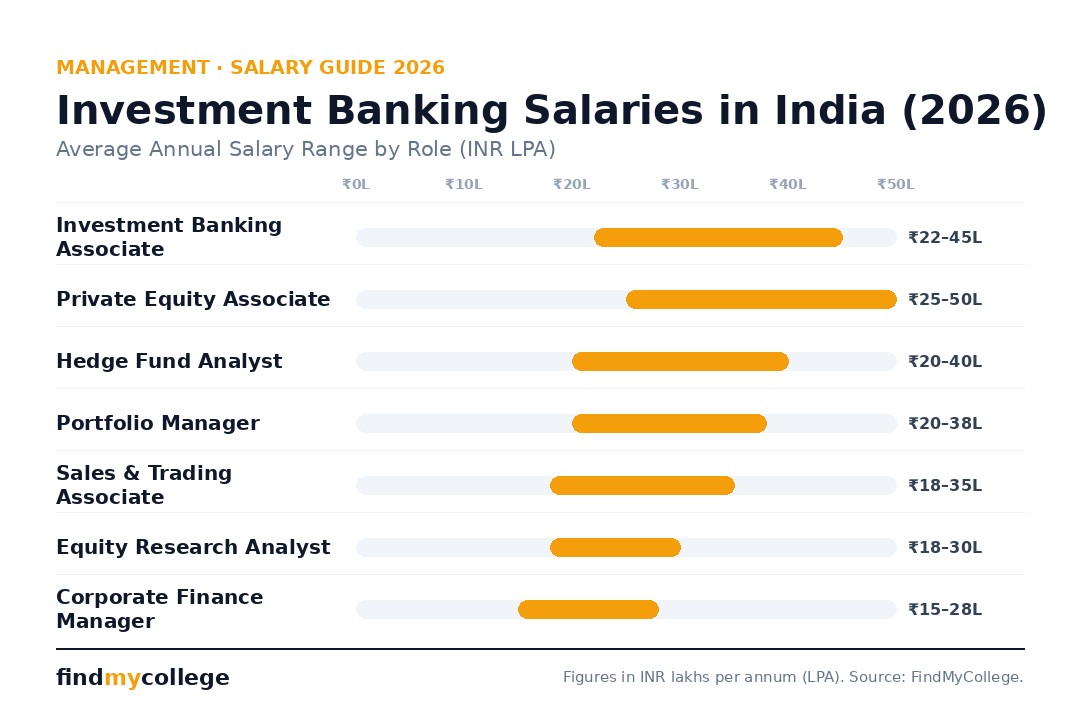
| Role | Description | Average Annual Salary Range (INR LPA, 2026) |
|---|---|---|
| Investment Banking Associate | Involved in M&A, capital raising, financial modeling, valuation, and client presentations. | 22 – 45+ |
| Equity Research Analyst | Analyzes companies, industries, and economic trends to provide investment recommendations. | 18 – 30 |
| Portfolio Manager | Manages investment portfolios for clients or institutions, making buy/sell decisions. | 20 – 38 |
| Private Equity Associate | Evaluates investment opportunities, conducts due diligence, and monitors portfolio companies. | 25 – 50+ |
| Hedge Fund Analyst | Researches and analyzes investment strategies for hedge funds across various asset classes. | 20 – 40 |
| Sales & Trading Associate | Facilitates transactions for clients, provides market insights, and manages risk. | 18 – 35 |
| Corporate Finance Manager | Works within a corporation on financial strategy, M&A, capital structure, and treasury. | 15 – 28 |
How do MBA in Investment Banking salaries compare to other MBA specializations?
MBA in Investment Banking salaries are generally among the highest compared to other MBA specializations, especially for graduates from top-tier institutions. While consulting and product management also offer competitive packages, investment banking often leads in terms of starting compensation and bonus potential.
| MBA Specialization | Average Annual Salary Range (INR LPA, 2026) | Key Characteristics |
|---|---|---|
| Investment Banking | 18 – 35 (up to 50+ for top roles/firms) | High compensation, demanding hours, analytical rigor, deal-making focus. |
| Consulting | 16 – 30 | Problem-solving, strategy, client interaction, extensive travel, diverse industries. |
| Marketing | 10 – 22 | Brand management, sales, digital marketing, consumer insights, creative roles. |
| Finance (General) | 12 – 25 | Broader finance roles, corporate finance, financial planning, less specialized than IB. |
| Operations | 10 – 20 | Supply chain, logistics, process optimization, efficiency improvement. |
| Product Management | 15 – 28 | Tech-focused, product strategy, development lifecycle, cross-functional leadership. |
It’s important to note that while investment banking offers high financial rewards, it often comes with a demanding work-life balance, especially in the initial years.
Is an MBA in Investment Banking worth it for the salary and career prospects?
Yes, an MBA in Investment Banking is generally considered highly worth it for the salary and career prospects, particularly for individuals passionate about finance and willing to commit to a rigorous professional path. The significant financial compensation, rapid career progression, and exposure to high-stakes transactions make it an attractive option.
Beyond the immediate salary, an MBA in Investment Banking provides unparalleled networking opportunities, develops strong analytical and strategic thinking skills, and opens doors to senior leadership roles within investment banks, private equity firms, hedge funds, and corporate finance departments of large corporations. The specialized knowledge gained is highly valued across the financial industry.
What is the eligibility for MBA in Investment Banking programs in India?
The eligibility criteria for an MBA in Investment Banking in India typically include a bachelor’s degree with a minimum of 50-60% marks, a strong score in an entrance exam (CAT, XAT, GMAT, NMAT, SNAP), and often 2-5 years of relevant work experience. Some top programs may also require specific undergraduate backgrounds in commerce, economics, engineering, or science.
Key Eligibility Requirements:
- Bachelor’s Degree: A minimum of 3-4 years bachelor’s degree in any discipline from a recognized university, with at least 50% aggregate marks (45% for reserved categories).
- Entrance Exams: A valid score in national-level MBA entrance exams like CAT, XAT, GMAT, NMAT, or SNAP. Some colleges may conduct their own tests.
- Work Experience: While not always mandatory for all programs, 2-5 years of relevant work experience (especially in finance, consulting, or analytics) is highly preferred by top-tier institutions and can significantly boost your application.
- English Proficiency: Strong command of English, often assessed through the entrance exam or a separate test.
- Interview & GD: Successful performance in Group Discussions (GD) and Personal Interviews (PI) rounds.
How much does an MBA in Investment Banking cost in India?
The cost of an MBA in Investment Banking in India varies widely, ranging from INR 5 Lakhs to INR 30 Lakhs or more for the entire program. This cost depends heavily on whether you choose a government-funded institution or a private business school.
- Government Institutions (e.g., IIMs, FMS): Fees typically range from INR 12 Lakhs to INR 25 Lakhs for the two-year program. These institutions are highly subsidized and offer excellent ROI.
- Private Business Schools (e.g., ISB, XLRI, SPJIMR, NMIMS): Fees can range from INR 18 Lakhs to INR 30 Lakhs or even higher for premier private colleges.
- Other Private Colleges: Fees can be lower, starting from INR 5 Lakhs to INR 15 Lakhs, but the placement and salary outcomes might also be proportionally lower.
It’s crucial to factor in additional costs such as living expenses, study materials, and other miscellaneous charges when calculating the total investment.
What are the top recruiting companies for MBA in Investment Banking in India?
Top recruiting companies for MBA in Investment Banking in India include a mix of global bulge bracket firms, domestic investment banks, private equity firms, and consulting companies with strong financial advisory practices.
- Bulge Bracket Investment Banks: Goldman Sachs, Morgan Stanley, JP Morgan, Bank of America Merrill Lynch, Citi, Credit Suisse (now UBS), Deutsche Bank.
- Domestic Investment Banks: ICICI Securities, Axis Capital, Kotak Investment Banking, JM Financial, Edelweiss Financial Services.
- Private Equity Firms: Blackstone, KKR, Carlyle, Advent International, TPG Capital, Multiples Alternate Asset Management.
- Consulting Firms (Financial Advisory): McKinsey & Company, Boston Consulting Group (BCG), Bain & Company, Deloitte, EY, PwC, KPMG.
- Asset Management Companies: BlackRock, HDFC AMC, ICICI Prudential AMC.
- Hedge Funds: Various boutique hedge funds and prop trading firms.
Explore more on FindMyCollege
Related pages for MBA in Investment Banking aspirants on findmycollege.com:
Frequently Asked Questions
What is the typical career progression after an MBA in Investment Banking?
Typical career progression starts as an Investment Banking Associate, moving to Vice President (VP), then Director, and eventually Managing Director (MD). Each promotion brings increased responsibility, client interaction, and significantly higher compensation.
Are bonuses a significant part of the MBA in Investment Banking salary?
Yes, bonuses are a very significant part of the overall compensation in investment banking, often ranging from 50% to 150% of the base salary, especially for front-office roles in top firms. They are performance-based and tied to individual and firm performance.
Do I need a finance background to pursue an MBA in Investment Banking?
While a finance background can be advantageous, it is not strictly mandatory. Many successful investment bankers come from diverse backgrounds like engineering, economics, or even humanities. However, a strong aptitude for quantitative analysis and a genuine interest in finance are essential.
What skills are crucial for a high-paying job in Investment Banking?
Key skills include strong financial modeling and valuation, analytical thinking, attention to detail, communication and presentation skills, resilience, long working hours tolerance, and networking abilities.
What are the major entrance exams for MBA in Investment Banking in India?
The major entrance exams are CAT (Common Admission Test), XAT (Xavier Aptitude Test), GMAT (Graduate Management Admission Test – for international programs and some Indian schools like ISB), NMAT by GMAC, and SNAP (Symbiosis National Aptitude Test).
What is the return on investment (ROI) for an MBA in Investment Banking in India?
The ROI for an MBA in Investment Banking from a top-tier Indian institution is generally excellent, with graduates often recovering their tuition fees within 2-4 years due to high starting salaries and rapid career progression. For example, a program costing INR 20 Lakhs with a starting salary of INR 25 LPA offers a very strong ROI.