
Masters in Graphic Design Salary in India 2026
Nishit Kumar is a senior EdTech industry leader with over a decade of experience in building and scaling education platforms, shaping their product, content, and growth strategy. At…
Latest update: Masters in Graphic Design 2026 admissions & dates updated. Read more ›
Welcome to the comprehensive guide on Masters in Graphic Design salary in India for 2026. This page is designed for prospective students and parents seeking detailed information about career prospects, earning potential, and return on investment for a Master’s degree in Graphic Design in India. Understanding the salary landscape is crucial for making informed decisions about your higher education and career path in the dynamic design industry.
What is the average salary after a Masters in Graphic Design in India?
The average starting salary for a Masters in Graphic Design graduate in India typically ranges from INR 4.5 LPA to INR 8 LPA. This figure can vary significantly based on factors such as the reputation of the institution, the student’s portfolio, specialization, location, and the type of company (e.g., startup, MNC, design agency).
With 2-5 years of experience, professionals can expect their salaries to increase to INR 8 LPA to INR 15 LPA, and for senior roles or specialized positions with over 5 years of experience, salaries can exceed INR 20 LPA, especially in leading design firms or tech companies.
Which specializations in Graphic Design lead to higher salaries?
Certain specializations within Graphic Design are currently in high demand and tend to command higher salaries due to their critical role in digital transformation and user experience. These include UI/UX Design, Motion Graphics, Interaction Design, and Brand Strategy.
- UI/UX Design: Focuses on creating intuitive and user-friendly interfaces and experiences for digital products. High demand in tech and product companies.
- Motion Graphics: Involves creating animated graphics for web, TV, and film. Essential for advertising, entertainment, and digital marketing.
- Interaction Design: A broader field encompassing UI/UX, focusing on the interaction between users and products.
- Brand Strategy & Identity: Involves developing comprehensive brand visual systems and strategies, crucial for corporate branding.
What are the top job roles and their expected salaries for Masters in Graphic Design graduates?
Graduates with a Masters in Graphic Design can pursue a variety of rewarding roles across different industries. The salary for each role is influenced by experience, company size, and location.
Entry-Level Roles (0-2 years experience)
- Junior Graphic Designer: INR 3.5 – 6 LPA
- UI Designer: INR 4.5 – 7.5 LPA
- UX Researcher/Designer: INR 5 – 8 LPA
- Motion Graphics Artist: INR 4 – 7 LPA
Mid-Level Roles (2-5 years experience)
- Senior Graphic Designer: INR 6 – 12 LPA
- Lead UI/UX Designer: INR 8 – 15 LPA
- Art Director (Junior): INR 7 – 13 LPA
- Product Designer: INR 9 – 16 LPA
Senior-Level Roles (5+ years experience)
- Design Manager: INR 12 – 20 LPA+
- Creative Director: INR 15 – 25 LPA+
- Head of Design/VP Design: INR 20 – 40 LPA+
- UX Lead/Architect: INR 18 – 30 LPA+
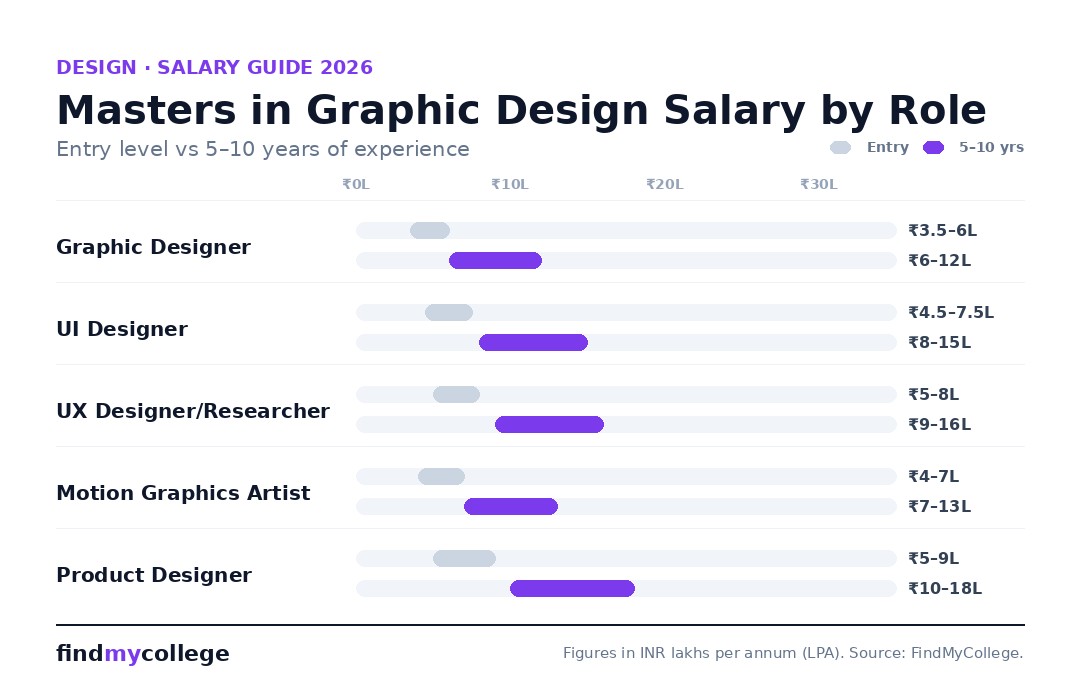
Here’s a table illustrating typical salary ranges for various roles:
| Job Role | Average Annual Salary (INR) – Entry Level (0-2 Yrs) | Average Annual Salary (INR) – Mid Level (2-5 Yrs) | Average Annual Salary (INR) – Senior Level (5+ Yrs) |
|---|---|---|---|
| Graphic Designer | 3.5 – 6 LPA | 6 – 12 LPA | 10 – 18 LPA |
| UI Designer | 4.5 – 7.5 LPA | 8 – 15 LPA | 15 – 25 LPA |
| UX Designer/Researcher | 5 – 8 LPA | 9 – 16 LPA | 18 – 30 LPA |
| Motion Graphics Artist | 4 – 7 LPA | 7 – 13 LPA | 12 – 20 LPA |
| Product Designer | 5 – 9 LPA | 10 – 18 LPA | 20 – 35 LPA |
| Art Director | N/A (typically mid-level+) | 7 – 13 LPA | 15 – 25 LPA |
People Also Read



How does the college reputation impact salary after a Masters in Graphic Design?
The reputation of the college significantly impacts the starting salary and career trajectory for Masters in Graphic Design graduates. Graduates from top-tier institutions often secure better placements, higher starting salaries, and access to a wider network of industry professionals.
Prestigious colleges often have strong industry ties, dedicated placement cells, and curricula that are updated to meet current industry demands. This leads to students being better prepared and more sought after by leading companies. For example, graduates from institutions like NID, IDC IIT Bombay, or Symbiosis Institute of Design typically command higher packages compared to those from lesser-known colleges.
Is a Masters in Graphic Design worth it for jobs and salary in India?
Yes, a Masters in Graphic Design is generally worth it for jobs and salary in India, especially for those looking to specialize, advance into leadership roles, or transition into high-demand areas like UI/UX and Product Design. While a Bachelor’s degree can get you an entry-level position, a Master’s degree provides deeper theoretical knowledge, advanced practical skills, and often a more sophisticated portfolio, which can lead to better job opportunities and higher earning potential.
The design industry in India is booming, driven by digital transformation, e-commerce, and the increasing importance of user experience. Companies are willing to pay a premium for skilled designers who can create impactful visual communication and intuitive digital products. A Master’s degree helps you stand out in a competitive market.
What is the return on investment (ROI) for a Masters in Graphic Design in India?
The Return on Investment (ROI) for a Masters in Graphic Design in India can be substantial, especially when considering the long-term career growth and increased earning potential. While the upfront cost of tuition can be significant, particularly for private institutions, the enhanced salary prospects and career advancement opportunities often justify the investment.
For instance, if a Master’s degree costs INR 5-15 Lakhs and leads to an average starting salary that is INR 2-4 LPA higher than a Bachelor’s degree holder, the investment can be recovered within 2-5 years, assuming consistent career progression. Furthermore, the skills acquired, networking opportunities, and potential for leadership roles contribute to a higher lifetime earning potential.
How does salary vary by city for Graphic Design professionals in India?
Salaries for Graphic Design professionals in India vary significantly by city, primarily due to the concentration of design studios, tech companies, and the overall cost of living. Major metropolitan areas with thriving tech and creative industries generally offer higher salaries.
- Tier-1 Cities (e.g., Bangalore, Mumbai, Delhi-NCR, Hyderabad, Pune): These cities are hubs for IT, startups, advertising, and e-commerce, leading to higher demand and better pay scales. Average salaries can be 15-30% higher than in Tier-2 cities.
- Tier-2 Cities (e.g., Chennai, Kolkata, Ahmedabad, Jaipur): While growing, these cities may offer slightly lower salaries compared to Tier-1 cities, but also come with a lower cost of living.
For example, a UI/UX Designer with 3 years of experience might earn INR 10-15 LPA in Bangalore, while a similar role in Ahmedabad might fetch INR 7-12 LPA.
What are the eligibility criteria for Masters in Graphic Design in India?
The general eligibility criteria for a Masters in Graphic Design (M.Des or M.A. in Graphic Design) in India typically include:
- Bachelor’s Degree: A Bachelor’s degree in Design (B.Des), Fine Arts (BFA), Architecture (B.Arch), or a related field from a recognized university. Some institutions may accept graduates from other disciplines with a strong portfolio and relevant work experience.
- Minimum Marks: A minimum aggregate score, usually 50-60%, in the Bachelor’s degree.
- Entrance Exams: Most top institutions require candidates to clear national-level design entrance exams such as CEED (Common Entrance Examination for Design) for IITs and IISc, or institutional-specific exams like NID DAT (for NID), UCEED (for some UCEED-accepting colleges), or Symbiosis Entrance Exam for Design (SEED) for Symbiosis.
- Portfolio: A strong portfolio showcasing design skills, creativity, and problem-solving abilities is often a mandatory requirement.
- Interview: Shortlisted candidates typically undergo a personal interview round.
Key Entrance Exams for M.Des 2026
| Exam Name | Conducting Body | Application Period (Tentative 2026) | Exam Date (Tentative 2026) | Accepting Colleges |
|---|---|---|---|---|
| CEED | IIT Bombay | Sept – Nov 2025 | Jan 2026 | IITs (Bombay, Delhi, Guwahati, Hyderabad, Kanpur, Roorkee), IISc Bangalore, IIITDM Jabalpur, etc. |
| NID DAT (M.Des) | National Institute of Design (NID) | Sept – Nov 2025 | Dec 2025 (Prelims), Apr 2026 (Mains) | All NID campuses |
| SEED (M.Des) | Symbiosis International University | Oct 2025 – Jan 2026 | Feb 2026 | Symbiosis Institute of Design (SID) |
Explore more on FindMyCollege
Related pages for Masters in Graphic Design aspirants on findmycollege.com:
Frequently Asked Questions
What is the difference between M.Des and MA in Graphic Design?
M.Des (Master of Design) is typically offered by design-focused institutions and IITs, emphasizing a more practical, research-oriented, and interdisciplinary approach to design. MA (Master of Arts) in Graphic Design is often offered by universities and may have a more theoretical or humanities-based approach, though practical components are still significant. M.Des is generally considered more industry-aligned for professional design roles.
Can I pursue a Masters in Graphic Design without a design background?
While most programs prefer a design background, some institutions may accept candidates from other disciplines (e.g., Engineering, Architecture, Fine Arts) if they can demonstrate strong creative aptitude through a compelling portfolio and relevant work experience. Bridging courses or foundation programs might be required.
Are there good scholarship opportunities for Masters in Graphic Design in India?
Scholarship opportunities exist, though they might be more limited compared to other fields. Some institutions offer merit-based scholarships, while others might have need-based financial aid. Government scholarships for specific categories (e.g., SC/ST/OBC) are also available. It’s best to check with individual colleges and government scholarship portals.
What skills are most important for a high-paying Graphic Design job?
Beyond core design principles and software proficiency, critical skills for high-paying jobs include UI/UX principles, user research, prototyping, motion graphics, branding strategy, design thinking, communication, problem-solving, and project management. A strong portfolio demonstrating these skills is paramount.
How important is a portfolio for Masters in Graphic Design admissions and jobs?
A portfolio is critically important for both admissions to a Masters in Graphic Design program and for securing jobs afterward. It serves as a visual resume, showcasing your skills, creativity, design process, and problem-solving abilities. For admissions, it helps evaluators assess your potential; for jobs, it’s often the primary factor in hiring decisions.
What are the career prospects for freelance Graphic Designers after a Master’s degree?
A Master’s degree can significantly boost career prospects for freelance Graphic Designers. It provides advanced skills, a stronger portfolio, and credibility, allowing freelancers to command higher rates, attract more prestigious clients, and specialize in niche, high-value areas like UI/UX consulting, brand strategy, or motion graphics for corporate clients. Networking opportunities from the program also help in client acquisition.
What is the typical duration of a Masters in Graphic Design program in India?
Most Masters in Graphic Design (M.Des or MA) programs in India are two years in duration, typically spread across four semesters. Some specialized postgraduate diplomas might be shorter, but a full Master’s degree generally follows the two-year structure.