Master of Public Administration (MPA) India 2026: Overview
Nishit Kumar is a senior EdTech industry leader with over a decade of experience in building and scaling education platforms, shaping their product, content, and growth strategy. At…
Latest update: Master of Public Administration 2026 admissions & dates updated. Read more ›
Welcome to the comprehensive overview of the Master of Public Administration (MPA) program in India for the academic year 2026. This page is designed for prospective students and parents seeking detailed information about this postgraduate degree, which prepares individuals for leadership and management roles in public service, non-profit organizations, and international agencies. An MPA equips graduates with critical analytical, managerial, and policy-making skills essential for addressing complex societal challenges.
What is a Master of Public Administration (MPA)?
A Master of Public Administration (MPA) is a postgraduate professional degree in public policy and administration, focusing on the practical application of theory to real-world public service challenges. Unlike an MBA, which emphasizes private sector management, an MPA specifically targets the unique complexities of governance, public finance, policy analysis, and ethical leadership within governmental and non-governmental organizations.
What is the eligibility for Master of Public Administration in India?
The general eligibility for a Master of Public Administration (MPA) in India requires a bachelor’s degree from a recognized university, typically with a minimum aggregate score. While specific percentages vary by institution, most universities look for candidates with a strong academic background and often prefer those with some relevant work experience.
- Academic Qualification: A Bachelor’s degree (e.g., BA, B.Sc, B.Com, B.Tech) in any discipline from a recognized Indian or foreign university.
- Minimum Marks: Generally, a minimum of 50-60% aggregate marks in the qualifying bachelor’s degree is required. Some top institutions might have higher cut-offs.
- Work Experience: While not always mandatory, many premier institutions and executive MPA programs highly value 2-5 years of work experience in government, NGOs, or related sectors. This can sometimes compensate for a slightly lower academic percentage.
- Entrance Exams: Admission often requires qualifying in national-level or university-specific entrance examinations, followed by group discussions and personal interviews.
What are the common specializations offered in MPA programs?
MPA programs in India offer various specializations to cater to diverse career interests within the public sector. These specializations allow students to deepen their expertise in specific areas of public policy and management.
- Public Policy Analysis: Focuses on evaluating, formulating, and implementing public policies.
- Urban and Regional Planning: Deals with the management and development of urban areas and regions.
- Development Studies: Concentrates on socio-economic development, poverty alleviation, and sustainable growth.
- Human Resource Management in Public Sector: Specializes in managing personnel within government and public organizations.
- Financial Management in Public Sector: Covers public budgeting, financial accountability, and resource allocation.
- Health Policy and Management: Addresses challenges in public health systems and healthcare delivery.
- Environmental Policy and Management: Focuses on environmental governance, sustainability, and climate change policies.
How much does a Master of Public Administration cost in India (2026)?
The cost of a Master of Public Administration (MPA) in India varies significantly based on the type of institution (government vs. private) and its reputation. Government-funded universities generally offer more affordable programs compared to private institutions.
Here’s an estimated fee range for MPA programs in India for 2026:
| Institution Type | Annual Fee Range (INR) | Total Program Fee (INR, 2 years) |
|---|---|---|
| Government Universities/Institutes | ₹20,000 – ₹1,50,000 | ₹40,000 – ₹3,00,000 |
| Private Universities/Institutes | ₹1,00,000 – ₹5,00,000+ | ₹2,00,000 – ₹10,00,000+ |
These figures are indicative and may not include additional costs like hostel fees, examination fees, and study materials.
What is the admission process for MPA in India for 2026?
The admission process for MPA programs in India typically involves several stages, including application submission, entrance examinations, and subsequent selection rounds. Key dates for 2026 admissions will generally fall within the following periods:
- Application Period: December 2025 – March 2026 (for most institutions).
- Entrance Exams: March – May 2026.
- Results & Interviews: May – June 2026.
- Admissions & Classes Begin: July – August 2026.
Common Entrance Exams for MPA in India
Many universities conduct their own entrance exams, while some accept scores from national-level tests. Some prominent exams include:
- TISSNET: For Tata Institute of Social Sciences (TISS) programs, including Public Policy and Governance.
- JNU Entrance Exam: For Jawaharlal Nehru University’s MPA-related courses.
- DUET: Delhi University Entrance Test for various postgraduate programs.
- University-Specific Exams: Many state and private universities conduct their own aptitude tests.
Typical Exam Pattern
Entrance exams usually assess a candidate’s general aptitude, analytical skills, and awareness of current affairs. A common pattern includes:
| Section | Typical Topics | Weightage (Approx.) |
|---|---|---|
| General Knowledge & Current Affairs | Politics, Economy, Social Issues, International Relations | 25-30% |
| Logical Reasoning & Data Interpretation | Puzzles, Series, Charts, Graphs | 20-25% |
| Quantitative Aptitude | Arithmetic, Algebra, Geometry (up to 10th standard) | 20-25% |
| English Language & Comprehension | Grammar, Vocabulary, Reading Comprehension | 20-25% |
Is Master of Public Administration worth it for jobs in India?
Yes, a Master of Public Administration (MPA) is highly worth it for individuals aspiring to impactful careers in public service and related sectors in India. The degree provides specialized skills and knowledge that are in high demand for roles in government, NGOs, international organizations, and corporate social responsibility (CSR) departments.
Career Prospects and Salary Outcomes
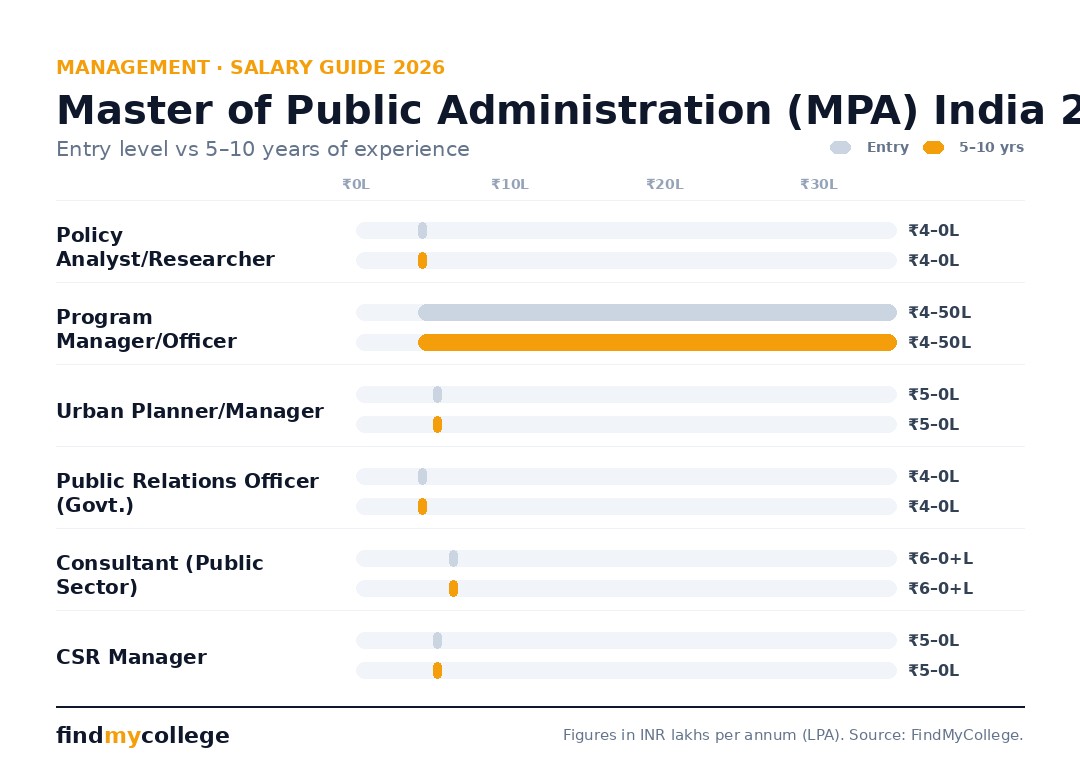
MPA graduates in India find diverse career opportunities. The salary depends on the sector, organization, experience, and specific role. Here’s an overview of potential roles and salary ranges:
| Job Role | Typical Employers | Average Annual Salary Range (INR) – Entry to Mid-level |
|---|---|---|
| Policy Analyst/Researcher | Think Tanks, Government Ministries, Research Institutions | ₹4,00,000 – ₹8,00,000 |
| Program Manager/Officer | NGOs, International Development Agencies, Government Schemes | ₹4,50,000 – ₹9,00,000 |
| Urban Planner/Manager | Municipal Corporations, Urban Development Authorities | ₹5,00,000 – ₹10,00,000 |
| Public Relations Officer (Govt.) | Government Departments, Public Sector Undertakings (PSUs) | ₹4,00,000 – ₹7,50,000 |
| Consultant (Public Sector) | Consulting Firms (e.g., PwC, Deloitte, KPMG – public sector advisory) | ₹6,00,000 – ₹12,00,000+ |
| CSR Manager | Large Corporations | ₹5,00,000 – ₹10,00,000 |
Graduates can also pursue civil services (UPSC, State PSCs) with enhanced understanding of governance and public policy.
MPA vs. MBA: Which is better for a career in India?
The choice between an MPA and an MBA depends entirely on your career aspirations. An MPA (Master of Public Administration) is better suited for those aiming for careers in public service, non-profit management, policy analysis, and social impact, while an MBA (Master of Business Administration) is ideal for individuals seeking leadership roles in the private corporate sector, focusing on profit generation and business strategy.
Key Differences: MPA vs. MBA
| Feature | Master of Public Administration (MPA) | Master of Business Administration (MBA) |
|---|---|---|
| Primary Focus | Public service, policy, governance, social impact | Private sector management, profit, business strategy |
| Core Subjects | Public Policy, Public Finance, Ethics, Program Evaluation, Urban Planning, Development Studies | Marketing, Finance, Operations, HR, Strategy, Entrepreneurship |
| Career Paths | Government, NGOs, Think Tanks, International Organizations, CSR | Consulting, Investment Banking, Marketing, Product Management, Entrepreneurship |
| Skills Developed | Policy analysis, public budgeting, program management, ethical leadership, advocacy | Financial analysis, market strategy, team leadership, operational efficiency, negotiation |
| Value Proposition | Solving societal problems, public good, community development | Maximizing shareholder value, business growth, competitive advantage |
What are the top colleges for MPA in India?
Several reputable institutions in India offer excellent Master of Public Administration or closely related programs. These colleges are known for their strong faculty, research output, and industry connections.
- Tata Institute of Social Sciences (TISS), Mumbai: Offers MA in Public Policy and Governance, known for its strong social science foundation.
- Jawaharlal Nehru University (JNU), Delhi: Offers MA in Politics with specialization in International Relations, Public Administration, etc.
- Indian Institute of Public Administration (IIPA), Delhi: A premier institution specifically dedicated to public administration training and research.
- University of Delhi (DU): Offers MA in Public Administration through various colleges.
- TERI School of Advanced Studies, Delhi: Offers MA in Public Policy and Sustainable Development.
- Azim Premji University, Bengaluru: Offers MA in Public Policy and Governance, with a strong focus on social justice.
- OP Jindal Global University, Sonipat: Offers MA in Public Policy.
- Symbiosis School of Economics, Pune: Offers M.Sc. in Economics with a strong public policy component.
Frequently Asked Questions
Can I pursue MPA after any bachelor’s degree?
Yes, most MPA programs in India accept graduates from any discipline (Arts, Science, Commerce, Engineering) as long as they meet the minimum aggregate marks and clear the entrance examinations. A diverse academic background is often seen as an asset.
Is an MPA equivalent to an MBA for government jobs?
No, an MPA is not equivalent to an MBA for government jobs in terms of its focus, but it is often more relevant. While an MBA focuses on business management, an MPA directly prepares individuals for administrative and policy roles within government, making it highly suitable for public sector careers and civil services.
Are there distance learning or online MPA programs available in India?
Yes, some universities and institutions offer distance learning or online MPA programs. These are particularly beneficial for working professionals who wish to upgrade their skills without leaving their current jobs. Always check the accreditation and recognition of such programs.
What is the typical duration of an MPA program in India?
The typical duration for a full-time Master of Public Administration (MPA) program in India is two years, divided into four semesters. Part-time or executive MPA programs might have slightly different durations.
Do MPA programs include internships?
Yes, most reputable MPA programs include a mandatory internship component, usually during the summer break between the first and second years. Internships provide practical exposure to government departments, NGOs, think tanks, or international organizations, which is crucial for career development.
What skills will I gain from an MPA?
An MPA program develops a wide range of critical skills, including policy analysis, program evaluation, public budgeting and financial management, ethical leadership, strategic planning, data analysis, communication, and stakeholder engagement, all tailored for the public and non-profit sectors.