
Master of Public Health (MPH) India 2026: Comprehensive Overview
Nishit Kumar is a senior EdTech industry leader with over a decade of experience in building and scaling education platforms, shaping their product, content, and growth strategy. At…
Latest update: Master of Public Health 2026 admissions & dates updated. Read more ›
Welcome to the comprehensive overview of the Master of Public Health (MPH) program in India for 2026. This page is designed to provide prospective students and their parents with a detailed understanding of this crucial postgraduate degree, addressing common questions and offering insights into its structure, benefits, and career outcomes. The MPH is a globally recognized professional degree for those seeking to make a significant impact on community health, disease prevention, and health policy.
What is a Master of Public Health (MPH)?
A Master of Public Health (MPH) is a postgraduate professional degree designed to train students in various aspects of public health, focusing on preventing disease, promoting health, and prolonging life among populations. It equips graduates with the knowledge and skills to address complex health challenges at local, national, and global levels, encompassing areas like epidemiology, biostatistics, environmental health, health policy, and social and behavioral sciences.
The MPH curriculum typically blends theoretical knowledge with practical application, often including fieldwork, internships, and capstone projects. It prepares professionals for leadership roles in government health agencies, non-governmental organizations (NGOs), international health bodies, research institutions, and the private sector.
What is the eligibility for Master of Public Health (MPH) in India?
To be eligible for an MPH program in India, candidates generally need a bachelor’s degree in a health-related field, though some programs accept graduates from other disciplines with relevant work experience. Specific requirements can vary significantly between institutions.
General Eligibility Criteria:
- Educational Qualification: A bachelor’s degree (MBBS, BDS, BAMS, BHMS, BPT, BOT, BSc Nursing, BVSc, BPharm, Life Sciences, Social Sciences, Statistics, or equivalent) from a recognized university. Some universities may also accept B.Tech/BE graduates with relevant experience.
- Minimum Marks: Typically, a minimum of 50-60% aggregate marks in the qualifying bachelor’s degree is required.
- Work Experience: While not always mandatory, 1-2 years of relevant work experience in the health sector (e.g., clinical, public health, research, community development) is highly preferred by many top institutions and can strengthen an application significantly. Some programs may even mandate it.
- Entrance Exams: Many prominent universities conduct their own entrance examinations (e.g., TISSNET for TISS, university-specific tests) or consider national-level scores.
- English Proficiency: For international students or those from non-English medium backgrounds, IELTS/TOEFL scores might be required.
How long is the Master of Public Health (MPH) program in India?
The Master of Public Health (MPH) program in India is typically a two-year, full-time postgraduate degree, structured into four semesters. Some institutions might offer part-time or executive MPH programs with a longer duration (e.g., 3-4 years).
What are the common specializations available in MPH?
MPH programs in India offer a range of specializations, allowing students to focus on specific areas of public health that align with their career interests. These specializations equip graduates with targeted expertise.
Key MPH Specializations:
- Epidemiology: Focuses on the study of disease patterns, causes, and effects in human populations.
- Biostatistics: Involves the application of statistical methods to biological and health-related data.
- Health Policy and Management: Deals with the development, implementation, and evaluation of health policies and the management of health systems.
- Environmental Health: Examines the impact of environmental factors on human health and strategies for prevention.
- Social and Behavioral Sciences: Explores the social, cultural, and behavioral determinants of health and disease.
- Global Health: Addresses health issues that transcend national borders and require international cooperation.
- Maternal and Child Health: Focuses on health issues affecting women, infants, children, and adolescents.
- Health Promotion and Education: Concentrates on designing and implementing programs to improve health behaviors.
- Nutrition and Public Health: Integrates nutritional science with public health principles to address dietary challenges.
How much does Master of Public Health (MPH) cost in India?
The cost of an MPH program in India varies significantly based on the type of institution (government vs. private), its reputation, and the specific program structure. Fees can range from very affordable at government-funded universities to substantially higher at private institutions.
MPH Fee Ranges (Annual, 2026 Estimates):
| Institution Type | Annual Fee Range (INR) | Key Considerations |
|---|---|---|
| Government/Public Universities (e.g., AIIMS, JIPMER, TISS, central universities) | ₹20,000 – ₹1,50,000 | Highly subsidized, competitive admission, excellent faculty, often includes hostel fees. |
| Private Universities/Institutes (e.g., Manipal, SRM, Amrita, Symbiosis) | ₹1,50,000 – ₹6,00,000+ | Higher fees, diverse specializations, potentially better infrastructure, varying placement support. |
| International Collaborations/Executive Programs | ₹5,00,000 – ₹10,00,000+ | Premium programs, often for working professionals, may include international modules. |
Additional costs include hostel fees (if applicable), study materials, examination fees, and living expenses, which can add ₹50,000 – ₹2,00,000 annually depending on the city.
What is the admission process for MPH in India for 2026?
The admission process for MPH programs in India typically involves an application, an entrance examination, and often an interview or group discussion. Key dates and specific steps vary by institution.
General Admission Process Steps:
- Research Programs: Identify universities offering MPH programs and specializations of interest.
- Check Eligibility: Verify specific academic and work experience requirements for each chosen program.
- Application Submission: Complete the online application form, submitting required documents (transcripts, certificates, statement of purpose, letters of recommendation, work experience certificates).
- Entrance Examination: Prepare for and appear in the university’s entrance exam (e.g., TISSNET, university-specific tests). Some institutions may accept GATE scores or have their own aptitude tests.
- Group Discussion (GD) / Personal Interview (PI): Shortlisted candidates are invited for GD/PI rounds to assess communication skills, subject knowledge, and motivation.
- Merit List & Admission Offer: Final selection is based on a composite score from academic performance, entrance exam, GD/PI, and sometimes work experience.
- Fee Payment & Enrollment: Secure admission by paying the first installment of fees and completing enrollment formalities.
Tentative 2026 Admission Timeline:
| Activity | Tentative Months (2025-2026) | Notes |
|---|---|---|
| Application Window | October – January | Varies by university; some open earlier. |
| Entrance Exams | January – March | Specific dates announced by each institution. |
| GD/PI Rounds | March – April | Conducted for shortlisted candidates. |
| Merit List & Offers | May – June | Final results declared. |
| Admission & Enrollment | June – July | Fee payment and document verification. |
| Classes Begin | July – August | Academic session commences. |
Is Master of Public Health (MPH) worth it for jobs in India? What are the career prospects?
Yes, a Master of Public Health (MPH) is highly worth it for jobs in India, especially given the increasing focus on public health infrastructure, disease prevention, and health policy. Graduates are in demand across various sectors, addressing critical health challenges.
Career Prospects and Job Roles:
MPH graduates can pursue diverse and impactful careers. The demand for public health professionals has surged, particularly in light of global health crises, making it a highly relevant and rewarding field.
- Epidemiologist: Investigates disease outbreaks, patterns, and causes.
- Biostatistician: Designs studies, analyzes health data, and interprets results.
- Health Program Manager/Officer: Plans, implements, and evaluates public health programs.
- Public Health Consultant: Advises organizations on health strategies and policies.
- Health Educator/Promoter: Develops and delivers health awareness campaigns.
- Research Scientist/Associate: Conducts research in public health, clinical trials, or policy.
- Policy Analyst: Evaluates health policies and advocates for evidence-based changes.
- Environmental Health Specialist: Assesses and manages environmental risks to public health.
- Monitoring and Evaluation (M&E) Officer: Tracks the progress and impact of health interventions.
Top Employers:
- Government Health Departments (Central & State)
- World Health Organization (WHO), UNICEF, UNAIDS, World Bank
- NGOs (e.g., Bill & Melinda Gates Foundation, Doctors Without Borders, PATH)
- Research Institutions (e.g., ICMR, PHFI, various university research centers)
- Hospitals and Healthcare Systems
- Pharmaceutical Companies and CROs (Contract Research Organizations)
- Corporate Social Responsibility (CSR) arms of private companies
- Academic Institutions (teaching and research)
What is the average salary after MPH in India?
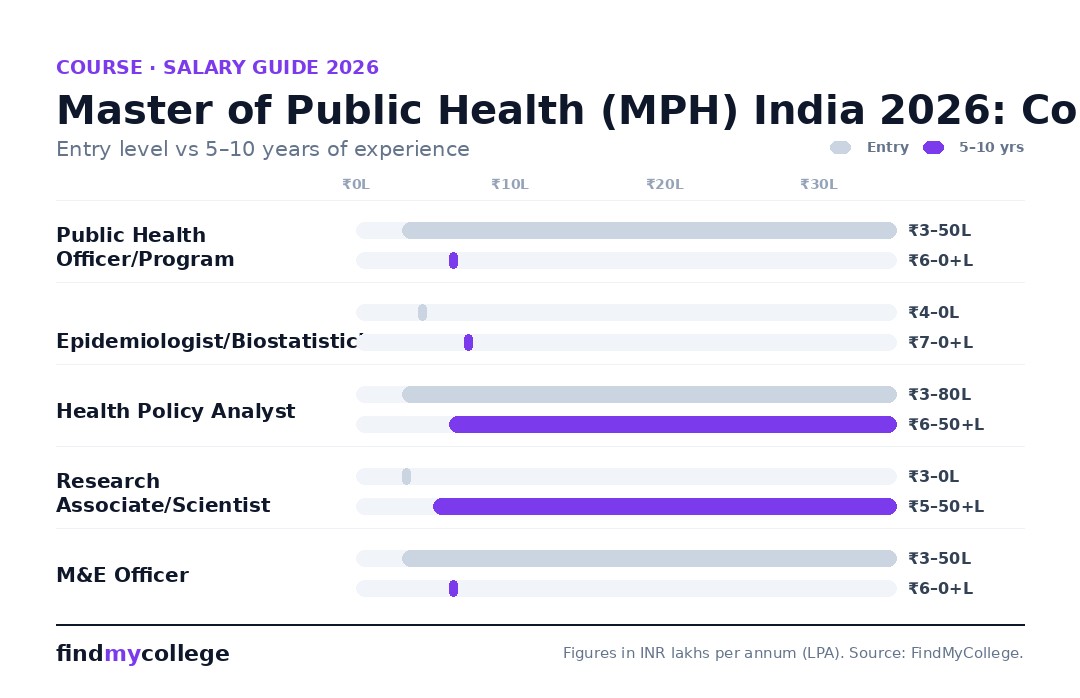
The average salary after an MPH in India varies based on experience, specialization, employer type, and location. Entry-level salaries can range from ₹3.5 LPA to ₹6 LPA, while experienced professionals can earn significantly more.
Average Salary Ranges by Role (Annual, 2026 Estimates):
| Job Role | Entry-Level Salary (INR) | Mid-Career Salary (INR) |
|---|---|---|
| Public Health Officer/Program Manager | ₹3,50,000 – ₹5,50,000 | ₹6,00,000 – ₹12,00,000+ |
| Epidemiologist/Biostatistician | ₹4,00,000 – ₹6,00,000 | ₹7,00,000 – ₹15,00,000+ |
| Health Policy Analyst | ₹3,80,000 – ₹5,80,000 | ₹6,50,000 – ₹13,00,000+ |
| Research Associate/Scientist | ₹3,00,000 – ₹5,00,000 | ₹5,50,000 – ₹10,00,000+ |
| M&E Officer | ₹3,50,000 – ₹5,00,000 | ₹6,00,000 – ₹11,00,000+ |
Salaries in international organizations (WHO, UNICEF) or top-tier private consultancies can be substantially higher, often starting from ₹8-10 LPA for entry-level roles.
MPH vs. MHA: Which is better?
The choice between MPH (Master of Public Health) and MHA (Master of Hospital Administration) depends entirely on your career aspirations. MPH focuses on population health and disease prevention, while MHA focuses on the management of healthcare facilities.
Comparison Table: MPH vs. MHA
| Feature | Master of Public Health (MPH) | Master of Hospital Administration (MHA) |
|---|---|---|
| Primary Focus | Population health, disease prevention, health promotion, policy, community health. | Management and administration of hospitals and healthcare organizations. |
| Scope | Macro-level health issues, public health systems, global health. | Micro-level operations, hospital efficiency, patient care delivery, financial management. |
| Typical Roles | Epidemiologist, Health Program Manager, Policy Analyst, Biostatistician, Community Health Worker. | Hospital Administrator, Healthcare Manager, Operations Manager, Quality Assurance Manager. |
| Employers | Government health agencies, NGOs, international organizations, research institutes, public health departments. | Hospitals (private & public), clinics, healthcare consulting firms, insurance companies. |
| Skills Developed | Epidemiological analysis, policy formulation, health communication, research methods, community engagement. | Financial management, human resource management, healthcare operations, strategic planning, quality improvement. |
If your passion lies in improving health outcomes for entire communities, preventing diseases, and influencing health policy, MPH is the ideal choice. If you are interested in the operational and administrative aspects of running healthcare facilities, MHA would be more suitable.
Frequently Asked Questions
Is an MPH degree recognized globally?
Yes, an MPH degree from a reputable institution in India is generally recognized globally. Many Indian universities follow international standards, and the core curriculum aligns with global public health competencies, facilitating opportunities for graduates to work internationally.
Can I pursue an MPH after a non-medical background?
Yes, many MPH programs in India accept graduates from non-medical backgrounds such as social sciences, statistics, life sciences, and even engineering, provided they meet specific academic criteria and sometimes have relevant work experience. It’s crucial to check individual university requirements.
What is the difference between an MPH and an MSc in Public Health?
An MPH is typically a professional degree focused on practical application and leadership in public health practice, often requiring fieldwork or internships. An MSc in Public Health is generally more research-oriented and academic, focusing on developing research skills and theoretical knowledge in a specific public health discipline.
Are there any scholarships available for MPH in India?
Yes, various scholarships are available for MPH students in India. These can be offered by government bodies (e.g., UGC, ICMR), universities themselves, NGOs, and international organizations. It’s advisable to check the websites of prospective universities and funding agencies for specific scholarship opportunities and deadlines.
What are the key skills required to succeed in an MPH program?
Key skills for success in an MPH program include strong analytical and critical thinking abilities, good communication skills, teamwork, problem-solving, research aptitude, and a genuine interest in public health issues. Basic statistical knowledge can also be very beneficial.
Can I do an MPH part-time while working?
Some universities and institutions in India offer part-time or executive MPH programs designed for working professionals. These programs often have flexible schedules, such as evening classes or weekend modules, to accommodate those who wish to continue their employment while studying.