
Master of Surgery (MS) in Ophthalmology India 2026 Overview
Nishit Kumar is a senior EdTech industry leader with over a decade of experience in building and scaling education platforms, shaping their product, content, and growth strategy. At…
Latest update: Master of Surgery in Ophthalmology 2026 admissions & dates updated. Read more ›
Welcome to the comprehensive overview of the Master of Surgery (MS) in Ophthalmology program in India for the academic year 2026. This page is designed to provide aspiring medical professionals and their families with all the essential information needed to understand this specialized postgraduate medical degree, which focuses on the diagnosis, treatment, and prevention of diseases and disorders of the eye.
What is Master of Surgery (MS) in Ophthalmology?
Master of Surgery (MS) in Ophthalmology is a three-year postgraduate medical degree in India that trains doctors to become specialized eye surgeons and ophthalmologists. The program provides in-depth knowledge and practical skills in medical and surgical management of ocular conditions, preparing graduates for a career dedicated to eye care.
This advanced degree covers a wide spectrum of eye health, from common refractive errors to complex surgical procedures for cataracts, glaucoma, retinal detachments, and corneal transplants. Students gain expertise through a rigorous curriculum combining theoretical knowledge, clinical rotations, surgical training, and research.
What is the Eligibility for Master of Surgery (MS) in Ophthalmology in India 2026?
To be eligible for MS Ophthalmology in India for the 2026 academic year, candidates must possess an MBBS degree from a recognized medical college and complete a compulsory rotating internship. Additionally, they must qualify for a national-level entrance examination, typically NEET-PG.
Detailed Eligibility Criteria:
- Educational Qualification: Candidates must hold an MBBS degree awarded by a university or institution recognized by the Medical Council of India (MCI) / National Medical Commission (NMC).
- Internship: Completion of a compulsory one-year rotating internship by the specified cut-off date (usually around March 31st of the admission year).
- Permanent/Provisional Registration: Candidates must have permanent or provisional registration with the MCI/NMC or a State Medical Council.
- Entrance Examination: Qualification in the National Eligibility cum Entrance Test (Postgraduate) – NEET-PG 2026, or other state/institutional-specific entrance exams if applicable (though NEET-PG is the primary gateway).
- Minimum Marks: General category candidates typically need to secure a minimum of 50th percentile in NEET-PG, while SC/ST/OBC candidates require a 40th percentile, and PwD candidates need a 45th percentile.
What is the Admission Process for MS Ophthalmology in India 2026?
The admission process for MS Ophthalmology in India for 2026 primarily involves appearing for NEET-PG, followed by centralized counseling based on merit. Candidates will then choose their preferred colleges and specializations based on their rank and seat availability.
Step-by-Step Admission Process:
- NEET-PG Application: Apply for NEET-PG 2026 online, typically between October and November 2025.
- NEET-PG Examination: Appear for NEET-PG 2026, usually held in January or February 2026.
- NEET-PG Result: Results are declared, generally in March 2026.
- Counseling Registration: Register for All India Quota (AIQ) counseling conducted by the Medical Counselling Committee (MCC) and/or State Quota counseling conducted by respective state authorities. This usually begins in April/May 2026.
- Choice Filling & Locking: Based on their NEET-PG rank, candidates fill in their choices of colleges and specializations.
- Seat Allotment: Seats are allotted in multiple rounds based on merit, choices, and reservation policies.
- Reporting to College: Candidates who are allotted a seat must report to the respective college for document verification and admission formalities within the stipulated timeframe.
How Much Does Master of Surgery (MS) in Ophthalmology Cost in India 2026?
The cost of pursuing MS Ophthalmology in India for 2026 varies significantly, ranging from approximately INR 50,000 to INR 25 Lakhs per annum, depending on whether the institution is government-funded or private. Government colleges offer significantly lower fees due to subsidies, while private colleges and deemed universities have higher fee structures.
MS Ophthalmology Fee Ranges (Annual, 2026 Estimates):
| Institution Type | Approximate Annual Fees (INR) | Additional Costs (Hostel, Exam, etc.) |
|---|---|---|
| Government Medical Colleges | INR 50,000 – INR 3,00,000 | INR 10,000 – INR 50,000 |
| Private Medical Colleges | INR 8,00,000 – INR 25,00,000 | INR 50,000 – INR 2,00,000 |
| Deemed Universities | INR 15,00,000 – INR 35,00,000 | INR 75,000 – INR 2,50,000 |
These figures are indicative and can vary. Some private institutions may also have management quota seats with even higher fees.
What is the Syllabus and Course Structure for MS Ophthalmology?
The MS Ophthalmology syllabus is comprehensive, covering all aspects of ocular anatomy, physiology, pathology, pharmacology, and clinical and surgical ophthalmology over three years. The course structure typically includes didactic lectures, clinical postings, surgical training, seminars, journal clubs, and a mandatory thesis/dissertation.
Typical MS Ophthalmology Syllabus Overview (Year-wise):
| Year | Key Subjects/Focus Areas |
|---|---|
| Year 1 |
|
| Year 2 |
|
| Year 3 |
|
Is Master of Surgery (MS) in Ophthalmology Worth It for Jobs and Career Prospects?
Yes, MS Ophthalmology is highly worth it for robust job prospects and a rewarding career, as there is a consistent demand for skilled ophthalmologists in India and globally. Graduates can pursue diverse roles in clinical practice, surgery, academia, and research, with excellent earning potential.
Career Paths and Job Roles:
- Consultant Ophthalmologist: Working in private hospitals, government hospitals, or setting up independent practice.
- Ophthalmic Surgeon: Specializing in specific surgical areas like cataract, retina, glaucoma, or refractive surgery.
- Academician/Professor: Teaching and conducting research in medical colleges and universities.
- Research Scientist: Contributing to advancements in ocular medicine and surgery.
- Public Health Ophthalmologist: Working with NGOs or government programs for community eye health.
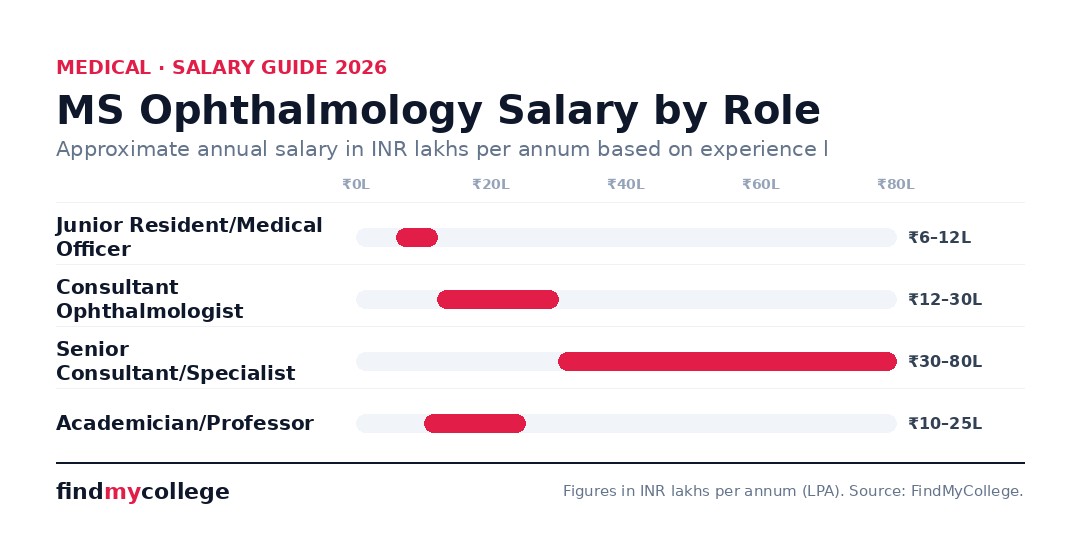
Average Salary for MS Ophthalmology Graduates in India (Annual, 2026 Estimates):
Salaries vary based on experience, location, type of employer (government vs. private), and sub-specialization.
| Job Role | Experience Level | Approximate Annual Salary (INR) |
|---|---|---|
| Junior Resident/Medical Officer | 0-2 Years (Post-MS) | INR 6,00,000 – INR 12,00,000 |
| Consultant Ophthalmologist | 3-7 Years | INR 12,00,000 – INR 30,00,000 |
| Senior Consultant/Specialist Surgeon | 8+ Years | INR 30,00,000 – INR 80,00,000+ |
| Academician/Professor | Varies | INR 10,00,000 – INR 25,00,000 |
What are the Top Colleges for MS Ophthalmology in India?
Several prestigious medical colleges and institutions across India offer excellent MS Ophthalmology programs, known for their robust clinical training, research facilities, and experienced faculty. These include both government and private institutions.
Some of the highly-regarded institutions include:
- All India Institute of Medical Sciences (AIIMS), New Delhi
- Postgraduate Institute of Medical Education and Research (PGIMER), Chandigarh
- Jawaharlal Institute of Postgraduate Medical Education and Research (JIPMER), Puducherry
- Maulana Azad Medical College (MAMC), New Delhi
- Seth G.S. Medical College and KEM Hospital, Mumbai
- Christian Medical College (CMC), Vellore
- Armed Forces Medical College (AFMC), Pune
- King George’s Medical University (KGMU), Lucknow
- Grant Medical College and Sir J.J. Group of Hospitals, Mumbai
- Institute of Ophthalmology, Joseph Eye Hospital, Tiruchirappalli
What are the Pros and Cons of Pursuing MS Ophthalmology?
MS Ophthalmology offers a highly rewarding career with excellent earning potential and the ability to significantly impact patients’ quality of life, but it demands rigorous training, long hours, and continuous learning.
Pros:
- High Demand: Constant need for eye care specialists due to increasing prevalence of eye diseases.
- Rewarding Career: Ability to restore or preserve vision, directly improving patients’ lives.
- Good Earning Potential: Ophthalmologists are among the highest-paid medical specialists.
- Diverse Practice Options: Can work in hospitals, private clinics, academia, or research.
- Technologically Advanced Field: Constant innovation in diagnostic tools and surgical techniques keeps the field exciting.
- Work-Life Balance (Post-Residency): Generally better than some other surgical specialties once established.
Cons:
- Highly Competitive: Admission to MS Ophthalmology programs is extremely competitive.
- Demanding Residency: Long hours, intense clinical and surgical training, and significant academic pressure during the three years.
- High Cost of Education: Especially in private institutions.
- Continuous Learning: Requires ongoing education and skill upgrades due to rapid advancements in the field.
- Precision and Responsibility: Eye surgery demands extreme precision, and errors can have severe consequences.
What is the difference between MS Ophthalmology and DNB Ophthalmology?
Both MS Ophthalmology and DNB Ophthalmology are postgraduate medical degrees that qualify doctors to practice as ophthalmologists, but they differ primarily in their awarding body, examination structure, and institutional affiliation. MS is awarded by universities, while DNB is awarded by the National Board of Examinations (NBE).
MS vs. DNB Ophthalmology Comparison:
| Feature | MS (Master of Surgery) Ophthalmology | DNB (Diplomate of National Board) Ophthalmology |
|---|---|---|
| Awarding Body | Recognized Universities (e.g., Delhi University, MUHS) | National Board of Examinations (NBE) |
| Institutions | Medical Colleges affiliated with universities | NBE-accredited hospitals and institutions (both government & private) |
| Curriculum Focus | Strong emphasis on academic research (thesis mandatory), clinical & surgical training. | Strong emphasis on clinical & surgical training, with a dissertation/thesis component. |
| Examination | University-conducted exams (theory & practical), thesis defense. | Centralized NBE-conducted exams (theory & practical), dissertation submission. |
| Recognition | Equivalently recognized by NMC/MCI for practice and teaching. | Equivalently recognized by NMC/MCI for practice and teaching. |
| Availability of Seats | Generally more seats in traditional medical colleges. | Seats available in a wider range of hospitals, including non-teaching hospitals. |
| Stipend | Varies by state/institution, generally good in government colleges. | Varies, often comparable to MS stipends, sometimes lower in private DNB hospitals. |
Both degrees are equally valid for practicing ophthalmology in India and pursuing fellowships or super-specializations. The choice often comes down to the specific institution, training environment, and personal preference.
Frequently Asked Questions
What is the age limit for MS Ophthalmology in India?
There is generally no upper age limit for pursuing MS Ophthalmology in India, provided candidates meet all other eligibility criteria, including the MBBS degree and NEET-PG qualification.
Can I pursue a super-specialization after MS Ophthalmology?
Yes, after completing MS Ophthalmology, you can pursue super-specializations like Vitreo-Retinal Surgery, Glaucoma, Cornea, Oculoplasty, Pediatric Ophthalmology, or Neuro-Ophthalmology through fellowships (e.g., FICO, FRCS, or institutional fellowships) or M.Ch./DM programs if available.
What is the typical duration of the MS Ophthalmology course?
The Master of Surgery (MS) in Ophthalmology program is a full-time, three-year postgraduate course.
Are there any scholarships available for MS Ophthalmology students?
Scholarships are generally limited for postgraduate medical courses. However, some institutions may offer stipends to resident doctors, and certain government schemes or private trusts might provide financial aid based on merit or need. It’s best to check with individual colleges or state medical education departments.
What are the key skills required to be a successful ophthalmologist?
Key skills include excellent hand-eye coordination, meticulous attention to detail, strong diagnostic abilities, good communication skills, empathy, patience, and the ability to work under pressure, especially during surgical procedures.
How many seats are available for MS Ophthalmology in India?
The number of MS Ophthalmology seats varies each year but is generally in the range of 1,500-2,000 across all government and private medical colleges in India, in addition to DNB seats. The exact figures are released by MCC and NBE annually.
Is a thesis mandatory for MS Ophthalmology?
Yes, a thesis or dissertation based on original research is a mandatory component of the MS Ophthalmology curriculum, which must be submitted and defended as part of the final examination requirements.
What is the difference between an Ophthalmologist, Optometrist, and Optician?
An Ophthalmologist is a medical doctor (MD/MS) who specializes in eye and vision care, qualified to perform eye surgery, diagnose and treat all eye diseases, and prescribe glasses/contact lenses. An Optometrist (OD) provides primary vision care, including eye exams, vision tests, prescribing corrective lenses, and detecting certain eye abnormalities, but generally does not perform surgery. An Optician is a technician who fits, supplies, and dispenses eyeglasses and contact lenses based on prescriptions from ophthalmologists or optometrists, but does not perform eye exams or diagnose eye conditions.