

M.Sc in Clinical Research Salary in India (2026)
Nishit Kumar is a senior EdTech industry leader with over a decade of experience in building and scaling education platforms, shaping their product, content, and growth strategy. At…
Latest update: M.Sc in Clinical Research 2026 admissions & dates updated. Read more ›
For science graduates aspiring to a career at the forefront of medical innovation, an M.Sc in Clinical Research offers a robust pathway. This postgraduate degree equips students with the knowledge and skills to design, conduct, and manage clinical trials, playing a pivotal role in bringing new drugs and therapies to market. A common and critical question for prospective students and their parents is about the potential M.Sc in Clinical Research salary in India. This comprehensive guide for 2026 will delve into the earning potential, career trajectories, and factors influencing salaries in this dynamic field.
What is the average M.Sc in Clinical Research Salary in India?
The average M.Sc in Clinical Research salary in India typically ranges from INR 3.5 LPA to INR 8 LPA for freshers, with experienced professionals earning significantly more. The exact figures depend heavily on the specific role, employer (CRO, pharmaceutical company, hospital), location, and individual skill set.
Clinical Research is a rapidly expanding sector in India, driven by a growing pharmaceutical industry and an increase in global clinical trial outsourcing. An M.Sc degree provides a specialized edge, enabling graduates to step into roles that are critical for drug development and regulatory compliance. Initial salaries might seem moderate, but the growth trajectory in this field is steep, with substantial increments as one gains experience and expertise.
What factors influence M.Sc in Clinical Research Salary?
Several key factors significantly influence the M.Sc in Clinical Research salary in India. Understanding these can help students strategize their career path for optimal earning potential.
- Experience Level: This is the most significant determinant. Fresh graduates will start at entry-level salaries, which increase substantially with 2-5 years of experience and even more with 5+ years.
- Job Role/Designation: Different roles within clinical research have varying pay scales. For instance, a Clinical Research Associate (CRA) generally earns more than a Clinical Research Coordinator (CRC) at the entry level.
- Employer Type: Multinational Contract Research Organizations (CROs) and large pharmaceutical companies often offer higher salaries compared to smaller CROs, academic institutions, or hospitals.
- Location: Major metropolitan cities like Bangalore, Hyderabad, Mumbai, Pune, and Delhi NCR, which are hubs for pharmaceutical and biotech industries, typically offer higher salaries due to higher demand and cost of living.
- Skills and Specializations: Proficiency in specific areas like data management, medical writing, pharmacovigilance, or regulatory affairs can command better salaries. Certifications (e.g., CCRP) also add value.
- Academic Background & College Reputation: While an M.Sc is the baseline, a strong academic record and a degree from a well-reputed institution can sometimes lead to better starting packages.
What are the top job roles and their M.Sc in Clinical Research Salary ranges?
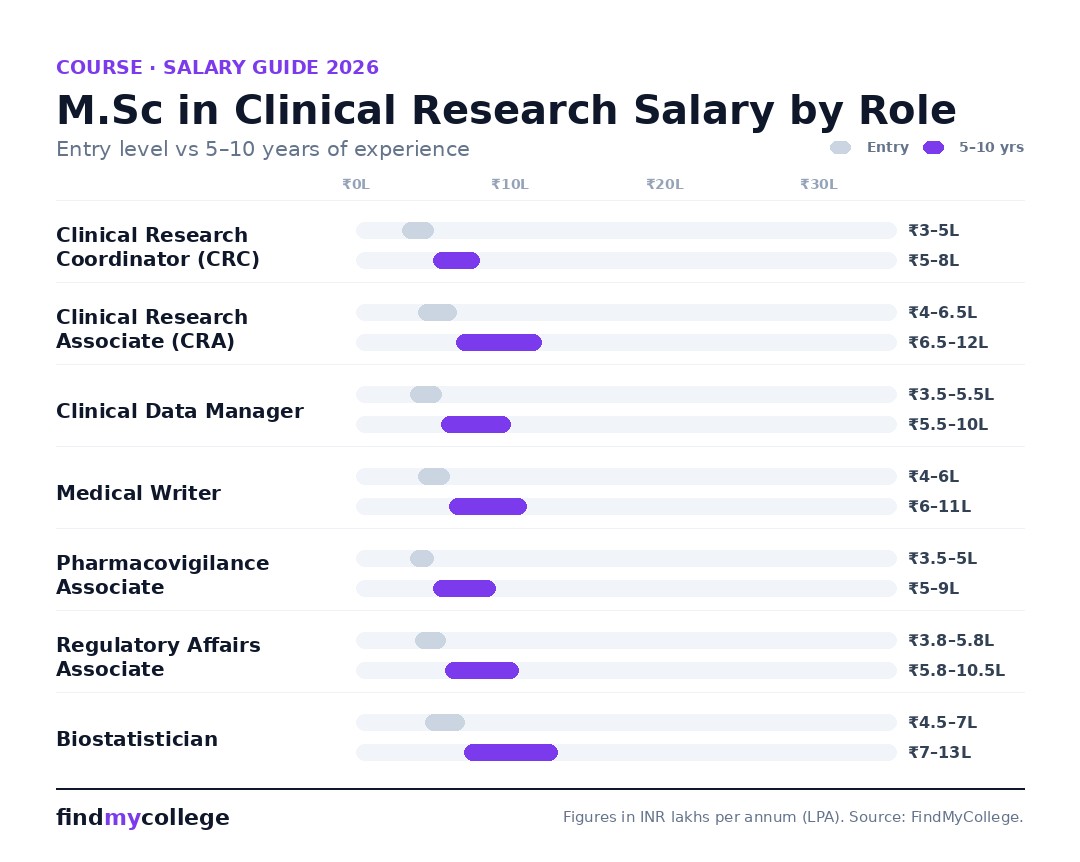
Graduates with an M.Sc in Clinical Research can pursue a diverse range of roles within pharmaceutical companies, Contract Research Organizations (CROs), biotechnology firms, and hospitals. Here’s a breakdown of common roles and their typical salary ranges in India for 2026:
| Job Role | Entry-Level Salary (INR LPA) | Mid-Level Salary (INR LPA) | Senior-Level Salary (INR LPA) |
|---|---|---|---|
| Clinical Research Coordinator (CRC) | 3.0 – 5.0 | 5.0 – 8.0 | 8.0 – 12.0+ |
| Clinical Research Associate (CRA) | 4.0 – 6.5 | 6.5 – 12.0 | 12.0 – 20.0+ |
| Clinical Data Manager | 3.5 – 5.5 | 5.5 – 10.0 | 10.0 – 18.0+ |
| Medical Writer | 4.0 – 6.0 | 6.0 – 11.0 | 11.0 – 18.0+ |
| Pharmacovigilance Associate | 3.5 – 5.0 | 5.0 – 9.0 | 9.0 – 15.0+ |
| Regulatory Affairs Associate | 3.8 – 5.8 | 5.8 – 10.5 | 10.5 – 17.0+ |
| Biostatistician | 4.5 – 7.0 | 7.0 – 13.0 | 13.0 – 22.0+ |
| Project Manager (Clinical Trials) | N/A (requires experience) | 10.0 – 18.0 | 18.0 – 30.0+ |
Note: These are indicative ranges for 2026 and can vary based on specific company policies, individual performance, and market demand.
How does M.Sc in Clinical Research salary compare to other Science PG degrees?
An M.Sc in Clinical Research generally offers competitive salaries, often starting higher than some traditional M.Sc programs in pure sciences (e.g., Botany, Zoology) but potentially similar to or slightly lower than highly specialized M.Tech or MBA programs in the initial years. Its strength lies in its industry-specific focus and clear career progression.
Compared to an M.Sc in Biotechnology or Microbiology, Clinical Research often provides a more direct entry into the pharmaceutical and healthcare industry with defined roles. While an M.Sc in Pharmacy (M.Pharm) might lead to similar roles, the M.Sc in Clinical Research specifically hones skills for trial management and regulatory aspects, making it highly sought after for specific industry functions. The growth potential for an M.Sc in Clinical Research is robust, especially for those who gain experience in project management or specialized areas.
Is M.Sc in Clinical Research worth it for jobs and salary growth?
Yes, an M.Sc in Clinical Research is generally considered a highly worthwhile investment for job prospects and salary growth in India. The specialized knowledge and practical skills gained are directly applicable to a high-demand industry.
The clinical research industry in India is projected for significant growth, driven by increasing R&D investments, a large patient pool, and cost-effectiveness for global trials. This ensures a steady demand for qualified professionals. While initial salaries may not be exceptionally high, the career progression is strong. With 3-5 years of experience, professionals can expect substantial salary hikes and move into leadership or specialized roles, making the long-term salary growth very attractive.
What are the career prospects after M.Sc in Clinical Research?
The career prospects after an M.Sc in Clinical Research are excellent and diverse, spanning various sectors of the healthcare and pharmaceutical industry. Graduates are equipped for roles across the entire lifecycle of clinical trials.
- Pharmaceutical Companies: Work in R&D, regulatory affairs, medical affairs, or clinical operations departments.
- Contract Research Organizations (CROs): These are the primary employers, offering roles in clinical monitoring, data management, project management, and quality assurance for trials conducted on behalf of pharma companies.
- Biotechnology Companies: Similar roles to pharma, but often with a focus on novel biological products.
- Hospitals and Academic Medical Centers: Manage clinical trials conducted within institutional settings, often as CRCs or research nurses.
- Medical Device Companies: Oversee clinical trials for new medical devices.
- Regulatory Bodies: Opportunities in government agencies involved in drug approval and regulation.
- Independent Consulting: Experienced professionals can work as independent consultants for clinical trial design, management, or regulatory strategy.
What is the eligibility for M.Sc in Clinical Research?
The general eligibility criteria for an M.Sc in Clinical Research in India require candidates to hold a bachelor’s degree in a relevant science or healthcare discipline from a recognized university.
- Required Degrees: Typically, a B.Sc (Life Sciences, Microbiology, Biotechnology, Biochemistry, Chemistry, Nursing), B.Pharm, BDS, BAMS, BHMS, or MBBS degree.
- Minimum Marks: Most institutions require a minimum aggregate of 50-60% in the qualifying bachelor’s degree.
- Entrance Exams: Some universities or colleges may conduct their own entrance exams, followed by a personal interview. Others might offer admission based on merit in the bachelor’s degree.
- Age Limit: Generally, there is no upper age limit for M.Sc in Clinical Research programs.
How much does M.Sc in Clinical Research cost in India?
The cost of pursuing an M.Sc in Clinical Research in India varies significantly based on the type of institution (government vs. private) and its reputation. The fee ranges for 2026 are as follows:
| Institution Type | Average Annual Fee Range (INR) | Total Course Fee Range (INR) |
|---|---|---|
| Government Universities/Colleges | 30,000 – 1,00,000 | 60,000 – 2,00,000 |
| Private Universities/Colleges | 1,00,000 – 3,50,000 | 2,00,000 – 7,00,000 |
These figures typically cover tuition fees but may not include hostel charges, examination fees, or other miscellaneous expenses. It’s advisable to check the specific fee structure of each college.
Explore more on FindMyCollege
Related pages for M.Sc in Clinical Research aspirants on findmycollege.com:
Frequently Asked Questions
Which companies hire M.Sc Clinical Research graduates?
Top companies hiring M.Sc Clinical Research graduates include multinational pharmaceutical giants like Pfizer, Novartis, GSK, AstraZeneca, and leading CROs such as IQVIA, Syneos Health, Parexel, PPD, and ICON. Indian pharma companies like Dr. Reddy’s, Cipla, and Sun Pharma also recruit actively.
What is the scope of M.Sc in Clinical Research abroad?
The scope of M.Sc in Clinical Research abroad is excellent, particularly in countries with strong pharmaceutical and biotech industries like the USA, UK, Canada, and European nations. Indian graduates with an M.Sc and relevant experience are often sought after for roles in global clinical trials, offering higher salaries and diverse work environments.
Are there any entrance exams for M.Sc in Clinical Research?
While some universities admit based on merit, many prominent institutions conduct their own entrance exams for M.Sc in Clinical Research. Examples include the entrance tests by Manipal Academy of Higher Education (MAHE), SRM Institute of Science and Technology, and some state university common entrance tests. These exams typically assess general aptitude, scientific knowledge, and English proficiency.
What are the key skills required for a successful career in Clinical Research?
Key skills include strong scientific understanding, attention to detail, excellent communication (written and verbal), critical thinking, problem-solving abilities, ethical conduct, data analysis skills, and proficiency in regulatory guidelines (ICH-GCP). Organizational and project management skills are also crucial.
Can I pursue a Ph.D. after M.Sc in Clinical Research?
Yes, an M.Sc in Clinical Research provides a strong foundation for pursuing a Ph.D. in related fields such as Clinical Pharmacology, Epidemiology, Public Health, or specific areas of drug development. A Ph.D. can open doors to research-intensive roles in academia, advanced R&D, and leadership positions.
What is the difference between Clinical Research and Clinical Practice?
Clinical Research focuses on investigating new treatments, diagnostics, or devices through human trials to establish their safety and efficacy. It involves study design, data collection, analysis, and regulatory compliance. Clinical Practice, on the other hand, involves the direct care and treatment of patients using established medical knowledge and approved therapies. While both are healthcare-related, research aims to advance knowledge, while practice applies existing knowledge.