GATE 2026 cutoff for Civil Engineering released by IIT Guwahati: check qualifying marks and trends
In short
- IIT Guwahati released the official GATE 2026 cutoff for Civil Engineering (CE) on 18 October 2026, around March 19, on the official GATE 2026 website.
- The qualifying cutoff for General category candidates in Civil Engineering (CE) is 28.7 marks, for OBC-NCL / EWS it is 25.8 marks, and for SC / ST / PwD it is 19.1 marks.
- Admission into old IITs requires 65+ marks for general category candidates, while top NITs target 45-55 raw marks or a GATE score above 650 for high-demand specializations.
- For direct recruitment into Public Sector Undertakings (PSUs), a raw score of 70-80+ marks is generally required to achieve a rank in the top 100-200.
- Candidates can check the official cutoff by visiting the official GATE 2026 website: gate2026.iitg.ac.in.
The Indian Institute of Technology (IIT) Guwahati has released the official GATE 2026 cutoff for Civil Engineering (CE) and other subjects on 18 October 2026. Candidates who appeared in the GATE 2026 exam for the CE subject can now check the minimum marks required to qualify the examination on the official GATE 2026 website.
This cutoff information is crucial for candidates to understand the minimum eligibility for various post-graduate admissions and recruitment opportunities. The GATE 2026 cutoff is categorized into qualifying cutoff, which determines if a student has passed the exam, and admission cutoff, which varies by institute based on competition and seat availability.
GATE 2026 Official Qualifying Cutoff for Civil Engineering and Other Papers
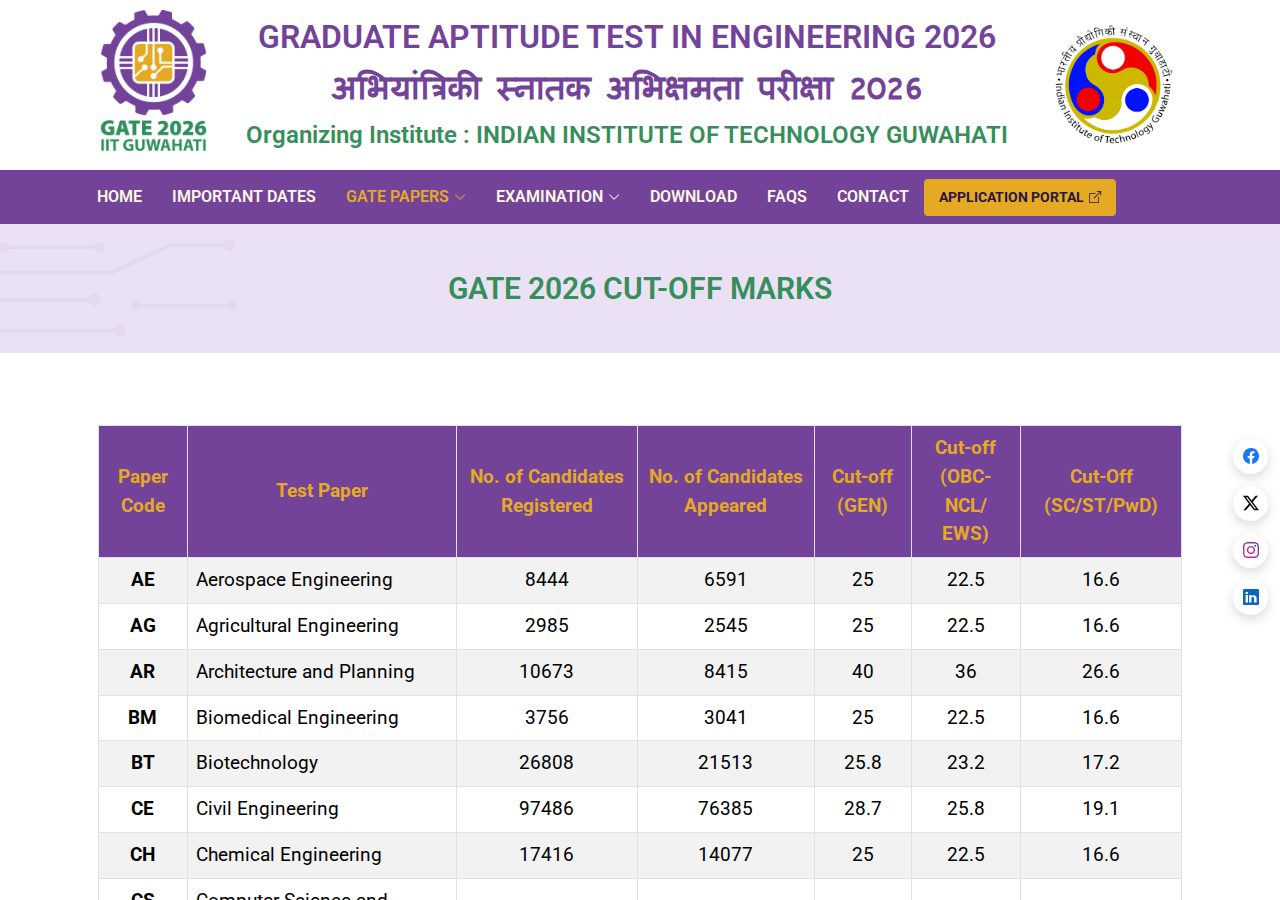
IIT Guwahati, the organizing institute for GATE 2026, released the official qualifying cutoffs around March 19, 2026. The qualifying cutoff for Civil Engineering (CE) for the General (UR) category is 28.7 marks. For OBC-NCL / EWS category candidates, the cutoff is 25.8 marks, and for SC / ST / PwD category candidates, it is 19.1 marks.

The GATE 2026 cutoff for Computer Science and Information Technology (CS) for the General category is 30 marks, for Electrical Engineering (EE) it is 27.7 marks, and for Electronics and Communication Engineering (EC) it is 26.4 marks. Many papers under the general category, including Architecture and Planning, Ecology and Evolution, Metallurgical Engineering, Petroleum Engineering, and some XH papers, have a qualifying cutoff of 40 marks.
| Test Paper | General (GEN) | OBC-NCL / EWS | SC / ST / PwD |
|---|---|---|---|
| AE Aerospace Engineering | 25 | 22.5 | 16.6 |
| AG Agricultural Engineering | 25 | 22.5 | 16.6 |
| AR Architecture and Planning | 40 | 36 | 26.6 |
| BM Biomedical Engineering | 25 | 22.5 | 16.6 |
| BT Biotechnology | 25.8 | 23.2 | 17.2 |
| CE Civil Engineering | 28.7 | 25.8 | 19.1 |
| CH Chemical Engineering | 25 | 22.5 | 16.6 |
| CS Computer Science and Information Technology | 30 | 27 | 20 |
| CY Chemistry | 25 | 22.5 | 16.6 |
| DA Data Science and Artificial Intelligence | 26.4 | 23.7 | 17.5 |
| EC Electronics and Communication Engineering | 26.4 | 23.7 | 17.5 |
| EE Electrical Engineering | 27.7 | 24.9 | 18.4 |
| ES Environmental Science and Engineering | 30 | 27 | 20 |
| EY Ecology and Evolution | 40 | 36 | 26.6 |
| GE Geomatics Engineering | 25 | 22.5 | 16.6 |
| GG-1 Geology and Geophysics (Geology) | 39.3 | 35.3 | 26.1 |
| GG-2 Geology and Geophysics (Geophysics) | 37.1 | 33.3 | 24.7 |
| IN Instrumentation Engineering | 39.8 | 35.8 | 26.5 |
| MA Mathematics | 34.7 | 31.2 | 23.1 |
| ME Mechanical Engineering | 25.2 | 22.6 | 16.7 |
| MN Mining Engineering | 29.5 | 26.5 | 19.6 |
| MT Metallurgical Engineering | 40 | 36 | 26.6 |
| NM Naval Architecture and Marine Engineering | 33.7 | 30.3 | 22.4 |
| PE Petroleum Engineering | 40 | 36 | 26.6 |
| PH Physics | 25.5 | 22.9 | 17 |
| PI Production and Industrial Engineering | 36 | 32.4 | 24 |
| ST Statistics | 30.4 | 27.3 | 20.2 |
| TF Textile Engineering and Fibre Science | 31.5 | 28.3 | 21 |
| XE Engineering Sciences | 35.2 | 31.6 | 23.4 |
| XH-C1 Humanities and Social Sciences (Economics) | 35.7 | 32.1 | 23.8 |
| XH-C2 Humanities and Social Sciences (English) | 40 | 36 | 26.6 |
| XH-C3 Humanities and Social Sciences (Linguistics) | 37.4 | 33.6 | 24.9 |
| XH-C4 Humanities and Social Sciences (Philosophy) | 38.3 | 34.4 | 25.5 |
| XH-C5 Humanities and Social Sciences (Psychology) | 39.3 | 35.3 | 26.1 |
| XH-C6 Humanities and Social Sciences (Sociology) | 40 | 36 | 26.6 |
| XL Life Sciences | 36.3 | 32.6 | 24.1 |
Admission Cutoffs and Recruitment Opportunities
While qualifying GATE is a prerequisite, it does not guarantee admission to institutes or direct recruitment. Admission cutoffs, which are typically higher than qualifying marks, are set by individual institutes such as IITs, NITs, and PSUs. For admission into old IITs like IIT Bombay, Madras, and Delhi, general category candidates generally need to score 65+ marks. Top NITs target a raw score of 45-55 marks or a GATE score above 650 for high-demand specializations.
For direct recruitment into Public Sector Undertakings (PSUs), a raw score of 70-80+ marks is often required to achieve a rank in the top 100-200. The GATE 2026 answer key was released on 22 February 2026 by IIT Guwahati, allowing candidates to calculate approximate scores. The final marks for GATE 2026 were released by IIT Guwahati on its portal tentatively in March 2026.
Past Year Trends for Civil Engineering Cutoffs
The qualifying marks for Civil Engineering generally fluctuate between 26 and 33 marks for the General category, based on trends from the previous five years. The 2023 Civil Engineering paper saw a dip to 26.6 marks due to tough question sets, while the 2022 cutoff peaked at 30.4 marks. A notable trend is the narrowing gap between General and OBC-NCL/EWS categories, while SC/ST/PwD marks consistently remain at roughly two-thirds of the General category cutoff.
The GATE qualifying marks are influenced by factors such as the exam’s difficulty, the number of candidates, previous year cutoffs, and candidate category. Reserved category candidates receive relaxation in cutoffs, with OBC-NCL/EWS typically 10% lower than General, and SC/ST/PwD roughly 33% lower. The GATE 2025 cutoff was set by IIT Roorkee, and the GATE 2027 exam will be conducted by IIT Madras in February 2027, with results announced on 19 March 2027.
| GATE Year | General (GEN) | OBC-NCL / EWS | SC / ST / PwD |
|---|---|---|---|
| 2025 | 29.2 | 26.2 | 19.4 |
| 2024 | 28.3 | 25.4 | 18.8 |
| 2023 | 26.6 | 23.9 | 17.7 |
| 2022 | 30.4 | 27.3 | 20.2 |
| 2021 | 29.2 | 26.2 | 19.4 |
Factors Influencing GATE Cutoffs
Several factors contribute to the annual variation in GATE cutoffs. The difficulty level of the exam has an inverse relationship with the cutoff; tougher papers often lead to lower qualifying marks, potentially dropping by 1-3 marks. A higher number of registered applicants increases competition, exerting upward pressure on the cutoff.
While seat availability does not directly affect passing marks, fewer seats in top programs result in much higher admission-based scores. For papers with multiple sessions, normalization processes are applied to ensure fairness and prevent any candidate from being disadvantaged by a tougher session slot. The GATE 2026 exam also introduced a new category of subject, XE 1.
| Factor | Impact on Cutoff | Key Details |
|---|---|---|
| Difficulty level of exam | Inverse Relationship | Tougher papers lead to low qualifying marks. If paper is tricky, the cutoff may drop by 1-3 marks. |
| Candidate Volume | High Upward Pressure | A higher number of registered applicants increases competition, driving cutoff upward. |
| Seat Availability | Admission-Specific | While it doesn’t affect passing marks, fewer seats in top programs lead to much higher admission-based scores. |
| Normalization | Fairness Adjustment | For papers with multiple sessions, marks are normalized to ensure no candidate is disadvantaged by a tougher session slot. |
Further reading

📰 More Education News
- WBJEE counselling admissions surge by 75.4% in 2026, total UG admissions up 49.9%Oct 18, 2026 • Nishit Kumar
- TS Intermediate Public Exam 2027 dates expected soon: practicals in January, theory in FebruaryOct 18, 2026 • Nishit Kumar
- GATE 2026 cutoff for Data Science & AI released: check qualifying marks and top institute scoresOct 18, 2026 • Nishit Kumar
- UID Bengaluru B.Des 2027: Apply now, fees detailedOct 18, 2026 • Nishit Kumar