NMMS exam 2026-27 on November 7; previous year papers available for download
In short
- The NMMS examination for the 2026-27 academic year will be conducted on November 7, 2026, for Class 8 students.
- The central government scholarship provides ₹12,000 annually from Class 9 to Class 12 to eligible students.
- Students from economically weaker sections with a parental income not exceeding ₹3,50,000 per annum are eligible.
- The exam comprises a Mental Ability Test (MAT) and a Scholastic Aptitude Test (SAT), each with 90 multiple-choice questions.
- Previous year question papers for 2024, 2025, and 2026, along with answer keys, are available for download from state SCERT websites.
The National Means-cum-Merit Scholarship (NMMS) examination for the academic year 2026-27 is set to take place on November 7, 2026. This examination is a central government initiative designed to offer financial assistance to meritorious students from economically weaker sections (EWS) to encourage them to complete their secondary education up to Class 12.
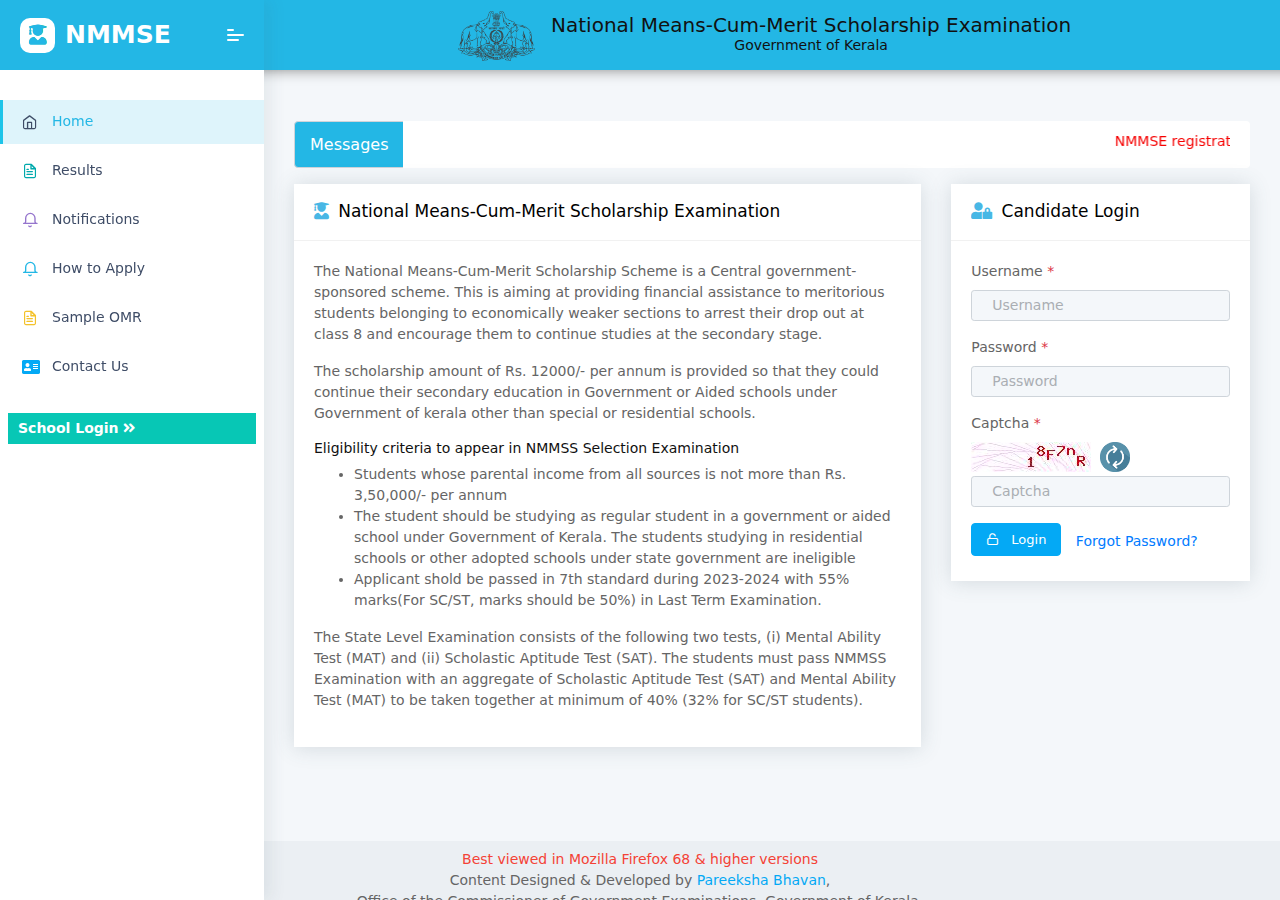
The scholarship scheme, administered by the Ministry of Education, Government of India, aims to prevent students from dropping out after Class 8 by providing ₹12,000 per year from Class 9 to Class 12. Approximately 100,000 fresh scholarships are awarded annually across India, with funds disbursed directly into student bank accounts via Direct Benefit Transfer (DBT).
NMMS Examination Structure and Eligibility
The NMMS exam is conducted for Class 8 students and consists of two main tests: the Mental Ability Test (MAT) and the Scholastic Aptitude Test (SAT). Each section contains 90 multiple-choice questions, totaling 180 questions for 180 marks, with a duration of 90 minutes for each section. There is generally no negative marking in most states for the NMMS exam. Students must achieve a minimum aggregate of 40% in MAT and SAT combined to pass, while SC/ST students require a minimum aggregate of 32%.
Eligibility criteria for the scholarship include a parental income from all sources not exceeding ₹3,50,000 per annum. Applicants must be studying as regular students in government or aided schools and should have passed the 7th standard with at least 55% marks (50% for SC/ST students). Students enrolled in Kendriya Vidyalayas (KVS), Jawahar Navodaya Vidyalayas (JNV), Sainik Schools, and private schools are not eligible for this scholarship.
To continue receiving the scholarship, students must maintain a minimum of 55% marks in Class 9 and 11 (50% for SC/ST students) and secure at least 60% marks in the Class 10 Board exam (55% for SC/ST students).
| Particulars | Details |
|---|---|
| Exam Mode | Offline (Pen and Paper) |
| Question Type | Multiple Choice Questions (MCQs) |
| Sections | MAT and SAT |
| Questions in MAT | 90 |
| Questions in SAT | 90 |
| Total Questions | 180 |
| Duration | 90 Minutes for each section |
| Total Marks | 180 |
| Negative Marking | No |
Syllabus and Preparation Resources
The NMMS syllabus for the Scholastic Aptitude Test (SAT) covers Science (Physics, Chemistry, Biology, Environmental Science), Mathematics (Algebra, Geometry, Arithmetic, Data Interpretation), and Social Science (History, Geography, Civics), based on the Class 7 and 8 curriculum. The SAT section specifically includes 35 Science questions, 35 Social Science questions, and 20 Mathematics questions. The Mental Ability Test (MAT) syllabus focuses on Reasoning & Aptitude, Logical Reasoning, and Applied Reasoning, including topics such as analogies, classification, coding-decoding, series, patterns, blood relations, direction sense, clocks, calendars, and problem-solving.
Students preparing for the upcoming examination can access previous year question papers for 2024, 2025, and 2026, along with their answer keys. These resources are available for download from the official State Education Board (SCERT) websites of respective states. For instance, the NMMS examination for the 2025-26 academic year in Kerala was held on January 21, 2026.
| Exam Paper | Subject / Area | Topics Covered |
|---|---|---|
| Mental Ability Test (MAT) | Reasoning & Aptitude | Analogies, Classification, Coding–Decoding Series & Patterns |
| Mental Ability Test (MAT) | Series & Patterns | Series, Pattern Completion |
| Mental Ability Test (MAT) | Logical Reasoning | Blood Relations, Direction Sense |
| Mental Ability Test (MAT) | Applied Reasoning | Clocks, Calendars, Problem Solving, Logical Reasoning |
| Scholastic Aptitude Test (SAT) | Science | Physics, Chemistry, Biology, Environmental Science |
| Scholastic Aptitude Test (SAT) | Mathematics | Algebra, Geometry, Arithmetic, Data Interpretation |
| Scholastic Aptitude Test (SAT) | Social Science | History, Geography, Civics |
| Scholastic Aptitude Test (SAT) | Language Skills | English and regional language comprehension |
Geographic Scope of the Examination
The NMMS examination is conducted across numerous states and union territories in India. These include Uttar Pradesh, Kerala, Gujarat, Rajasthan, Tamil Nadu, Andhra Pradesh, Arunachal Pradesh, Assam, Bihar, Chhattisgarh, Goa, Haryana, Himachal Pradesh, Jammu & Kashmir, Jharkhand, Karnataka, Madhya Pradesh, Maharashtra, Manipur, Meghalaya, Mizoram, Nagaland, Odisha, Punjab, Sikkim, Telangana, Tripura, Uttarakhand, West Bengal, Andaman & Nicobar Islands, Chandigarh, Dadra & Nagar Haveli and Daman & Diu, Delhi, Ladakh, and Lakshadweep, and Puducherry. Each state conducts the exam under the supervision of its respective State Education Board (SCERT).
To download previous year question papers, students are advised to visit the official SCERT website of their state, navigate to the NMMS or “Previous Year Question Papers” section, select the desired year (e.g., 2025, 2024), and download the PDF. The answer key provided with each paper can be used for self-assessment and practice.
Further reading

📰 More Education News
- TALLENTEX 2027: Register now for October 25 examsOct 25, 2026 • Nishit Kumar
- MCC NEET PG counselling 2026: private deemed universities hike fees up to 1,471%Oct 25, 2026 • Nishit Kumar
- Apply for BCA AI/ML programs in Haryana/Delhi NCR for 2026-27 admissionsOct 25, 2026 • Nishit Kumar
- NEET UG 2026 stray vacancy round: 335 medical seats unfilled in Karnataka, report by October 25Oct 25, 2026 • Nishit Kumar