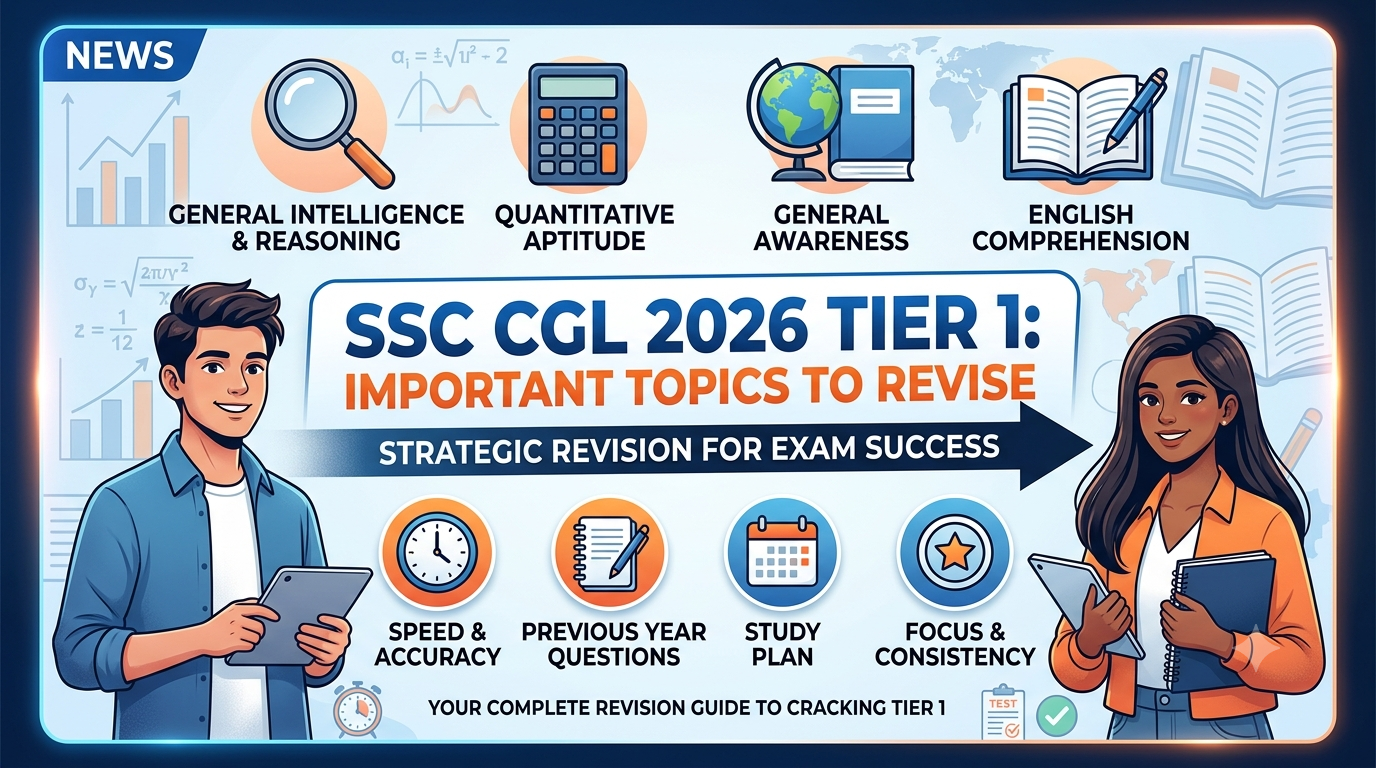
SSC CGL 2026: Key Topics to Master for the Tier 1 Exam
The Staff Selection Commission Combined Graduate Level (SSC CGL) exam remains one of the most competitive national selection processes. With thousands of aspirants competing for coveted central government posts, cracking Tier 1 requires a focused, strategic revision plan.
Tier 1 serves as a crucial screening stage. The exam features 100 multiple-choice questions worth 200 marks, with a strict 60-minute timeframe split into 15-minute sectional windows. Each wrong answer incurs a deduction of 0.50 marks.
To maximize your score in this high-speed test, you must prioritize high-yield, repetitive topics across all four sections.
1. Quantitative Aptitude: Balancing Arithmetic and Advanced Math
Quantitative Aptitude often acts as the primary differentiator in candidate performance. For Tier 1, the questions test a blend of quick mental arithmetic and core theoretical concepts.
High-Priority Focus Areas
-
Data Interpretation (DI): Usually accounts for 3 to 5 questions. Questions centered on pie charts, bar graphs, and tabular data offer high-return points. Practice ratio conversions and percentage calculations to solve these within seconds.
-
Arithmetic Core: Focus on Profit & Loss, Percentages, and Simple & Compound Interest. Master short techniques like the ratio method and the tree method for interest formulas to speed up calculation time.
-
Time, Speed, Distance & Work: Expect standard question variations involving relative speeds, trains, and pipe-and-cistern setups.
-
Advanced Mathematics:
-
Geometry: Revisit essential circle properties (chords, tangents) and triangle centers.
-
Algebra: Revise algebraic identities ($x + \frac{1}{x}$ forms) and basic surds.
-
Trigonometry: Focus on basic identities and standard complementary angle transformations.
-
Revision Strategy: If a problem takes longer than 60 seconds to process during practice, park it. Tier 1 rewards speed and question selection over brute-force problem-solving.
2. General Intelligence & Reasoning: The Maximum Scoring Zone
Reasoning offers the highest potential for scoring 45+ marks out of 50. The logical patterns tested by the SSC are typically consistent and predictable year after year.
| Topic Category | Specific Focus Areas | Expected Question Range |
| Coding-Decoding | Letter shifting, numerical mapping, symbol swap | 2 – 4 questions |
| Analogy & Classification | Number pairs, word associations, odd-one-out | 4 – 6 questions |
| Series Completion | Missing numbers, alphanumeric patterns | 3 – 5 questions |
| Non-Verbal Reasoning | Mirror images, paper folding, embedded figures | 3 – 5 questions |
| Logical Deductions | Syllogisms, Venn diagrams, blood relations | 2 – 4 questions |
Revision Strategy: Learn positional values of the English alphabet (forward and reverse) by heart. Visual reasoning questions can be solved directly on screen without scratch paper.
3. English Comprehension: Grammar and Vocabulary
The English section tests language accuracy and comprehension under tight time constraints. Vocabulary holds significant weight in this section.
Essential Topics to Revise
-
Vocabulary: Previous Year Questions (PYQs) frequently yield repeat terms. Revise One Word Substitutions, Idioms & Phrases, and antonym/synonym lists.
-
Grammar Rules: Re-examine core grammatical rules around Subject-Verb Agreement, Prepositions, and Tenses. Rule-based topics like Active/Passive Voice and Direct/Indirect Speech offer straightforward points once key transformation rules are memorized.
-
Cloze Test & Reading: Daily reading practice builds the context sensitivity required to complete 5-question cloze passages quickly.
4. General Awareness: Static Knowledge and Current Affairs
General Awareness is often the quickest section to complete, but its vast scope makes selective revision necessary. Focus on high-probability subject areas rather than attempting exhaustive readings.
-
Static GK: Focus heavily on Indian Art and Culture (classical/folk dances, musical instruments, festivals) and Indian Polity (Key Constitutional Articles, Fundamental Rights, and Amendments).
-
General Science: Prioritize basic Biology (diseases, human body systems, deficiency vitamins) and common everyday chemical formulas.
-
Current Affairs: Review event compilations spanning the last 6 to 8 months. Pay close attention to major sports honours, international summits, key appointments, and central government welfare initiatives.
Final Review Roadmap
To maximize your revision efficiency, maintain a strict schedule, focus on high-weightage chapters, and avoid spending excessive time on difficult, low-yield questions.

📰 More Education News
- NMMS 2026: Apply online now for 1,00,000 scholarshipsOct 21, 2026 • Nishit Kumar
- Assam JMEE 2027 notification awaited: application, exam dates expected soonOct 21, 2026 • Nishit Kumar
- NLU placements 2026: average salary ₹15-20 lakh, top recruiters announcedOct 21, 2026 • Nishit Kumar
- Assam JMEE 2027 notification awaited for MCA admissionsOct 21, 2026 • Nishit Kumar