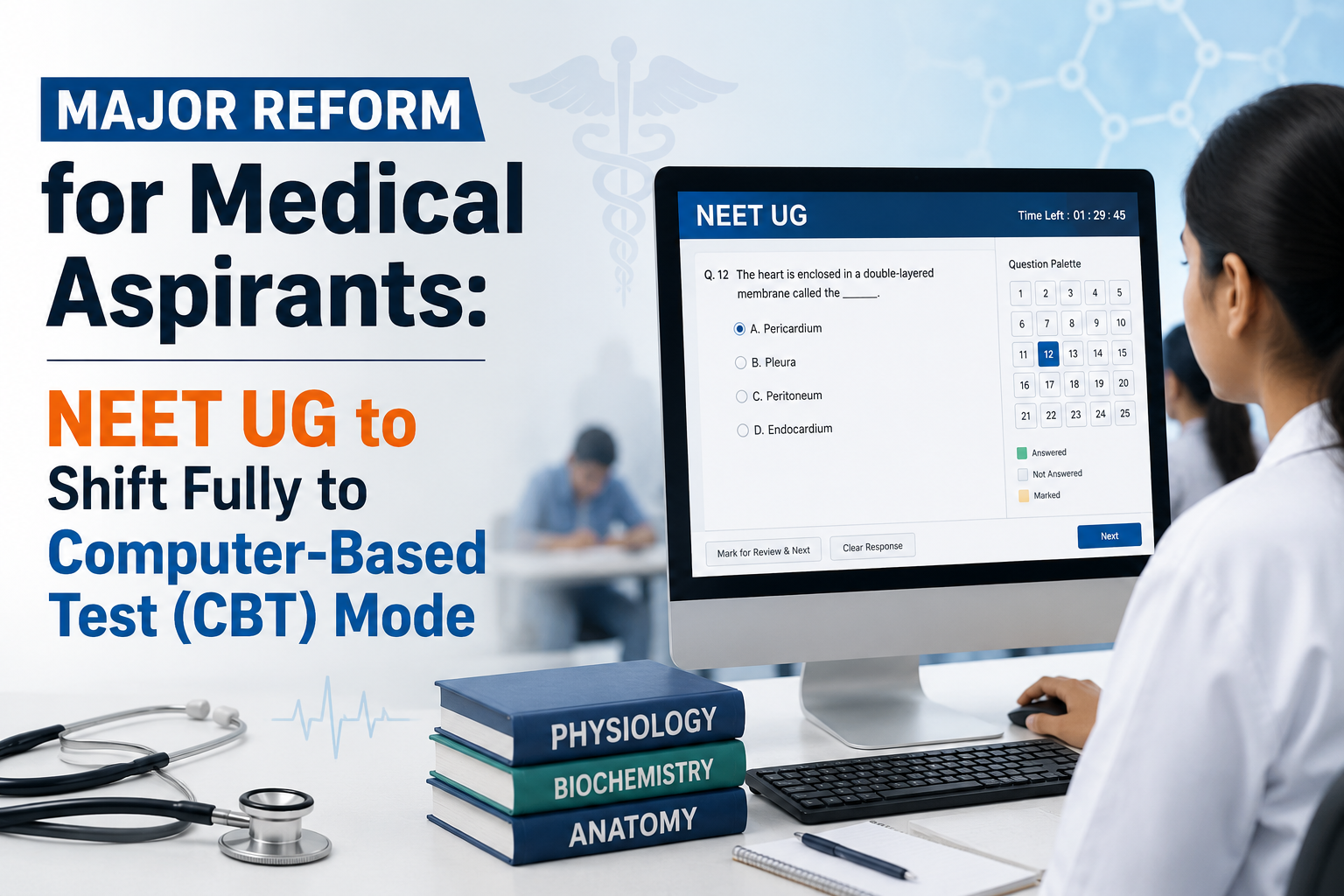
Major Reform for Medical Aspirants: NEET UG to Shift Fully to Computer-Based Test (CBT) Mode
In a landmark decision that promises to reshape the landscape of medical entrance examinations in India, Union Education Minister Dharmendra Pradhan has announced that the National Eligibility cum Entrance Test for Undergraduate courses (NEET UG) will shift entirely to a Computer-Based Test (CBT) format starting from the 2027 academic cycle. This major reform marks the end of the traditional pen-and-paper OMR sheet testing model that millions of students have used for decades.
The announcement comes on the heels of intense public and political scrutiny following paper leak incidents and administrative oversights in recent examination cycles. By transitioning to a secure digital environment, the Ministry of Education aims to safeguard the integrity of India’s largest medical entrance test and restore trust among millions of hard-working aspirants.
Why the Paradigm Shift?
The decision to eliminate the pen-and-paper format stems from recommendations made by a high-level expert committee—headed by former ISRO Chairman Dr. K. Radhakrishnan—formed to overhaul the functioning of the National Testing Agency (NTA).
The core vulnerability of the traditional system lay in its reliance on physical question papers and Optical Mark Recognition (OMR) sheets. The chain of custody involved in printing, transporting, storing, and distributing paper documents across thousands of test centers created multiple points where security breaches could occur.
By shifting to an online, computer-based framework, question papers will be encrypted and transmitted directly to individual computer terminals right before the examination begins. This eliminates physical touchpoints and effectively cuts off the networks of education mafias attempting to leak exam papers in advance.
How the 2027 Exam Format Will Work?
While the medium of testing is changing, key academic parameters will remain familiar to prevent unnecessary distress for students.
-
Academic Pattern Remains Intact: The syllabus, total marks (720), and question distribution across Physics, Chemistry, and Biology will stay identical to the existing pattern.
-
Multi-Shift Administration: Given that over 2 million students take NEET UG every year, conducting a single-day online exam is logistically difficult. The exam is planned to be conducted across multiple days and shifts.
-
Fairness via Normalization: To account for any slight variation in difficulty levels across different test shifts, the NTA will use a standardized percentile-based normalization process, similar to the process currently used for JEE Main.
-
Standardized Infrastructure: The government plans to utilize verified infrastructure, prioritizing government institutions like Kendriya Vidyalayas, Navodaya Vidyalayas, and trusted digital testing centers to maintain strict surveillance.
Reassuring the Student Community
Addressing the media, Dharmendra Pradhan emphasized that the government’s top priority is to protect deserving, meritorious candidates.
“We want to reassure meritorious students. We do not want the exam mafia to snatch seats from deserving candidates. We do not want moneybags to take these seats. The decision has been taken keeping students’ best interests in mind.”
— Dharmendra Pradhan, Union Education Minister
To ease the transition, the government and the NTA plan to release official mock tests and software demos well ahead of the 2027 cycle. This will allow students from all backgrounds, including rural and under-resourced areas, to get hands-on experience with on-screen navigation, flagging questions, and digital timer management.
What Lies Ahead for Aspirants?
For candidates currently preparing for NEET UG 2027, the shift requires a slight adjustment in preparation habits rather than a change in core study material:
-
Shift to Screen-Based Practice: Instead of practicing solely on physical OMR sheets with ballpoint pens, students should gradually incorporate online mock tests to build comfort with reading long questions on monitors.
-
Focus on Time Management: Online testing interfaces allow quick navigation between sections and clear tagging for “marked for review” questions, helping candidates manage their time more efficiently.
-
No Change in Core Syllabus: Concepts, NCERT textbooks, and problem-solving fundamentals remain the foundation for scoring well.
This transition brings NEET UG in line with major national competitive exams like JEE Main, CAT, and CUET. While it represents a major logistical shift for the administration, it stands as a decisive step toward creating an error-free, secure, and transparent admission process for India’s future doctors.





Further reading
📰 More Education News
- NIFT 2027 UG regular and lateral entry applications open: apply by 16 NovemberOct 23, 2026 • Nishit Kumar
- NIPER JEE 2027 syllabus, exam pattern, and book selection detailed for master’s admissionsOct 23, 2026 • Nishit Kumar
- UP, TN, Maharashtra, MP, Karnataka 10th, 12th board exam dates 2027 outOct 23, 2026 • Nishit Kumar
- CUET B.Pharm question paper 2027: NTA clarifies subject choice, exam patternOct 23, 2026 • Nishit Kumar