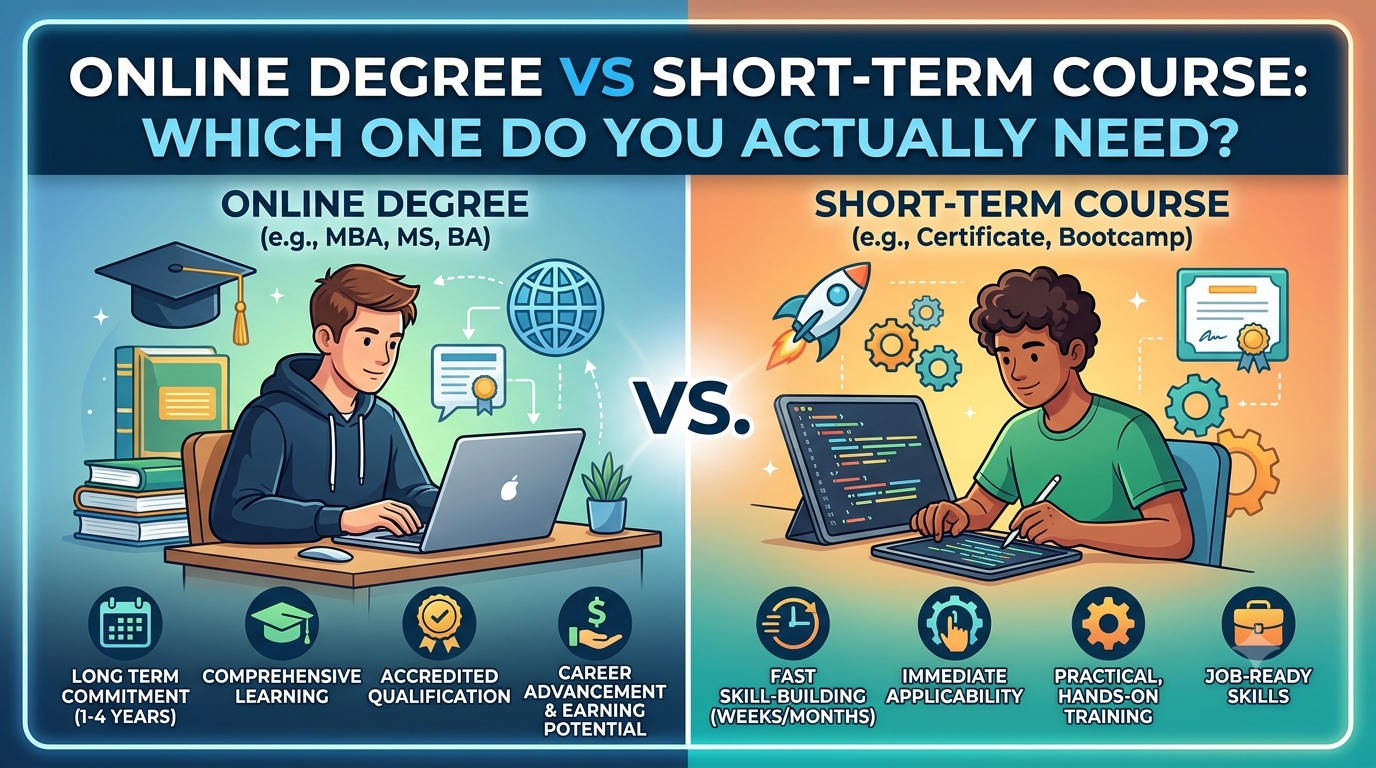
Online Degree vs Short-Term Course: Which One Do You Actually Need?
Choosing between an online degree and a short-term course can be confusing, especially when both promise better career opportunities. An online degree may help you qualify for jobs that require a formal educational qualification, while a short-term course can teach you a specific skill in a few weeks or months.
The right choice depends on where you are in your career. A college student looking for their first job may need a different learning path than a working professional who wants to switch careers or learn a new tool. Similarly, someone who wants to move into management may benefit more from a recognised degree than from a short course alone.
Before spending money on another qualification, it is worth understanding what each option offers, how much time it takes, and what employers expect from candidates in your chosen field.
What Is the Difference Between an Online Degree and a Short-Term Course?
The biggest difference is the purpose of each option. An online degree provides a broader education in a subject, while a short-term course focuses on learning a particular skill or area of knowledge.
An online degree usually follows a structured curriculum over several semesters. Depending on the programme, it may include assignments, examinations, projects, and practical learning. Students study a subject in greater depth and receive a degree after meeting the university’s requirements.
A short-term course is generally more focused. It may teach you how to use a software tool, understand digital marketing, analyse business data, or learn the basics of graphic design. Some courses take only a few days, while others last several months.
Here is a quick comparison.
| Factor | Online Degree | Short-Term Course |
|---|---|---|
| Main purpose | Build academic knowledge and earn a formal qualification | Learn a specific skill or subject |
| Duration | Usually 2–4 years, depending on the degree | A few days to several months |
| Learning approach | Structured curriculum with multiple subjects | Focused lessons and practical exercises |
| Cost | Often higher overall, depending on the university | Usually lower, though advanced courses can be expensive |
| Career value | Useful for roles requiring a degree or higher qualification | Useful for demonstrating relevant skills |
| Flexibility | Often designed for flexible study, but deadlines still apply | Usually flexible, depending on the provider |
| Assessment | Assignments, examinations, projects, or a combination | Quizzes, projects, assessments, or a final test |
| Final outcome | Degree certificate from the awarding university | Certificate of completion or professional certification, depending on the programme |
Neither option is automatically better. An online degree can provide the educational foundation needed for long-term career growth, while a short-term course can help you develop a skill that you can use immediately.
When Should You Choose an Online Degree?
An online degree makes more sense when you need a formal qualification to enter a profession, qualify for a particular job, or move towards a long-term career goal.
For example, a graduate applying for a management position may find that employers prefer candidates with an MBA. Similarly, someone who has completed Class 12 may need a bachelor’s degree to meet the eligibility requirements for many entry-level jobs or postgraduate programmes.
Here are some situations where an online degree may be the better choice.
You Do Not Have a College Degree Yet
If you have completed Class 12 but have not pursued graduation, an online bachelor’s degree can help you build your educational qualifications while studying from home.
This can be useful if you are working, preparing for competitive examinations, managing family responsibilities, or unable to attend a regular college.
Depending on your interests, you could consider programmes such as BA, B.Com, BBA, BCA, or other eligible bachelor’s degrees.
However, before enrolling, check whether the university and programme are recognised and whether the degree meets the eligibility requirements for your intended career or further studies.
Your Target Job Requires a Formal Qualification
Some jobs have specific educational requirements. Employers may ask for a bachelor’s degree, postgraduate degree, or a particular professional qualification.
For instance, a candidate applying for certain management, administrative, academic, or specialist positions may need a recognised degree to be considered.
A short course can improve your skills, but it generally cannot replace a mandatory academic qualification.
If a job description specifically asks for a degree, completing several short courses may not solve the eligibility problem.
You Want to Move Into Management
Working professionals sometimes reach a point where their experience is useful, but they want to move into leadership, business development, operations, or managerial roles.
In such cases, an MBA or another relevant postgraduate degree may be worth considering, particularly if the target positions value postgraduate education.
An online MBA can allow working professionals to continue earning while pursuing higher education. However, its value depends on the university, programme quality, skills gained, work experience, and the requirements of the roles they want to pursue.
A degree alone does not guarantee a promotion or salary increase. It should support a clear career plan rather than serve as a qualification collected without a specific purpose.
You Want to Keep Your Future Options Open
A recognised degree can also help if you are unsure about your exact career direction but know that you want to continue studying or qualify for a wider range of opportunities.
For example, a bachelor’s degree may help you meet the basic eligibility requirements for postgraduate study, certain competitive examinations, or jobs that require graduation.
This does not mean every degree will open every door. Eligibility rules differ across employers, institutions, and professions. Still, a relevant degree can provide a stronger academic foundation than a short course alone.
When Is a Short-Term Course a Better Choice?
A short-term course may be more useful when you already have the required educational qualification and need to learn something specific for your current job or next career move.
Instead of spending several years studying a broad subject, you can focus on the exact skill you need.
Consider these situations.
You Want to Learn a Job-Ready Skill Quickly
Suppose you work in marketing but do not know how to run paid advertising campaigns. You may not need another degree to fill this gap.
A practical course in Google Ads, social media advertising, or campaign analytics could be a more direct option.
Similarly, a person interested in data analysis could start with Excel, SQL, Power BI, or Python, depending on their existing knowledge and career goals.
The important thing is to choose a course that includes practical work. Watching lessons is useful, but completing projects helps you understand how to apply what you have learned.
You Want to Improve Your Current Job Performance
Not every career goal requires a major educational investment.
A sales professional might need better presentation skills. An HR executive might want to learn recruitment analytics. An accountant might benefit from advanced Excel or accounting software training.
In these cases, a short course can help address a specific weakness without requiring a long break from work or a large financial commitment.
It is also easier to identify whether the learning is useful because you can apply it to your daily responsibilities.
You Want to Test a New Career Before Making a Big Decision
Changing careers can be expensive, especially if you immediately enrol in a multi-year programme without knowing whether you enjoy the field.
A short course can help you explore an area before committing to a longer qualification.
For example, someone considering a career in user experience design could start with a beginner course and complete a small design project. A person interested in data analytics could learn spreadsheet basics and work on a sample dataset.
This gives you a chance to understand the subject, the type of work involved, and the skills you need to develop.
A short course will not automatically make you job-ready, but it can help you make a more informed decision about your next step.
You Need a Specific Skill for a Job Application
Sometimes, the gap between your current profile and a job requirement is quite small.
You may already have the necessary degree and experience but lack familiarity with a particular tool or method.
If an employer asks for knowledge of a CRM platform, a reporting tool, or a particular design application, a relevant course may help you close that gap.
In this situation, enrolling in another degree could take more time and money than necessary.
Online Degree vs Short-Term Course: Which One Costs More?
Cost is an important factor, but comparing the total fee alone does not tell you which option offers better value.
An online degree generally involves a larger financial commitment because it lasts longer. Students may need to pay semester-wise or annual fees, along with examination charges or other applicable costs.
Short-term courses are often less expensive, particularly when they focus on one skill. However, advanced professional training, industry certifications, and specialised programmes can also be costly.
The actual cost depends on the provider, course content, duration, and learning support.
Compare the Total Cost, Not Just the Advertised Fee
Before enrolling in an online degree, check the complete programme fee, examination charges, study material costs, and any other compulsory payments.
For short-term courses, find out whether the advertised price includes assessments, project reviews, certification, and access to the learning platform.
You should also consider the time involved. A degree may require a regular weekly study schedule over several years, while a short course may be completed alongside a full-time job in a few weeks.
Here is an illustrative comparison. These figures are examples for planning purposes, not standard market prices.
| Expense | Online Degree | Short-Term Course |
|---|---|---|
| Tuition or course fee | ₹50,000–₹2,00,000 or more in total, depending on the programme | ₹2,000–₹30,000 or more, depending on the course |
| Duration | Usually several semesters | A few weeks to several months |
| Additional costs | May include examination fees and other university charges | May include exam fees, software, or optional certification |
| Financial commitment | Usually spread across a longer period | Often a smaller, shorter-term expense |
These ranges are broad illustrations. Actual fees can fall outside them, particularly for specialised programmes or premium training providers.
Think About the Value You Will Get
A low-cost course is not automatically a good investment, and an expensive degree is not automatically worth the money.
Ask yourself three questions before paying:
- Will this qualification help me meet a real job or education requirement?
- Will I gain knowledge or skills that I can actually use?
- Is there a more affordable way to achieve the same goal?
If a ₹5,000 course teaches you a skill you need for your current role, it may be a better use of money than an unrelated degree.
On the other hand, if your target career requires a recognised bachelor’s or master’s degree, a short course may not provide the qualification you need, regardless of how affordable it is.
Which Option Helps You Get a Job Faster?
This depends on the job you want and the qualifications you already have.
A short-term course can help you learn a relevant skill quickly, but completing it does not mean you will immediately get a job. Employers may also look for practical experience, a portfolio, communication skills, and evidence that you can solve real problems.
An online degree may take longer, but it can help you meet formal eligibility requirements that a short course cannot satisfy.
Consider these examples.
Example 1: A Graduate Who Wants to Enter Digital Marketing
Imagine you have a B.Com degree and want to apply for digital marketing jobs.
You could begin with a practical course covering SEO, paid advertising, content marketing, and analytics. You could then create sample campaigns, analyse website data, or build a small portfolio.
In this situation, a short-term course may be the more direct route because you already have a bachelor’s degree.
You would not necessarily need another degree just to learn digital marketing basics.
Example 2: A Class 12 Student Who Wants a Corporate Job
Now consider someone who has completed Class 12 and wants to work in business, finance, or administration.
A short course in Excel, accounting software, or communication skills could help, but it may not meet the graduation requirement for many corporate positions.
A bachelor’s degree could provide the required academic foundation, while short courses could help build practical skills alongside it.
For this person, a degree may be the more important first step.
Example 3: A Working Professional Who Wants a Promotion
Suppose you have been working in operations for five years and want to move into a managerial role.
The right decision depends on the employer and the roles you are targeting. If an MBA or postgraduate qualification is preferred or required, an online degree may help. If the main gap is project management, reporting, or data analysis, a specialised course may be more useful.
Before enrolling, review job descriptions for the positions you want. This can help you understand whether employers are asking for a formal qualification, a specific skill, relevant experience, or a combination of all three.
What Do Employers Value More: Degrees or Certificates?
There is no single answer because employers do not evaluate every role in the same way.
For some jobs, a degree is a basic requirement. For others, practical skills and work experience may carry more weight. Many employers look at a combination of education, skills, experience, and the candidate’s ability to perform the job.
A degree can show that you have completed a structured programme of study. A short-term certificate can show that you have studied a particular subject or tool. Neither one, by itself, proves that you can perform every task required in a role.
When a Degree Matters More
A formal degree can be important when:
- The job advertisement specifies a bachelor’s or master’s degree.
- The employer uses educational qualifications as an initial screening criterion.
- You want to pursue higher education that requires a particular degree.
- The role has formal qualification or licensing requirements.
For regulated professions, always check the specific educational and professional requirements. A general online degree may not be sufficient for every profession.
When Skills Matter More
A short-term course can be especially useful when:
- You already meet the educational requirements for the role.
- The job requires knowledge of specific software or tools.
- You need to demonstrate practical ability in a technical or creative field.
- You want to update your skills as industry practices change.
For example, a digital marketing employer may want to see whether you can analyse campaign performance, conduct keyword research, or improve website content. A certificate can support your application, but practical examples of your work may provide stronger evidence of your ability.
The best approach is to match your learning choice to the actual expectations of employers in your field.
Can You Pursue an Online Degree and a Short-Term Course Together?
Yes. In fact, combining the two can be a sensible option if you have enough time and a clear reason for doing so.
An online degree can provide academic knowledge and a recognised qualification, while a short-term course can help you develop skills that are directly relevant to a job.
For example, a BBA student interested in digital marketing could learn SEO and Google Analytics alongside their degree. A B.Com student could learn advanced Excel, financial modelling, or accounting software. An MBA student interested in business analytics could develop skills in Power BI or SQL.
This combination can help you connect classroom concepts with practical work.
How to Combine Both Without Feeling Overwhelmed
You do not need to enrol in several courses at once. A simple plan is often more effective.
Step 1: Choose your main qualification. If you need a degree to meet educational requirements, make that your priority.
Step 2: Identify one skill gap. Look at job descriptions and identify a skill that appears frequently in the roles you want.
Step 3: Choose a focused course. Select a course that teaches that skill through examples, assignments, or projects.
Step 4: Apply what you learn. Build a project, practise using the tool, or apply the skill to your current work.
Step 5: Review your progress. Once you are comfortable with that skill, decide whether you need another course.
Remember that doing more courses is not always better. A person who has completed one relevant course and built a strong project may be better prepared than someone who has collected several certificates without applying the knowledge.
How to Choose the Right Option for Your Career Goals?
If you are still unsure, start by identifying the problem you want to solve. Do you lack a formal qualification, need a specific skill, want to change careers, or hope to move into a higher position?
Your answer will help you decide where to invest your time and money.
| Your Current Situation | Option to Consider | Why |
|---|---|---|
| You have completed Class 12 and need graduation | Online bachelor’s degree | Helps you work towards formal educational eligibility |
| You are a graduate and want to learn SEO or digital marketing | Short-term course | Builds specific skills without requiring another degree |
| You want to qualify for a role requiring a postgraduate degree | Relevant online postgraduate degree | May help meet the qualification requirement |
| You need to learn Excel, SQL, or a business tool | Short-term course | Focuses directly on the skill you need |
| You want to change careers but are unsure about the field | Short-term introductory course first | Helps you explore the subject before making a larger commitment |
| You want to move into management and your target roles value an MBA | Online MBA, if suitable | Can provide postgraduate business education alongside work |
| You already have a degree but lack practical experience | Short course plus projects or internships | Helps you demonstrate job-related skills |
These are starting points rather than fixed rules. Your experience, finances, available time, and the requirements of your chosen field may change the decision.
Check Recognition Before Choosing an Online Degree
If you decide to pursue an online degree in India, verify the university and the specific programme’s recognition or entitlement for the relevant academic session.
Check the applicable University Grants Commission (UGC) and Distance Education Bureau (DEB) information rather than relying only on advertisements or a university’s general claims.
Also confirm the programme’s eligibility criteria, examination process, total fees, student support, and whether the qualification will be accepted for your intended purpose.
For a short-term course, look into the provider’s credibility, instructor experience, curriculum, practical assignments, and the value of its certificate in your chosen industry.
A recognised institution or a well-known platform can be a useful starting point, but you should still examine what the course actually teaches.