PG Diploma in Clinical Embryology: Duration, Eligibility & Scope
The Post Graduate Diploma in Clinical Embryology (PGDCE) is a 1-year postgraduate diploma program spread across 2 semesters that provides practical and theoretical training in assisted reproductive technologies (ART), IVF laboratory procedures, and embryology.
| Parameter | Details |
|---|---|
| Course Duration | 1 Year (2 Semesters) |
| Course Level | Postgraduate Diploma |
| Educational Eligibility | MBBS degree or Graduation/Post-Graduation in Life Sciences, Biology, Biotechnology, Nursing, or related fields |
What is PG Diploma in Clinical Embryology
The Post Graduate Diploma in Clinical Embryology (PGDCE) is a specialized 1-year postgraduate diploma program structured into two semesters. It is designed to provide comprehensive theoretical and hands-on laboratory training in assisted reproductive technology (ART), gamete biology, and in vitro fertilization (IVF) procedures.
This course equips graduates and healthcare professionals with technical skills in handling human gametes, maintaining embryology laboratory standards, and understanding the biological principles governing fertilization and early embryonic development.
PG Diploma in Clinical Embryology Eligibility
To secure admission to a Post Graduate Diploma in Clinical Embryology, candidates must meet specific academic qualifications. Eligibility criteria across recognized institutions require candidates to hold an MBBS degree or a Bachelor’s or Postgraduate degree in Life Sciences, Biology, Biotechnology, Nursing, or related allied health disciplines.
Applicants must obtain a minimum aggregate score of 50-60% in their qualifying degree examination. Candidates belonging to reserved categories are provided with a relaxation of 5-10% in minimum qualifying marks, depending on institutional guidelines.
PG Diploma in Clinical Embryology Admission Process
Admission to the Post Graduate Diploma in Clinical Embryology program involves verifying academic eligibility, submitting institutional applications, and undergoing selection assessments. Candidates holding an eligible degree in Life Sciences, Biotechnology, Nursing, or Medicine submit their application forms alongside academic transcripts and relevant work experience details.
Depending on the university, applicants may be required to take an institutional entrance examination that evaluates foundational knowledge in human physiology, general biology, and laboratory practices. Shortlisted candidates participate in personal interviews or counseling sessions conducted by the selection committee prior to final seat allocation.
PG Diploma in Clinical Embryology Syllabus and Subjects
The curriculum for the Post Graduate Diploma in Clinical Embryology combines classroom instruction with extensive clinical laboratory training. Core subjects covered across universities include Gametogenesis, stages of embryonic development, fertilization, placental function, ethical considerations, organ formation, teratology, and innovations in ART.
Institutions such as Yenepoya University structure their coursework around Andrology, Embryology, Research Methodology and Biostatistics, Assisted Reproductive Technology theory and practicals, and a mandatory dissertation. Practical training emphasizes essential IVF techniques, including semen analysis, oocyte retrieval, sperm preparation, embryo culture, cryopreservation, and embryo transfer.
| Semester | Core Theoretical & Practical Subjects |
|---|---|
| Semester 1 | Overview of Embryology & Stages of Embryonic Development |
| Semester 1 | Gametogenesis (Sperm and Egg Development) & Fertilization |
| Semester 1 | Andrology & Andrology (Practical) |
| Semester 1 | Embryology & Embryology (Practical) |
| Semester 1 | Research Methodology, Biostatistics & Stem Cell Biology |
| Semester 1 | Ethical and Legal Considerations in Embryology |
| Semester 2 | Assisted Reproductive Technology (ART) Theory & Practical |
| Semester 2 | Organ Formation, Nervous System & Cardiovascular Development |
| Semester 2 | Genetic Regulation in Embryogenesis & Teratology |
| Semester 2 | Innovations in ART (IVF, ICSI, Cryopreservation) |
| Semester 2 | Dissertation / Project Work |
Top PG Diploma in Clinical Embryology Colleges
| Institution Name | Location | Key Program Focus |
|---|---|---|
| All India Institute of Medical Sciences (AIIMS) | New Delhi | Clinical Embryology Training |
| Christian Medical College (CMC) | Vellore, Tamil Nadu | Clinical Embryology Training |
| Manipal University | Manipal, Karnataka | Clinical Embryology Training |
| Rajiv Gandhi University of Health Sciences (RGUHS) | Bengaluru, Karnataka | Clinical Embryology Training |
| Institute of Clinical Embryology | Hyderabad, Telangana | Clinical Embryology Training |
| Yenepoya University (Bangalore Campus) | Bengaluru, Karnataka | Andrology, Embryology, ART & Dissertation |
Top institutions offering Clinical Embryology training in India include AIIMS Delhi, CMC Vellore, Manipal University, RGUHS Bangalore, Institute of Clinical Embryology Hyderabad, and Dr. Aravind’s IVF. These programs prepare students with knowledge and hands-on skills in assisted reproductive technologies.
PG Diploma in Clinical Embryology Career Scope and Salary
Graduates holding a PG Diploma in Clinical Embryology have access to diverse professional roles within fertility clinics, clinical research organizations, and hospital reproductive units. Primary career designations include Clinical Embryologist, Lab Supervisor in Fertility Clinics, Reproductive Geneticist, Embryology Laboratory Manager, Fertility Consultant, and Reproductive Medicine Researcher.
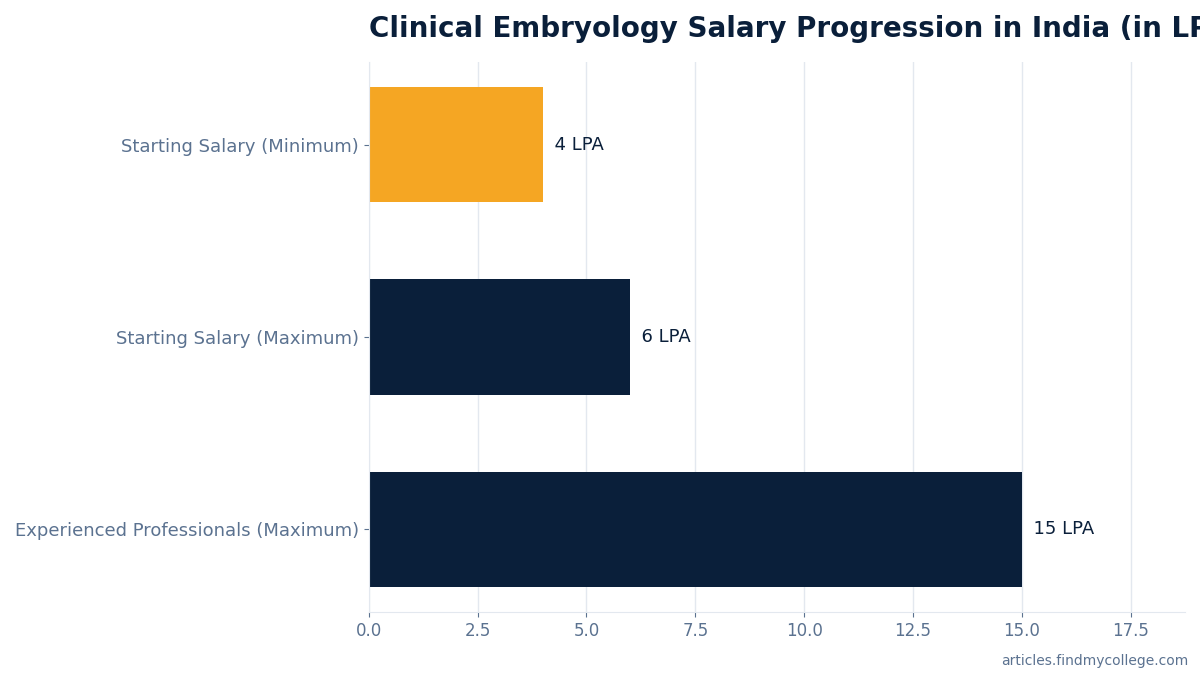
In India, top healthcare networks and organizations such as Apollo Hospitals, Fortis Healthcare, Max Healthcare, Manipal Hospitals, AIIMS, and ICMR recruit trained clinical embryology professionals. A junior clinical embryologist in India typically earns a starting salary ranging between INR 4 Lakhs and INR 6 Lakhs per annum.
For those looking to advance their qualifications, higher study pathways after completing the diploma include an M.Sc. in Clinical Embryology, an M.D. in Obstetrics and Gynecology, or specialized Fellowships in Reproductive Medicine and Stem Cell Research.
PG Diploma in Clinical Embryology vs M.Sc. in Clinical Embryology
| Parameter | PG Diploma in Clinical Embryology | M.Sc. in Clinical Embryology |
|---|---|---|
| Course Duration | 1 Year (2 Semesters) | 2 Years |
| Course Type | Postgraduate Diploma | Postgraduate Master’s Degree |
| Eligibility | MBBS or Bachelor’s/Post-Graduation in Life Sciences, Biology, Biotechnology, or Nursing | MBBS or Bachelor’s degree in Life Sciences, Biology, Biotechnology, or Nursing |
The PG Diploma in Clinical Embryology is a 1-year program divided into two semesters focusing on ART laboratory practices. Graduates can later pursue higher study options such as an M.Sc. in Clinical Embryology, M.D. in Obstetrics and Gynecology, or research fellowships.
How to Apply for PG Diploma in Clinical Embryology Admission in 2026: Step by Step
- Check Educational Eligibility: Verify that you hold an MBBS degree or a Bachelor’s/Postgraduate degree in Life Sciences, Biotechnology, Biology, or Nursing with at least 50-60% aggregate marks.
- Submit Online Application Form: Complete the application form provided by the selected university or institute with educational transcripts and work experience details.
- Appear for Entrance Exam or Assessment: Take the institutional entrance examination if mandated to evaluate foundational knowledge in biology, human physiology, and laboratory techniques.
- Attend Interview or Counseling Session: Participate in the personal interview or academic counseling session conducted by the admission committee.
| What to do | Where | Link |
|---|---|---|
| Compare colleges, fees and cutoffs | PG Diploma in Clinical Embryology colleges in India | findmycollege.com |
FAQs
Who is eligible for MSc or PG Diploma in Clinical Embryology?
Candidates holding an MBBS degree or a Bachelor’s/Post-Graduation degree in Life Sciences, Biology, Biotechnology, Nursing, or related fields are eligible. A minimum aggregate score of 50-60% is required in the qualifying degree, with a 5-10% relaxation provided to reserved categories.
Is a clinical embryologist a doctor?
Not necessarily. While MBBS graduates can become clinical embryologists, non-doctor science graduates holding degrees in Life Sciences, Biotechnology, or Biology can also pursue clinical embryology.
What degree is required to become an embryologist?
To work as an embryologist, you need a PG Diploma in Clinical Embryology, an M.Sc. in Clinical Embryology, or related postgraduate qualifications in reproductive science.
How long does it take to become an embryologist?
A PG Diploma in Clinical Embryology takes 1 year (2 semesters) to complete. An M.Sc.
How much does a junior embryologist earn in India?
A junior clinical embryologist in India earns a starting salary ranging between INR 4 Lakhs and INR 6 Lakhs per annum. Experienced professionals can earn between INR 8 Lakhs and INR 15 Lakhs per annum.
What are the course fees for PG Diploma in Clinical Embryology?