Pharmacy as a Career: Scope, Job Profiles and Industry Demand
Nishit Kumar is a senior EdTech industry leader with over a decade of experience in building and scaling education platforms, shaping their product, content, and growth strategy. At…
A career in pharmacy offers diverse opportunities spanning drug manufacturing, clinical research, hospital care, and regulatory affairs, backed by an Indian pharmaceutical market projected to reach $130 billion by 2030.
An average annual compensation of INR 2,91,945 highlights the steady earning potential available across healthcare and life science sectors. Below is a detailed breakdown covering academic pathways, job profiles, fee structures, top recruiters, government opportunities, and entry pathways for aspiring pharmacy professionals.
| Parameter | Details |
|---|---|
| Average Pharmacist Salary (India) | INR 2,91,945 per year |
| Indian Pharma Market Projection | $130 Billion by 2030 (EY-FICCI Report) |
| Key Academic Degrees | D.Pharm (2 Yrs), B.Pharm (4 Yrs), Pharm.D (6 Yrs), M.Pharm (2 Yrs) |
| Regulatory Body for Licensing | State Pharmacy Council (under PCI guidelines) |
| Major Entrance Exams | GPAT, NIPER JEE, BITSAT, KCET, MH CET, OJEE |
| 10+2 Eligibility | Minimum 50%-55% in Physics, Chemistry, and Biology/Mathematics |
Pharmacy Scope in India
- Market Growth: The Indian pharmaceutical market is projected to reach a valuation of $130 billion towards the end of 2030 according to an EY-FICCI report.
- Average Compensation: The average salary for a professional pharmacist in India is INR 2,91,945 per year.
- Licensing Requirement: To practice pharmacy in India, candidates must register with their respective State Pharmacy Council after obtaining a recognized qualification.
According to an EY-FICCI report, the Indian pharmaceutical market is projected to reach a valuation of $130 billion towards the end of 2030. To practice legally, pharmacists must register with their State Pharmacy Council after earning a recognized qualification.
Pharmacy Academic Pathways: D.Pharm, B.Pharm, Pharm.D and M.Pharm
Pharmacy education in India offers pathways ranging from introductory diplomas to doctoral research degrees. The Diploma in Pharmacy (D.Pharm) is a 2-year foundational program, while the Bachelor of Pharmacy (B.Pharm) is a 4-year degree covering Human Anatomy & Physiology, Pharmaceutical Chemistry, Pharmacology, Biochemistry, Microbiology, and Pharmaceutical Engineering. Candidates completing D.Pharm can secure lateral entry directly into the 2nd year of B.Pharm on a merit basis.
For advanced clinical specialization, the Doctor of Pharmacy (Pharm.D) spans 6 years, comprising 5 years of academic study and 1 year of compulsory residency or internship. Applicants must be between 17 and 23 years of age on or before December 31st of the admission year. Furthermore, B.Pharm degree holders can gain lateral entry into the 4th year of the Pharm.D program on a merit basis.
| Course Level | Duration | Eligibility Criteria | Average Course Fee (INR) | Key Entrance Exams |
|---|---|---|---|---|
| Diploma in Pharmacy (D.Pharm) | 2 Years | 10+2 with Science stream | INR 40,000 – 1,00,000 / year | BITSAT, MET, KCET, TS EAMCET, MH CET |
| Bachelor of Pharmacy (B.Pharm) | 4 Years | 10+2 with 50-55% in Physics & Chemistry + PCB/PCM | INR 60,000 – 3,00,000 total | OJEE, NPAT, NIPER JEE, LPUNEST |
| Doctor of Pharmacy (Pharm.D) | 6 Years (5 yrs academic + 1 yr internship) | 10+2 (50% in PC+M/B) or D.Pharm; Age 17-23 yrs | INR 2,00,000 – 9,00,000 total | NIMSEE, BV CET, MET |
| Master of Pharmacy (M.Pharm) | 2 Years | B.Pharm with minimum 50-55% aggregate | INR 30,000 – 2,00,000 / year | GPAT, AP PGECET, TS PGECET, BITS HD |
| Ph.D. in Pharmacy | 3 – 5 Years | M.Pharm with minimum 55% aggregate | INR 50,000 – 4,00,000 total | NIPER JEE, UGC NET, CSIR NET, SET |
Top Colleges and Fee Structure for Pharmacy Courses
| College | City | Ownership | Total course fee | NIRF rank |
|---|---|---|---|---|
| Jamia Hamdard University | Delhi | — | ₹84,000 | 1 (Pharmacy, 2025) |
| Birla Institute of Technology and Science Pilani | Pilani | Private | ₹1.84 lakh | 2 (Pharmacy, 2025) |
| Manipal University Manipal | Manipal | — | ₹59,000 | 3 (Overall, 2025) |
| Panjab University | Chandigarh | Government | ₹29,400 | 3 (Pharmacy, 2025) |
| Jamia Millia Islamia University | Delhi | Government | ₹1.05 lakh | 4 (Overall, 2025) |
| JSS College of Pharmacy | Ooty | Private | ₹1.20 lakh | 4 (Pharmacy, 2025) |
| Delhi University | Delhi | Government | — | 5 (Overall, 2025) |
| Banaras Hindu University | Varanasi | Government | ₹28,552 | 6 (Overall, 2025) |
| Institute of Chemical Technology Mumbai | Mumbai | — | ₹2.07 lakh | 6 (Pharmacy, 2025) |
| JSS Academy of Higher Education & Research | Mysore | — | ₹1.20 lakh | 7 (Pharmacy, 2025) |
| College | City | Ownership | Total course fee |
|---|---|---|---|
| Government Medical College Kottayam | Kottayam | Government | ₹9,260 |
| Jadavpur University | Kolkata | Government | ₹9,600 |
| Shri Ramdevi Ramdayal Tripathi Mahila Polytechnic | Kanpur | Government | ₹10,370 |
| BK Mody Government Pharmacy College | Surat | Government | ₹10,700 |
| Government College of Pharmacy Karad | Karad | Government | ₹12,000 |
| Rajasthan University of Health Sciences | Jaipur | Government | ₹15,000 |
| LLRM Medical College | Meerut | Government | ₹22,000 |
| Annamalai University | Chidambaram | Government | ₹25,740 |
| Government Homoeopathic Medical College | Calicut | Government | ₹26,980 |
| Royal Institute of Management & Advanced Studies | Ratlam | Government | ₹28,500 |
| College | City | Ownership | Total course fee | Average package |
|---|---|---|---|---|
| Bhagwati Institute of Technology and Science | Ghaziabad | Private | ₹1.62 lakh | 4.8 LPA |
| Technocrats Institute of Technology Bhopal | Bhopal | Private | ₹96,000 | 4.5 LPA |
| Bombay College of Pharmacy | Mumbai | Private (aided) | ₹2.40 lakh | 4 LPA |
| Shri Govindram Seksaria Institute of Technology and Science | Indore | Private (aided) | ₹1.70 lakh | 3.5 LPA |
| Raj Kumar Goel Institute of Technology | Ghaziabad | Private | ₹1.86 lakh | 3.5 LPA |
| Bharat Institute of Technology Meerut | Meerut | Private | ₹1.40 lakh | 3 LPA |
| Kailash Institute of Pharmacy & Management | Gorakhpur | Private | ₹1.00 lakh | 3 LPA |
| Al Ameen College of Pharmacy | Bangalore | Private | ₹1.40 lakh | 2.7 LPA |
| Jodhpur Institute of Engineering and Technology | Jodhpur | Private | ₹1.65 lakh | 2.64 LPA |
| IIMT Group of Colleges Greater Noida | Greater Noida | Private | ₹1.56 lakh | 2.54 LPA |
| City | Colleges | Fee range | Well-known options |
|---|---|---|---|
| Lucknow | 61 | ₹45,000 – ₹4.80 lakh | University of Lucknow, Integral University |
| Bangalore | 56 | ₹43,800 – ₹6.04 lakh | Dayananda Sagar University, Rajiv Gandhi University of Health Sciences |
| Bhopal | 55 | ₹45,000 – ₹3.10 lakh | Bhabha University, LNCT University |
| Pune | 52 | ₹51,000 – ₹6.55 lakh | MIT World Peace University, Savitribai Phule Pune University |
| Hyderabad | 47 | ₹90,000 – ₹4.28 lakh | Jawaharlal Nehru Technological University Hyderabad, Osmania University |
| Jaipur | 41 | ₹15,000 – ₹7.40 lakh | Banasthali Vidyapith, Suresh Gyan Vihar University |
| Dehradun | 30 | ₹67,000 – ₹4.23 lakh | DIT University, Uttaranchal University |
| Indore | 30 | ₹47,100 – ₹2.84 lakh | IPS Academy Indore, Devi Ahilya Vishwavidyalaya |
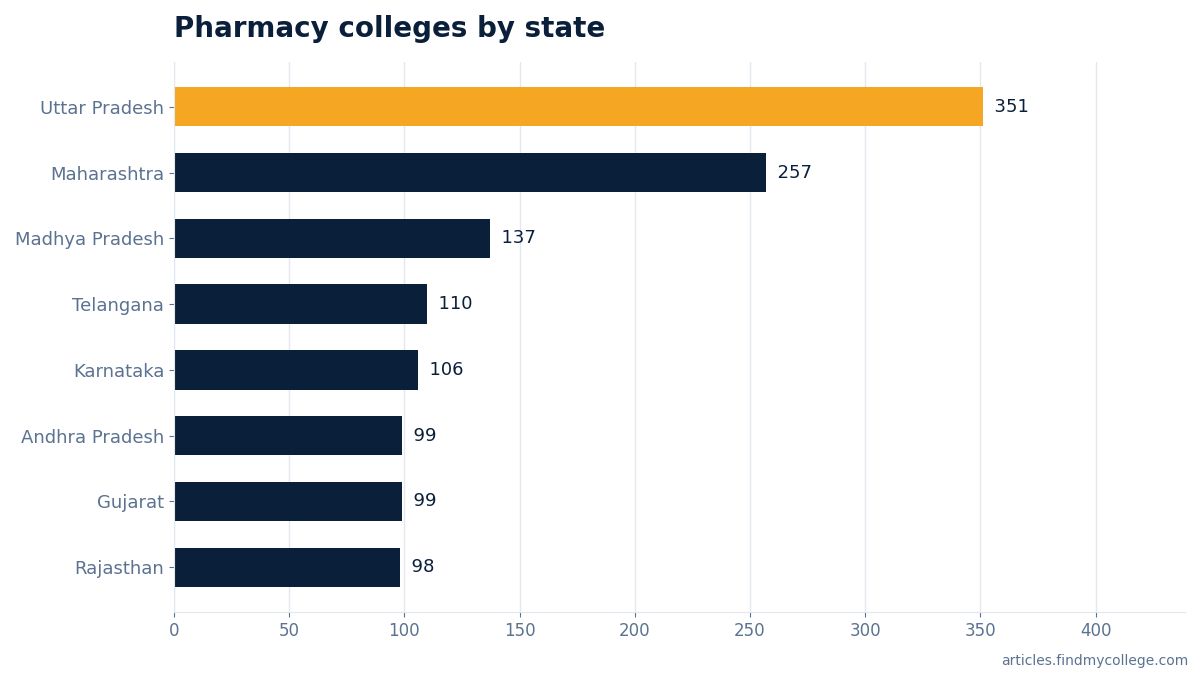
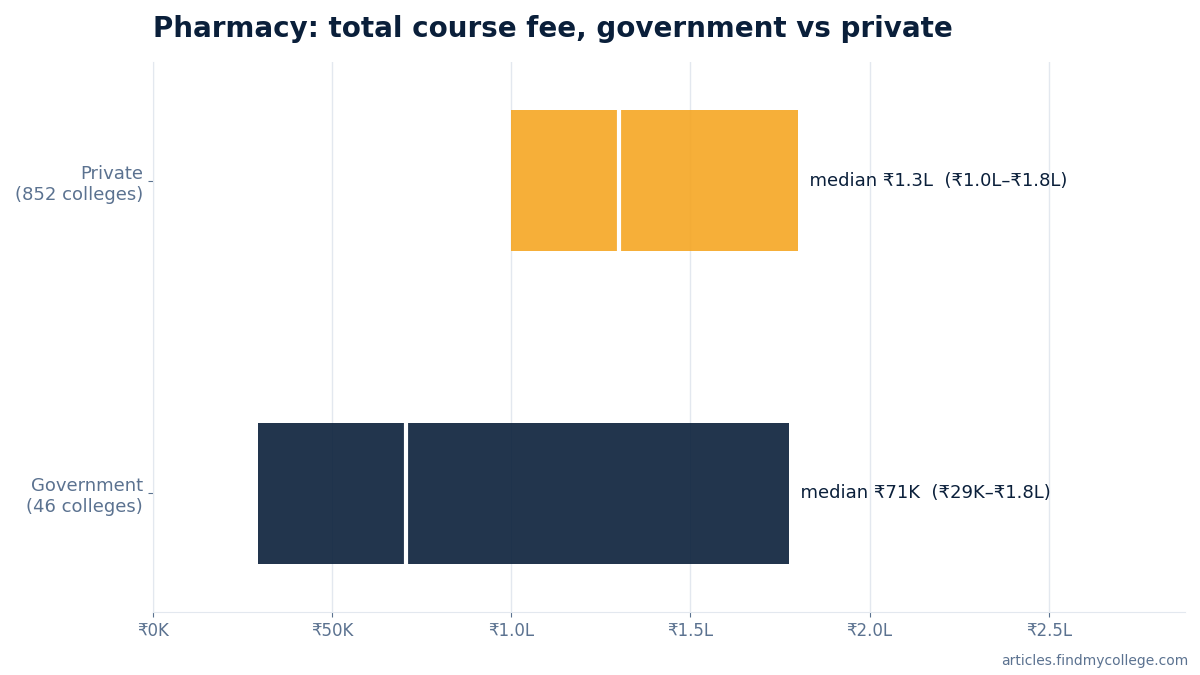
At least 1845 colleges offer Pharmacy in India, with private institutions having a median fee of ₹1.30 lakh and government colleges at ₹70,572. While JSS Academy of Higher Education & Research lists a ₹1.20 lakh fee for regular study, distance program fees remain unstated.
Job Roles after Pharmacy
| Job Role | Primary Responsibilities | Typical Employment Settings |
|---|---|---|
| Drug Inspector | Monitoring drug utility & safety, inspecting medical shops, sampling for spurious drugs | Government Drug Control Departments |
| Clinical Research Associate | Organizing and monitoring clinical trials of new drugs to assess safety & efficacy | Clinical Research Organizations, Pharma Labs |
| Regulatory Affairs Officer | Ensuring regulatory compliance, obtaining drug licenses, drafting official drug labels | Pharma Manufacturers, Regulatory Agencies |
| Medical Sales Representative | Promoting prescription drugs and medical devices to healthcare professionals | Pharmaceutical Marketing Divisions |
| College | City | Ownership | Total course fee | Average package |
|---|---|---|---|---|
| Bhagwati Institute of Technology and Science | Ghaziabad | Private | ₹1.62 lakh | 4.8 LPA |
| Technocrats Institute of Technology Bhopal | Bhopal | Private | ₹96,000 | 4.5 LPA |
| Bombay College of Pharmacy | Mumbai | Private (aided) | ₹2.40 lakh | 4 LPA |
| Shri Govindram Seksaria Institute of Technology and Science | Indore | Private (aided) | ₹1.70 lakh | 3.5 LPA |
| Raj Kumar Goel Institute of Technology | Ghaziabad | Private | ₹1.86 lakh | 3.5 LPA |
| Bharat Institute of Technology Meerut | Meerut | Private | ₹1.40 lakh | 3 LPA |
| Kailash Institute of Pharmacy & Management | Gorakhpur | Private | ₹1.00 lakh | 3 LPA |
| Al Ameen College of Pharmacy | Bangalore | Private | ₹1.40 lakh | 2.7 LPA |
| Jodhpur Institute of Engineering and Technology | Jodhpur | Private | ₹1.65 lakh | 2.64 LPA |
| IIMT Group of Colleges Greater Noida | Greater Noida | Private | ₹1.56 lakh | 2.54 LPA |
Pharmacy graduates can pursue roles like Drug Inspector, Clinical Research Associate, and Regulatory Affairs Officer across clinical care, research, and regulatory bodies. Among private colleges, average placement packages reach up to 4.8 LPA, with a median average package of 2.59 LPA across 28 colleges.
Higher Studies after Pharmacy
Pursuing higher education allows pharmacy graduates to specialize in focused scientific disciplines. The 2-year Master of Pharmacy (M.Pharm) requires a B.Pharm degree with a minimum 50% to 55% aggregate mark. Higher entrance tests like GPAT, AP PGECET, TS PGECET, and BITS HD serve as primary pathways for post-graduate admissions.
For advanced scientific research and academic careers, Ph.D. programs in Pharmacy span 3 to 5 years, requiring an M.Pharm degree with at least 55% aggregate marks. Doctoral aspirants qualify through examinations such as NIPER JEE, UGC NET, CSIR NET, or state-level SET exams.
Short-Term Certifications to Boost Pharmacy Skills
| Certification Title | Provider Organization | Duration | Estimated Fee (INR) |
|---|---|---|---|
| Certificate in Pharmacy Assistant (CPA) | National Council of Training Academy | 6 Months | INR 8,000 |
| Become a Pharmacy Technician | Udemy | 4 Hours 55 Mins | INR 649 |
| Essentials of Good Pharmacy Practice | Taipei Medical University (FutureLearn) | 3 Weeks | INR 550 |
| Industry Certificate in Pharmaceutical Sales and Marketing Management | IGMPI | 3 Months | INR 32,500 |
| Pharmacy for Beginners | Universiti Malaya (FutureLearn) | 3 Weeks | INR 770 |
Candidates must register with their respective State Pharmacy Council after obtaining a recognized qualification to practice pharmacy in India. Short-term certifications offer optional skill enhancement alongside formal academic degrees.
How to Start a Career as Pharmacy: Step by Step
- Check Eligibility Criteria: Pass 10+2 in Science stream with Physics and Chemistry as compulsory subjects alongside Mathematics or Biology, securing a minimum aggregate of 50%-55% marks.
- Register and Appear for Entrance Exams: Apply for state or national entrance tests such as GPAT, NIPER JEE, BITSAT, KCET, MH CET, OJEE, or MET depending on the course level.
- Enrol in a Recognized Institution: Secure admission into a D.Pharm, B.Pharm, or Pharm.D program offered by a Pharmacy Council of India (PCI) approved institution or recognized university.
- Complete Academic Curriculum and Practical Internship: Undergo theoretical coursework and complete mandatory industrial or hospital internship training (1 year compulsory for Pharm.D graduates).
- Register with State Pharmacy Council: Apply for registration with the respective State Pharmacy Council after obtaining a recognized qualification to receive a practice license.
- Apply for Jobs or Pursue Higher Education: Explore roles such as Drug Inspector or Clinical Research Associate, or apply for M.Pharm or Ph.D. specialization programs.
| What to do | Where | Link |
|---|---|---|
| Compare colleges, fees and cutoffs | Pharmacy colleges in India | findmycollege.com |
Completing a recognized pharmacy program and registering with the State Pharmacy Council enables graduates to practice legally in India. Candidates can then pursue professional job roles or enroll in advanced master’s and doctoral degrees.
FAQs
Is pharmacy a good career option in India?
Yes. India’s pharmaceutical market is projected to reach $130 billion by 2030. The field offers recession-proof stability, diverse job roles across manufacturing, clinical research, and hospitals, with an average salary of INR 2,91,945 per year.
Is pharmacy without NEET?
Yes.
What is the monthly income of pharmacy professionals in India?
The average salary for a professional pharmacist in India is INR 2,91,945 per year. Total compensation varies based on job profile, academic credentials, employer, location, and individual experience across clinical, industrial, and regulatory domains.
Which government job is best after pharmacy?
Key government jobs include Drug Inspector, responsible for monitoring drug quality and inspecting medical stores, and Hospital Pharmacist in government hospitals and public healthcare facilities. Candidates must register with their State Pharmacy Council to qualify for these positions.
Which job is best after B Pharmacy?
Top career profiles following a B.Pharm degree include Clinical Research Associate, Regulatory Affairs Officer, Drug Inspector, Formulation Development (F&D) Associate, Quality Control Associate, and Medical Sales Representative across leading pharmaceutical firms and clinical research labs.
What degree is required to open a medical drug store in India?
To open a retail drug store or pharmacy in India, completing at least a 2-year Diploma in Pharmacy (D.Pharm) from a PCI-approved institute and registering with the State Pharmacy Council is compulsory.