

PhD Degree in Economics: Eligibility, Admission Process and Scope
Nishit Kumar is a senior EdTech industry leader with over a decade of experience in building and scaling education platforms, shaping their product, content, and growth strategy. At…
- 29 Nov 2026Christ University PhD in Economics Application Deadline
Applications for the PhD in Economics programme across Christ University campuses remain open until 29 November 2026.
A PhD Degree in Economics is a 3 to 5-year doctoral program focused on advanced research in economic theory, econometrics, macroeconomics, microeconomics, and applied policy. Candidates require a Master’s degree in Economics or a related discipline with at least 55% aggregate marks, with selection based on entrance exams like UGC-NET, GATE, or university tests followed by an interview and research proposal defense.
The details below outline eligibility standards, step-by-step selection procedures, core syllabus subjects, fee structures across public and private institutes, top universities in India and abroad, and career prospects with salary expectations.
| Parameter | Details |
|---|---|
| Course Level | Doctorate / Doctoral Degree |
| Duration | 3 to 5 years (Full-Time) / 4 years (Extramural) |
| Eligibility Criteria | Post-graduate degree in Economics or related stream with at least 55% aggregate marks (or UG B.E./B.Tech toppers with 75% marks + GATE score) |
| Entrance Exams | UGC-NET, GATE, JCECE, GRE / GMAT (for foreign universities) |
| Course Fee Range | INR 30,000 per year to INR 80,000 – 6,00,000 for full course duration |
| Average Starting Salary | INR 2 to 8 LPA (Starting); up to INR 12 to 26 LPA for experienced professionals |
| Top Recruiters | Goldman Sachs, TCS, Infosys, Microsoft, ONGC, Reliance Industries, Bank of India, BPCL, Flipkart, Cognizant |
What is Ph.D. in Economics
| Parameter | Details |
|---|---|
| Course Level | Doctorate |
| Course Duration | 3 to 5 years (Full-Time) |
| Examination Type | Semester System |
| Minimum Eligibility | Master’s or M.Phil degree in Economics with 55% aggregate marks |
A Ph.D. in Economics is a doctoral program focused on macroeconomics and microeconomics.
Ph.D. in Economics Eligibility
Eligibility requirements for admission to a doctoral program in economics across Indian institutions include:
- Master’s Degree: Candidates must hold a Master’s or M.Phil degree in Economics or a relevant discipline with a minimum of 55% aggregate marks from a recognized university. For instance, Shiv Nadar Institution of Eminence accepts post-graduation in any discipline with at least 55% aggregate marks.
- Direct Entry for Engineering Graduates: Direct admission to a Ph.D. in Economics is available for top rankers holding a B.E. or B.Tech degree from reputed universities with at least 75% aggregate marks and a valid GATE score.
- M.Phil Exemption: Applicants who have completed an M.Phil degree through a formal entrance examination may be exempted from written Ph.D. entrance tests at several universities.
Ph.D. in Economics Admission Process
Admission to a Ph.D. in Economics involves qualifying through national or institutional entrance exams, followed by a research proposal defense and interview. National exams include UGC-NET, GATE, and state-level exams such as JCECE.
Institutional written tests evaluate fundamental analytical skills. For example, the written examination and interview at Shiv Nadar Institution of Eminence assess candidates across four domain areas: Microeconomics, Macroeconomics, Statistics & Econometrics, and Mathematical Economics. Shortlisted applicants present their research design to a departmental committee to secure final selection.
Ph.D. in Economics Syllabus and Subjects
- Microeconomics: Preference relations, choice rules, weak axiom of revealed preference, utility maximization, profit maximization, cost minimization, choice under uncertainty, and game theory.
- Macroeconomics: Neoclassical growth models (Solow model), dynamic optimization, micro-foundations of dynamic macroeconomic models, fiscal policy, Ricardian equivalence, and monetary policy.
- Statistics & Econometrics: Probability theory, statistical inference, heteroskedasticity, multicollinearity, linear regression models, maximum likelihood estimation, endogeneity, and binary choice models.
- Mathematical Economics: Linear algebra, real analysis, optimization appropriate for post-graduate economics, and concave-convex functions.
Written entrance tests and interviews evaluate candidate knowledge across microeconomics, macroeconomics, statistics, econometrics, and mathematical economics. Courses also cover research methodology and advanced topics in economics.
Top Ph.D. in Economics Colleges
| College | City | Ownership | Total course fee | NIRF rank |
|---|---|---|---|---|
| Indian Institute of Technology Madras | Chennai | Government | ₹30,850 | 1 (Overall, 2025) |
| Jawaharlal Nehru University | Delhi | Government | — | 2 (Overall, 2025) |
| Punjab Agricultural University | Ludhiana | — | ₹2.32 lakh | 3 (Overall, 2025) |
| Indian Institute of Technology Bombay | Mumbai | Government | ₹70,200 | 3 (Overall, 2024) |
| Jamia Millia Islamia University | Delhi | Government | — | 4 (Overall, 2025) |
| Indian Institute of Technology Kanpur | Kanpur | Government | ₹52,200 | 5 (Overall, 2025) |
| Delhi University | Delhi | Government | ₹7,130 | 5 (Overall, 2025) |
| Banaras Hindu University | Varanasi | Government | — | 6 (Overall, 2025) |
| ShereKashmir University of Agricultural Sciences and Technology of Jammu | Jammu | — | ₹1.01 lakh | 7 (Overall, 2025) |
| Birla Institute of Technology and Science Pilani | Pilani | Private | ₹1.93 lakh | 7 (Overall, 2025) |
in Economics across government and private sectors. Top-ranked government options include IIT Madras and IIT Kanpur, while BITS Pilani leads among top NIRF-ranked private institutes.
| College | City | Ownership | Total course fee |
|---|---|---|---|
| Birla Institute of Technology and Science Pilani | Pilani | Private | ₹1.93 lakh |
| Christ University | Bangalore | Private | ₹1.88 lakh |
| Chandigarh University | Chandigarh | Private | ₹4.38 lakh |
| VIT University Chennai | Chennai | Private | ₹1.33 lakh |
| Marwadi University | Rajkot | Private | ₹2.25 lakh |
| SVKM’s Narsee Monjee Institute of Management Studies Navi Mumbai | Navi Mumbai | Private | ₹3.00 lakh |
| PSG College of Arts and Science | Coimbatore | Private (aided) | ₹51,000 |
| Stella Maris College | Chennai | Private (aided) | ₹1.80 lakh |
| Dev Bhoomi Uttarakhand University | Dehradun | Private | ₹2.75 lakh |
| Kristu Jayanti College | Bangalore | Private | ₹2.40 lakh |
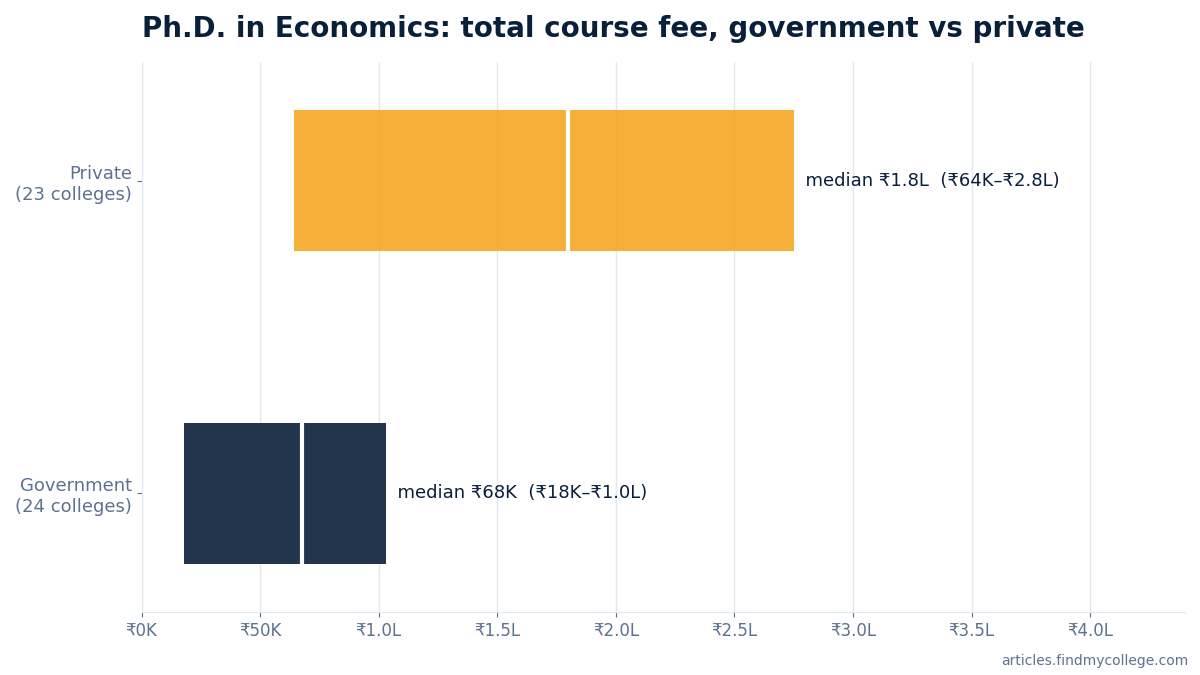
Private colleges offering doctoral programs in economics have a median total course fee of ₹1.80 lakh. Prominent private and private-aided institutions include BITS Pilani, Christ University, and Stella Maris College Chennai.
| City | Colleges | Fee range | Well-known options |
|---|---|---|---|
| Chennai | 26 | ₹30,850 – ₹1.80 lakh | Indian Institute of Technology Madras, University of Madras |
| Mumbai | 25 | ₹45,911 – ₹7.50 lakh | Indian Institute of Technology Bombay, Mumbai University |
| Pune | 22 | ₹70,550 – ₹3.40 lakh | Fergusson College, MIT World Peace University |
| Bangalore | 19 | ₹72,875 – ₹4.11 lakh | Alliance University, Christ University |
| Delhi | 17 | ₹7,130 – ₹2.25 lakh | Jamia Millia Islamia University, Delhi University |
| Jaipur | 16 | ₹30,970 – ₹12.00 lakh | Manipal University Jaipur, University of Rajasthan |
| Kolkata | 13 | ₹5,000 – ₹5.40 lakh | Jadavpur University, The West Bengal National University of Juridical Sciences |
| Ahmedabad | 12 | ₹60,000 – ₹2.45 lakh | Dr. Babasaheb Ambedkar Open University, Ahmedabad University |
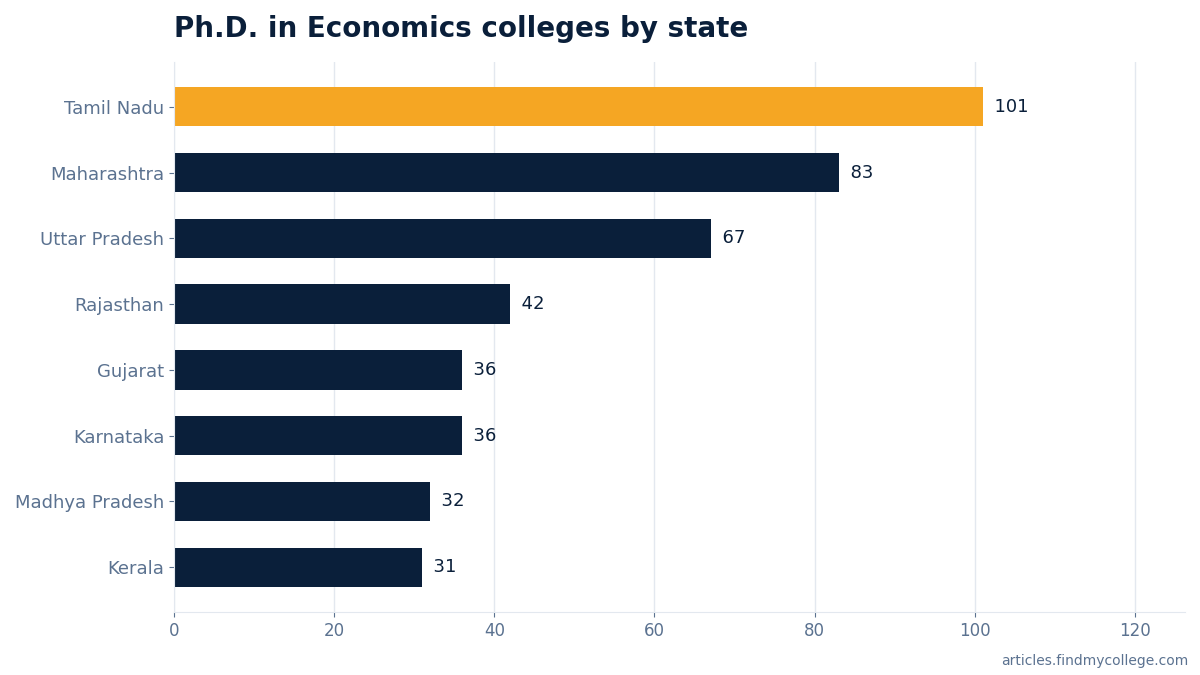
Tamil Nadu leads Indian states with 101 economics Ph.D. colleges, followed by Maharashtra with 83 and Uttar Pradesh with 67. Major academic hubs like Chennai, Mumbai, and Pune provide extensive options across diverse fee ranges.
| College | City | Ownership | Total course fee |
|---|---|---|---|
| Maulana Azad National Urdu University | Hyderabad | University | — |
| Vardhman Mahaveer Open University | Kota | — | ₹93,000 |
| Dr. B.R. Ambedkar Open University | Hyderabad | — | ₹48,000 |
| Tamil Nadu Open University | Chennai | — | ₹1.00 lakh |
| Indira Gandhi National Open University | Delhi | Government | ₹16,800 |
Distance and open university programs provide flexible doctoral pathways, including IGNOU in Delhi at ₹16,800 and Dr. B.R. Ambedkar Open University at ₹48,000.
Top Global Universities for PhD in Economics and International Scope
International doctoral programs in economics maintain rigorous selection standards, with acceptance rates ranging between 2.4 percent and 7.4 percent. Premier global institutions like Harvard University and the Massachusetts Institute of Technology (MIT) consistently top the QS and THE subject rankings for economics.
| Name of University | QS Ranking (Economics) | THE Ranking (Business & Economics) |
|---|---|---|
| Harvard University | 1 | 3 |
| Massachusetts Institute of Technology (MIT) | 2 | 1 |
| Stanford University | 3 | 2 |
| University of Chicago | 4 | 7 |
| University of California, Berkeley (UCB) | 6 | 4 |
| London School of Economics and Political Science (LSE) | 7 | 11 |
| Yale University | 8 | 9 |
| University of Oxford | 9 | 5 |
| University of Cambridge | 10 | 5 |
| Columbia University | 11 | 14 |
Ph.D. in Economics Career Scope and Salary
| Job Profile | Average Annual Salary (INR) |
|---|---|
| Research Assistant | Rs 3.10 to 5 Lakhs |
| Associate Professor | Rs 4 to 8 Lakhs |
| Research Scientist | Rs 6 to 12 Lakhs |
| Consultant | Rs 8 to 10 Lakhs |
| Professor | Rs 7.80 to 30 Lakhs |
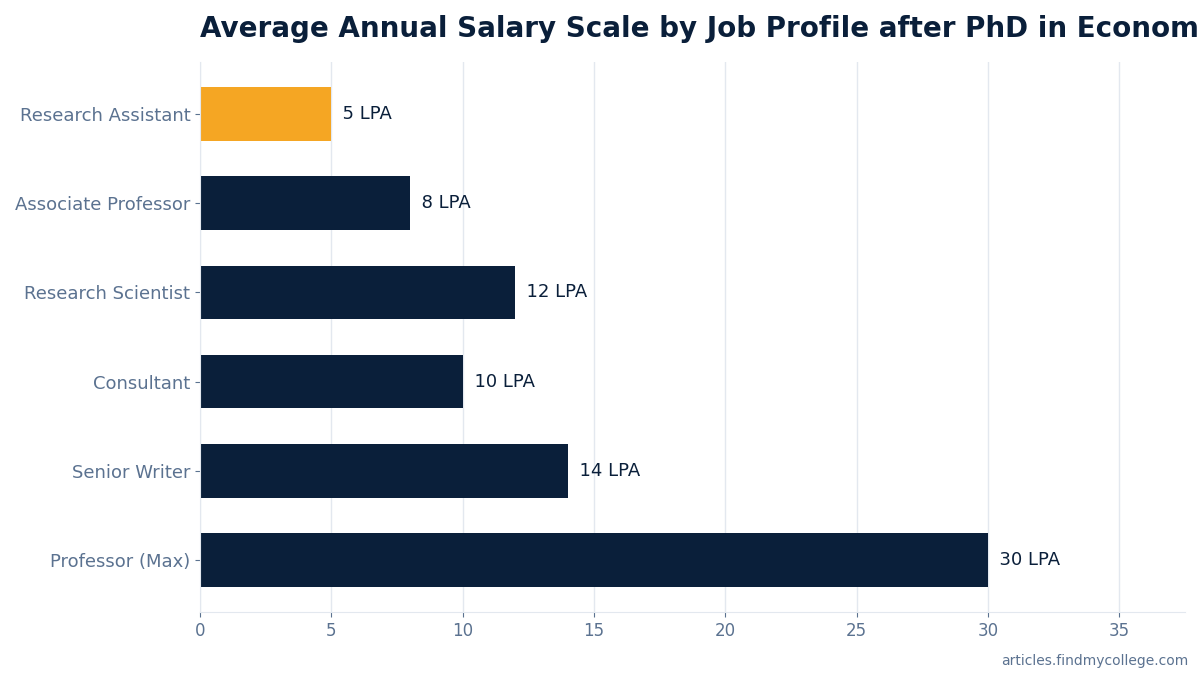
Graduates can sit for UPSC’s Indian Economic Service exam or join top recruiters like Goldman Sachs, TCS, and Microsoft.
How to Apply for Ph.D. in Economics Admission in 2026: Step by Step
- Check Eligibility Criteria: Confirm a Master’s or M.Phil degree in Economics with at least 55% aggregate marks, or direct entry for UG B.E./B.Tech toppers with 75% marks and a valid GATE score.
- Register for Entrance Exam: Apply for entrance tests such as UGC-NET, GATE, or JCECE. Candidates who cleared an M.Phil degree through an entrance test may be exempt from the Ph.D. level entrance exam.
- Prepare Research Proposal: Submit a research proposal detailing your proposed Ph.D. project outline and research methodology alongside the application.
- Appear for Written Entrance Test & Interview: Attend the institutional evaluation covering Microeconomics, Macroeconomics, Statistics & Econometrics, and Mathematical Economics, followed by an interview round.
- Complete Document Verification and Admission Formalities: Upon selection, verify transcripts and pay the applicable fees, such as the INR 30,000 annual fee for full-time Indian nationals at GITAM Hyderabad.
| What to do | Where | Link |
|---|---|---|
| Compare colleges, fees and cutoffs | Ph.D. in Economics colleges in India | findmycollege.com |
Candidates with an M.Phil qualification cleared via an entrance exam may bypass institutional written tests at several universities.
FAQs
Is it possible to get a PhD in economics?
Yes, candidates holding a Master’s degree in Economics or a related discipline with at least 55% aggregate marks can pursue a PhD in Economics through national entrance exams like UGC-NET or university-level entrance tests.
Are M.Phil graduates exempt from the PhD entrance exam?
Yes, candidates who cleared an M.Phil degree through an entrance test may be exempt from the Ph.D. level entrance exam at several universities.
Does PhD give you a higher salary?
Yes, earning a PhD in Economics increases earning potential. The average starting salary ranges between INR 2 to 8 Lakhs per annum, with high-paying roles earning between INR 12 to 26 LPA.
What are PhD degree fees?
In Indian colleges, the average tuition fee for a Ph.D. in Economics ranges between INR 80,000 to INR 6,00,000 for 3 to 5 years. Some institutes like GITAM Hyderabad charge an annual fee of INR 30,000.
Which college is best for a PhD in economics?
Top Indian institutes include Indian Statistical Institute (ISI) Kolkata, Indian Institutes of Technology (IITs), Indian Institutes of Management (IIMs), Fergusson College Pune, Loyola College Chennai, and Shiv Nadar IoE.
What are the eligibility criteria for PhD in Economics?
Candidates require a Master’s or M.Phil degree in Economics with a minimum 55% aggregate score. Engineering toppers with a B.E./B.Tech degree and 75% marks plus a GATE score can also apply directly.