

Ph.D in Education Salary in India 2026: Comprehensive Guide
Nishit Kumar is a senior EdTech industry leader with over a decade of experience in building and scaling education platforms, shaping their product, content, and growth strategy. At…
Latest update: Ph.D in Education 2026 admissions & dates updated. Read more ›
Pursuing a Ph.D in Education in India opens doors to diverse career paths in academia, research, policy-making, and educational leadership. While the primary motivation for a doctorate is often intellectual curiosity and contribution to knowledge, understanding the potential salary and career outcomes is crucial for prospective students. This comprehensive guide details the salary landscape for Ph.D in Education graduates in India for 2026, covering various roles, sectors, and factors influencing earning potential.
What is the average salary for a Ph.D in Education graduate in India?
The average starting salary for a Ph.D in Education graduate in India typically ranges from INR 6 LPA to INR 12 LPA, depending on the institution, sector (government vs. private), and specific role. With experience, this can significantly increase, often reaching INR 15 LPA to INR 30 LPA or more for senior positions.
A Ph.D in Education equips individuals with advanced research skills, pedagogical expertise, and a deep understanding of educational theories and practices. These skills are highly valued in academic institutions, research organizations, government bodies, and even corporate training departments. The salary package is influenced by several factors, including the reputation of the awarding university, the candidate’s research area, publications, and prior work experience.
What are the top job roles and their salaries after a Ph.D in Education?
Graduates with a Ph.D in Education can pursue a variety of specialized roles, primarily in academia and research. The salaries for these roles vary based on the institution type, location, and years of experience.
Professor/Assistant Professor
This is one of the most common and sought-after career paths. Ph.D holders are essential for teaching at university and college levels, guiding research, and contributing to curriculum development. Salaries are often governed by UGC (University Grants Commission) norms for government institutions.
- Assistant Professor: INR 7 LPA – INR 15 LPA (starting, as per 7th Pay Commission for government universities)
- Associate Professor: INR 12 LPA – INR 25 LPA
- Professor: INR 18 LPA – INR 35 LPA+
Educational Researcher/Analyst
These professionals work with research organizations, NGOs, government bodies, or even private educational companies to conduct studies, analyze data, and inform educational policies and practices.
- Entry-Level: INR 6 LPA – INR 10 LPA
- Mid-Career: INR 10 LPA – INR 18 LPA
- Senior/Lead Researcher: INR 18 LPA – INR 30 LPA+
Curriculum Developer/Specialist
Ph.D in Education graduates are well-suited to design, evaluate, and improve educational curricula for schools, colleges, and online learning platforms.
- Entry-Level: INR 5 LPA – INR 9 LPA
- Experienced: INR 9 LPA – INR 16 LPA
Educational Consultant
Consultants provide expert advice to educational institutions, government agencies, or private firms on various aspects like pedagogy, policy, technology integration, and institutional development.
- Independent Consultant (per project/retainer): Highly variable, can range from INR 50,000 to several lakhs per project.
- Consulting Firm Employee: INR 8 LPA – INR 25 LPA+ (depending on firm and experience)
School Principal/Administrator (Higher Education)
While often requiring prior teaching/administrative experience, a Ph.D can accelerate career progression into leadership roles within educational institutions.
- School Principal: INR 8 LPA – INR 20 LPA (varies greatly by school type and location)
- Dean/Director (Higher Ed): INR 15 LPA – INR 40 LPA+
Here’s a table summarizing potential salary ranges for key roles:
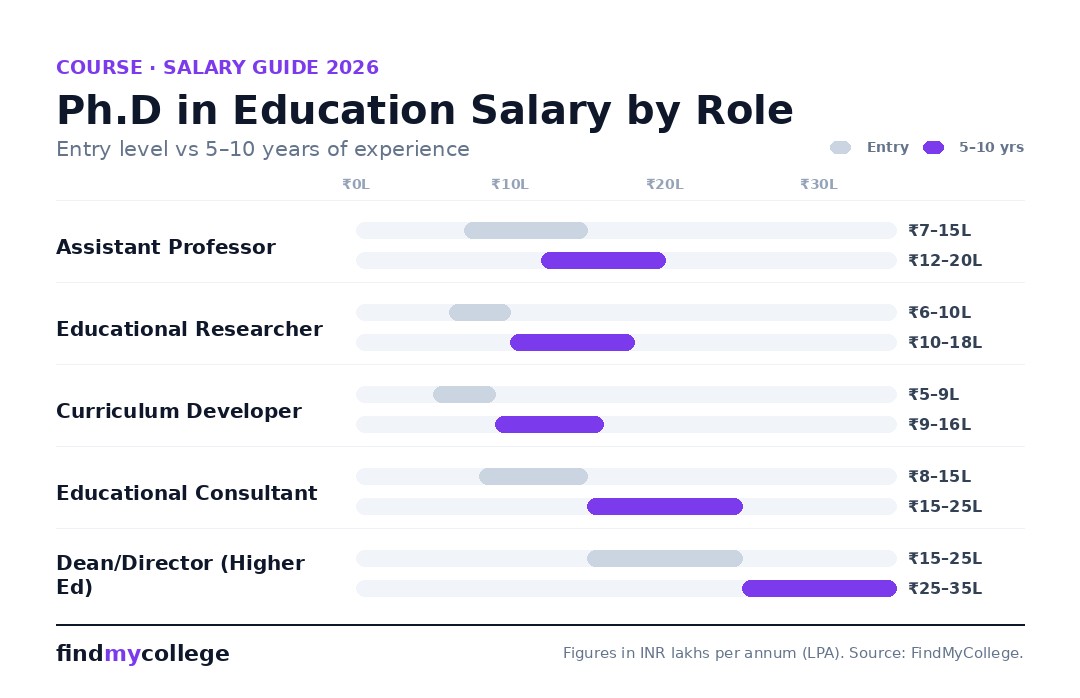
| Job Role | Entry-Level Salary (INR LPA) | Mid-Career Salary (INR LPA) | Senior-Level Salary (INR LPA) |
|---|---|---|---|
| Assistant Professor | 7 – 15 | 12 – 20 | 18 – 35+ (as Professor) |
| Educational Researcher | 6 – 10 | 10 – 18 | 18 – 30+ |
| Curriculum Developer | 5 – 9 | 9 – 16 | 15 – 25 |
| Educational Consultant | 8 – 15 | 15 – 25 | 25 – 40+ |
| Dean/Director (Higher Ed) | 15 – 25 | 25 – 35 | 35 – 50+ |
How does the type of institution (government vs. private) affect Ph.D in Education salaries?
Salaries for Ph.D in Education graduates differ significantly between government and private institutions. Government institutions (central and state universities, UGC-funded colleges) generally offer structured pay scales based on the 7th Pay Commission recommendations, often with better benefits and job security. Private institutions, while potentially offering higher starting salaries in some cases, often have more variable pay structures based on institutional policy, performance, and market demand.
- Government Institutions: Salaries are typically standardized, with increments and promotions based on UGC norms and seniority. Benefits like HRA, medical allowances, and pension schemes are often robust.
- Private Institutions: Salaries can be competitive, especially in well-established private universities. However, they might lack the same level of job security or comprehensive benefits package as government roles. Performance-based incentives are more common.
Is a Ph.D in Education worth it for job prospects and salary in India?
Yes, a Ph.D in Education is generally considered worthwhile for enhancing job prospects and salary potential, particularly for those aspiring to careers in academia, advanced research, or leadership roles in the educational sector. While the initial investment in time and effort is substantial, the long-term returns in terms of career advancement, intellectual satisfaction, and higher earning potential are significant.
A Ph.D provides a competitive edge in a crowded job market, especially for roles requiring specialized knowledge and research capabilities. It often becomes a prerequisite for senior academic positions (Associate Professor, Professor, Dean) and high-level research roles. The return on investment (ROI) is often seen over a longer career span, as doctoral graduates tend to have higher lifetime earnings compared to those with only a Master’s degree in Education.
What factors influence the salary of a Ph.D in Education graduate?
Several critical factors determine the salary package for a Ph.D in Education graduate in India:
- University Reputation: Graduates from top-tier universities (e.g., JNU, DU, BHU, TISS, central universities) often command higher salaries due to the perceived quality of their research and academic training.
- Research Specialization: Niche and in-demand research areas (e.g., educational technology, special education, policy analysis, psychometrics) can lead to better opportunities and higher pay.
- Publications & Conferences: A strong record of publications in reputed journals and presentations at national/international conferences significantly boosts a candidate’s profile and negotiation power.
- Teaching/Research Experience: Prior experience, even as a research assistant or guest lecturer during the Ph.D, is highly valued.
- Location: Metropolitan cities like Delhi, Mumbai, Bangalore, and Hyderabad generally offer higher salaries compared to smaller towns, though the cost of living is also higher.
- Sector: As discussed, government vs. private sector roles have different pay structures.
- Soft Skills: Strong communication, leadership, and collaboration skills are increasingly important for all roles and can influence salary negotiations.
How much does a Ph.D in Education cost in India?
The cost of pursuing a Ph.D in Education in India varies widely based on the type of institution. Government universities typically have significantly lower fees, ranging from INR 10,000 to INR 50,000 per annum. Private universities can charge substantially more, from INR 50,000 to INR 2,00,000 per annum or even higher for specialized programs or deemed universities.
It’s important to consider not just tuition fees but also other expenses like research materials, conference travel, living expenses, and potentially lost income if pursuing the Ph.D full-time without a fellowship. Many Ph.D students secure fellowships (e.g., UGC NET JRF, institutional fellowships) which provide a monthly stipend and often cover tuition fees, making the degree more accessible.
What are the career prospects for a Ph.D in Education outside of academia?
While academia is a primary destination, a Ph.D in Education also opens doors to meaningful careers outside traditional university settings:
- Government & Policy: Roles in ministries of education, NITI Aayog, NCERT, SCERTs, or other government agencies involved in educational policy formulation, evaluation, and implementation.
- Non-Governmental Organizations (NGOs): Working with NGOs focused on education, literacy, child development, or social justice, often in program design, monitoring & evaluation, or advocacy roles.
- Corporate Sector: Opportunities in corporate training and development, instructional design for e-learning companies, educational technology firms, or HR departments focusing on learning and development.
- International Organizations: Roles with UNESCO, UNICEF, World Bank, or other international bodies working on global education initiatives.
Explore more on FindMyCollege
Related pages for Ph.D in Education aspirants on findmycollege.com:
Frequently Asked Questions
What is the eligibility criteria for a Ph.D in Education in India?
Typically, candidates must hold a Master’s degree (M.A. Education, M.Ed, or equivalent) with at least 55% aggregate marks (50% for reserved categories) from a recognized university. Many universities also require candidates to clear an entrance examination and/or an interview.
Are there any entrance exams for Ph.D in Education?
Yes, most universities conduct their own entrance exams. Additionally, qualifying national-level exams like UGC NET (National Eligibility Test) with JRF (Junior Research Fellowship) often exempt candidates from the university entrance test and provide a stipend.
Can I pursue a Ph.D in Education part-time?
Many universities offer part-time Ph.D programs, especially for working professionals. The duration is typically longer than full-time programs, and eligibility criteria might include a minimum number of years of teaching or research experience.
What are the typical specializations within a Ph.D in Education?
Common specializations include Educational Psychology, Educational Technology, Curriculum Studies, Educational Administration & Leadership, Special Education, Educational Policy, Comparative Education, and Teacher Education.
How long does it take to complete a Ph.D in Education in India?
A full-time Ph.D in Education typically takes a minimum of 3 years and a maximum of 6 years. Part-time programs can extend up to 7-8 years.
Do Ph.D in Education graduates get good research funding opportunities?
Yes, Ph.D graduates, especially those in academic roles, are well-positioned to apply for research grants and funding from various national and international bodies like UGC, ICSSR, DST, and private foundations, which can significantly boost their professional profile and income.
What is the difference between a Ph.D in Education and an Ed.D?
While both are doctoral degrees, a Ph.D in Education (Doctor of Philosophy) is typically more research-intensive and theory-focused, preparing graduates for academic and research careers. An Ed.D (Doctor of Education) is often more practice-oriented, focusing on applying research to solve practical problems in educational settings, suitable for educational leaders and administrators.