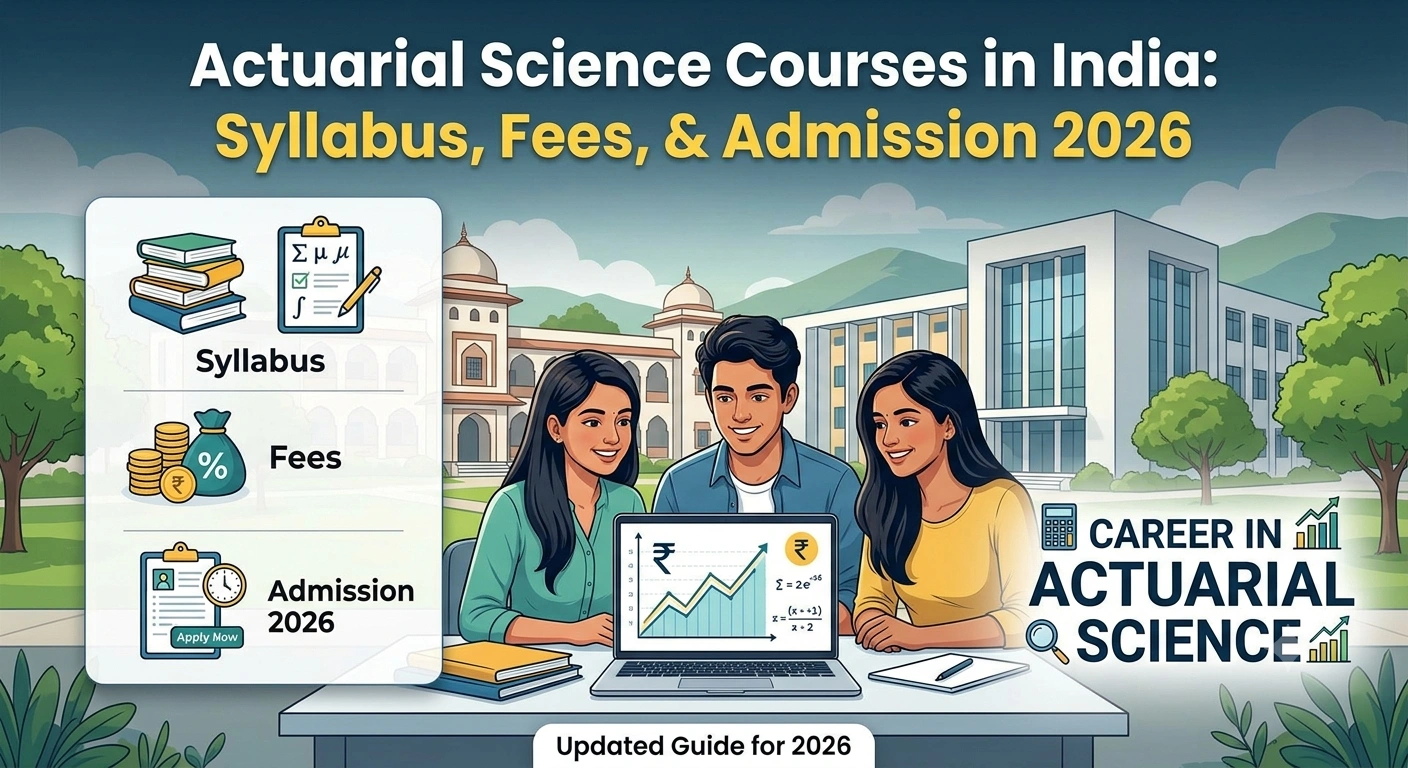
Actuarial Science Courses in India: Syllabus, Fees, & Admission 2026
An actuarial science course in India offers a challenging yet highly rewarding path for students passionate about mathematics, statistics, and financial risk management. This specialised discipline equips professionals to analyse future financial events, making it crucial for insurance, pension, and investment sectors. Here, you’ll find comprehensive details on the 2026 syllabus, fees, admission requirements, and leading institutions to kickstart your journey.
Actuarial Science Course Overview: Subjects, Syllabus, & Core Concepts 2026
The actuarial science course blends mathematics, statistics, finance, economics, and risk management to assess financial risks and forecast outcomes. It applies probability methods to foresee the financial impact of an uncertain future, guiding organisations with data-driven models for informed decisions.
- Course Focus: Blends math, stats, finance, economics, and risk management.
- Major Subjects: English, Mathematics, Statistics, Logic, and Data Interpretation.
- Key Disciplines: Math, Stats, Financial Economics, Insurance, Risk Modelling, Business Management.
- Course Levels: Undergraduate, Postgraduate, Diploma, Certificate, Doctorate.
- Course Duration: Certificate (3M-1Y), UG (3Y), PG (2Y), Diploma (1Y), Professional (5-7Y).
- Course Difficulty: Considered difficult due to rigorous training and demanding exams.
The actuarial science course syllabus, certified by the Institutes of Actuaries of India (IAI), is structured across four distinct stages, ensuring comprehensive training in core principles and specialised practices for 2026.
| Stage | Subject Code | Subject Name |
| CORE PRINCIPLES | CS1 | Actuarial Statistics |
| CORE PRINCIPLES | CS2 | Risk Modelling & Survival Analysis |
| CORE PRINCIPLES | CM1 | Actuarial Mathematics for Modelling |
| CORE PRINCIPLES | CM2 | Economic Modelling |
| CORE PRINCIPLES | CB1 | Business Finance |
| CORE PRINCIPLES | CB2 | Business Economics |
| CORE PRINCIPLES | CB3 | Business Management |
| CORE PRACTICES | CP1 | Actuarial Practice |
| CORE PRACTICES | CP2 | Modelling Practice |
| CORE PRACTICES | CP3 | Communications Practice |
| SPECIALIST PRINCIPLES | SP1 | Health & Care |
| SPECIALIST PRINCIPLES | SP2 | Life Insurance |
| SPECIALIST PRINCIPLES | SP4 | Pension and Other Benefits |
| SPECIALIST PRINCIPLES | SP5 | Investment & Finance |
| SPECIALIST PRINCIPLES | SP6 | Financial Derivatives |
| SPECIALIST PRINCIPLES | SP7 | General Insurance – Reserving & Capital Modelling |
| SPECIALIST PRINCIPLES | SP8 | General Insurance – Pricing |
| SPECIALIST PRINCIPLES | SP9 | Enterprise Risk Management |
| SPECIALIST ADVANCED | SA1 | Health & Care |
| SPECIALIST ADVANCED | SA2 | Life Insurance |
| SPECIALIST ADVANCED | SA3 | General Insurance |
| SPECIALIST ADVANCED | SA4 | Pensions & Other Benefits |
| SPECIALIST ADVANCED | SA7 | Investment & Finance |
Also Read: Actuarial Science Career in India: Job Roles, Salary, Top Recruiters, More
Institute of Actuaries of India (IAI) Course Structure & Exams 2026
The Institute of Actuaries of India (IAI), a statutory body established under The Actuaries Act 2006, offers a formal actuarial course in India. This structured education in actuarial science leads to an actuary qualification upon clearing all necessary examinations.
| Particulars | Details |
| Name of the Exam | Actuarial Common Entrance Test (ACET) |
| Duration | 3 hours, single slot |
| Total Marks | 100 |
| Number of Questions | 45 Questions – 1 mark each, 20 Questions – 2 marks each, 5 Questions – 3 marks each |
| Sections in the Exam | Section 1: Mathematics, Data Interpretation and Statistics, having 55% of weightage; Section 2: English and Logical Reasoning |
| Weightage of the Sections | Section 1 – 55% weightage; Section 2 – 45% weightage |
| Exam Centres | 24 (Mumbai, Delhi, Indore, Kolkata, Nagpur, Bangalore, Ranchi, Gurgaon, Kochi, Chennai, Bhubaneswar, Pune, Dehradun, Hyderabad, Patna, Raipur, Vizag, Jaipur, Coimbatore, Ahmedabad, Baroda, Lucknow, Guwahati and Chandigarh) |
| Sample Papers and Reference Books | Students will be able to access sample papers and books on the official website of IAI once they have registered for the exam. |
How to Pursue Actuarial Science in India: Step-by-Step Guide 2026
The actuarial science journey in India typically begins after Class 12, with the Institute of Actuaries of India (IAI) being the recognized body. This guide outlines the step-by-step process and key requirements to pursue this challenging yet rewarding actuarial science course.
| Step | Action and Description | Key Details & Requirements |
| 1 | Build a strong foundation in Mathematics | After Class 10th, take Commerce with Mathematics or Science with Mathematics (PCM). |
| 2 | Pursue relevant undergraduate or postgraduate studies (optional but recommended) | Examples: B.Sc. Mathematics, B.Sc. Statistics, B.Sc. Economics, B.Com, or direct Actuarial Science programs. Minimum academic eligibility: Class 12 with Mathematics or Statistics. |
| 3 | Register for and clear the Actuarial Common Entrance Test (ACET) | Gateway exam by IAI. Fee: ₹500. Mode: Online, 3 Hours, 70 MCQs, 50% qualifying marks. Sections: Mathematics (30), Statistics (30), Data Interpretation (15), English (15), Logical Reasoning (10). Exemption criteria available. |
| 4 | Become a Student Member of the Institute of Actuaries of India (IAI) | Essential for accessing study resources and applying for exams. One-time fee: ₹4,000. Yearly renewal: ₹2,000. |
| 5 | Begin the Actuarial Exam Journey | Clear professional actuarial exams structured into four levels by the IAI. Each paper exam fee: ₹3,000 – ₹10,000. Syllabus: Core Principles (7 papers), Core Practices (3 papers), Specialist Principles (choose 2 out of 9), Specialist Advanced (choose 1 out of 7). Average global pass rates: 30–40%. |
| 6 | Achieve professional designations | Become an Associate by clearing Core Principles and Core Practices stages. Become a Fellow by clearing all four stages and acquiring 3 years of relevant work experience. Number of papers sufficient to secure an Actuary job: 5 papers. Estimated total cost for full journey to Fellow: ₹3–5 lakhs (over 5–8 years). Average duration: 5–8 years. |
Also Read: Finance Certificate Courses (2026): Eligibility, Duration, Fees, Top Institutes & Job Scope
People Also Read




Online vs. Traditional Actuarial Science Courses: Pros & Cons 2026
This section explores the distinct advantages and disadvantages of online, traditio nal, and hybrid actuarial science courses for 2026 admissions. Prospective students can compare program durations, fees, eligibility, and unique benefits to choose the best actuarial science course path.
- Online/Distance BSc Actuarial Science Program Duration: 3 years
- Online/Distance BSc Actuarial Science Average Course Fees (per year): INR 27,000 to INR 30,000
- Online/Distance BSc Actuarial Science Eligibility: 10+2 with 50% marks in Mathematics
- Online/Distance BSc Actuarial Science Pros (Flexibility): Flexible learning schedule, study at own pace, 24/7 online material, recorded lectures.
- Online/Distance BSc Actuarial Science Pros (Cost): Lower course fees compared to regular mode education.
- Online/Distance BSc Actuarial Science Pros (Support): Expert faculty, 24/7 academic support, free counselling.
For those considering an online actuarial science course, key admission deadlines for 2026 are important to note.
| Institute | Admission Last Date |
| IMTS Institute | 30 June 2026 |
| Mangalayatan University | 29 June 2026 |
These dates highlight specific application windows for online BSc Actuarial Science programs.
- Traditional/Regular BSc Actuarial Science Program Duration: 3-4 years (Undergraduate)
- Traditional/Regular BSc Actuarial Science Average Course Fees (Undergraduate): ₹40,000 – ₹3.5 lakh
- Traditional/Regular BSc Actuarial Science Pros (Accreditation): Offered in regular mode as per UGC guidelines.
- Traditional/Regular BSc Actuarial Science Cons (Cost): Higher course fees compared to distance education.
Traditional actuarial science courses offer a structured learning environment, often at a higher cost.
- Hybrid MSc in Actuarial Science with Data Analytics Program Duration: 2 years
- Hybrid MSc in Actuarial Science with Data Analytics Accreditation: IFoA (UK) accredited; CAS Silver Level partner.
- Hybrid MSc in Actuarial Science with Data Analytics Pros (Flexibility & Rigor): Combines online flexibility with academic rigour and structured offline sessions.
- Hybrid MSc in Actuarial Science with Data Analytics Pros (Career Progression): Faster career progression with industry exposure, projects, and internships.
- Hybrid MSc in Actuarial Science with Data Analytics Pros (Training): Practical hands-on training with Python, R, VBA, Prophet.
- Hybrid MSc in Actuarial Science with Data Analytics Pros (Exam Success): Higher exam success rate via multiple assessments, strategic planning.
The Hybrid MSc program offers extensive benefits for career advancement and professional recognition in actuarial science.
| Benefit Category | Details |
| Networking | Strong industry network through connections with top recruiters, industry leaders, and fellow professionals. |
| Placement | 100% Placement Assistance. |
| IFoA Exemptions | Eligibility for up to 7 IFoA exams (CP1, CM1, CM2, CB1, CB2, CS1 and CS2). |
| CAS Waivers | Eligibility for up to 5 CAS academic waivers (Exam 1, Exam 2, MAS-I, VEE – Economics, and VEE – Accounting & Finance). |
| Learning Format | Live online classes, recorded lectures with LMS, offline examinations, offline networking events, capstone projects. |
These additional features highlight the comprehensive support and opportunities available through the Hybrid MSc program.
Top Universities & Colleges for Actuarial Science in India 2026
India offers a growing landscape for actuarial science course studies, with 23 colleges and 14 universities dedicated to the field. This section highlights top institutions, particularly those excelling in research performance, and identifies key cities for pursuing an Acturial Science Course.
| India Rank | University Name | City | State | Asia Rank | World Rank | Acceptance Rate | Founded Year |
| 1 | University of Delhi | Delhi | Haryana | #43 | #340 | 64% | 1922 |
| 2 | Symbiosis International University | Pune | Maharashtra | #93 | #578 | — | 2002 |
| 3 | Indian Statistical Institute | Kolkata | West Bengal | #122 | #693 | — | 1931 |
| 4 | IMS Unison University | Dehradun | Uttarakhand | #154 | #790 | — | 2013 |
| 5 | Indian Institute of Technology Delhi | Delhi | Haryana | #167 | #834 | 13% | 1961 |
| 6 | VIT University | Vellore | Tamil Nadu | #199 | #939 | 79% | 1984 |
| 7 | Manipal Academy of Higher Education | Manipal | Karnataka | #208 | #963 | 60% | 1993 |
| 8 | Jadavpur University | Kolkata | West Bengal | #211 | #971 | — | 1955 |
| 9 | Indian Institute of Technology Kharagpur | Kharagpur | West Bengal | #212 | #976 | 13% | 1951 |
| 10 | Christ University | Bangalore | Karnataka | #219 | #991 | 10% | 1969 |
| 11 | Amity University | Noida | Uttar Pradesh | #243 | #1039 | — | 2005 |
| 12 | Lovely Professional University | Phagwara | Punjab | #250 | #1052 | 80% | 2005 |
| 13 | Indian Institute of Technology Roorkee | Roorkee | Uttarakhand | #286 | #1113 | 13% | 1847 |
| 14 | University of Calcutta | Kolkata | West Bengal | #317 | #1180 | 22% | 1857 |
The University of Delhi leads the research performance rankings, with other top institutions like Symbiosis International University and the Indian Statistical Institute also featuring prominently. Delhi, Pune, and Kolkata emerge as significant hubs for actuarial science education, reflecting a strong academic presence.
Frequently Asked Questions
What is the step-by-step process to pursue Actuarial Science in India in 2026?
For 2026, pursue Actuarial Science in India by fulfilling specific eligibility for courses and applying to top colleges. The admission process varies based on the course level.
Which are the best actuarial science colleges in India?
India features over 29 actuarial science colleges. One notable institution in Pune, Maharashtra, was ranked #118th/300 for Science in 2026.
What is the best university in India for Actuarial sciences?
India has 14 universities ranked for Actuarial Science based on research performance. Delhi, Pune, Kolkata, and Dehradun are considered the best cities for study.
What is Acturial Science Course?
Actuarial Science courses teach skills to predict future financial risks by analyzing past data, ensuring company financial stability. This interdisciplinary field draws on mathematics, statistics, and economics.
What are the eligibility requirements for Acturial Science Course?
Eligibility varies by course level. For UG courses, candidates must pass Class 12 with Mathematics and a minimum 50% aggregate score.
How do I apply for Acturial Science Course?
Applying typically involves checking eligibility, completing an application form, and preparing for the entrance exam, which often requires 6-8 months of study.
Actuarial Science Courses in India – Frequently Asked Questions
What is Actuarial Science and what skills does it require?
Actuarial Science deals with evaluating risks and requires a strong foundation in Statistics, Analysis, and Mathematics. Practicing actuaries also utilize computer science to solve problems like insurance costs and investment hedging.
Is there a professional body for Actuarial Science in India?
Yes, the Institute of Actuaries of India (IAI) governs the actuarial profession in the country. The provisions for this body came into force on November 10, 2006, as notified by the Government of India.
What types of degrees or courses are available in Actuarial Science in India?
Many universities and colleges in India offer Actuarial Science courses, including Bachelor's degrees like B.Sc in Actuarial Science. Some institutions, such as Patkar-Varde College, offer a Bachelor’s Degree in Actuarial Science and Quantitative Finance.
How can students find top Actuarial Science colleges in India?
Students can find top Actuarial Science colleges in India through available rankings, such as those for 2026. These rankings often provide details on fees, admission processes, and placement records for various institutions.
What career opportunities are available after completing an Actuarial Science course?
A background in Actuarial Science prepares learners for a rewarding career in risk analysis and insurance. Graduates can hold positions such as actuaries, analysts, consultants, product managers, and financial advisers.