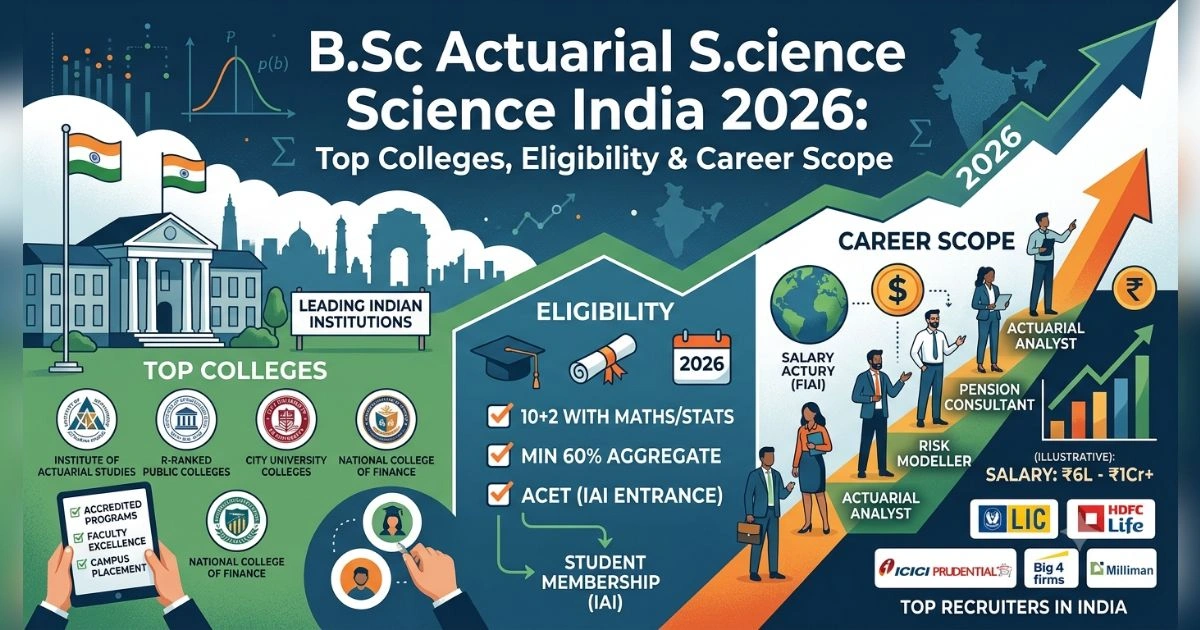
BSc Actuarial Science in India 2026: Top Colleges, Eligibility & Career Scope
Pursuing a B.Sc Actuarial Science degree in India offers a direct pathway to a high-demand, intellectually stimulating career focused on financial risk management. This specialised undergraduate program equips students with advanced mathematical, statistical, and economic modelling skills crucial for the insurance, pension, and finance sectors. Discover everything from top colleges and eligibility to career scope and professional exam pathways for your 2026 admissions journey.
What is B.Sc Actuarial Science in 2026? Definition & Scope
B.Sc Actuarial Science is an undergraduate program primarily focused on advanced mathematics, statistics, economics, finance, and risk management. This 3-year degree equips students with analytical skills to analyse financial risk and make informed business decisions, preparing them for a high-demand career.
| Field | Value |
| Course Name | BSc Actuarial Science |
| Full Form | Bachelor of Science in Actuarial Science |
| Eligibility | 10+2 with a minimum of 50% in Mathematics/Statistics |
| Duration | 3 years |
| Average Course Fees | Rs. 27,000 to Rs. 30,000 per year |
| Institute Name | IMTS Institute |
| Study Mode | Distance Education |
| Subjects | Mathematics, Probability, Statistics, Economics, Financial Mathematics, Risk Management |
| Program Level | Undergraduate |
| Age Limit | No specific age limit |
| Job Roles | Actuary, Risk Analyst, Financial Planner, Insurance Analyst, Data Analyst |
| Average Salary Offered | INR 3,00,000 – INR 8,00,000 per annum |
Top B.Sc Actuarial Science Colleges India 2026: Rankings, Fees, Eligibility & Admission Dates 2026
B.Sc Actuarial Science is a 3-year undergraduate programme that combines mathematics, statistics, finance, and risk management to prepare students for careers in insurance, investment banking, pension funds, and financial consulting. India has a limited but growing number of colleges offering a dedicated B.Sc in Actuarial Science, making seat competition notably high at top institutions. Graduates are also encouraged to pursue papers from the Institute and Faculty of Actuaries (IFoA, UK) or the Institute of Actuaries of India (IAI) alongside their degree for professional certification.
| Rank | College | Location | Type | Total Fees (3 Years) | Average Package | Admission Mode |
| 1 | Christ University | Bengaluru, Karnataka | Deemed (Private) | Rs. 7,74,000 | Rs. 7,50,000 LPA | Christ University Entrance Test |
| 2 | Amity University, Noida | Noida, Uttar Pradesh | Private | Rs. 5,66,500 | Rs. 9,60,000 LPA | Amity JEE / Merit |
| 3 | Sharda University | Greater Noida, UP | Private | Rs. 4,35,500 | Rs. 4,00,000 LPA | Merit / Direct |
| 4 | Chanakya University | Bengaluru, Karnataka | Private | Rs. 2,25,000 | Not Available | Merit / Entrance |
| 5 | Bishop Heber College | Tiruchirappalli, Tamil Nadu | Autonomous (Aided) | Rs. 1,08,000 | Not Available | TANCET / Merit |
| 6 | Vignan’s Foundation for Science, Technology and Research | Guntur, Andhra Pradesh | Deemed | Rs. 2,70,000 | Rs. 44,00,000 (Highest) | University Entrance / Merit |
| 7 | Sir Sitaram and Lady Shantabai Patkar College (SSLSPCAS) | Mumbai, Maharashtra | Autonomous (Aided) | Rs. 39,318 | Not Available | MHT CET / Merit |
| 8 | Kavayitri Bahinabai Chaudhari North Maharashtra University (NMU) | Jalgaon, Maharashtra | State University | Rs. 53,100 | Not Available | MHT CET / Merit |
| 9 | Babu Banarasi Das University (BBDU) | Lucknow, Uttar Pradesh | Private | Rs. 3,50,000 | Not Available | JEE Main / Merit |
| 10 | Rai Technology University (RTU) | Bengaluru, Karnataka | Private | Rs. 1,40,000 to Rs. 3,13,000 | Not Available | KCET / Merit |
| 11 | Sri Sathya Sai Institute of Higher Learning (SSSIHL) | Anantapur, Andhra Pradesh | Deemed | No Tuition Fee (fully funded) | Not Available | SSSIHL Entrance Test |
| 12 | Assam Down Town University | Guwahati, Assam | Private | Rs. 1,29,000 | Not Available | University Entrance / Merit |
| 13 | Kumaun University | Nainital, Uttarakhand | State University | Rs. 6,000 to Rs. 15,000 | Not Available | State Merit |
| 14 | Maharishi University of Information Technology (MUIT) | Noida, Uttar Pradesh | Private | Rs. 3,60,000 | Not Available | Merit / Direct |
| 15 | YCMOU (Distance Mode) | Nashik, Maharashtra | State Open University | Rs. 18,000 to Rs. 35,000 | Not Available | Direct Admission |
People Also Read



Eligibility Criteria for B.Sc Actuarial Science 2026
| Requirement | Details |
| Minimum Qualification | Class 12 (10+2) or equivalent from a recognised board |
| Compulsory Subject | Mathematics in Class 12 (mandatory at all institutions) |
| Minimum Percentage | 50% aggregate in Class 12 for the General category; 45% for SC/ST/OBC at most colleges |
| Additional Subject | Physics, Statistics, or Economics preferred at select colleges |
| Entrance Exam | Varies by institution (see table below) |
| Age Limit | No upper age limit at most institutions |
Also Read: MBA Finance Salary in India 2026: Average Pay, Job Roles, Top B-Schools & More
Entrance Exams Accepted for B.Sc Actuarial Science Admission 2026
| Entrance Exam | Accepted By | Exam Period |
| Christ University Entrance Test | Christ University Bengaluru | March to April 2026 |
| Amity JEE | Amity University Noida | March to May 2026 |
| MHT CET | NMU Jalgaon, SSLSPCAS Mumbai, Maharashtra colleges | May 2026 |
| KCET | Rai Technology University Bengaluru | May 2026 |
| TANCET | Bishop Heber College, Tamil Nadu colleges | May 2026 |
| JEE Main | BBDU Lucknow, select private universities | January and April 2026 |
| SSSIHL Entrance Test | Sri Sathya Sai Institute of Higher Learning | March 2026 |
| Merit Based (Class 12 Marks) | Kumaun University, YCMOU, most state universities | June to July 2026 |
Admission Dates for B.Sc Actuarial Science 2026
| College | Application Start | Application Last Date | Admission Process | Session Start |
| Christ University | January 2026 | April 2026 | Entrance Test + Interview | July 2026 |
| Amity University, Noida | January 2026 | June 2026 | Amity JEE / Merit | July 2026 |
| Sharda University | January 2026 | June to July 2026 | Merit / Direct | July 2026 |
| Chanakya University | February 2026 | June 2026 | Merit / Entrance | July 2026 |
| Bishop Heber College | March 2026 | June 2026 | TANCET / Merit | July 2026 |
| NMU Jalgaon | March 2026 | July 2026 | MHT CET / Merit | July 2026 |
| BBDU Lucknow | January 2026 | July 2026 | JEE Main / Merit | July 2026 |
| Kumaun University | April 2026 | July 2026 | Merit (Class 12) | July to August 2026 |
| YCMOU (Distance) | April 2026 | September 2026 | Direct Admission | July 2026 |
Fee Comparison: Government vs Private B.Sc Actuarial Science Colleges
| Category | Total Fees (3 Years) | Examples |
| Government / State University | Rs. 6,000 to Rs. 55,000 | Kumaun University, NMU Jalgaon, SSLSPCAS Mumbai |
| Autonomous Aided | Rs. 1,00,000 to Rs. 2,00,000 | Bishop Heber College, Vignan’s University |
| Deemed / Private (Budget) | Rs. 2,00,000 to Rs. 4,50,000 | Chanakya University, Sharda University, BBDU |
| Deemed / Private (Premium) | Rs. 5,00,000 to Rs. 8,00,000 | Christ University, Amity University |
| Fully Funded | No tuition fee | SSSIHL Anantapur |
B.Sc Actuarial Science vs Professional Actuarial Exams
Most colleges in India integrate their B.Sc curriculum with preparation support for IAI (Institute of Actuaries of India) or IFoA (UK) professional examinations. Students who clear CT (Core Technical) papers during their degree gain a significant head start in professional certification:
| Professional Body | Country | Number of Exams | Recognition |
| Institute of Actuaries of India (IAI) | India | 15 papers (CS, CM, CB, SP, SA series) | Recognised by IRDAI, PFRDA, Government of India |
| Institute and Faculty of Actuaries (IFoA) | UK / Global | 13 papers | Globally recognised; accepted in 50+ countries |
| Society of Actuaries (SOA) | USA | 10 exams | Preferred for US and international roles |
| Casualty Actuarial Society (CAS) | USA | 9 exams | Specialised in property and casualty insurance |
Career Outlook: Qualified actuaries in India earn between Rs. 8,00,000 and Rs. 35,00,000 per annum at entry to mid-level positions. The demand for actuaries is growing rapidly in life insurance, general insurance, health insurance, pension funds, and risk consulting firms like Deloitte, KPMG, Towers Watson, and Milliman. India currently has fewer than 500 fully qualified fellows of IAI against a growing demand of 5,000+ — making this one of the most future-proof and high-paying careers in the finance sector.
B.Sc Actuarial Science Admission Process 2026: Key Steps & Deadlines
Registration has started for the July 2026 session for B.Sc Actuarial Science at IMTS Institute, with applications open at various universities. This section details key admission steps, deadlines, eligibility, and top colleges for the BSc Actuarial Science program.
- Admission Status (IMTS Institute): Registration has started for the July 2026 session.
- Application Deadline (IMTS Institute): 30 June 2026.
- Application Deadline (Mangalayatan University): 29 June 2026.
- Application Window (Christ University): Open from 08-Dec-2025 until 07-Jun-2026.
- General Eligibility (Academic): Class 12 or equivalent from a recognised Indian Board.
- General Eligibility (Subject): Mathematics or Statistics as a compulsory subject in Class 12.
Beyond general requirements, specific institutes have their own criteria and admission processes. Most admissions are entrance exam-based, with some colleges conducting their own tests or accepting national-level scores.
| Category | Detail |
| General Eligibility (Minimum Percentage) | Minimum 70% aggregate marks in compulsory subjects (may vary by institute). |
| Eligibility (IMTS Institute, Distance Education) | 10+2 with 50% marks and Mathematics as a compulsory subject. |
| Eligibility (Mangalayatan University, Distance Education) | 50% in 12th with Mathematics. |
| Eligibility (Thakur College of Science & Commerce) | Higher Secondary School Certificate (Std. XII) with minimum 50% aggregate marks or equivalent. |
| Admission Process (IMTS Institute, Distance Education) | Visit official website, consult counsellor, fill admission form, complete process as per instructions. |
| Admission Process (Thakur College of Science & Commerce) | Register for Aptitude Test and Interview. Admission based on academic, non-academic, test, and interview performance. |
| Recommended Entrance Exam | Actuarial Science Entrance Exam conducted by the Institute of Actuaries of India. |
Also read: Scope of Doing MBA Finance in India (2026): Jobs, Salary, Top Recruiters & Future
| College Name | Admission Process | BSc Actuarial Science Fee (Average) |
| Amity University | Entrance based-Merit based | INR 1,05,000 |
| Lovely Professional University | Jalandhar | INR 90,000 |
| Bishop Heber College | Entrance based-Merit based | INR 97,000 |
| Yashwantrao Chavan Maharashtra Open University | Nashik | INR 1,12,000 |
| Kavayitri Bahinabai Chaudhari North Maharashtra University | Entrance based-Merit based | INR 17,000 |
| Amity School of Insurance Banking and Actuarial Science | Noida | INR 1,05,000 |
| Jain University | Entrance based-Merit based | INR 1,24,000 |
| Chandigarh University | Entrance based-Merit based | INR 60,000 |
| University of Petroleum and Energy Studies | Dehradun | INR 3,92,500 |
| NIMS University | Jaipur | INR 40,000 per annum |
B.Sc Actuarial Science Syllabus 2026: Core Subjects & Exam Preparation
The BSc Actuarial Science program spans 3 years and 6 semesters, offering a comprehensive curriculum aligned with professional actuarial examinations. This section details the core subjects, program structure, and essential information for preparing for qualifying exams like ACET.
| Semester | Subjects of Study |
| Semester-I | Mathematics for Actuaries |
| Semester-I | Descriptive Statistics |
| Semester-I | Interest Rates and Annuities |
| Semester-I | Basics of Accounting |
| Semester-II | Business Economics I |
| Semester-II | Probability and Distributions |
| Semester-II | Advanced Applications of Annuities |
| Semester-II | Corporate Finance |
| Semester-III | Business Economics II |
| Semester-III | Estimation and Hypotheses Testing |
| Semester-III | Life Insurance: Principles, Products, Practices |
| Semester-III | Communication and Research Methodologies |
| Semester-IV | Stochastic Processes |
| Semester-IV | Survival Analysis |
| Semester-IV | Non-life Insurance: Principles, Products, Practices |
| Semester-IV | Excel, Macros With Visual Basic |
| Semester-V | Risk Models for General Insurance |
| Semester-V | Reserving and Time Series |
| Semester-V | Business Environment and Enterprise Risk Management |
| Semester-V | Actuarial Applications Using EXCEL |
| Semester-VI | Life Insurance Pricing |
| Semester-VI | Reserving and Joint Life Distributions |
| Semester-VI | Portfolio Theory Development |
| Semester-VI | Derivative Pricing and Risk Management |
This detailed syllabus for the BSc Actuarial Science program covers a progression of subjects from foundational mathematics and statistics to advanced topics in insurance, finance, and risk management across six semesters.
- Subject 1: Functions of Mathematics
- Subject 2: 2 Dimensional Analytical Geometry
- Subject 3: Essential usages of English Language
- Subject 4: Application and Numerical Methods
- Subject 5: Understanding self for Effectiveness
| Particulars | Details |
| Conducting Body | IAI |
| Mode | Online |
| Duration | 3 Hours |
| Questions | 70 MCQs |
| Frequency | 3 times a year |
| Qualifying Marks | 50% |
The ACET exam, conducted online by IAI, is a 3-hour test with 70 MCQs, held three times a year, requiring 50% for qualification.
| Section | Marks |
| Mathematics | 30 |
| Statistics | 30 |
| Data Interpretation | 15 |
| English | 15 |
| Logical Reasoning | 10 |
The ACET exam evaluates candidates across five key sections: Mathematics, Statistics, Data Interpretation, English, and Logical Reasoning, each contributing specific marks to the total score.
| Level | Subjects |
| Core Principles | CS1, CS2, CM1, CM2, CB1, CB2, CB3 |
| Core Practices | CP1, CP2, CP3 |
| Specialist Principles | SP1–SP9 |
| Specialist Advanced | SA1–SA7 |
The Actuarial Science syllabus from IAI is structured into Core Principles, Core Practices, Specialist Principles, and Specialist Advanced levels, aligning the academic program with professional qualification requirements.
- Knowledge: Strong mathematical and statistical knowledge
- Thinking: Analytical thinking and problem-solving
- Technical: Technical skills (Excel, R, Python)
- Business: Understanding of finance and business
- Communication: Communication skills
- Method 1: Lectures
- Method 2: Practical Sessions
- Method 3: Research Papers
- Method 4: Seminars
- Method 5: Group Discussions
- Method 6: Traditional Classroom-Based Teaching
- Topic 1: Functions of Mathematics
- Topic 2: Geometry
- Topic 3: General Insurance
- Topic 4: Statistics
- Topic 5: Calculus Application
The B.Sc Actuarial Science program has a duration of 3 Years across 6 Semesters. Its curriculum scope broadly covers mathematics, statistics, finance, economics, and risk management, aligning with the requirements for qualifying actuarial examinations from esteemed institutes like the Institute of Actuaries of India (IAI) and the Institute and Faculty of Actuaries (IFOA).
Also Read: Scope of Accounting and Finance in India (2026): Jobs, Salary, Top Recruiters & Future
Actuarial Science Career Scope 2026: Job Roles, Salaries & Recruiters
Graduates with a BSc Actuarial Science degree can expect a salary range of INR 2.5 LPA – INR 15 LPA, with starting salaries around 3 Lakhs per annum. This section details the diverse job roles, salary expectations, and major recruiters shaping the actuarial science career landscape.
| Job Profile | Job Description |
| Budget Analyst | These professionals are responsible for analyzing financial data, developing budget plans and monitoring spending. |
| Economist | Economists use economic theories, models and data to analyze various aspects of the economy like production distribution and consumption of goods and services. |
| Actuary | The main job of an actuary is to analyze risk situations and provide preventative measures and solve such problems. They are mostly required in insurance and pension domains as they can foretell future wrongs. |
| Mathematician | They do a lot of research in developing mathematical principles. Mathematicians evaluate data and apply mathematical tools and techniques in solving real-world problems. |
| Cost Estimator | A cost estimator is a professional who analyzes project requirements and specifications to estimate the expected costs involved. |
| Financial Analyst | These professionals work in various industries including banking and investment firms to analyze financial data, market trends and economic factors. |
| Insurance Underwriter | They decide whether the insurance companies provide insurance to individuals or organisations and if yes then on what terms and conditions. They also look into insurance premiums and coverage amounts. |
| Post-Secondary Teacher | These teachers help students by teaching them technical subjects related to finance and insurance. They also publish books and scholarly articles in the insurance domain and conduct a lot of readers around Actuarial Science. |
Actuarial Professional Exams 2026: IAI & IFoA Exemptions & Pathways
Navigating actuarial professional exams in 2026 involves understanding various pathways and exemptions offered by the Institute of Actuaries of India (IAI) and the Institute and Faculty of Actuaries (IFoA). Students with a BSc Actuarial Science degree can benefit from direct entry exemptions, streamlining their journey towards an actuarial qualification.
- IAI Direct Entry Exemption: A BSc Actuarial Science degree grants Year 1 exemption.
- IAI ACET Registration Fee: Free from 2026 onwards.
- IFoA Entrance Exam: No entrance exam required for student membership.
- Core Principles Syllabus: IAI and IFoA CS1, CS2, CM1, CM2, CB1, CB2 syllabi are identical.
- IAI to IFoA Fellowship: FIAI designation allows FIA status via MRA with 3+ years experience.
- SOA Waiver Eligibility: Waivers are granted for specific IAI exams, or IFoA equivalent.
These pathways highlight opportunities for aspiring actuaries to gain exemptions and navigate professional bodies efficiently. While IAI and IFoA share core syllabi, their specific exam structures and membership requirements differ, offering varied routes to qualification.
| Institute of Actuaries of India (IAI) Exams Passed | Waivers from SOA Examination |
| Core Statistics (CS1) or CT3 prior to 2019 | Exam P and VEE Mathematical Statistics |
| Core Mathematics (CM1) or CT1 prior to 2019 | Exam FM |
| Core Business Finance (CB1) or CT2 prior to 2019 | VEE Accounting and Finance |
| Core Business Economics (CB2) or CT7 prior to 2019 | VEE Economics |
B.Sc Actuarial Science vs B.Sc Quantitative Finance: Course Comparison 2026
This comparison details key aspects of the B.Sc. Actuarial Science & Quantitative Finance and the B.Sc. in Actuarial Science programs. A significant distinction is that the B.Sc Actuarial Science & Quantitative Finance program is India’s only degree accredited by IFoA for up to six actuarial paper exemptions, offering a strong foundation for a career in BSc Actuarial Science.
| Feature | B.Sc. Actuarial Science & Quantitative Finance (Patkar-Varde/Thakur) | B.Sc. in Actuarial Science (DYPU) |
| Program Name | B.Sc. in Actuarial Science and Quantitative Finance | B.Sc. in Actuarial Science |
| Duration | 3 years, Full-time | 3 years, Full-time, On Campus |
| Affiliation/University | University of Mumbai (conferred by Patkar-Varde College, affiliated to University of Mumbai; also offered by Thakur College of Science and Commerce) | DY Patil University, Navi Mumbai (Vijay Patil School of Management) |
| Fees (2026-27) | INR 5,00,000/- per year | |
| Intake Capacity | 60 Students (Thakur College) | |
| Total Credits | 132 (Thakur College) | |
| Credits per Semester | 22 (Thakur College) | |
| Academic Commencement | Academic Year 2026–2027 (Thakur College) | |
| Eligibility | Cleared HSC or equivalent (Science/Commerce/Arts), QAT/ACET/any Actuarial Paper and interview (Patkar-Varde); Class 12 (H.S.C.) or equivalent in any stream, Mathematics in Class 12, min 40% aggregate (Thakur) | Pass in Class XII examination (Maharashtra Board or equivalent) with Mathematics as compulsory subject, min 50% aggregate (45% for reserved category) |
| Accreditation/Exemptions | India’s Only Degree Program to be accredited by IFoA for Exemptions (up to 6 Actuarial Papers: CM1, CM2, CS1, CS2, CB1 & CB2) | Aligned with global actuarial certifications (IFoA, SOA, IAI); Accreditation |
| Internship | 2-months Mandatory Internships (in penultimate year), 100% Job Placement Assistance | Summer Internships (typically during 3rd year), dedicated career services, internship opportunity integrated into the programme |
| Specialization | Elective A: Actuarial Science, Elective B: Quantitative Finance (from Semester 5) | Flexible electives that let students broaden into data science, analytics, and risk management |
| International Exposure | International Tie-ups At Australia And UK And Internship Opportunities | edX (MIT and Harvard), Harvard Business School Online |
| Faculty Experience | Industry Experts with 40+ Years of Cumulative Experience | Experienced faculty, qualified actuaries, finance professionals, and industry practitioners |
Frequently Asked Questions
What are the entry requirements for a BSc in Actuarial Science?
Applicants must qualify in the 10+2/12th final examination with a minimum 50% in the science stream from a recognized university and pass an entrance examination. Admission is merit-based.
What career opportunities are available after a BSc Actuarial Science degree?
Graduates pursue careers in insurance, finance, consulting, and risk management. They apply mathematical, statistical, and financial techniques to assess and manage risks in various industries.
How does BSc Actuarial Science differ from a general mathematics degree?
BSc Actuarial Science is a specialized mathematics degree accredited by the Institute and Faculty of Actuaries, offering up to 5 professional exam exemptions (CS1, CS2, CM1, CB1, CB2), unlike a general mathematics degree.
What professional exemptions can I gain with a BSc Actuarial Science?
A BSc Actuarial Science can provide up to 5 exemptions from the Institute and Faculty of Actuaries’ professional examinations (CS1, CS2, CM1, CB1, CB2), subject to satisfactory performance and module options.
When do applications typically open for BSc Actuarial Science programs?
Applications for BSc Actuarial Science programs, such as distance education for the 2026-27 academic session at IMTS Institute, typically open well in advance of the study period.