Top BSc Courses After 12th Science: Specializations, Scope, & Selection Guide 2026
Discover the best BSc courses after 12th Science in 2026 with top specializations, career scope, eligibility, and high-paying opportunities in India.
Choosing the right BSc courses after 12th is a pivotal decision that shapes your academic and professional future. As the landscape of higher education and industry evolves rapidly towards 2026, a diverse array of specializations offers incredible opportunities to align your passions with high-demand careers. From cutting-edge technology to vital healthcare and environmental fields, a BSc degree provides a robust foundation for growth. This comprehensive guide will help you explore top specializations, understand their scope, and select the best course based on your interests and career aspirations.
Most In-Demand BSc Specializations After 12th Science in 2026
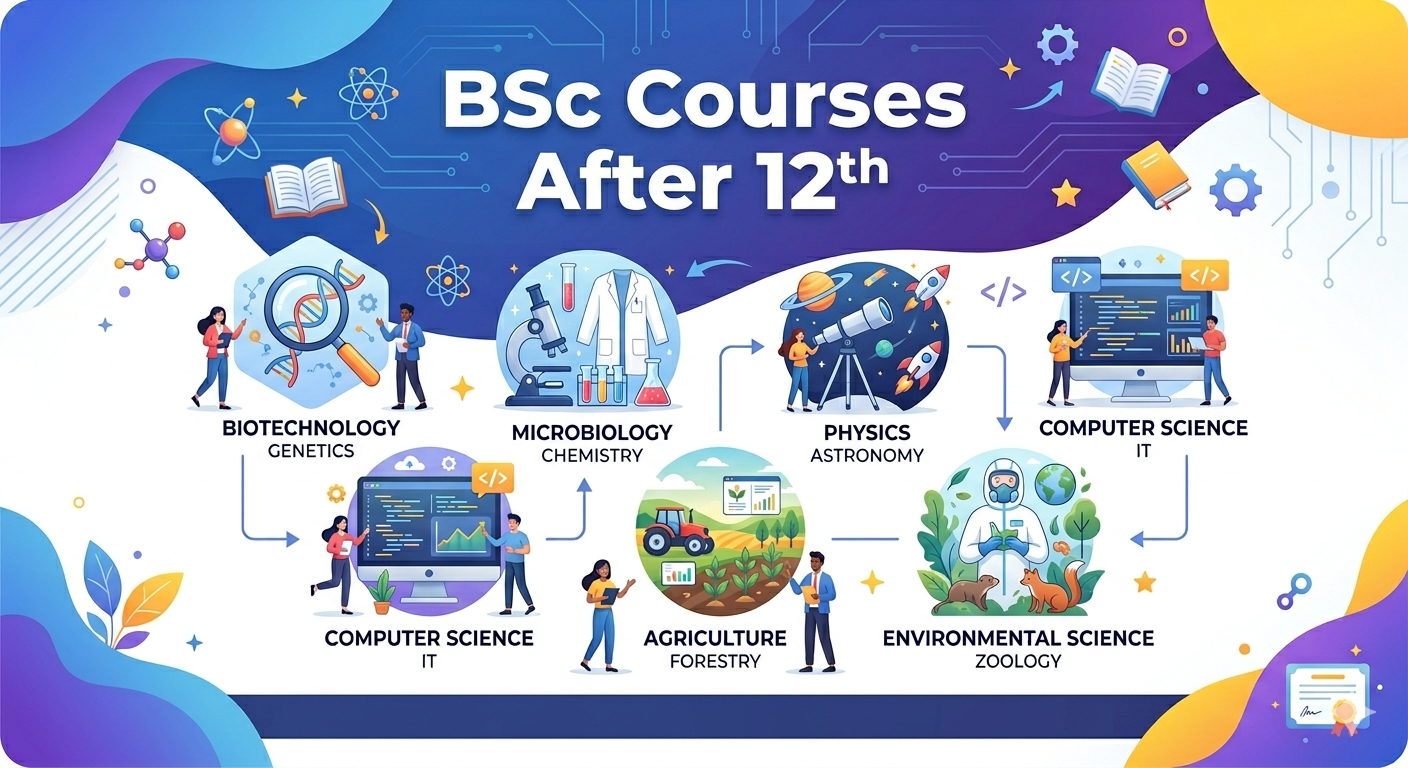
The science sector is experiencing rapid growth, leading employers to specifically seek graduates from B.Sc. programs. This section highlights the most in-demand bsc courses after 12th science for 2026, detailing various specializations and their promising career prospects.
| B.Sc. Course | Duration | Best Career Paths | Growth Outlook |
| B.Sc. in Biotechnology | 3-4 Years | – Pharma R&D – Genomics – Vaccine development – Biotech startups | Very High |
| B.Sc. in Chemistry | 3-4 Years | – Drug discovery – Materials science – Industrial catalysis – Quality control | High |
| B.Sc. in Physics | 3-4 Years | – Instrumentation – Space research – Optics – Quantum technology – Data science | High |
| B.Sc. in Mathematics | 3-4 Years | – Data science – Cryptography – Algorithm design – Financial modelling – Actuarial roles | Very High |
| B.Sc. in Economics | 3-4 Years | – Economic modelling – Policy research – Banking – Consulting – Development studies | High |
| B.Sc. in Economics and Finance | 3-4 Years | – Financial forecasting – Quantitative economics – Investment research – Risk modelling | Very High |
| B.Sc. in Computer Science | 3-4 Years | – Software development – AI algorithms – Bioinformatics tools – Space mission simulations | Very High |
| B.Sc. in Environmental Science | 3-4 Years | – Climate modelling – Pollution tracking – Sustainability consulting – Hydrology | High |
| B.Sc. in Nursing | 4 Years | – Clinical nursing – Hospital management – Public health – Research nursing | Very High |
| B.Sc. in Agriculture | 4 Years | – Agri-tech – Government research roles – Precision farming – Food technology | Moderate to High |
| B.Sc. in Forensic Science | 3-4 Years | – Crime labs – Government forensic departments – Legal consulting | Moderate |
| B.Sc. in Psychology | 3 Years | – Clinical psychology – UX research – HR analytics – Mental health consulting | High |
| B.Sc. in Nutrition and Dietetics | 3-4 Years | – Clinical dietetics – Sports nutrition – Food product development – Public health | High |
Top BSc Courses for PCB Students After 12th with Career Options 2026
For PCB students, pursuing bsc courses after 12th in 2026 offers diverse career options in life sciences and healthcare. These 3 to 4-year programs lead to average annual salaries of INR 3.5 to 7.4 lakhs, preparing graduates for a dynamic scientific future.
| Course | Career Opportunities | Avg Salary (INR) |
| BSc in Pharmacy | Retail/Clinical Pharmacist | 3 Lakhs to 6 Lakhs per annum |
| BSc Biotechnology | Biotech Researcher | 4.5 Lakhs to 8 Lakhs per annum |
| BSc Nursing | Nurse, Supervisor | 3 Lakhs to 5 Lakhs per annum |
| BSc Microbiology | Lab Scientist | 3.5 Lakhs to 7 Lakhs per annum |
| BSc Radiology | X-ray Technician, Radiologist | 11 Lakhs to 50 Lakhs per annum (with exp.) |
Popular BSc Streams: Computer Science, Agriculture, Nursing, Biotechnology 2026
Admissions for BSc courses are open for the academic year 2026, offering diverse opportunities for students seeking bsc courses after 12th. This section explores popular BSc streams like Computer Science, Agriculture, Nursing, and Biotechnology, detailing their focus, curriculum, and potential career paths.
| Specialisation | Top Recruiters | Average Salary Range (INR per annum) |
| B.Sc. Biotechnology | Biocon, Serum Institute, Bharat Biotech, Dr. Reddy’s | ₹3.5 – ₹8 LPA |
| B.Sc. Computer Science / IT | TCS, Infosys, Wipro, Microsoft, Google | ₹4 – ₹10 LPA |
| B.Sc. Nursing | AIIMS, Apollo Hospitals, Fortis, Max Healthcare | ₹3 – ₹7 LPA |
| B.Sc. Agriculture | IFFCO, NABARD, ITC Agri Business, Mahindra Agribusiness | ₹3 – ₹6.5 LPA |
| B.Sc. Microbiology | Cipla, Lupin, Dr. Lal PathLabs, Biotech labs | ₹3 – ₹6 LPA |
| B.Sc. Data Science / Statistics | Deloitte, EY, Accenture, HSBC, analytics startups | ₹5 – ₹12 LPA |
| B.Sc. Environmental Science | TERI, NGOs, ESG firms, Govt. agencies | ₹3 – ₹7 LPA |
BSc Course Scope & High-Paying Career Opportunities in India 2026
B.Sc. degrees in India, under NEP 2020, are typically 4-year undergraduate programs with a 3-year exit option, offering expanding career scope. This section explores high-paying bsc courses after 12th, their duration, salary potential, and diverse career paths across various industries by 2026.
| B.Sc. Course | Career Options | Expected Salary (2026) | Industries |
| B.Sc. Artificial Intelligence and Machine Learning | AI Engineer, ML Developer, Data Analyst | ₹6 – ₹12 LPA | Tech Startups, IT, FinTech, Robotics |
| B.Sc. Cyber Security and Digital Forensics | Cybersecurity Analyst, Forensic Investigator | ₹6 – ₹11 LPA | Cybersecurity Firms, Government, Law Enforcement |
| B.Sc. Data Science | Data Scientist, Business Analyst | ₹6 – ₹12 LPA | Tech, Banking, Consulting, E-commerce |
| B.Sc. Food Nutrition and Dietetics | Dietitian, Food Analyst, Clinical Nutritionist | ₹3 – ₹6 LPA | Healthcare, Wellness, Hospitals, FMCG |
| B.Sc. Microbiology | Microbiologist, Lab Technologist, Biotech Associate | ₹3.5 – ₹7 LPA | Pharmaceuticals, Research Labs, Biotech |
| B.Sc. Clinical Research | Clinical Research Associate, Data Manager | ₹4 – ₹8 LPA | Clinical Trials, Hospitals, Pharma Companies |
| B.Sc. Medical Lab Technician (MLT) | Lab Technologist, Pathology Assistant | ₹2.5 – ₹5.5 LPA | Diagnostics, Hospitals, Laboratories |
| B.Sc. Operation Theatre Technician (OTT) | OT Technician, Surgical Assistant | ₹3 – ₹6 LPA | Hospitals, Nursing Homes, Surgical Centres |
| B.Sc. Physics, Maths, Chemistry, Geology | Research Assistant, Analyst, Teaching, Scientist | ₹3 – ₹7 LPA | Education, Oil & Gas, Research Institutions |
| B.Sc. Economics with Data Science | Data Economist, Policy Analyst, Financial Consultant | ₹5 – ₹10 LPA | Think Tanks, Consulting Firms, Govt, FinTech |
| B.Sc. Economics and Finance | Investment Banker, Economic Analyst | ₹5 – ₹9 LPA | Banks, Financial Institutions, Startups |
| B.Sc. Psychology and Behaviour | Psychologist, HR Analyst, Behavioural Trainer | ₹4 – ₹8 LPA | Mental Health, HR, NGOs, Educational Institutes |
Top BSc Colleges in India
India has several prestigious universities and colleges offering high-quality BSc programs in science, research, and applied fields. Top choices are listed in the table below:
| College Name | Location | Popular BSc Courses |
| St. Stephen’s College | Delhi | Physics, Chemistry, Mathematics, Computer Science, Statistics |
| Hindu College | Delhi | Physics, Chemistry, Mathematics, Life Sciences |
| Loyola College | Chennai | Biotechnology, Microbiology, Computer Science, Physics |
| St. Xavier’s College | Mumbai | Life Sciences, Chemistry, Environmental Science |
| Christ University | Bengaluru | Biotechnology, Data Science, Computer Science, Psychology |
| Miranda House | Delhi | Physics, Chemistry, Zoology, Botany |
| Lady Shri Ram College (LSR) | Delhi | Statistics, Mathematics, Life Sciences |
| Hansraj College | Delhi | Physics, Chemistry, Mathematics |
| Fergusson College | Pune | Chemistry, Electronics, Computer Science |
| Madras Christian College (MCC) | Chennai | Zoology, Botany, Chemistry, Biotechnology |
Eligibility Criteria for BSc Courses After 12th Science
BSc courses after 12th Science generally follow a standard eligibility framework across India, though specific requirements may vary slightly depending on the college and specialization.
- 12th Pass Qualification: Candidates must have successfully completed their 10+2 education from a recognized board such as CBSE, ICSE, or any State Board in India.
- Science Stream Requirement: Students are generally required to have studied the Science stream in Class 12, with PCM for technical courses like Physics or Computer Science and PCB for life science-related courses.
- Minimum Marks Requirement: Most colleges require a minimum aggregate of 45% to 60% in Class 12, although reputed universities and top colleges may ask for higher percentages ranging from 60% to 75%.
- Subject-Specific Requirements: Certain BSc courses require specific subjects, such as Mathematics for Computer Science and Statistics or Biology for Biotechnology, Microbiology, and Nursing programs.
- Entrance Exam Requirement: Some universities and institutions require candidates to qualify entrance exams like CUET-UG or conduct their own admission tests, while many private colleges offer direct merit-based admissions.
- Age Criteria: In most cases, candidates should be at least 17 years old at the time of admission, although this condition is primarily applicable to select professional or allied health science programs.
Admission Process for BSc Courses After 12th
The admission process for BSc courses after 12th Science varies across universities in India, with some colleges offering merit-based admission while others require entrance exams. However, the overall process follows a common step-by-step structure.
Check Eligibility Criteria: Candidates must first ensure they meet the required eligibility conditions, including passing 12th Science with the necessary subjects and minimum percentage required for the chosen BSc course.
Fill Application Form: Students need to apply through the official website of the university or college by filling out the application form with personal, academic, and course-related details.
Appear for Entrance Exam (If Required): Some universities conduct entrance exams such as CUET-UG or their own institutional tests, which candidates must qualify to become eligible for admission.
Merit List or Result Declaration: Colleges release a merit list based on 12th marks and/or entrance exam scores, and shortlisted candidates are called for the next stage of admission.
Counselling and Seat Allotment: Selected students participate in counselling sessions where seats are allotted based on rank, preference, and availability of seats in the chosen BSc specialization.
Document Verification and Fee Payment: Finally, candidates must submit required documents for verification and pay the admission fees to confirm their seat in the BSc program.
How to Choose Best BSc Course After 12th Based on Interests 2026
Choosing the best bsc courses after 12th in 2026 requires careful consideration of key factors, as an informed decision lays the groundwork for a successful career. This guide outlines essential steps to help students select the ideal B.Sc. program based on their interests and future aspirations.
- Specialisation Interests: Choose a science branch that excites you for long-term career satisfaction.
- Career Opportunities: Research job prospects in high-demand fields like data science, IT, or biotechnology.
- Eligibility Requirements: Verify Class 12th percentage, subject needs, and entrance exam scores for B.Sc. courses.
- Institution Reputation: Select a reputed college with good infrastructure, faculty, and industry collaborations.
- Course Curriculum: Review syllabus, lab facilities, and research opportunities for practical knowledge.
- Location and Fees: Consider tuition fees, scholarships, and location when choosing bsc courses after 12th.
Frequently Asked Questions
1. What are popular BSc courses after 12th Science?
Popular BSc courses include Computer Science, Biotechnology, Nursing, Agriculture, Microbiology, Physics, Chemistry, and Data Science. These courses offer strong career scope in healthcare, IT, research, and emerging technology fields.
2. What are the eligibility requirements for BSc courses after 12th?
Students must pass 10+2 from a recognized board, usually with a Science stream. Minimum marks range from 45% to 60%, and specific subjects like PCM or PCB are required depending on the chosen specialization.
3. How do I apply for BSc courses after 12th?
You can apply through university websites by filling out application forms. Admission may be merit-based or entrance-based (like CUET-UG), followed by counseling, document verification, and fee payment to confirm admission.
4. What is the scope of BSc courses after 12th in 2026?
BSc courses offer strong scope in 2026 across IT, healthcare, biotech, data science, and environmental fields. Graduates can pursue higher studies or job roles in research, analytics, and government and private sectors.
5. Which BSc course has the highest salary after 12th?
BSc in Data Science, Computer Science, AI/ML, and Cyber Security generally offer the highest salaries, with starting packages ranging from ₹5 LPA to ₹12 LPA depending on skills, college, and industry demand.