
Ph.D. in Working Professionals (Management) India 2026 Overview
Nishit Kumar is a senior EdTech industry leader with over a decade of experience in building and scaling education platforms, shaping their product, content, and growth strategy. At…
Latest update: Ph.D in Working Professionals 2026 admissions & dates updated. Read more ›
Welcome to the comprehensive overview page for the Ph.D. in Working Professionals (Management) program in India for the academic year 2026. This page is designed to provide prospective students and their families with a deep understanding of this unique doctoral program, tailored for individuals who wish to pursue advanced research while continuing their professional careers.
What is a Ph.D. in Working Professionals (Management)?
A Ph.D. in Working Professionals (Management) is a doctoral program specifically designed for experienced professionals who aspire to contribute to academic research and industry knowledge while maintaining their full-time employment. Unlike traditional full-time Ph.D. programs, this stream offers flexibility in coursework, research methodology, and thesis submission, accommodating the demanding schedules of working individuals.
The program emphasizes applied research, problem-solving, and the development of new theoretical frameworks relevant to contemporary management challenges. It typically involves a blend of weekend classes, online modules, intensive workshops, and self-paced research under the guidance of a faculty supervisor.
What is the eligibility for Ph.D. in Working Professionals (Management) in India?
Eligibility for a Ph.D. in Working Professionals (Management) generally requires a Master’s degree in Management or a related discipline, significant professional experience, and a strong academic record. Specific criteria can vary by institution but typically include:
- Educational Qualification: A Master’s degree (e.g., MBA, PGDM, M.Tech, M.Com, M.A. in Economics/Psychology) with at least 55% aggregate marks (or equivalent CGPA) from a recognized university. Some institutions may accept a Bachelor’s degree with exceptional academic and professional credentials, often requiring an M.Phil. or equivalent research experience.
- Professional Experience: A minimum of 5 to 10 years of relevant managerial or professional experience post-Master’s degree is usually mandatory. This experience should demonstrate leadership, decision-making, and a clear understanding of industry practices.
- Entrance Exam: Most universities require candidates to clear a national-level entrance exam (e.g., UGC NET, CSIR NET, GATE) or the university’s own Ph.D. entrance test. Some premier institutions might accept GMAT/GRE scores.
- Research Proposal: A well-articulated research proposal outlining the intended area of study, research questions, methodology, and potential contributions is a crucial part of the application process.
- Interview: Shortlisted candidates undergo an interview process to assess their research aptitude, motivation, and alignment with the faculty’s research interests.
Are there any age limits or specific industry requirements?
Generally, there are no strict upper age limits for Ph.D. in Working Professionals programs, as they target experienced individuals. While specific industry requirements are rare, institutions prefer candidates whose professional experience aligns with the management specializations offered (e.g., Marketing, Finance, HR, Operations, Strategy, IT Management).
How much does Ph.D. in Working Professionals (Management) cost in India?
The cost of a Ph.D. in Working Professionals (Management) in India varies significantly based on the institution type (government vs. private) and its prestige. Fees typically range from moderate to substantial, reflecting the specialized nature of the program and the resources provided.
| Institution Type | Annual Fee Range (INR) | Total Program Cost (3-5 years, INR) |
|---|---|---|
| Government/Public Universities (e.g., IIMs, IITs, Central Universities) | ₹50,000 – ₹2,50,000 | ₹2,00,000 – ₹10,00,000 |
| Private Universities/Institutes (e.g., ISB, Symbiosis, Amity) | ₹2,00,000 – ₹7,00,000+ | ₹8,00,000 – ₹30,00,000+ |
These figures are indicative for 2026 and may not include additional costs like examination fees, thesis submission fees, travel for workshops, research expenses, or international conference participation. Some institutions may offer scholarships or fee waivers for exceptional candidates, though these are less common for working professional programs.
What is the admission process and key dates for 2026?
The admission process for a Ph.D. in Working Professionals (Management) typically involves several stages, with application cycles often opening in late 2025 for the 2026 intake. While exact dates vary, a general timeline is:
- Application Window: September – December 2025
- Entrance Exam/Shortlisting: January – February 2026
- Interviews: March – April 2026
- Admission Offers: April – May 2026
- Program Commencement: July – August 2026
Typical Admission Process Steps:
- Online Application: Submit application form, academic transcripts, experience certificates, and a Statement of Purpose (SOP).
- Research Proposal Submission: A detailed proposal outlining your research interest, problem statement, literature review, methodology, and expected outcomes.
- Entrance Examination: Appear for the university’s Ph.D. entrance test or submit valid scores from national-level exams (UGC NET, CSIR NET, GATE, GMAT, GRE).
- Personal Interview: Discuss your research proposal, academic background, professional experience, and motivation for pursuing a Ph.D.
- Final Selection: Based on a holistic evaluation of all components.
What specializations are available in Ph.D. in Working Professionals (Management)?
Ph.D. programs for working professionals in Management offer a wide array of specializations, allowing candidates to delve deep into areas relevant to their professional expertise and research interests. Common specializations include:
- Marketing Management: Consumer behavior, digital marketing, brand management, marketing analytics.
- Financial Management: Corporate finance, investment banking, financial markets, risk management.
- Human Resource Management: Organizational behavior, talent management, HR analytics, industrial relations.
- Operations Management: Supply chain management, logistics, quality management, service operations.
- Strategic Management: Corporate strategy, international business, entrepreneurship, innovation management.
- Information Systems/Technology Management: IT strategy, data analytics, cybersecurity management, digital transformation.
- Business Analytics: Big data, machine learning applications in business, predictive modeling.
- Economics: Managerial economics, industrial organization, public policy.
Is Ph.D. in Working Professionals (Management) worth it for career advancement and jobs?
Yes, a Ph.D. in Working Professionals (Management) can be highly beneficial for career advancement, opening doors to senior leadership roles, specialized consulting, and academic positions. It signifies a deep level of expertise, critical thinking, and research capability that is valued across various sectors.
Career Outcomes:
- Senior Leadership/C-Suite: The doctoral degree enhances strategic thinking and problem-solving skills, making graduates ideal candidates for C-level positions (CEO, COO, CTO) or senior management roles.
- Management Consulting: Ph.D. holders are sought after by top consulting firms for their analytical rigor and ability to tackle complex business problems.
- Academia: Many graduates transition into academia as professors, researchers, or deans, contributing to management education and knowledge creation.
- Research & Development: Roles in corporate R&D departments, think tanks, or policy-making bodies.
- Entrepreneurship: The research skills and deep domain knowledge can significantly aid in developing innovative business ventures.
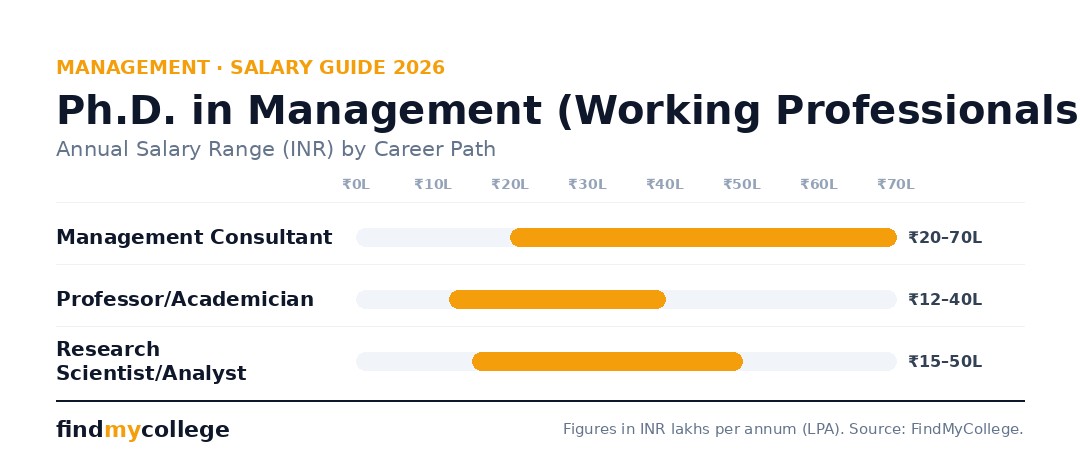
Salary Expectations Post-Ph.D. (Indicative Ranges):
Salaries can vary widely based on industry, role, prior experience, and the institution from which the Ph.D. was obtained. The Ph.D. primarily enhances existing career trajectories rather than guaranteeing a fresh entry-level salary.
| Career Path | Annual Salary Range (INR) | Description |
|---|---|---|
| Senior Management/Leadership | ₹25,00,000 – ₹1,00,00,000+ | Enhanced promotion prospects, higher strategic influence. |
| Management Consultant | ₹20,00,000 – ₹70,00,000+ | Specialized advisory roles, higher billing rates. |
| Professor/Academician | ₹12,00,000 – ₹40,00,000+ | Assistant/Associate/Full Professor roles in B-schools. |
| Research Scientist/Analyst | ₹15,00,000 – ₹50,00,000+ | R&D roles in corporate or government sectors. |
How does a Ph.D. for Working Professionals compare to a regular Ph.D. or an Executive MBA?
The Ph.D. for Working Professionals is distinct from both a traditional full-time Ph.D. and an Executive MBA, each serving different career objectives and requiring different commitments.
Comparison Table:
| Feature | Ph.D. for Working Professionals | Traditional Full-time Ph.D. | Executive MBA (EMBA) |
|---|---|---|---|
| Primary Goal | Deep research, academic contribution, career enhancement while working. | Full-time academic research, career in academia/research. | Management skill upgrade, networking, career acceleration. |
| Target Audience | Experienced professionals (5-10+ years) seeking doctoral research. | Recent postgraduates or early-career professionals. | Mid-to-senior level professionals (5-15 years) seeking leadership roles. |
| Program Structure | Part-time, flexible, weekend/online classes, self-paced research. | Full-time, campus-based, intensive coursework, dedicated research. | Part-time, weekend/modular classes, case studies, group projects. |
| Duration | 3-6 years (flexible) | 4-5 years (intensive) | 1-2 years |
| Output | Doctoral thesis, research publications. | Doctoral thesis, extensive publications. | Management degree, enhanced business acumen. |
| Financial Aid | Limited scholarships, self-funded. | Stipends, tuition waivers (common). | Self-funded, some corporate sponsorships. |
What are the pros and cons of pursuing a Ph.D. in Working Professionals (Management)?
Deciding to pursue a Ph.D. as a working professional involves weighing significant advantages against considerable challenges.
Pros:
- Career Advancement: Enhances credibility, opens doors to senior leadership, consulting, and academic roles.
- Deep Expertise: Develops specialized knowledge and research skills in a chosen domain.
- Networking: Connects with leading academics, industry experts, and a cohort of accomplished professionals.
- Intellectual Stimulation: Opportunity to engage in rigorous academic inquiry and contribute to knowledge.
- Flexibility: Designed to accommodate professional commitments, allowing continued employment.
- Personal Growth: Fosters discipline, critical thinking, and problem-solving abilities.
Cons:
- Time Commitment: Extremely demanding, requiring significant personal time sacrifices (even with flexibility).
- High Cost: Generally expensive, with fewer funding opportunities compared to full-time Ph.D.s.
- Work-Life Balance: Can be severely strained due to balancing work, family, and academic responsibilities.
- Isolation: Research can be a solitary endeavor, and balancing it with professional life can lead to feelings of isolation.
- Rigorous Standards: Despite flexibility, academic rigor and thesis quality expectations remain high.
- Delayed Gratification: Long program duration means rewards are not immediate.
Frequently Asked Questions
Can I pursue a Ph.D. in Working Professionals without a Master’s degree?
While most programs require a Master’s, some institutions may consider candidates with an exceptional Bachelor’s degree, extensive professional experience (e.g., 15+ years), and sometimes an M.Phil. or equivalent research background. It’s best to check individual university criteria.
Are there any part-time Ph.D. programs for working professionals that are fully online?
Fully online Ph.D. programs for working professionals are emerging, especially post-pandemic. However, many still incorporate mandatory on-campus workshops, viva voce, or research colloquia to ensure academic rigor and interaction. Verify the specific program structure with the institution.
What is the typical duration to complete a Ph.D. in Working Professionals?
The typical duration ranges from 3 to 6 years. While some highly dedicated individuals might complete it in 3 years, 4-5 years is more common, especially given the demands of balancing work and research.
Do I need to quit my job to pursue this Ph.D.?
No, the core design of the Ph.D. in Working Professionals program is to allow candidates to continue their employment. The flexible structure, weekend classes, and self-paced research are specifically tailored for this purpose.
What kind of research topic is suitable for a Ph.D. in Working Professionals?
Ideal research topics often leverage the candidate’s professional experience, addressing real-world business problems, industry trends, or organizational challenges. Applied research with practical implications is highly valued, though theoretical contributions are also welcome.
Are there scholarships available for Ph.D. in Working Professionals?
Scholarships are less common for working professional Ph.D. programs compared to full-time Ph.D.s. However, some institutions might offer partial fee waivers or research grants for exceptional candidates, and some employers may sponsor their employees’ doctoral studies.
What is the difference between a Ph.D. and a DBA (Doctor of Business Administration)?
Both are doctoral degrees for professionals. A Ph.D. (Doctor of Philosophy) is generally more research-intensive and theory-focused, aiming to contribute to academic knowledge. A DBA (Doctor of Business Administration) is often more practice-oriented, focusing on applying existing theory to solve complex business problems and contribute to professional practice, though the distinction can blur depending on the institution.
How important is the research proposal in the admission process?
The research proposal is critically important. It demonstrates your research aptitude, understanding of your chosen field, ability to formulate research questions, and potential to complete a doctoral thesis. A well-structured and compelling proposal can significantly enhance your chances of admission.