What Happens If You Change Your Mind After Paying the Online University Fee?
You have compared online degree programmes, checked the fees, and finally completed the payment. A few days later, however, you receive a better admission offer, reconsider your budget, or realise that the course is not right for you.
Now comes the question: Can you cancel your admission and get your money back?
The answer depends on the type of fee you paid, when the university receives your withdrawal request, your admission status, and the refund policy applicable to your programme. Paying a university fee does not automatically mean the entire amount is non-refundable. However, a full refund is not guaranteed either.
In India, the University Grants Commission (UGC) has issued fee-refund guidelines for higher education institutions. Understanding the applicable rules and your university’s own policy can help you make an informed decision if your plans change.
Can You Get a Refund After Paying an Online University Fee?
Yes, you may be eligible for a full or partial refund after paying your online university fee.
The UGC’s Fee Refund Policy 2025–26 notice, dated October 27, 2025, continues the existing refund framework for the specified admission cycle. The underlying framework sets out refund categories according to when the institution receives a student’s withdrawal notice in relation to its formally notified last date of admission.
Read the UGC refund policy 2025-26 here.
However, the 2025–26 notice should not be treated as proof that the same arrangements automatically apply to every later admission cycle. Before requesting a refund, check whether the UGC has issued a subsequent policy and confirm the rules applicable to your university and academic session.
You should also distinguish between the different components of your payment. An application fee, registration charge, tuition fee, examination fee, and security deposit may be treated differently under the applicable policy.
How Much of Your Online University Fee Can You Get Back?
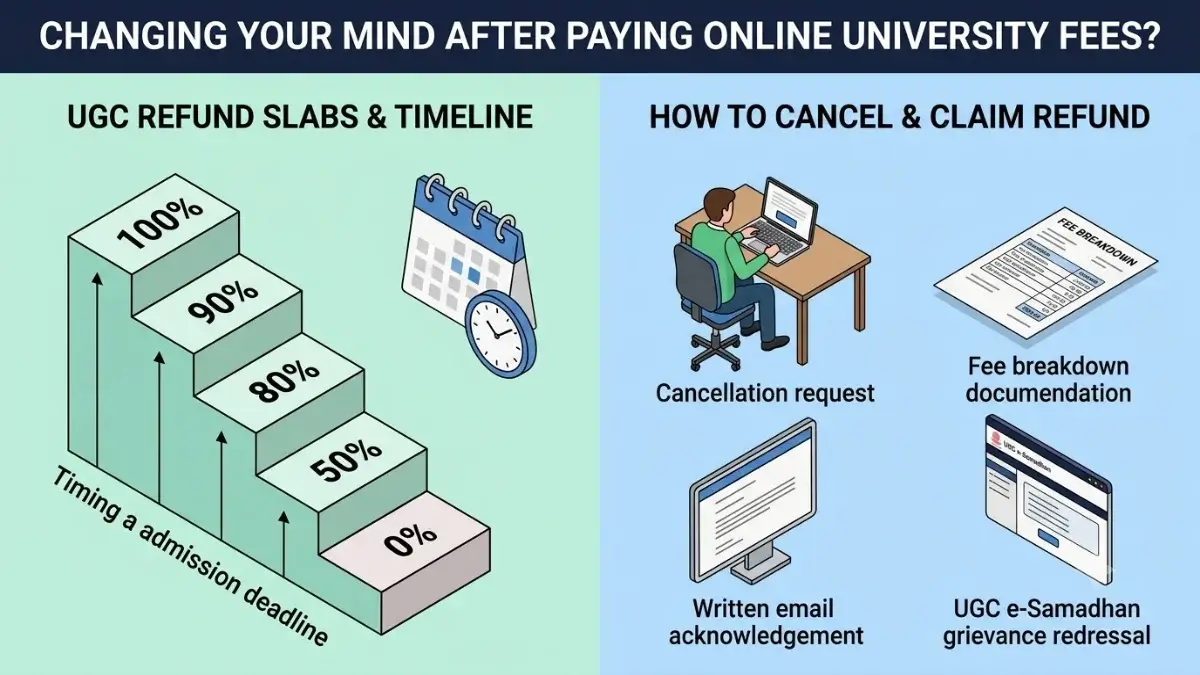
The UGC refund framework reproduced in the 2025–26 notice sets out five refund categories based on the timing of the withdrawal request.
| When the institution receives your withdrawal notice | Refund percentage |
| 15 days or more before the notified last date of admission | 100% |
| Less than 15 days before the notified last date of admission | 90% |
| Up to 15 days after the notified last date of admission | 80% |
| More than 15 days but within 30 days after the notified last date | 50% |
| More than 30 days after the notified last date | 0% |
Important: These categories are based on the formally notified last date of admission, not simply the date you paid the fee or attended your first class. The policy also permits a processing deduction in the applicable early-withdrawal category, subject to the prescribed limit. Check the exact provision in the policy applicable to your admission.
The UGC’s 2024–25 notice included special arrangements for that admission cycle: a full refund for cancellations up to September 30, 2024, and a full refund with a processing deduction of no more than ₹1,000 up to October 31, 2024. Those were historical deadlines, not ongoing deadlines for future admissions.
The UGC’s October 2025 notice carries forward the existing framework for the specified period and refers to its continuation until a revised policy is issued. Because policies and admission schedules can change, verify the latest official guidance before relying on the table.
Why the Type of Fee Matters
Your payment receipt may contain several components:
- Application fee: Charged for processing your application. Its refundability depends on the applicable terms and rules.
- Registration or processing fee: May be subject to specific conditions or permitted deductions. The label alone does not determine whether the charge can be retained.
- Admission or tuition fee: May qualify for a full or partial refund depending on the applicable rules and withdrawal date.
- Examination, project, or service charges: May have separate conditions, so ask the university how each charge is treated.
- Security deposit or caution money: The UGC framework provides for a full refund of qualifying deposits that are not part of the fees chargeable, subject to the applicable provisions.
Do not assume that a fee is automatically non-refundable simply because it is labelled a registration or processing charge. Ask the university to identify the relevant policy clause and explain any proposed deduction.
What If You Change Your Mind Before Classes Begin?
If you decide not to continue before classes start, submit your cancellation request as soon as possible.
You might have received admission to another university, changed your preferred specialisation, reconsidered the cost, or realised that the programme does not match your career goals.
However, withdrawing before classes begin does not automatically guarantee a full refund. Your eligibility still depends on the applicable deadline, the policy in force, and the type of fee paid.
For example, suppose you pay an online MBA admission fee and receive a better-suited offer from another university a few days later. Check the first university’s officially notified last date of admission and submit a formal withdrawal request promptly.
Do not simply stop responding to admission emails or assume that your seat will be cancelled automatically. Ask for written acknowledgment of your request and keep proof of when the institution received it.
What If Classes Have Already Started?
Your refund position may become more complicated if the applicable withdrawal deadline has passed.
The university must assess your request under the rules and policy that apply to your admission. It may also need to clarify how particular charges, such as examination or service fees, are treated.
If you have not accessed classes or learning materials, mention this in your withdrawal request and ask the institution to verify its records. However, non-attendance or non-use does not automatically establish an entitlement to a full refund. Similarly, the UGC refund percentages should not be interpreted as depending solely on whether classes have started; the framework bases those categories on the timing of the withdrawal notice relative to the notified last date of admission.
University-specific rules can also differ. For example, the University of Delhi issued a fee-refund notification on June 1, 2026, for prospective application from the 2026–27 academic session. Its provisions include a 100% refund, subject to the specified withdrawal or processing fee, for withdrawal on or before the notified last date of admission; a 50% refund, excluding that fee, for withdrawal within the following 30 days; and no fee refund after that period. The notification also addresses examination fees and semester withdrawals separately.
Although, this is a university-specific example, not a universal refund schedule for online universities.
How to Cancel Your Online Admission and Request a Refund
Once you decide to withdraw, the safest approach is to submit a formal request through the university’s prescribed process.
Step 1: Check the Official Refund Policy
Read the admission prospectus, refund-policy page, admission agreement, and any relevant terms provided during payment.
Confirm the applicable academic session, last date of admission, refund percentages, permitted deductions, and cancellation procedure.
If the policy is unclear, ask the admissions or finance office for written clarification.
Step 2: Submit a Written Cancellation Request
Use the university’s prescribed withdrawal form or admission portal, if available. Otherwise, contact the official admissions office or registrar to confirm the correct process.
Include your programme, application or enrolment number, payment date, amount paid, and transaction reference. Clearly state that you want to cancel your admission and request the refund due under the applicable policy.
Step 3: Attach the Required Documents
Depending on the institution’s requirements, you may need:
- Admission or application confirmation.
- Fee payment receipt.
- Application or enrolment number.
- Completed withdrawal form.
- Bank details in the prescribed format.
Submit only the documents requested through the university’s official channel.
Step 4: Obtain Written Acknowledgment
Keep the email confirmation, portal receipt, or other proof showing when your request was received.
This matters because the UGC framework bases the refund category on when the institution receives the withdrawal notice. A phone call or informal message may not provide the same reliable record.
Step 5: Request a Refund Calculation
Ask the university to confirm:
- The total amount paid.
- The amount considered refundable.
- Each proposed deduction and the policy clause supporting it.
- The expected refund date.
The UGC framework specifies a 15-day refund timeline for eligible refunds, calculated from receipt of the written application. Check that this provision applies to your case and follow up in writing if the refund is delayed.
What If You Paid Through an Admission Partner?
Some students apply through an education platform, admission counsellor, or third-party partner rather than directly through the university.
In these cases, check your payment receipt and admission documents to confirm who collected the fee and which organisation handles refunds.
The UGC’s Fee Refund Policy 2025–26 refers to arrangements involving organisations that conduct counselling, process admissions, or collect fees on behalf of participating higher education institutions. Under the specified provisions, the concerned institution is responsible for the refund.
If you paid through an admission partner, submit your cancellation request to the university and, where relevant, the payment partner. Ask the university to confirm which refund policy applies and how your refund will be processed.
An intermediary’s involvement does not automatically remove the university’s responsibility under the applicable UGC provisions. Check the official UGC Fee Refund Policy and verify whether any subsequent policy applies to your admission session.
What If You Paid Through an Education Loan or EMI?
Cancelling your university admission does not necessarily cancel an education loan or EMI arrangement.
If your tuition was financed, contact your lender promptly and explain that you have requested admission cancellation.
Ask whether:
- The loan amount has already been disbursed to the university.
- The university must return the refund directly to the lender.
- Interest or processing charges have accrued.
- Your EMI schedule will continue.
- Additional documents are needed to adjust the loan or close the account.
Do not stop EMI payments without speaking to the lender. The university’s refund process and your loan-repayment obligations may be treated separately under the applicable arrangements.
What If the University Says Your Fee Is Non-Refundable?
A verbal statement that a fee is non-refundable does not, by itself, explain whether the decision complies with the applicable rules.
Ask the university to clarify:
- Which policy clause supports the refusal?
- Was the condition disclosed in the official admission documents?
- Does the condition apply to the entire payment or only a particular fee component?
- How was the refundable amount calculated?
- What is the formal grievance-redressal procedure?
Keep the response in writing and compare it with the policy applicable to your admission.
Under the UGC’s Redressal of Grievances of Students Regulations, 2023, delay in or denial of a fee refund due to a student who withdraws within the applicable period is recognised as a potential student grievance.
If the university does not resolve the issue, you can escalate it through the institution’s grievance-redressal mechanism and, where appropriate, the UGC e-Samadhan portal. The portal provides a centralised mechanism for submitting student grievances and tracking their status.
Include your payment receipt, withdrawal request, acknowledgment, applicable policy, refund calculation, and the university’s response. A complaint does not guarantee a full refund; the outcome depends on the facts and applicable rules.
How to Avoid Refund Problems Before Paying
You cannot always predict whether your plans will change, but a few checks can reduce the risk of a difficult refund process.
- Read the refund policy: Download the official prospectus and cancellation terms before making payment.
- Understand the fee breakdown: Separate tuition, registration, application, examination, and other charges.
- Check the deadline: Record the formally notified last date of admission and any withdrawal deadlines.
- Verify the payment recipient: Use the university’s official payment gateway and avoid transferring money to unauthorised personal accounts.
- Clarify non-refundable charges: Ask for written confirmation if the policy is unclear.
- Save your records: Keep receipts, admission letters, policy documents, emails, and transaction references.
- Check the refund process: Confirm how to submit a cancellation request, which office handles it, and how you can track its status.
These steps are useful even when you are confident about your decision to enrol. Knowing the cancellation terms before paying can prevent unnecessary uncertainty later.
So, What Should You Do If You Change Your Mind After Paying?
Changing your mind after paying an online university fee does not automatically mean losing the entire amount. Your refund position depends on the applicable rules, the type of fee paid, your withdrawal date, and the university’s official policy.
Submit a written cancellation request promptly, obtain acknowledgment, ask for a clear refund calculation, and preserve your records. If the university refuses a refund that appears to be due, request the reason in writing and use the appropriate grievance-redressal process.
Before paying, understand the cancellation terms as carefully as you review the curriculum and fees. If your plans change, act quickly, follow the official procedure, and document every step.