NMMS 2026-27: Apply on NSP by October 31; state dates vary
In short
- The National Scholarship Portal (NSP) is accepting fresh and renewal applications for the NMMS Scheme until October 31, 2026.
- Students currently in Class 8 at government, government-aided, or state board schools are eligible to apply for the 2026-27 scholarship.
- Around 1,00,000 scholarships of Rs 12,000 per year are awarded to meritorious students from economically weaker sections.
- State-wise application deadlines for the NMMS examination vary, with several states having closing dates in late October and early November 2026.
- Applicants must ensure their annual parental income does not exceed Rs 3,50,000 and their Aadhaar is linked to their bank account for direct benefit transfer.
The application window for the National Means-cum-Merit Scholarship (NMMS) Scheme for the 2026-27 academic year is currently open, with the National Scholarship Portal (NSP) accepting registrations and renewals until October 31, 2026. This initiative by the Ministry of Education, Government of India, aims to provide financial assistance to meritorious students from economically weaker sections, helping them continue their school education and mitigate dropout rates after Class 8.
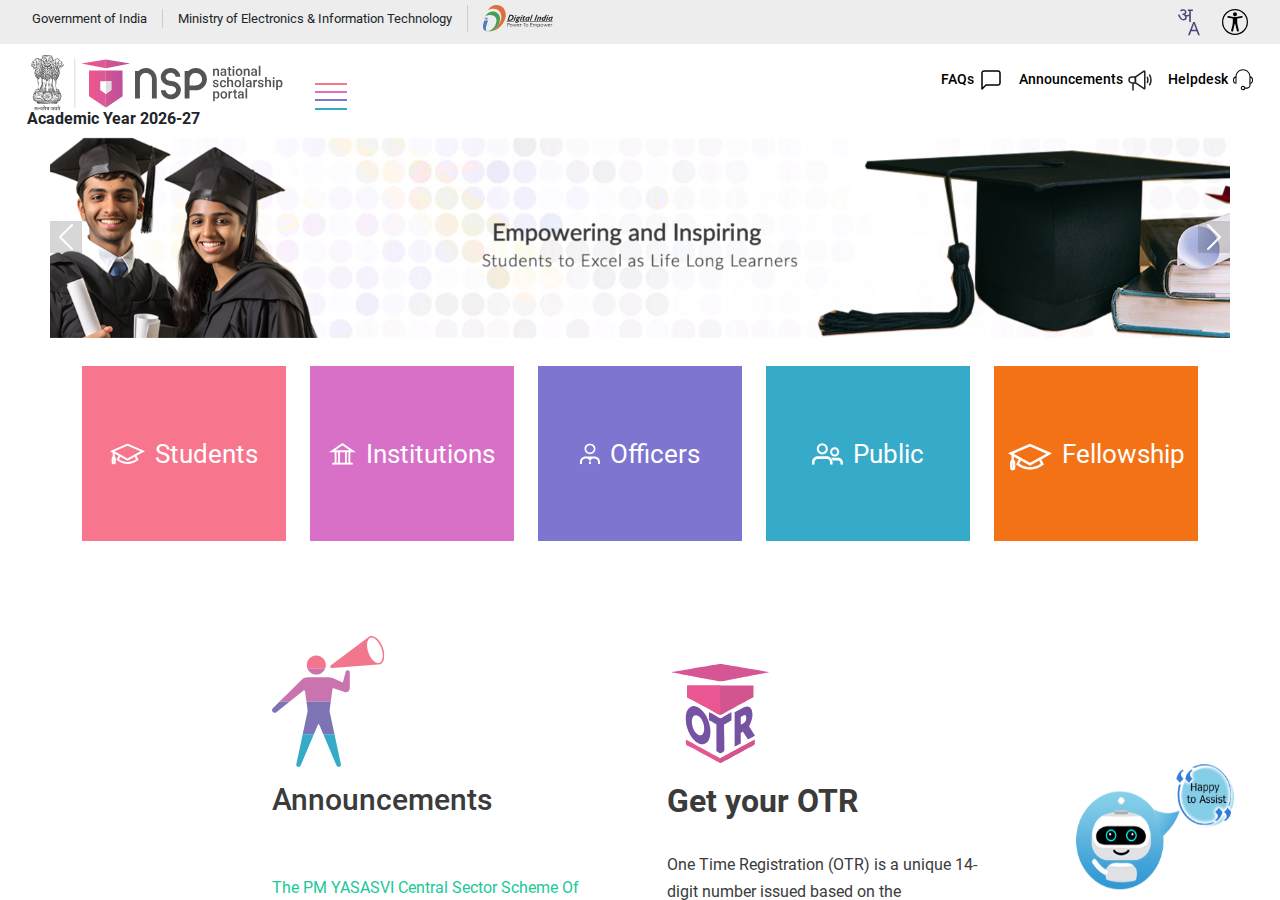
The scholarship, which provides Rs 12,000 per year (Rs 1,000 per month) to selected students from Class 9 to Class 12, targets approximately 1,00,000 beneficiaries annually. While the NSP serves as the central platform for scholarship disbursement, the initial application process and examination are managed by the respective State Councils of Educational Research and Training (SCERTs), leading to varying state-specific application and examination dates.
NMMS Application and Verification Deadlines
The National Scholarship Portal (NSP) commenced registration for the NMMS Scholarship 2026-27 on June 1, 2026, with the final date for submitting applications set for October 31, 2026. Following the application submission, a series of verification processes are scheduled. The deadline for Defective Application Verification and Institute Verification is November 15, 2026, while District/State/Ministry Nodal Officer (DNO/SNO/MNO) Verification must be completed by November 30, 2026.
Students who were selected in the NMMS Examination 2025 are required to submit a fresh application on the NSP for the 2026-27 scholarship session using their existing One-Time Registration (OTR). Similarly, NMMS students from 2024, 2023, and 2022 must submit their renewal applications on the NSP, also utilising their existing OTR. Aadhaar seeding with the student’s bank account is mandatory for receiving scholarship funds via Direct Benefit Transfer (DBT) through the Public Financial Management System (PFMS).
| Event | Dates |
|---|---|
| Registration Started | June 1, 2026 |
| Last Date to Apply | October 31, 2026 |
| Defective Application Verification Open up to | November 15, 2026 |
| Institute Verification Open up to | November 15, 2026 |
| DNO/SNO/MNO Verification Open up to | November 30, 2026 |
State-Wise Application and Examination Schedules
The application forms for the NMMS 2026-27 examination have been released by several states, including Tamil Nadu, Gujarat, Karnataka, Andhra Pradesh, and Uttarakhand. While the NSP handles the scholarship application post-qualification, the examination application dates and modes vary significantly across states. As of October 27, 2026, states like Tamil Nadu, Gujarat, and Uttarakhand have application deadlines in late October and early November. For instance, Tamil Nadu’s application window is from October 26 to November 3, 2026, while Gujarat’s closes on October 30, 2026.
The NMMS examination itself is conducted in an offline (OMR-based) mode, with admit cards typically released 10-15 days prior to the exam date, available for download from the respective SCERT portals or provided through schools. Upcoming examination dates range from November 2026 in states like Assam, Haryana, Himachal Pradesh, Rajasthan, and Telangana, to later dates in 2027 for states such as Bihar, Chhattisgarh, and Karnataka.
| States | Application Dates | Application Mode |
|---|---|---|
| NMMS Tamil Nadu | October 26 to November 3, 2026 | Offline (Through Schools) |
| NMMS Maharashtra Form | September 8 to October 28, 2026 | Through Schools (Online) |
| NMMS Gujarat | October 15 to October 30, 2026 | Through Schools (Offline) |
| NMMS Andhra Pradesh Form | September 11 to October 27, 2026 | Through Schools (Online) |
| NMMS Karnataka Form | September 23 to October 30, 2026 | Online |
| NMMS Uttarakhand Form | October 4 to October 31, 2026 | Through Schools (Offline) |
| NMMS Assam Form | Last date to apply is November 8, 2026 | Online |
| NMMS Mizoram Form | September 16 to November 6, 2026 | Through Schools (Offline) |
| NMMS Dadra & Nagar Haveli and Daman and Diu | October 16 to 24, 2026 | Through Schools (Offline) |
| NMMS Haryana Form | September 24 to October 24, 2026 | Online |
| NMMS Chhattisgarh Form | October 6 to October 23, 2026 | Through schools |
| NMMS Delhi Form | September 9 to October 13, 2026 | Through Schools (Online) |
| NMMS Meghalaya | July 29 to October 9, 2026 | Offline |
| NMMS West Bengal Form | July 28 to October 9, 2026 | Online |
| NMMS Kerala Form | September 15 to October 5, 2026 | Through Schools (Online) |
| NMMS Uttar Pradesh Form | August 18 to September 29, 2026 | Online |
| NMMS Chandigarh Form | Till September 30, 2026 | Offline |
| NMMS Odisha Form | August 18 to October 2, 2026 | Online |
| NMMS Punjab Form | September 1 to 19, 2026 | Online |
| NMMS Himachal Pradesh Form | August 1 to September 21, 2026 | Online |
| NMMS Nagaland Form | July 28 to August 31, 2026 | Through schools (Offline) |
| NMMS Telangana Form | July 20 to September 5, 2026 | Online |
| State / UT | Exam Date 2026-27 | Status |
|---|---|---|
| Andhra Pradesh | December 2026 | Upcoming |
| Assam | November 28, 2026 | Upcoming |
| Bihar | March 2027 | Upcoming |
| Chandigarh | To be announced | Upcoming |
| Chhattisgarh | May 2027 | Upcoming |
| Delhi | December 2026 | Upcoming |
| Gujarat | January 2027 | Upcoming |
| Haryana | November 2026 | Upcoming |
| Himachal Pradesh | November 1, 2026 | Upcoming |
| Jharkhand | March 2027 | Upcoming |
| Karnataka | February 2027 | Upcoming |
| Kerala | January 2027 | Upcoming |
| Madhya Pradesh | To be announced | Upcoming |
| Maharashtra | December 2026 | Upcoming |
| Odisha | December 6, 2026 | Upcoming |
| Punjab | January 2027 | Upcoming |
| Rajasthan | November 2026 | Upcoming |
| Telangana | November 1, 2026 | Upcoming |
| Uttar Pradesh | November 1, 2026 | Upcoming |
| Uttarakhand | To be announced | Upcoming |
| West Bengal | December 12, 2026 | Upcoming |
Eligibility Criteria and Examination Pattern
To be eligible for the NMMS Scholarship 2026-27, students must currently be studying in Class 8 at a government, government-aided, or state board school. A key financial criterion is that the annual parental income from all sources must not exceed Rs 3,50,000. Students enrolled in Kendriya Vidyalayas (KVS) and Jawahar Navodaya Vidyalayas (JNV) are not eligible for this scholarship. For scholarship continuation in higher secondary school, students must achieve at least 60% marks in the Class 10 Board Examination. To receive the scholarship in Class 12, students must pass Class 11 on the first attempt with a minimum of 55% marks, with a 5% relaxation for SC/ST students in academic performance.
The NMMS selection test comprises two parts: the Mental Ability Test (MAT) and the Scholastic Aptitude Test (SAT). Each test consists of 90 Multiple Choice Questions (MCQs) and has a duration of 90 minutes. The minimum qualifying marks for both MAT and SAT are 40% for General, Backward Class (BC), and Physically Handicapped (PH) categories, equivalent to 36 marks. For Scheduled Caste (SC) and Scheduled Tribe (ST) categories, the minimum qualifying marks are 32%, or 29 marks.
| Particulars | Eligibility conditions |
|---|---|
| Who can submit the NMMS application form? | Class 8th Students |
| Paper | Questions | Marks | Duration |
|---|---|---|---|
| MAT | 90 | 90 | 90 minutes |
| SAT | 90 | 90 | 90 minutes |
| Category | Minimum Marks |
|---|---|
| General / BC / PH | 40% (36 Marks) |
| SC / ST | 32% (29 Marks) |
Further reading

📰 More Education News
- RRU: Apply for LLM, PhD admissions for 2027-28 session nowOct 27, 2026 • Nishit Kumar
- IRMA Anand MBA admissions 2027-29 open: apply by 24 DecemberOct 27, 2026 • Nishit Kumar
- UP Board exam 2027 centre list objections open: submit by October 28Oct 27, 2026 • Nishit Kumar
- AP LAWCET 2026 Phase 2 counselling registration deadline is October 28Oct 27, 2026 • Nishit Kumar