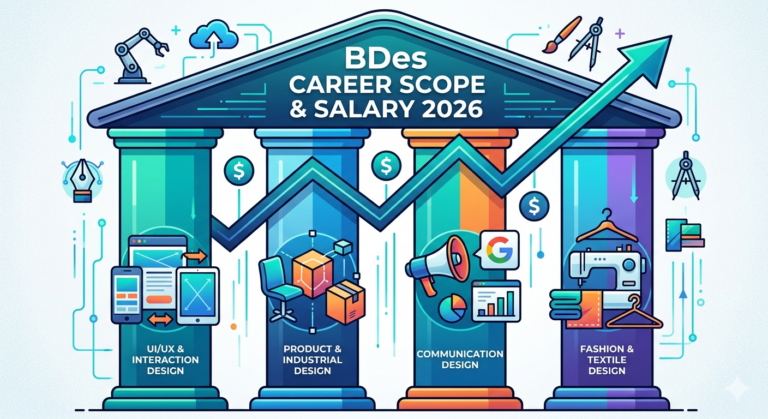

Bachelor of Fine Arts (BFA) Scope & Career in India 2026
Nishit Kumar is a senior EdTech industry leader with over a decade of experience in building and scaling education platforms, shaping their product, content, and growth strategy. At…
Latest update: Bachelor of Fine Arts 2026 admissions & dates updated. Read more ›
The Bachelor of Fine Arts (BFA) is an undergraduate degree program designed for students passionate about visual and performing arts. In India, the BFA offers a comprehensive curriculum that hones artistic skills, fosters creativity, and provides a strong foundation for diverse career paths in the ever-evolving creative industries. This page delves into the Bachelor of Fine Arts Scope & Career landscape in India for 2026, covering everything from eligibility and specializations to job prospects and salary expectations.
What is Bachelor of Fine Arts (BFA)?
The Bachelor of Fine Arts (BFA) is a professional undergraduate degree focused on the practical and theoretical aspects of visual and performing arts. Unlike a Bachelor of Arts (BA) in Fine Arts, a BFA program typically emphasizes studio work, practical training, and portfolio development, preparing students for direct entry into creative professions or further specialized studies.
Key Aspects of a BFA Program
- Duration: Typically 3 to 4 years, depending on the university and specialization.
- Focus: Hands-on training, skill development, critical analysis of art, and historical context.
- Eligibility: Primarily 10+2 (or equivalent) from a recognized board, often with an aptitude test or portfolio submission.
- Specializations: Wide range including Painting, Sculpture, Applied Art, Photography, Digital Art, Printmaking, Art History, and more.
What is the eligibility for Bachelor of Fine Arts in India for 2026?
To be eligible for a Bachelor of Fine Arts (BFA) program in India for the 2026 academic year, candidates generally need to have completed their 10+2 (or equivalent) examination from a recognized board. Most institutions require a minimum aggregate score, typically ranging from 45% to 50%, and many also mandate an aptitude test, practical examination, or portfolio submission to assess artistic potential.
Detailed Eligibility Criteria
- Educational Qualification: Successful completion of 10+2 or equivalent from a recognized Indian or international board.
- Minimum Marks: Generally 45-50% aggregate in 10+2, though some prestigious institutions might have higher cut-offs.
- Age Limit: While most universities do not have a strict upper age limit, some might specify a maximum age (e.g., 22-25 years).
- Entrance Exams/Portfolio: A crucial component for most BFA admissions. This often includes:
- Aptitude Test: Assessing general knowledge, reasoning, and artistic awareness.
- Practical Test: Evaluating drawing, sketching, composition, and color sense.
- Portfolio Submission: A collection of original artworks demonstrating the candidate’s skills and creative potential.
- Interview: To gauge passion, communication skills, and understanding of art.
Common Entrance Exams for BFA (2026 Tentative Dates)
Several universities conduct their own entrance exams. Some prominent ones include:
| Entrance Exam | Conducting Body | Application Period (Tentative 2026) | Exam Date (Tentative 2026) |
|---|---|---|---|
| NID DAT (B.Des) | National Institute of Design | Oct – Dec 2025 | Jan – Feb 2026 |
| UCEED (B.Des) | IIT Bombay | Sep – Nov 2025 | Jan 2026 |
| CUET (for various central universities) | NTA | Feb – Mar 2026 | May 2026 |
| BHU UET (BFA) | Banaras Hindu University | Feb – Mar 2026 | May – Jun 2026 |
| JMI Entrance Exam (BFA) | Jamia Millia Islamia | Mar – Apr 2026 | Jun 2026 |
Note: Dates are tentative for 2026 and subject to change. Students are advised to check official university websites for the most accurate and updated information.
People Also Read


How much does Bachelor of Fine Arts cost in India?
The cost of a Bachelor of Fine Arts (BFA) program in India varies significantly based on the type of institution (government vs. private), its reputation, location, and the specific specialization chosen. Generally, government colleges offer more affordable fees, ranging from INR 10,000 to INR 80,000 per annum, while private institutions can charge anywhere from INR 50,000 to INR 3,00,000 or more per annum.
BFA Fee Structure (Annual Range 2026)
| Type of Institution | Annual Fee Range (INR) | Additional Costs (Approx.) |
|---|---|---|
| Government/Public Universities | 10,000 – 80,000 | Materials, Hostel (20k-60k), Exam Fees |
| Private Universities/Colleges | 50,000 – 3,00,000+ | Materials, Hostel (40k-1.5L), Portfolio Development, Workshops |
Additional costs may include art supplies, studio fees, workshop charges, hostel accommodation, and examination fees. Scholarships and educational loans are often available to help manage these expenses.
What are the specializations available in Bachelor of Fine Arts?
Bachelor of Fine Arts programs offer a diverse range of specializations, allowing students to focus on specific artistic disciplines. These specializations typically include Painting, Sculpture, Applied Art, Photography, Printmaking, Digital Art, Art History, and Visual Communication, among others, catering to various creative interests and career aspirations.
Popular BFA Specializations and Their Focus
- Painting: Focuses on various painting techniques, mediums (oil, acrylic, watercolor), art history, and critical analysis.
- Sculpture: Involves working with different materials like clay, stone, metal, wood, and exploring 3D forms and installations.
- Applied Art: Combines artistic skills with commercial applications, including advertising, graphic design, illustration, and product design.
- Photography: Covers technical aspects of photography, digital imaging, photojournalism, fashion photography, and artistic expression through the lens.
- Printmaking: Explores techniques like etching, lithography, screen printing, woodcut, and digital printmaking.
- Digital Art/New Media: Focuses on computer graphics, animation, web design, interactive media, and digital illustration.
- Art History & Art Criticism: Involves studying art movements, artists, and cultural contexts, often combined with practical studio work.
- Visual Communication: Emphasizes design principles for conveying messages visually, often overlapping with graphic design and multimedia.
- Ceramics: Specialization in pottery, ceramic sculpture, and glaze techniques.
Is Bachelor of Fine Arts worth it for jobs in India? (Scope & Career)
Yes, a Bachelor of Fine Arts (BFA) degree is increasingly worth it for jobs in India, especially with the booming creative and digital industries. While traditional art careers remain viable, the BFA’s scope has expanded significantly into areas like graphic design, animation, web design, photography, advertising, and content creation, offering diverse and financially rewarding career paths beyond just being a studio artist.
Career Prospects After BFA in India (2026)
The career landscape for BFA graduates is dynamic and multifaceted. Graduates can find opportunities in:
- Advertising & Marketing: Graphic Designer, Illustrator, Art Director, Visualizer.
- Media & Entertainment: Animator, Concept Artist, Storyboard Artist, Character Designer, VFX Artist, Photographer, Videographer.
- Publishing: Book Illustrator, Layout Designer, Editorial Designer.
- Fashion & Textile: Textile Designer, Fashion Illustrator, Surface Pattern Designer.
- IT & Tech: UI/UX Designer, Web Designer, Game Designer.
- Education: Art Teacher, Art Instructor, Art Therapist.
- Galleries & Museums: Curator, Art Restorer, Exhibition Designer, Gallery Manager.
- Freelance & Entrepreneurship: Independent Artist, Freelance Designer, Art Consultant.
Potential Job Roles and Average Salary Ranges (Annual, INR, 2026)
Salaries for BFA graduates can vary widely based on specialization, experience, portfolio quality, and the employer’s size and location. Entry-level salaries are typically lower but grow significantly with experience and a strong portfolio.
| Job Role | Entry-Level Salary (INR Lakhs/Annum) | Mid-Career Salary (INR Lakhs/Annum) | Top Employers/Industries |
|---|---|---|---|
| Graphic Designer | 2.5 – 4.5 | 5.0 – 10.0+ | Ad Agencies, Tech Companies, Marketing Firms |
| Animator/VFX Artist | 3.0 – 5.0 | 6.0 – 12.0+ | Animation Studios, Film Production, Gaming Companies |
| Illustrator | 2.0 – 4.0 | 4.5 – 9.0+ | Publishing Houses, Freelance, Ad Agencies |
| Photographer | 2.0 – 4.0 | 4.0 – 8.0+ | Media Houses, E-commerce, Freelance, Studios |
| UI/UX Designer | 3.5 – 6.0 | 7.0 – 15.0+ | IT Companies, Startups, Design Agencies |
| Art Teacher | 2.0 – 3.5 | 3.5 – 7.0+ | Schools, Art Institutes, Coaching Centers |
| Fine Artist (Independent) | Variable (Exhibitions, Commissions) | Highly Variable (Reputation-based) | Galleries, Private Collectors, Art Fairs |
Note: These are average ranges for 2026 and can vary based on individual skill, portfolio, location (metros vs. non-metros), and company.
What is the difference between BFA and BA in Fine Arts?
The primary difference between a Bachelor of Fine Arts (BFA) and a Bachelor of Arts (BA) in Fine Arts lies in their emphasis: BFA is a professional degree with a strong focus on practical studio work and skill development, whereas BA in Fine Arts is a liberal arts degree that prioritizes theoretical knowledge, art history, and critical studies, often with less intensive practical training.
BFA vs. BA in Fine Arts Comparison
- BFA (Bachelor of Fine Arts):
- Focus: Intensive practical training, studio work, portfolio development.
- Curriculum: Approximately 70-80% practical, 20-30% theoretical (art history, aesthetics).
- Objective: To train professional artists, designers, and creative practitioners.
- Career Path: Direct entry into creative industries (e.g., graphic designer, animator, studio artist).
- BA in Fine Arts (Bachelor of Arts in Fine Arts):
- Focus: Theoretical understanding, art history, criticism, philosophical aspects of art.
- Curriculum: Approximately 50-60% theoretical, 40-50% practical (varies).
- Objective: To provide a broad understanding of art within a liberal arts framework.
- Career Path: Often leads to roles in art education, art criticism, curatorial work, or further academic study (MA, PhD).
What are the pros and cons of pursuing a BFA?
Pursuing a BFA offers several advantages, including the development of strong creative skills, diverse career opportunities in growing industries, and personal fulfillment. However, it also comes with challenges such as intense competition, the need for continuous skill development, and potentially lower initial salaries compared to some STEM fields.
Pros of BFA
- Skill Development: Hones practical artistic skills, critical thinking, and problem-solving abilities.
- Diverse Career Paths: Opens doors to various creative fields beyond traditional art, including design, animation, and digital media.
- Personal Fulfillment: Allows individuals to pursue their passion and build a career around creativity.
- Industry Growth: The creative and digital industries in India are expanding, creating more demand for skilled professionals.
- Portfolio Building: The program structure inherently helps in building a strong professional portfolio.
Cons of BFA
- Competition: The creative field can be highly competitive, requiring continuous effort to stand out.
- Initial Salary: Entry-level salaries might be modest, especially for fine artists, though design roles often offer better compensation.
- Subjectivity: Art is subjective, and success can sometimes depend on networking and self-promotion.
- Continuous Learning: The creative industry evolves rapidly, necessitating constant skill upgrades and adaptation to new technologies.
- Material Costs: Art supplies and equipment can be expensive, adding to the overall cost of education.
What are the top colleges for BFA in India?
India boasts several reputable institutions offering quality BFA programs, known for their strong faculty, infrastructure, and industry connections. Some of the top colleges include Faculty of Fine Arts (MSU Baroda), College of Art (Delhi), Sir J.J. School of Art (Mumbai), Kala Bhavana (Visva-Bharati University), and Banaras Hindu University (BHU), among others.
Leading BFA Colleges in India
- Faculty of Fine Arts, Maharaja Sayajirao University of Baroda, Vadodara
- College of Art, University of Delhi, Delhi
- Sir J.J. School of Art, Mumbai
- Kala Bhavana, Visva-Bharati University, Santiniketan
- Faculty of Visual Arts, Banaras Hindu University (BHU), Varanasi
- Jamia Millia Islamia (JMI), New Delhi
- Government College of Art & Craft, Kolkata
- Chitrakala Parishath, Bengaluru
- Amity School of Fine Arts, Noida
- Lovely Professional University (LPU), Phagwara
Explore more on FindMyCollege
Related pages for Bachelor of Fine Arts aspirants on findmycollege.com:
Frequently Asked Questions
Can I pursue BFA after commerce or science stream in 12th?
Yes, students from any stream (Science, Commerce, or Arts) are generally eligible to pursue a BFA after 12th. The primary criteria for admission are usually your performance in the 12th standard and, more importantly, your aptitude in the entrance exam and/or portfolio submission.
What skills are essential for a successful BFA career?
Essential skills include strong drawing and sketching abilities, creativity, attention to detail, observation skills, patience, critical thinking, problem-solving, communication, and adaptability to new technologies and trends. A good portfolio and networking skills are also crucial.
Is a Master of Fine Arts (MFA) necessary after BFA?
An MFA is not always necessary but can be highly beneficial. It allows for deeper specialization, advanced skill development, and opens doors to academic careers (teaching at university level) or highly specialized roles in art and design. Many BFA graduates find good jobs directly after their bachelor’s, but an MFA can accelerate career growth and expertise.
What is the scope of BFA in animation and multimedia?
The scope of BFA in animation and multimedia is excellent and growing rapidly. Graduates can work as 2D/3D animators, character designers, concept artists, storyboard artists, VFX artists, game designers, motion graphics designers, and multimedia specialists in film, television, gaming, advertising, and e-learning industries.
How important is a portfolio for BFA admissions and careers?
A portfolio is extremely important for both BFA admissions and subsequent career prospects. For admissions, it demonstrates your artistic potential and skill. In your career, a strong, diverse, and professional portfolio is your primary tool to showcase your abilities to potential employers and clients, often more so than your academic grades.
Are there scholarships available for BFA students?
Yes, many government bodies, private organizations, and individual colleges offer scholarships for BFA students based on merit, financial need, or specific artistic talent. Students should research scholarships offered by their chosen institutions, state governments, and national art foundations.