

Bachelor in Marketing and Business Salary in India 2026
Nishit Kumar is a senior EdTech industry leader with over a decade of experience in building and scaling education platforms, shaping their product, content, and growth strategy. At…
Latest update: Bachelor in Marketing and Business 2026 admissions & dates updated. Read more ›
Understanding the salary potential after completing a Bachelor in Marketing and Business in India is crucial for prospective students and their parents. This comprehensive guide provides detailed insights into expected earnings, career paths, and factors influencing salary in 2026, ensuring you make an informed decision about your future.
What is the Average Salary for a Bachelor in Marketing and Business Graduate in India (2026)?
The average starting salary for a Bachelor in Marketing and Business graduate in India in 2026 typically ranges from INR 3.5 LPA to INR 6.5 LPA (Lakhs Per Annum). This figure can vary significantly based on factors such as the reputation of the institution, the student’s skills, specialisation, location, and the type of company they join.
Graduates from top-tier business schools or those with strong internship experiences often command higher starting packages. The marketing and business landscape is dynamic, with increasing demand for digitally-savvy professionals, which can positively impact salary prospects.
What are the Top Job Roles and Their Expected Salaries for Marketing and Business Graduates?
Graduates with a Bachelor in Marketing and Business can pursue a diverse range of roles across various industries. The expected salaries for these roles in 2026 reflect the demand and responsibilities associated with each position.
Marketing Roles
- Marketing Executive: This entry-level role involves assisting with marketing campaigns, market research, and promotional activities. Expected Salary: INR 3.0 – 5.5 LPA.
- Digital Marketing Specialist: Focuses on online marketing channels like SEO, SEM, social media, and content marketing. High demand drives competitive salaries. Expected Salary: INR 3.5 – 6.0 LPA.
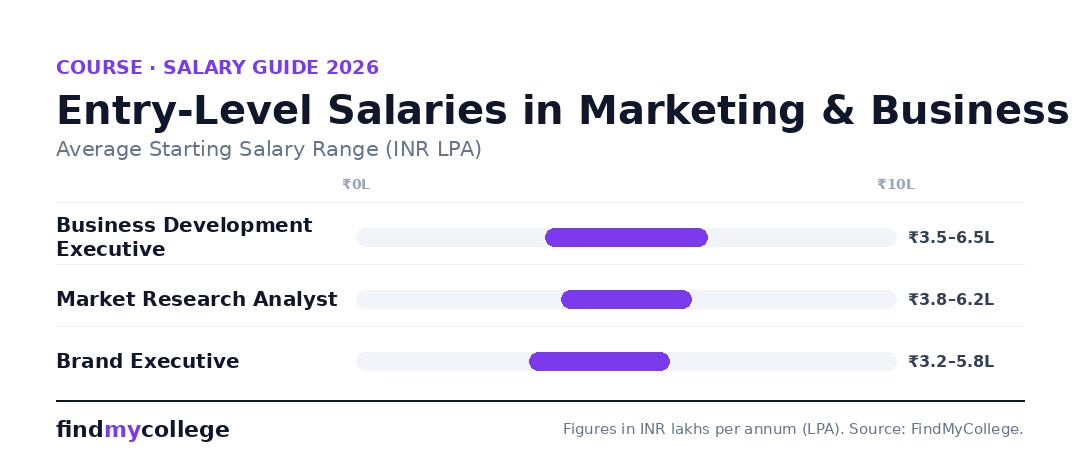
- Brand Executive: Works on developing and maintaining a brand’s image and market presence. Expected Salary: INR 3.2 – 5.8 LPA.
- Market Research Analyst: Gathers and analyses data to understand market trends and consumer behaviour. Expected Salary: INR 3.8 – 6.2 LPA.
Business Development & Sales Roles
- Business Development Executive: Identifies new business opportunities, builds client relationships, and drives sales. Expected Salary: INR 3.5 – 6.5 LPA.
- Sales Executive: Responsible for achieving sales targets by engaging with potential customers and closing deals. Expected Salary: INR 3.0 – 5.0 LPA (often with performance-based incentives).
Other Business Roles
- Operations Executive: Manages day-to-day business operations, ensuring efficiency and productivity. Expected Salary: INR 3.0 – 5.5 LPA.
- Human Resources Executive: Handles recruitment, employee relations, and HR policies. Expected Salary: INR 3.0 – 5.0 LPA.
Here’s a table summarising typical starting salary ranges for popular roles:
| Job Role (Entry-Level) | Average Starting Salary Range (INR LPA) – 2026 | Key Responsibilities |
|---|---|---|
| Marketing Executive | 3.0 – 5.5 | Campaign support, market research, content creation |
| Digital Marketing Specialist | 3.5 – 6.0 | SEO, SEM, social media, email marketing |
| Business Development Executive | 3.5 – 6.5 | Lead generation, client acquisition, sales strategy |
| Market Research Analyst | 3.8 – 6.2 | Data collection, trend analysis, report generation |
| Brand Executive | 3.2 – 5.8 | Brand strategy support, communication, positioning |
| Sales Executive | 3.0 – 5.0 + Incentives | Customer engagement, product presentation, sales closure |
People Also Read




Which Industries Offer the Best Salaries for Bachelor in Marketing and Business Graduates?
Certain industries tend to offer higher compensation packages for Bachelor in Marketing and Business graduates due to their growth potential, demand for skilled professionals, and overall profitability. In 2026, the following sectors are particularly lucrative:
- E-commerce & Technology: Companies like Amazon, Flipkart, Google, and various tech startups are constantly seeking marketing and business development talent to expand their digital footprint and user base. Salaries here can be significantly higher, especially for roles focused on digital strategy and analytics.
- Financial Services (FinTech): Banks, investment firms, and emerging FinTech companies require strong marketing to attract customers and business development to forge partnerships.
- Consulting: Management consulting firms hire business graduates to help clients solve complex problems, often offering premium salaries.
- FMCG (Fast-Moving Consumer Goods): Large FMCG companies (e.g., Unilever, P&G, Nestle) have well-structured marketing departments and offer competitive salaries, especially for brand management roles.
- Advertising & Media Agencies: While entry-level salaries might be moderate, these agencies offer rapid career progression and exposure to diverse clients, leading to higher earnings over time.
How Does College Reputation and Location Impact Salary?
The reputation of your college and the geographical location of your first job significantly influence your starting salary. Graduates from highly-ranked institutions often receive better placement opportunities and higher packages due to strong industry connections and perceived quality of education.
- Tier-1 Cities: Major metropolitan areas like Bengaluru, Mumbai, Delhi-NCR, Hyderabad, and Pune typically offer higher salaries due to a greater concentration of companies, diverse industries, and a higher cost of living.
- Tier-2 & Tier-3 Cities: Salaries in smaller cities may be comparatively lower, but so is the cost of living, which can balance out the net disposable income.
- College Ranking: Graduates from top-tier private universities or well-established government institutions often secure packages 15-30% higher than those from lesser-known colleges, even for similar roles.
What Skills and Specialisations Lead to Higher Salaries?
Developing specific skills and choosing relevant specialisations during your Bachelor in Marketing and Business can significantly boost your earning potential. Employers in 2026 are looking for graduates who are not just theoretically sound but also practically skilled.
- Digital Marketing Expertise: Proficiency in SEO, SEM, social media marketing, content marketing, email marketing, and analytics tools (Google Analytics, HubSpot) is highly valued.
- Data Analytics & Business Intelligence: The ability to interpret data, derive insights, and make data-driven decisions is crucial. Skills in Excel, SQL, or basic BI tools are a plus.
- Communication & Presentation Skills: Excellent verbal and written communication, along with strong presentation abilities, are essential for client-facing and strategic roles.
- Project Management: Understanding project lifecycle, resource allocation, and timely delivery can lead to roles with greater responsibility and better pay.
- Sales & Negotiation: For business development and sales roles, strong negotiation and persuasion skills are directly linked to higher performance-based earnings.
Popular Specialisations:
- Digital Marketing: Focuses on online channels and strategies.
- Brand Management: Concentrates on building and maintaining brand equity.
- Sales & Business Development: Emphasises client acquisition and revenue generation.
- Marketing Analytics: Blends marketing with data science.
Is a Bachelor in Marketing and Business Worth It for Jobs and Salary in 2026?
Yes, a Bachelor in Marketing and Business is generally considered a valuable degree for job prospects and salary in India in 2026, especially given the increasing importance of marketing and business acumen in a competitive global economy. The degree provides a broad foundation that opens doors to various roles across diverse industries.
The worth of the degree is amplified by:
- Versatility: Graduates are not confined to one industry or role.
- Growth Potential: With experience, salaries can grow significantly. A mid-career professional (5-8 years experience) can expect INR 8-15 LPA, while senior roles can command INR 20 LPA and above.
- Entrepreneurial Opportunities: The business knowledge gained is invaluable for those aspiring to start their own ventures.
- Demand for Digital Skills: The curriculum often incorporates digital marketing and business analytics, aligning with current industry demands.
What is the Salary Progression for a Bachelor in Marketing and Business Graduate?
Salary progression for a Bachelor in Marketing and Business graduate in India is typically strong, with significant increases observed with experience, skill development, and career advancement. While starting salaries are moderate, the growth trajectory is promising.
- Entry-Level (0-2 years): INR 3.5 – 6.5 LPA
- Mid-Level (3-6 years): INR 6.0 – 12.0 LPA (e.g., Senior Marketing Executive, Assistant Manager)
- Experienced (7-10 years): INR 10.0 – 20.0 LPA (e.g., Marketing Manager, Business Development Manager)
- Senior/Leadership (10+ years): INR 18.0 LPA and above (e.g., Head of Marketing, Sales Director, General Manager)
These figures are indicative and can be higher for individuals in high-growth sectors or those with exceptional performance and leadership skills.
Explore more on FindMyCollege
Related pages for Bachelor in Marketing and Business aspirants on findmycollege.com:
Frequently Asked Questions
What is the difference in salary between a BBA and a Bachelor in Marketing and Business?
While a BBA (Bachelor of Business Administration) is a broader degree, a Bachelor in Marketing and Business often implies a more specialised focus on marketing principles alongside general business. In terms of starting salary, there isn’t a vast difference; both typically fall within the INR 3.5 – 6.5 LPA range. However, a specialised marketing degree might give a slight edge for pure marketing roles, while a BBA offers more flexibility for general management positions.
Do internships affect the starting salary for marketing graduates?
Yes, internships significantly affect starting salaries. Graduates with relevant internship experience, especially from reputable companies, often command 10-20% higher starting packages. Internships provide practical skills, industry exposure, and networking opportunities, making candidates more attractive to employers.
Is pursuing a Master’s degree (MBA) necessary to earn a high salary in marketing?
While not strictly necessary for entry-level roles, an MBA (Master of Business Administration) can significantly boost salary potential and career progression, especially for leadership and strategic roles. Many professionals pursue an MBA after 2-5 years of work experience to accelerate their growth and target senior management positions with salaries often starting from INR 8-15 LPA post-MBA.
What are the typical benefits and perks offered along with the salary?
Beyond the base salary, graduates can expect various benefits and perks, especially in larger companies. These may include health insurance, provident fund (PF), gratuity, performance bonuses, travel allowances, mobile phone reimbursement, professional development opportunities, and sometimes stock options or employee discounts.
How does the global market compare to India for marketing salaries?
Salaries for marketing professionals in developed global markets (e.g., USA, UK, Canada, Australia) are generally significantly higher than in India, often by 3-5 times or more, especially when converted to INR. However, the cost of living in these countries is also substantially higher. Indian graduates with international experience or an international degree can leverage this for better opportunities globally or upon returning to India.
What are the career growth opportunities after a Bachelor in Marketing and Business?
Career growth opportunities are abundant. Graduates can progress from executive roles to managerial positions (e.g., Assistant Marketing Manager, Brand Manager), then to senior management (e.g., Marketing Director, Head of Digital Marketing), and eventually to leadership roles like Vice President of Marketing or Chief Marketing Officer (CMO). Specialisation, continuous learning, and strong performance are key drivers of this growth.