
CIMA India 2026 Overview: Management Accounting Career Guide
Nishit Kumar is a senior EdTech industry leader with over a decade of experience in building and scaling education platforms, shaping their product, content, and growth strategy. At…
Latest update: Chartered Institute of Management Accountant 2026 admissions & dates updated. Read more ›
Welcome to the comprehensive overview of the Chartered Institute of Management Accountant (CIMA) qualification in India for 2026. This guide is designed to provide prospective students and their parents with a clear, factual, and in-depth understanding of CIMA, helping you make informed decisions about your career in management accounting.
What is the Chartered Institute of Management Accountant (CIMA) Qualification?
The Chartered Institute of Management Accountant (CIMA) is a globally recognized professional body for management accountants. It focuses on providing professionals with the skills to drive business success by combining accounting, finance, and management expertise, enabling them to work across various business functions and industries.
CIMA is the world’s largest professional body of management accountants, offering the most relevant finance qualification for a career in business. Its syllabus is designed to equip individuals with not just technical accounting skills, but also strategic, risk management, and leadership competencies essential for modern business environments. The qualification is structured into three pillars: Enterprise, Performance, and Financial, each assessed at different levels of proficiency.
What is the Eligibility for Chartered Institute of Management Accountant in India (2026)?
Eligibility for CIMA in India is flexible, allowing entry at various stages depending on your prior academic qualifications or professional experience. Generally, a strong foundation in commerce or a related field is beneficial.
The entry points and their respective requirements are:
- Certificate in Business Accounting (CBA) Route: This is the entry-level for those without a relevant degree or professional qualification. No specific academic prerequisites are required, making it accessible to 10+2 graduates.
- Professional Qualification Route (Operational Level):
- Graduates with a commerce degree (B.Com, BBA, M.Com, MBA) or other relevant degrees.
- Holders of other accounting qualifications (e.g., CA Inter, ACCA Fundamentals, ICWA Inter).
- Students who have completed the CIMA Certificate in Business Accounting.
- Master’s Gateway Route: For MBA or Master’s in Accounting holders, allowing direct entry to the Management Case Study Exam, bypassing several earlier exams.
- CIMA-ACCA Strategic Gateway: For ACCA members, offering an accelerated route to CIMA membership.
- CIMA-CA/ICWA Gateway: For qualified CAs or ICWA members, providing exemptions and a fast-track to CIMA.
How is the CIMA Exam Structure and Syllabus for 2026?
The CIMA qualification is structured into three main levels: Operational, Management, and Strategic, each culminating in a case study exam. The syllabus for 2026 continues to emphasize a blend of financial, management, and business skills.
Each level consists of three objective tests (one for each pillar: Enterprise, Performance, Financial) and one integrated case study exam. The objective tests can be taken on demand, while case study exams are offered four times a year (February, May, August, November).
CIMA Syllabus Overview (2026)
| Level | Pillar: Enterprise (E) | Pillar: Performance (P) | Pillar: Financial (F) | Case Study Exam |
|---|---|---|---|---|
| Operational | E1: Organisational Management | P1: Management Accounting | F1: Financial Reporting and Taxation | Operational Case Study |
| Management | E2: Project and Relationship Management | P2: Advanced Management Accounting | F2: Advanced Financial Reporting | Management Case Study |
| Strategic | E3: Strategic Management | P3: Risk Management | F3: Financial Strategy | Strategic Case Study |
How Much Does Chartered Institute of Management Accountant Cost in India (2026)?
The cost of pursuing CIMA in India involves various fees, including registration, annual subscriptions, exam fees, and study material/tuition costs. These can range significantly based on your chosen study method and number of exemptions.
The total cost can vary from INR 2,50,000 to INR 5,00,000 or more, depending on exemptions, pass rates, and choice of tuition provider. Students should budget for these expenses over the course of their studies.
Estimated CIMA Fees in India (2026)
| Fee Type | Estimated Range (INR) | Frequency | Notes |
|---|---|---|---|
| Initial Registration Fee | 10,000 – 15,000 | One-time | For new students |
| Annual Student Subscription | 12,000 – 18,000 | Annually | Mandatory for active students |
| Objective Test Exam Fee (per exam) | 10,000 – 15,000 | Per exam | 9 objective tests in total for full qualification |
| Case Study Exam Fee (per exam) | 18,000 – 25,000 | Per exam | 3 case study exams in total for full qualification |
| Tuition/Study Material (per level) | 50,000 – 1,50,000 | Per level | Varies greatly by provider and study method (online/classroom) |
| Exemption Fees (per exemption) | 5,000 – 8,000 | Per exemption | Applicable if you qualify for exemptions |
Is Chartered Institute of Management Accountant Worth It for Jobs in India? What are the Career Prospects?
Yes, CIMA is highly worth it for jobs in India, offering excellent career prospects in diverse roles across various industries. CIMA-qualified professionals are in high demand for their strategic business acumen and ability to bridge the gap between finance and business operations.
Graduates can find roles in multinational corporations (MNCs), consulting firms, financial services, manufacturing, and public sector organizations. The qualification is particularly valued in roles that require strategic decision-making, performance management, and risk analysis.
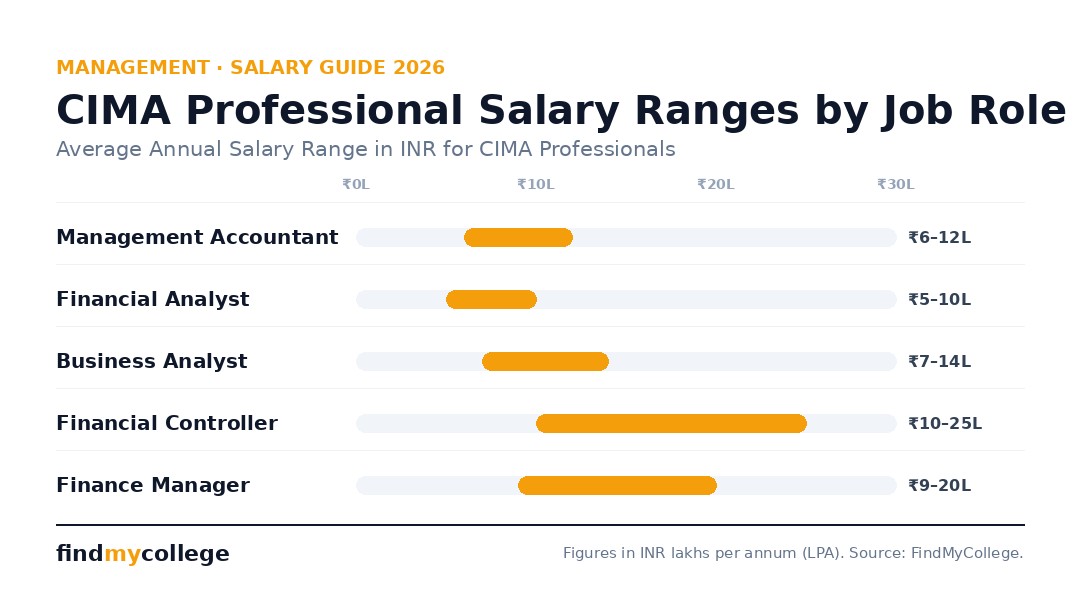
Typical Job Roles and Salary Ranges for CIMA Professionals in India
| Job Role | Average Annual Salary Range (INR) | Key Responsibilities |
|---|---|---|
| Management Accountant | 6,00,000 – 12,00,000 | Budgeting, forecasting, performance analysis, cost management |
| Financial Analyst | 5,00,000 – 10,00,000 | Financial modeling, investment appraisal, variance analysis |
| Business Analyst | 7,00,000 – 14,00,000 | Process improvement, strategic planning, data analysis |
| Financial Controller | 10,00,000 – 25,00,000+ | Overseeing financial operations, reporting, compliance |
| Finance Manager | 9,00,000 – 20,00,000+ | Team leadership, financial strategy, stakeholder management |
| Chief Financial Officer (CFO) | 30,00,000 – 1,00,00,000+ | Overall financial leadership, strategic direction, governance |
Note: Salaries are indicative and can vary based on experience, company, location, and individual skill set.
How Does CIMA Compare to CA (Chartered Accountant) and ACCA (Association of Chartered Certified Accountants) in India?
CIMA, CA, and ACCA are all prestigious accounting qualifications, but they cater to different career paths and have distinct focuses. CIMA is focused on management accounting and business strategy, CA on statutory auditing and taxation within India, and ACCA on global financial reporting and auditing.
CIMA vs. CA vs. ACCA: A Comparison
| Feature | CIMA | CA (India) | ACCA |
|---|---|---|---|
| Primary Focus | Management Accounting, Business Strategy, Performance Management | Statutory Audit, Taxation, Financial Accounting (Indian context) | Financial Reporting, Audit, Taxation (International context) |
| Global Recognition | High (especially in corporate finance & business roles) | Primarily India, some international recognition via MRA | Very High (global standard for financial accounting) |
| Eligibility | Flexible, 10+2, Graduates, other professionals | 10+2 (CPT/Foundation), Graduates (Direct Entry) | 10+2, Graduates, other professionals |
| Exam Structure | Objective Tests & Case Studies (3 levels) | Foundation, Intermediate, Final (3 levels) | Applied Knowledge, Applied Skills, Strategic Professional (3 levels) |
| Duration (Avg.) | 3-4 years (with exemptions, can be shorter) | 4.5-5 years (including articleship) | 3-4 years (with exemptions, can be shorter) |
| Career Path | Corporate Finance, Business Partnering, Consulting, Strategic Roles | Auditing, Taxation, Practice, Statutory Compliance, CFO roles in India | Auditing, Financial Reporting, Global Finance Roles, Practice |
| Cost (Avg. INR) | 2.5 – 5 Lakhs | 2 – 4 Lakhs (excluding coaching) | 3 – 6 Lakhs |
What are the Advantages and Disadvantages of Pursuing CIMA?
Like any professional qualification, CIMA comes with its own set of pros and cons that prospective students should consider.
Advantages of CIMA
- Global Recognition: CIMA is recognized and respected worldwide, opening doors to international career opportunities.
- Business-Focused: The syllabus is highly relevant to real-world business scenarios, equipping students with practical skills in strategic decision-making and performance management.
- Flexibility: On-demand objective tests and multiple case study sittings per year offer flexibility in study pace.
- Strong Career Prospects: High demand for CIMA-qualified professionals in corporate finance, business partnering, and leadership roles.
- Exemptions: Generous exemption policies for graduates and other professional qualification holders can shorten study duration.
Disadvantages of CIMA
- Cost: Can be relatively expensive, especially if multiple attempts are needed or premium tuition providers are chosen.
- Rigorous Exams: The case study exams require strong analytical and writing skills, often considered challenging.
- Less Focus on Statutory Audit/Tax (India): If your primary interest is statutory auditing or Indian taxation, CA might be a more direct route.
- Time Commitment: Requires significant dedication and study hours, especially for those working full-time.
How Long Does it Take to Complete CIMA in India?
The total time to complete the CIMA qualification in India typically ranges from 3 to 4 years for a student starting from the Certificate in Business Accounting level without significant exemptions. However, this can be significantly reduced for those with relevant degrees or professional qualifications who receive exemptions.
For instance, a graduate with a relevant B.Com or MBA might complete it in 2-3 years, while a CA or ICWA member could potentially finish in 1-2 years via accelerated routes.
Frequently Asked Questions
Is CIMA harder than CA?
The difficulty is subjective and depends on individual strengths. CIMA focuses more on strategic thinking, business analysis, and management accounting, while CA emphasizes statutory compliance, auditing, and Indian tax laws. Both are rigorous but test different skill sets.
Can I pursue CIMA after 12th in India?
Yes, you can start your CIMA journey after 12th by enrolling in the Certificate in Business Accounting (CBA) level, which has no specific academic prerequisites beyond basic numeracy and literacy.
Are CIMA exams online or offline in India?
CIMA objective tests are computer-based and can be taken at approved Pearson VUE test centers across India. Case study exams are also computer-based and administered at specific times four times a year at designated centers.
What is the passing rate for CIMA exams?
Passing rates for CIMA objective tests generally range from 60-80%, while case study exam pass rates are typically lower, often in the 40-60% range, reflecting their integrated and application-based nature.
Does CIMA require articleship or practical experience?
Yes, to become a Chartered Global Management Accountant (CGMA) and gain full CIMA membership, you need to demonstrate 3 years of relevant practical experience, which can be gained before, during, or after your exams. This experience must be supervised and cover aspects of management accounting.
Can CIMA lead to an MBA?
While CIMA is a professional qualification, it can be combined with an MBA. Some universities offer exemptions or fast-track options for CIMA members pursuing an MBA, recognizing the advanced business and management skills gained through CIMA.
Is CIMA recognized by Indian companies?
Yes, CIMA is increasingly recognized and valued by Indian companies, especially multinational corporations and large Indian conglomerates, for roles in finance, strategy, and business leadership. Its global relevance makes CIMA professionals highly sought after.
What is the CGMA designation?
The CGMA (Chartered Global Management Accountant) designation is a global designation for management accountants, jointly awarded by CIMA and the American Institute of Certified Public Accountants (AICPA). Upon completing the CIMA qualification and fulfilling practical experience requirements, you become a CGMA member.