

CIMA Salary in India 2026: Management Accountant Earnings
Nishit Kumar is a senior EdTech industry leader with over a decade of experience in building and scaling education platforms, shaping their product, content, and growth strategy. At…
Latest update: Chartered Institute of Management Accountant 2026 admissions & dates updated. Read more ›
Welcome to our comprehensive guide on Chartered Institute of Management Accountant (CIMA) salary in India for 2026. This page is designed to provide students and parents with a detailed understanding of the earning potential, career prospects, and financial outcomes associated with pursuing the CIMA qualification in India. We delve into various factors influencing salary, typical job roles, and how CIMA stands against other professional qualifications.
What is the average CIMA salary in India for a fresher in 2026?
For a CIMA fresher in India in 2026, the average starting salary typically ranges from INR 4.5 Lakhs to INR 7.5 Lakhs per annum. This figure can vary based on the city, the employing company’s size and industry, and the specific role undertaken. Graduates with strong practical skills, internships, and excellent communication abilities often command salaries at the higher end of this spectrum.
Entry-level roles for CIMA-qualified professionals often include Junior Management Accountant, Financial Analyst, Business Analyst, or Assistant Finance Manager. These positions provide a crucial foundation for career progression and significant salary growth in subsequent years.
How does CIMA salary in India compare to other finance qualifications like CA, ACCA, or MBA?
CIMA offers a competitive salary structure, particularly for roles focused on business strategy, performance management, and financial decision-making, often aligning closely with or even exceeding salaries for certain roles compared to other qualifications. While a Chartered Accountant (CA) might initially earn more in traditional audit or tax roles, CIMA professionals often see faster growth in corporate finance, strategic management, and consulting. ACCA also provides a strong foundation, but CIMA’s emphasis on management accounting gives it an edge in specific business-focused roles. An MBA, especially from a top-tier institution, can command higher initial salaries, but CIMA offers a more specialized and often faster route to senior finance roles.
CIMA vs. Other Qualifications: Salary & Role Comparison (Indicative 2026)
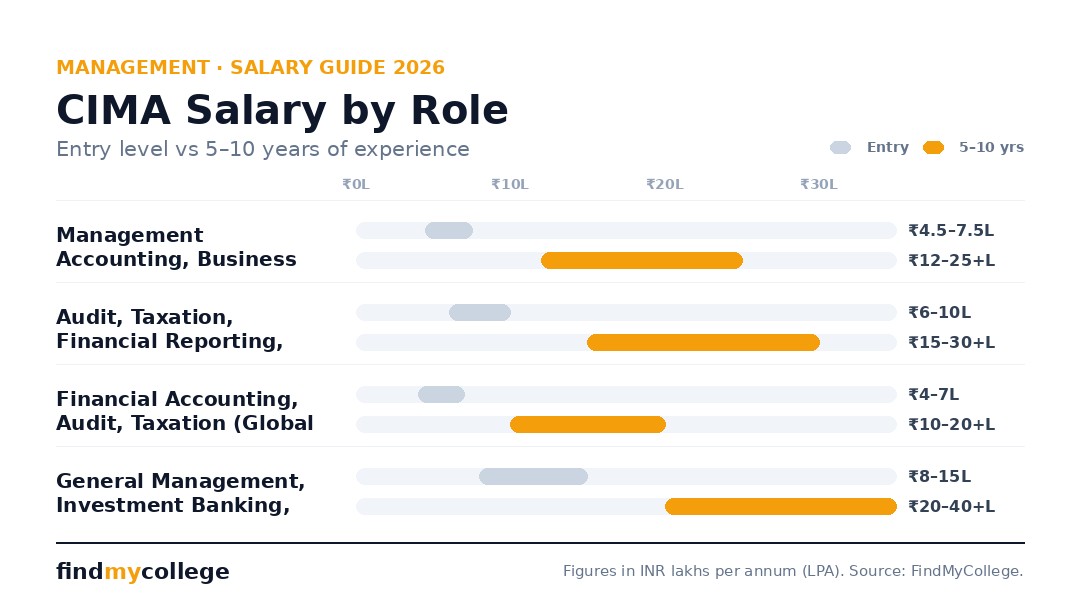
| Qualification | Typical Entry-Level Salary Range (INR Lakhs/annum) | Typical Mid-Career Salary Range (INR Lakhs/annum) | Primary Focus/Roles |
|---|---|---|---|
| CIMA | 4.5 – 7.5 | 12 – 25+ | Management Accounting, Business Partnering, Strategic Finance, Performance Management |
| CA (Chartered Accountant) | 6.0 – 10.0 | 15 – 30+ | Audit, Taxation, Financial Reporting, Compliance |
| ACCA (Association of Chartered Certified Accountants) | 4.0 – 7.0 | 10 – 20+ | Financial Accounting, Audit, Taxation (Global Focus) |
| MBA (Finance, Tier 1/2) | 8.0 – 15.0 | 20 – 40+ | General Management, Investment Banking, Consulting, Corporate Finance |
People Also Read



What factors influence CIMA salary in India?
Several critical factors influence the CIMA salary in India, leading to significant variations in earning potential. Understanding these can help students strategize their career path.
- Experience Level: This is the most significant factor. Salaries grow substantially with increasing years of relevant experience.
- Job Role/Designation: Roles like Financial Controller, Finance Manager, or Business Partner command higher salaries than entry-level positions.
- Industry: Sectors such as IT/ITES, Manufacturing, Financial Services, Consulting, and FMCG often offer better compensation packages.
- Company Size & Type: Multinational Corporations (MNCs) and large Indian conglomerates generally pay more than smaller firms or startups.
- Location: Major metropolitan cities like Mumbai, Bangalore, Delhi-NCR, Hyderabad, and Pune offer higher salaries due to higher cost of living and greater demand for skilled professionals.
- Skills & Specializations: Additional skills in data analytics, financial modeling, ERP systems (SAP, Oracle), and specific industry knowledge can boost earning potential.
- Educational Background: A strong academic record, coupled with CIMA, can also positively influence initial offers.
What are the typical CIMA job roles and their corresponding salaries in India for 2026?
CIMA qualification opens doors to a diverse range of roles across various industries. The salaries for these roles reflect the level of responsibility, strategic input, and experience required.
Indicative CIMA Job Roles and Salary Ranges (India, 2026)
| Job Role | Experience Level | Average Salary Range (INR Lakhs/annum) |
|---|---|---|
| Junior Management Accountant / Financial Analyst | Fresher – 2 years | 4.5 – 7.5 |
| Management Accountant / Business Analyst | 2 – 5 years | 7.0 – 12.0 |
| Senior Management Accountant / Finance Business Partner | 5 – 8 years | 12.0 – 18.0 |
| Financial Controller / Finance Manager | 8 – 12 years | 18.0 – 25.0 |
| Head of Finance / CFO (Small to Mid-size Co.) | 12+ years | 25.0 – 50.0+ |
Is CIMA worth it for jobs and salary prospects in India?
Yes, CIMA is highly worth it for job and salary prospects in India, especially for individuals aspiring to careers in strategic finance, business partnering, and management roles. The qualification is globally recognized and specifically designed to equip professionals with skills in financial strategy, risk management, and performance analysis, which are highly valued by employers in today’s dynamic business environment. CIMA professionals are not just number crunchers; they are strategic advisors who help businesses make informed decisions.
The demand for CIMA-qualified professionals is consistently growing in India, particularly in MNCs and large Indian corporations that require strong financial leadership and business acumen. The career progression is often faster into senior management roles compared to purely accounting-focused qualifications.
What is the eligibility for CIMA in India?
The eligibility for CIMA in India is quite flexible, allowing individuals from various academic backgrounds to pursue the qualification. There are multiple entry routes:
- Standard Entry Route: No prior accounting qualification is required. You can start with the Certificate in Business Accounting (CBA) and then progress to the Professional Qualification.
- Graduate Entry Route: If you hold a relevant degree (e.g., B.Com, BBA, MBA, Engineering), you may be eligible for exemptions from some or all of the Certificate level and potentially some Operational level exams.
- Professional Entry Route: If you are a member of an IFAC-recognized accounting body (like ICAI, ACCA, ICSI, etc.) or hold a relevant master’s degree in accounting/finance, you may be eligible for significant exemptions, potentially starting directly at the Management Case Study or Strategic Level.
All candidates must demonstrate proficiency in English. The CIMA registration process is online through the CIMA Global website, where you can also apply for exemptions based on your prior qualifications.
How much does CIMA cost in India for 2026?
The total cost of pursuing CIMA in India for 2026 can range significantly, typically between INR 2.5 Lakhs to INR 5.5 Lakhs, depending on the number of exemptions, study method (self-study vs. coaching), and exam attempts. This includes registration fees, annual subscriptions, exam fees for each level, and study material/tuition costs.
Indicative CIMA Cost Breakdown (India, 2026)
| Cost Component | Approximate Range (INR) | Notes |
|---|---|---|
| Initial Registration Fee | ~8,000 – 10,000 | One-time fee |
| Annual Student Subscription | ~12,000 – 15,000 per year | Paid annually until qualification |
| Exam Fees (Per Objective Test) | ~10,000 – 12,000 | 12 Objective Tests in total (Professional Level) |
| Exam Fees (Per Case Study Exam) | ~18,000 – 20,000 | 3 Case Study Exams in total (Operational, Management, Strategic) |
| Study Material / Coaching Fees | 1,00,000 – 3,00,000+ | Varies greatly by provider and study mode |
| Exemption Fees | ~5,000 – 8,000 per exemption | If applicable, can reduce overall cost by skipping exams |
It’s important to budget for potential re-takes and additional study resources. Many students opt for online coaching platforms which can be more cost-effective than traditional classroom coaching.
What is the CIMA exam pattern and dates for 2026 in India?
The CIMA qualification consists of three levels: Operational, Management, and Strategic, each culminating in a Case Study exam. Before each Case Study, there are three Objective Tests (OTs) per level.
- Objective Tests (OTs): These are computer-based, on-demand exams, meaning you can schedule them at any time throughout the year at a Pearson VUE test center. Each OT is 90 minutes long and assesses knowledge from specific subject areas.
- Case Study Exams: These are also computer-based and are offered four times a year (February, May, August, November) over a specific window (typically 3 days). These exams are 3 hours long and integrate knowledge from the three OTs of that level into a simulated business scenario.
For 2026, the exam pattern and structure are expected to remain consistent with previous years. Specific dates for the Case Study exam windows will be published on the CIMA Global website well in advance. Students should regularly check the official CIMA website for the most up-to-date information on exam registration deadlines and schedules.
Explore more on FindMyCollege
Related pages for Chartered Institute of Management Accountant aspirants on findmycollege.com:
Frequently Asked Questions
Is CIMA recognized in India?
Yes, CIMA is highly recognized in India, especially by multinational corporations and large Indian companies. It is considered a prestigious global qualification for management accountants and finance professionals.
What is the highest CIMA salary in India?
The highest CIMA salary in India can exceed 50 Lakhs per annum for experienced professionals in senior leadership roles like CFO, Head of Finance, or Finance Director, particularly in large MNCs or high-growth sectors.
Can I do CIMA after 12th in India?
Yes, you can start CIMA after 12th by enrolling in the Certificate in Business Accounting (CBA) level. This serves as the foundation before progressing to the Professional Qualification.
Are CIMA jobs available in India?
Yes, there is a strong demand for CIMA-qualified professionals in India across various industries, including IT/ITES, manufacturing, financial services, consulting, and FMCG, for roles like financial analyst, business partner, and finance manager.
What is the pass rate for CIMA exams in India?
CIMA does not publish country-specific pass rates. Globally, objective test pass rates typically range from 50-70%, while case study exam pass rates are generally lower, often in the 40-60% range, reflecting their integrated and application-based nature.
Does CIMA have good scope in India?
CIMA has excellent scope in India, particularly for those aiming for careers that blend finance with business strategy. Its focus on management accounting, performance management, and strategic decision-making makes graduates highly sought after in corporate finance and business leadership roles.
What is the duration to complete CIMA in India?
The duration to complete CIMA in India typically ranges from 2.5 to 4 years, depending on the entry route (exemptions), study pace, and number of exam attempts. Some highly dedicated students might complete it faster, while others might take longer.