Computer Science Syllabus: Core Subjects and Semester Modules
Nishit Kumar is a senior EdTech industry leader with over a decade of experience in building and scaling education platforms, shaping their product, content, and growth strategy. At…
- 1 Apr 2026Indira University releases updated semester-wise BSc Computer Science syllabus
The updated 6-semester BSc CS curriculum integrates Python programming, AI, machine learning, cloud computing, IoT applications, and DevOps practices.
Below is a detailed semester-wise module breakdown, laboratory practical structure, programming language requirements, fee ranges, and step-by-step admission guidelines for 2026.
| Parameter | Details |
|---|---|
| BSc Computer Science Duration | 3 Years (6 Semesters) |
| BE / BTech CSE Duration | 4 Years (8 Semesters) |
| Calcutta University BTech CSE Duration (Post-BSc) | 3 Years (6 Semesters / 161 Total Credits) |
| CBSE Class 11 CS Exam Scheme | 70 Marks Theory + 30 Marks Practical (100 Marks total) |
| Core Programming Languages Taught | C, C++, Java, Python, JavaScript, SQL |
Computer Science Subjects Year-wise
| Semester | Core Subjects |
|---|---|
| 1st Semester | Mathematics and Physics for Computing, Introduction to Programming, Engineering Mechanics |
| 2nd Semester | Data Structures and Algorithms, Digital Electronics, Object-Oriented Programming |
| 3rd Semester | Computer Organization, Operating Systems, Database Management Systems |
| 4th Semester | Computer Networks, Software Engineering, Theory of Computation |
| 5th Semester | Artificial Intelligence, Machine Learning, Internet of Things |
| 6th Semester | Cloud Computing, Cybersecurity, Distributed Systems |
| 7th Semester | Blockchain Technology, Big Data Analytics, Human-Computer Interaction |
| 8th Semester | Project Work, Industry Internship |
| Semester | Theory & Practical Subjects |
|---|---|
| 1st Semester | Digital Electronics, Foundation Math, Basics of CS, Windows OS, Environmental Science |
| 2nd Semester | Discrete Math, Open Source (Linux), DBMS, Programming Concepts, Front Office Management |
| 3rd Semester | OOP using C++, Technical Writing, PHP Fundamentals, Embedded Systems, Analytical Skills |
| 4th Semester | Advanced DBMS, System Analysis & Design, Values & Ethics, Math for CS, Java Programming |
| 5th Semester | Operating Systems, Python Programming, Data Structures, Software Engineering, System Software, DOS |
| 6th Semester | Computer Networks, Numerical Analysis, System Programming, Web Technology, Project Work |
| 7th Semester | Advanced OS, Cloud Computing, Advanced Software Engineering, Big Data Analytics, Mobile App Development |
| 8th Semester | Machine Learning, Artificial Intelligence, Cybersecurity, Distributed Computing, IoT |
BTech and BE CSE programs are spread over 8 semesters across 4 years, combining hardware fundamentals, software development, discrete mathematics, and industrial projects. Operating Systems coursework covers process scheduling, memory allocation, kernel architecture, file management, concurrency, and virtualization in Linux and Windows.
Programming Languages and Mathematical Foundations in CS
| Language | Primary Application Area in Syllabus |
|---|---|
| C | System programming, OS kernels, and hardware interfacing |
| C++ | Object-oriented programming, game development, and high-performance applications |
| Java | Enterprise software development, multithreading, and Android development |
| Python | Artificial intelligence, machine learning, data processing, and scripting |
| JavaScript | Web development, front-end interactivity, and web applications |
C language is taught for system programming, C++ for game development, Java for enterprise software, and Python for AI and data science. Discrete Mathematics and Linear Algebra support algorithm design and machine learning, while Graph Theory aids networking.
Computer Science Electives and Specialisations
Higher semesters allow students to tailor their degree toward specialized industry domains through elective modules.
Cybersecurity represents another major elective track within modern Computer Science degrees. Cybersecurity modules focus on encryption techniques, network security protocols, firewalls, intrusion detection systems, secure coding, and ransomware prevention. Elective coursework combines theoretical principles with advanced lab experiments to prepare graduates for domain-specific technical roles.
Computer Science Practicals and Projects
| Unit / Component | Key Topics Covered | Marks Allocation |
|---|---|---|
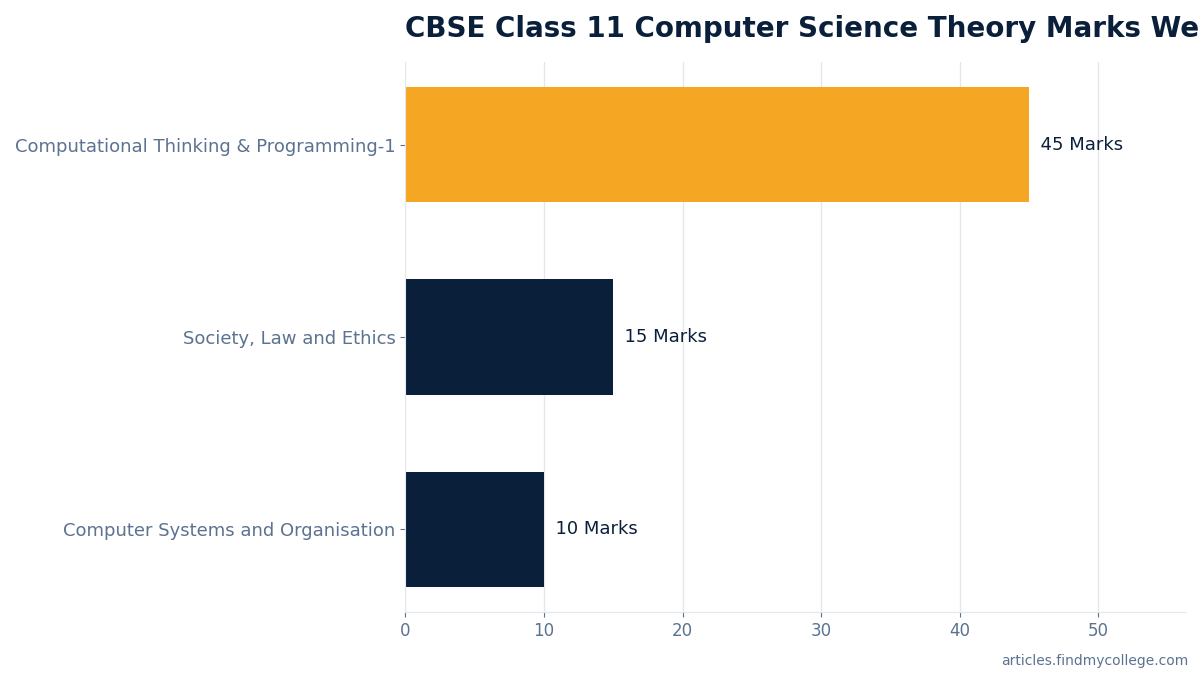
| Unit I: Computer Systems & Organisation | Hardware components, binary numbers, encoding schemes, Boolean logic gates, OS functions | 10 Marks |
| Unit II: Computational Thinking & Programming-1 | Algorithms, flowcharts, Python basics, loops, strings, lists, dictionaries, functions | 45 Marks |
| Unit III: Society, Law and Ethics | Cyber safety, phishing, digital footprints, intellectual property, ethical hacking awareness | 15 Marks |
| Practical Component | Python programs (12m), SQL queries (5m), Project work (8m), File & Viva (5m) | 30 Marks |
Class 11 CS practicals carry 30 marks for Python programs (12m), SQL queries (5m), project work (8m), and viva (5m). For higher studies, Calcutta University offers a 3-year BTech CSE program for BSc graduates in Physics, Mathematics, Statistics, or Computer Science.
CBSE Class 11 and Basic Computer Course Syllabus
Foundational computer science education begins at the senior secondary school level or through short-term diploma courses. CBSE Class 11 Computer Science (Code 083) carries 70 theory marks, dominated by Computational Thinking and Python Programming (45 marks / 64% weightage). The remaining theory score is split between Computer Systems & Organisation (10 marks) and Society, Law and Ethics (15 marks).
For non-degree learners, certification programs offer vocational IT proficiency. Basic Computer Courses offered by institutes like NIELIT cover MS Office productivity tools, operating system basics, web browsing, emails, and digital banking services.
| Course Type | Key Syllabus Modules Covered |
|---|---|
| 3-Month Basic Course | Computer Fundamentals, Windows OS, MS Word, MS Excel, MS PowerPoint, Email & Web Browsing, Antivirus |
| 6-Month Certificate / Diploma | OS Installation, MS Access Databases, Advanced Excel Formulas, Web Surfing, Digital Banking (UPI/Net Banking), Cyber Fraud Awareness |
| NIELIT Basic Computer Course (BCC) | GUI OS Operations, Word Processing, Spreadsheets, WWW & Web Browsers, Communication & E-mails, Financial Literacy & Banking Schemes |
Computer Science Colleges, Fees, and Placement Trends
At least 3,283 colleges offer Computer Science degrees across India, including 345 government institutions and 1,739 private colleges. Government colleges feature a median total course fee of ₹22,375, with the middle half ranging between ₹10,098 and ₹53,661 (based on data from 264 government colleges). Private colleges feature a higher fee scale, with a median total course fee of ₹90,000 and a middle half between ₹54,000 and ₹1.80 lakh (based on 1,211 private colleges).
State-level availability is highest in Tamil Nadu with 744 colleges, followed by Maharashtra (357), Karnataka (259), Madhya Pradesh (226), West Bengal (210), and Uttar Pradesh (205). Placement outcomes across 188 reporting institutions show a median average package of 3.07 LPA.
| College | City | Ownership | Total course fee | NIRF rank |
|---|---|---|---|---|
| Indian Institute of Science | Bangalore | — | ₹92,400 | 1 (Overall, 2025) |
| Jawaharlal Nehru University | Delhi | Government | — | 2 (Overall, 2025) |
| Manipal University Manipal | Manipal | — | ₹4.00 lakh | 3 (Overall, 2025) |
| Hans Raj College | Delhi | Government | ₹96,845 | 3 (Overall, 2025) |
| Kirori Mal College | Sonipat | Private | ₹50,790 | 4 (Overall, 2025) |
| Jamia Millia Islamia University | Delhi | Government | ₹20,950 | 4 (Overall, 2025) |
| Delhi University | Delhi | Government | ₹7,130 | 5 (Overall, 2025) |
| St. Stephen’s College | Delhi | Private (aided) | ₹92,049 | 5 (Overall, 2025) |
| Ramakrishna Mission Vivekananda Centenary College Rahara | Kolkata | — | ₹51,000 | 6 (Overall, 2025) |
| Banaras Hindu University | Varanasi | Government | ₹8,000 | 6 (Overall, 2025) |
| College | City | Ownership | Total course fee |
|---|---|---|---|
| Queen Mary’s College | Chennai | Government | ₹5,001 |
| Government College for Women (Autonomous) | Kumbakonam | Government | ₹5,040 |
| Periyar EVR College, Khajamalai | Tiruchirappalli | Government | ₹5,120 |
| Dr. Ambedkar Govt. Arts College | Chennai | Government | ₹5,220 |
| Government Arts College for Men | Chennai | Government | ₹5,780 |
| Panchayat College Bargarh | Bhubaneswar | Government | ₹5,913 |
| Government College for Girls | Gurugram | Government | ₹5,930 |
| Government College for Women Karnal | Karnal | Government | ₹5,938 |
| Government Arts College for Women Salem | Salem | Government | ₹6,000 |
| Kunthavai Naacchiyar Government Arts College for Women | Thanjavur | Government | ₹6,078 |
How to Apply for Computer Science Admission in 2026: Step by Step
- Evaluate BSc Graduate Pathways: Candidates with a BSc in Physics, Mathematics, Statistics, or Computer Science can apply for Calcutta University’s 3-year (6-semester) BTech CSE program.
- Select 3-Year Undergraduate Programs: Enroll in a 6-semester BSc Computer Science degree covering foundational programming, web development, data structures, DBMS, system design, and AI.
- Consider 4-Year Degree Options: Choose 8-semester BTech or BE CSE programs that combine hardware fundamentals, software development, discrete mathematics, and industrial projects.
- Explore Basic Computer Certifications: Pursue basic computer courses from institutes like NIELIT covering MS Office productivity tools, operating system basics, web browsing, emails, and digital banking services.
- Compare Institution Fee Structures: Select from 3283 computer science colleges, where government colleges have a median total fee of ₹22,375 while private colleges have a median fee of ₹90,000.
| What to do | Where | Link |
|---|---|---|
| Compare colleges, fees and cutoffs | Computer Science colleges in India | findmycollege.com |
Students can choose between 345 government colleges and 1739 private colleges offering Computer Science programs in India. Across 188 colleges with placement data, the median average placement package is 3.07 LPA.
FAQs
How many subjects are in computer science degrees?
A 3-year BSc Computer Science is structured across 6 semesters. A 4-year BTech or BE CSE program spans 8 semesters, combining hardware fundamentals, software development, discrete mathematics, and industrial projects.
How many subjects are in CSE 1st year 1st semester?
Which programming languages are taught in the computer science syllabus?
Core languages include C for system programming and hardware interfacing, C++ for game development, Java for enterprise software, and Python for AI and data science. SQL is taught for database management.
What mathematics subjects are essential for computer science?
Discrete Mathematics, Linear Algebra, Graph Theory, and Probability & Statistics form the mandatory mathematical foundation for CS degrees. These subjects support algorithm design and artificial intelligence.
How are marks split in CBSE Class 11 Computer Science?
CBSE Class 11 Computer Science carries 70 theory marks and 30 practical marks. Theory is dominated by Computational Thinking and Python Programming, while practicals evaluate Python programs, SQL queries, and project work.
What subjects are included in a basic computer course syllabus?
Basic Computer Courses cover MS Office productivity tools, operating system basics, web browsing, emails, and digital banking services. They prepare students to use computers for daily tasks and basic operations.