Criminal Law Course Details: Duration, Eligibility, Fees and Scope
Nishit Kumar is a senior EdTech industry leader with over a decade of experience in building and scaling education platforms, shaping their product, content, and growth strategy. At…
Prospective law students can evaluate course options, eligibility criteria, syllabus details, fee structures in government and private colleges, top institutes, and career scope across India.
| Parameter | Details |
|---|---|
| Course Duration | PG: 2 Years | PhD: 3-5 Years | Diploma/PG Diploma: 1 Year | Integrated UG: 5 Years |
| UG Eligibility | Class 12 or equivalent in any stream with 50-55% aggregate score |
| PG / LLM Eligibility | 3-year LLB or 5-year integrated LLB degree with minimum 50-55% aggregate score |
| Key Entrance Exams | CLAT, CUET-PG, CUET-UG, AP PGLCET, TS PGLCET, SLAT, AILET, UGC NET |
| Mandatory Practice License | Must pass All India Bar Examination (AIBE) and enrol with Bar Council to practice in court |
What is Criminal Law
Criminal Law focuses on legal frameworks defining offences against society and the state, alongside statutory provisions governing criminal investigation, prosecution, trial, and punishment. Legal education in this domain trains candidates to analyze crime patterns, penal codes, procedural law, rules of evidence, and fundamental rights protected under the justice system.
India maintains a student population of around 4.5 to 5 lakh law students with 40,000 to 45,000 graduating annually. Due to seat limits in specialized streams, only 5,000 to 7,000 postgraduate students specialize in Criminal Law each year, creating dedicated demand for specialized advocates and legal researchers.
Types and Specialisations of Criminal Law Courses
Law aspirants can enter criminal law through degree, diploma, and certificate programs depending on academic background and qualification level. BA Criminology is a 3-year undergraduate degree with total fees ranging between INR 50,000 and INR 5,20,000. For short-term postgraduate studies, a Diploma in Criminology takes 1 year to complete with average fees ranging from INR 10,000 to INR 45,000, while a Postgraduate Diploma in Criminal Justice (PGDCJ) takes 1 year with costs ranging between INR 10,000 and INR 55,000.
Popular specialisations within Criminal Law include Criminology & Forensic Science, Criminal Trial & Appeal, Bail & Criminal Revision, and Anti-Terrorist / Anti-Hijacking Matters. Short-term vocational courses like the Certificate Course on Practice and Procedure in New Criminal Laws cover recent legal reforms, specifically the Bharatiya Nyaya Sanhita 2023 (BNS), Bharatiya Nagarik Suraksha Sanhita 2023 (BNSS), and Bharatiya Sakshya Adhiniyam 2023 (BSA).
Criminal Law Eligibility
Eligibility standards vary according to the level of the course pursued. Specific requirements across undergraduate, postgraduate, diploma, and research levels are outlined below:
| Course Level | Minimum Educational Qualification | Minimum Aggregate Score | Accepted Entrance Exams |
|---|---|---|---|
| LLB Hons. | Class 12 or equivalent in any stream | 50% – 55% | CLAT, CUET-UG, SLAT, KLEE |
| LLM Criminal Law | 3-year LLB or 5-year integrated LLB | 50% – 55% | CUET-PG, CLAT-PG, AP PGLCET, TS PGLCET |
| Diploma / Certificate | Class 12 or equivalent in any stream | 50% – 55% | Merit-based / No entrance exam |
| PhD in Criminal Law | LLM or Master’s in relevant discipline | 50% – 55% | CLAT-PG, UGC NET, AILET |
Criminal Law Syllabus and Subjects
Curricula across criminal law programs combine theoretical knowledge of penal statutes with practical training in trial procedures and criminal advocacy. Course modules cover substantive legal codes, constitutional provisions, human rights principles, and forensic techniques.
Core subjects featured across criminal law programs include:
- Defences to criminal charges
- Criminology and Juvenile Justice
- Human Rights and Criminal Justice
- Crimes against people and property
- Bharatiya Nyaya Sanhita 2023 (BNS)
- Bharatiya Nagarik Suraksha Sanhita 2023 (BNSS)
- Bharatiya Sakshya Adhiniyam 2023 (BSA)
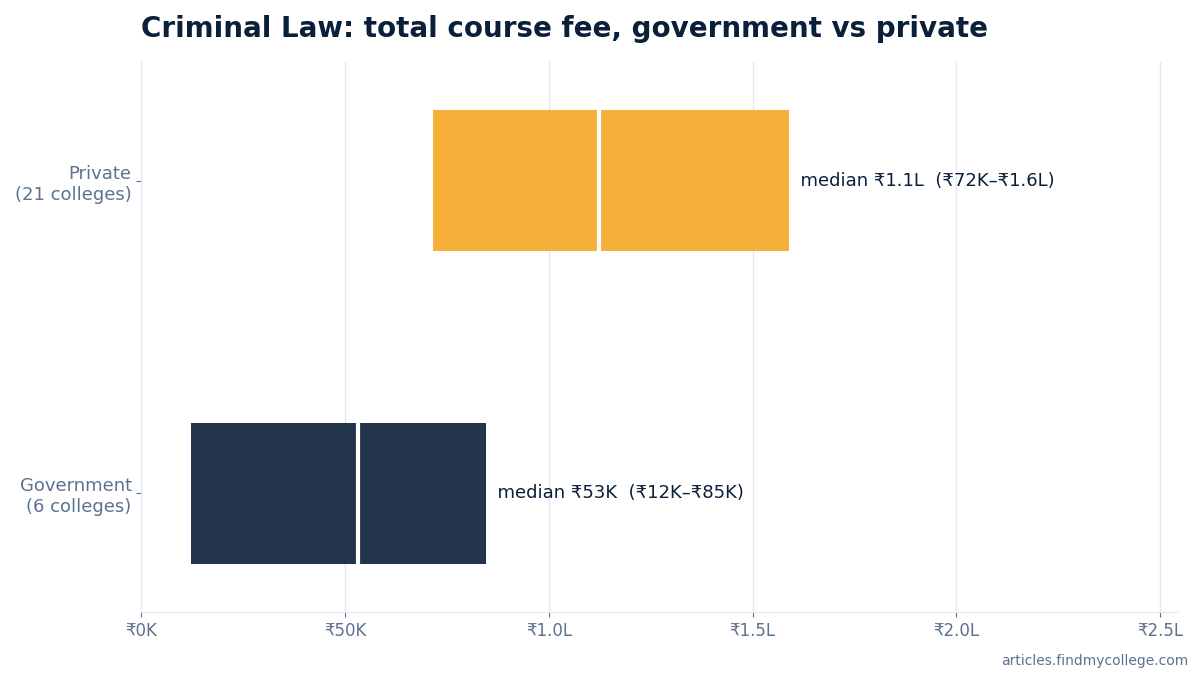
| College | City | Ownership | Total course fee |
|---|---|---|---|
| Gulbarga University | Gulbarga | Government | ₹5,690 |
| Adv. Ramkrishnaji Rathi Law College | Washim | Government | ₹14,257 |
| Jamia Millia Islamia University | Delhi | Government | ₹36,300 |
| Tamil Nadu Dr. Ambedkar Law University | Chennai | Government | ₹70,200 |
| Karnataka State Law University | Hubli | Government | ₹78,852 |
| NALSAR University of Law | Hyderabad | Government | ₹1.02 lakh |
| College | City | Ownership | Total course fee |
|---|---|---|---|
| SVKM’s Narsee Monjee Institute of Management Studies Navi Mumbai | Navi Mumbai | Private | ₹2.00 lakh |
| IIMT University | Meerut | Private | ₹1.32 lakh |
| Karnavati University | Gandhi Nagar | Private | ₹13.50 lakh |
| Gitarattan International Business School | Delhi | Private | ₹1.64 lakh |
| Shankersinh Vaghela Bapu Institute of Technology | Gandhi Nagar | Private | ₹80,000 |
| Fairfield Institute of Management and Technology | Delhi | Private | ₹1.02 lakh |
| Christ Academy Institute of Law | Bangalore | Private | ₹2.61 lakh |
| KC Law College Mumbai | Mumbai | Private (aided) | ₹1.12 lakh |
| Anand Law College | Anand | Private (aided) | ₹62,000 |
| Delhi Global Institute of Management | Faridabad | Private | ₹1.20 lakh |
| College | City | Ownership | Total course fee | NIRF rank |
|---|---|---|---|---|
| National Law School of India University | Bangalore | — | ₹1.14 lakh | 1 (Law, 2025) |
| NALSAR University of Law | Hyderabad | Government | ₹1.02 lakh | 3 (Law, 2025) |
| The West Bengal National University of Juridical Sciences | Kolkata | — | ₹99,000 | 4 (Law, 2025) |
| Faculty of Law Jamia Millia Islamia University | Nandurbar | Private | ₹36,300 | 5 (Law, 2023) |
| Symbiosis Law School Pune | Pune | University | ₹2.60 lakh | 7 (Law, 2025) |
| Jamia Millia Islamia University | Delhi | Government | ₹36,300 | 8 (Law, 2025) |
| Siksha ‘O’ Anusandhan University | Bhubaneswar | — | ₹1.50 lakh | 10 (Law, 2025) |
| Kalinga Institute of Industrial Technology | Bhubaneswar | — | ₹4.00 lakh | 14 (Law, 2025) |
| Saveetha Institute of Medical and Technical Sciences | Chennai | — | ₹2.50 lakh | 19 (Law, 2025) |
| Guru Gobind Singh Indraprastha University | Delhi | — | ₹1.68 lakh | 22 (Law, 2025) |
| City | Colleges | Fee range | Well-known options |
|---|---|---|---|
| Jaipur | 15 | ₹60,000 – ₹1.65 lakh | Manipal University Jaipur, Suresh Gyan Vihar University |
| Ahmedabad | 9 | ₹50,000 – ₹1.66 lakh | Nirma University, GLS University |
| Delhi | 9 | ₹36,300 – ₹2.45 lakh | Jamia Millia Islamia University, Guru Gobind Singh Indraprastha University |
| Lucknow | 8 | ₹80,000 – ₹1.10 lakh | Integral University, Maharishi University of Information Technology Lucknow |
| Chennai | 8 | ₹70,200 – ₹2.50 lakh | Saveetha Institute of Medical and Technical Sciences, Sathyabama Institute of Science and Technology |
| Bhopal | 7 | ₹40,000 – ₹1.54 lakh | LNCT University, Rabindranath Tagore University |
| Hyderabad | 6 | ₹95,000 – ₹9.20 lakh | NALSAR University of Law, ICFAI Foundation for Higher Education |
| Meerut | 6 | ₹79,000 – ₹1.33 lakh | IIMT University, Dewan Law College |
How to Apply for Criminal Law Admission in 2026: Step by Step
- Check eligibility criteria: Ensure completion of Class 12 or equivalent in any stream with 50% – 55% aggregate for undergraduate law courses, or a 3-year/5-year LLB degree with 50% – 55% aggregate for LLM programs.
- Register and appear for entrance exams: Apply for national-level entrance exams like CLAT, CUET-UG, or CUET-PG; state-level exams like AP PGLCET or TS PGLCET; or university-level exams like KLEE or SLAT.
- Fill out application forms and meet cutoffs: Complete college application forms with required credentials, take the entrance exam if applicable, and score above the minimum cutoff.
- Complete counselling and document verification: Review the merit list published online or on campus, and participate in counselling and document verification rounds when notified by email.
- Pay tuition fees and finalize admission: Pay the tuition fee specified by the institution to confirm your seat and close the admission process.
| What to do | Where | Link |
|---|---|---|
| Compare colleges, fees and cutoffs | Criminal Law colleges in India | findmycollege.com |
After graduating with an LLB, candidates must clear the All India Bar Examination (AIBE) and enrol with their state Bar Council to practice as a lawyer.
FAQs
What is the subject of criminal law?
Criminal law covers laws defining offences against the state/society, criminal behavior, procedural rules for investigation and trial, defenses to criminal charges, juvenile justice, and human rights in the criminal justice administration.
How to become a criminal lawyer after 12th?
After 12th, enrol in a 5-year integrated LLB degree (like BA LLB or BBA LLB) by clearing entrance exams like CLAT. Post-graduation, clear the All India Bar Examination (AIBE) and register with your state Bar Council.
What does PGDCJ stand for?
PGDCJ stands for Postgraduate Diploma in Criminal Justice. It is a 1-year postgraduate diploma course tailored for students and working professionals aiming to understand the legalities of the criminal justice system.
What is the syllabus of LLM in Criminal Law?
What is the average salary after completing a criminal law course?
With extensive courtroom experience and senior standing, earnings can grow from INR 18 LPA to over INR 1 Crore per year.
Can I study a Criminal Law course online in India?
Yes, private institutes and online platforms offer certificate and diploma courses in criminal law. However, licensing as a practicing advocate requires pursuing a formal BCI-recognized full-time LLB degree.