LLB After Graduation: Admission Process, Eligibility and Duration
Nishit Kumar is a senior EdTech industry leader with over a decade of experience in building and scaling education platforms, shaping their product, content, and growth strategy. At…
- 7 Oct 2026MHT CET Law College Predictor 2027 Tool Released
The MHT CET Law college predictor tool for 2027 admissions has been updated for 3-year and 5-year LLB courses across Maharashtra law colleges. - 1 Oct 2026LPUNEST 2027 Registration Active for Law Programs
LPUNEST 2027 online registration for law admissions is ongoing and will remain open until January 15, 2027.
A 3-year Bachelor of Laws (LLB) is a professional law degree designed for graduates in any stream (BA, B.Sc, B.Com, BBA, B.Tech) who have scored at least 45% aggregate marks (40% for SC/ST). Admission is granted based on entrance exams such as CUET PG / DU LLB, NLSAT, MH CET Law (3-Year), AP/TS LAWCET, or merit.
Tuition fees for a 3-year LLB range from ₹10,000 to ₹60,000 per year in government colleges and ₹30,000 to ₹2,00,000 per year in private law institutes. Below is a detailed breakdown of eligibility criteria, entrance exams, semester syllabus, fees, top colleges, and prospective career salaries available after graduation.
| Parameter | Details |
|---|---|
| Course Duration | 3 Years (6 Semesters) |
| Eligibility Criteria | Bachelor’s degree (10+2+3 pattern) in any discipline with minimum 45% aggregate marks (40% for SC/ST) |
| Upper Age Limit | No upper age limit enforced by the Bar Council of India |
| Annual Tuition Fees | ₹10,000 – ₹60,000/year (Government Colleges) | ₹30,000 – ₹2,00,000/year (Private Colleges) |
| Popular Entrance Exams | CUET PG / DU LLB, NLSAT, MH CET Law (3-Year), AP LAWCET, TS LAWCET, SLS AIAT, PU LLB |
| Starting Salary Range | ₹3 LPA – ₹8 LPA (Litigation) | ₹6 LPA – ₹15 LPA (Corporate Law) |
3-Year LLB Eligibility
To secure admission into a 3-year LLB course, candidates must fulfill the basic educational and minimum mark requirements specified by law institutions and the Bar Council of India:
- Educational Qualification: Any graduate degree under the 10+2+3 pattern (such as BA, B.Sc, B.Com, BBA, B.Tech) from a recognized university.
- Minimum Aggregate Marks: A minimum of 45% aggregate marks in the qualifying undergraduate degree, with a 5% relaxation for SC/ST candidates (requiring 40% aggregate marks).
- Age Limit: There is no upper age limit to pursue a 3-year LLB course as per updated Bar Council of India norms.
Top Law Entrance Exams for 3-Year LLB
Candidates seeking admission to top law institutes must clear designated national, state, or university-level entrance tests. CUET PG (DU LLB), NLSAT, MH CET Law (3-Year), PU LLB, SLS AIAT, AP LAWCET, and TS LAWCET are key entrance exams for 3-year LLB admissions. NLSAT is the official entrance examination conducted for 3-year LLB admissions at NLSIU Bengaluru, while SLS AIAT is conducted across four Symbiosis Law Schools located in Pune, Nagpur, Noida, and Hyderabad.
| Exam Name | Conducting Authority / Scope | Target Participating Institutions |
|---|---|---|
| CUET PG / DU LLB | National Testing Agency (NTA) | Faculty of Law (Delhi University), BHU, Central Universities |
| NLSAT | NLSIU Bengaluru | National Law School of India University (NLSIU), Bengaluru |
| PU LLB Entrance | Panjab University | Department of Laws PU Chandigarh & Regional Law Centres |
3-Year LLB Admission Process
Admissions to the 3-year LLB degree program are finalized through national or state-level entrance tests, followed by institutional or state-centralized counselling procedures. For instance, in AP LAWCET state admissions, 80% of seats are filled under the Convener quota based on entrance rank and 20% under the Management quota. Candidates must register on official portals, obtain valid ranks, complete choice filling, submit documents for verification, and pay institutional fees within defined deadlines.
People Also Read




3-Year LLB Syllabus and Subjects
The 3-year LLB program spans 6 academic semesters focusing entirely on core legal education, jurisprudence, procedural laws, and practical training. The curriculum includes core subjects like Law of Contract, Torts, IPC, Constitutional Law, Family Law, Environmental Law, Property Law, Administrative Law, Company Law, CrPC, CPC, Evidence Act, ADR, and IPR, along with mandatory practical training modules.
| Semester | Core & Practical Subjects |
|---|---|
| Semester I | Law of Contract I, Special Contract, Law of Torts (Motor Vehicles Act & Consumer Protection), Law of Crimes (IPC), Constitutional Law |
| Semester II | Family Law I, Family Law II, Environmental Law, Jurisprudence (Legal Theory & Method), Legal Language |
| Semester III | Property Law & Transfer of Property Act, Administrative Law, Company Law, Public International Law, Labour and Industrial Law |
| Semester IV | Principles of Taxation Law, Criminal Procedure Code (CrPC), Civil Procedure Code (CPC) & Limitation Act, Law of Evidence, Banking & N.I. Act |
| Semester V | Interpretation of Statutes, Alternate Dispute Resolution (ADR), Land Laws, Intellectual Property Laws (IPR), International Human Rights |
| Semester VI | White Collar Crime (Optional), Moot Court & Internship (Practical I), Drafting & Pleadings (Practical II), Professional Ethics (Practical III), Public Interest Lawyering (Practical IV) |
3-Year LLB Fees
- Government Law Colleges: Annual fees range from ₹10,000 to ₹60,000.
- Private Law Colleges: Annual fees range from ₹30,000 to ₹2,00,000.
- AP LAWCET Quota Breakdown: 80% of seats are filled under Convener quota based on entrance rank and 20% under Management quota.
Annual fees for a 3-year LLB range from ₹10,000 to ₹60,000 in government law colleges and ₹30,000 to ₹2,00,000 in private law colleges. In AP LAWCET state admissions, 80% seats are filled under Convener quota and 20% under Management quota.
Top 3-Year LLB Colleges
India houses several renowned government and private institutions offering 3-year LLB programs. Premier institutions include National Law School of India University (NLSIU), Bengaluru, Faculty of Law at University of Delhi, Symbiosis Law School, Pune, and Government Law College, Mumbai.
| College / Institution Name | NIRF Rank / Reputation | Admission Basis / Entrance Exam |
|---|---|---|
| NLSIU Bengaluru | NIRF Rank 1 | NLSAT Entrance Exam |
| Faculty of Law, University of Delhi (DU) | Top Central University Faculty | CUET PG / DU LLB Entrance |
| Symbiosis Law School (SLS), Pune | NIRF Rank 6 | SLS AIAT Entrance |
| Government Law College (GLC), Mumbai | Premier State Law College | MH CET Law (3-Year) |
| RGSOIPL, IIT Kharagpur | NIRF Rank 9 | IIT Kharagpur LLB Entrance Test |
| Banaras Hindu University (BHU), Varanasi | NIRF Rank 22 | CUET PG Entrance |
3-Year Law Course vs 5-Year Integrated Law Course
| Parameter | 3-Year LLB Course | 5-Year Integrated LLB Course (BA LLB/BBA LLB) |
|---|---|---|
| Duration | 3 Years (6 Semesters) | 5 Years (10 Semesters) |
| Minimum Eligibility | Bachelor’s degree in any stream (10+2+3) | Class 12 / Intermediate (10+2) from a recognized board |
| Curriculum Focus | Exclusively legal subjects and practical legal courses | Interdisciplinary non-law subjects (BA/BBA/B.Com) + Legal subjects |
| Target Candidates | Graduates deciding to enter the legal field after first degree | Students deciding to pursue law immediately after high school |
The 3-year LLB is structured exclusively for candidates who already possess an undergraduate degree, whereas the 5-year integrated law program is pursued right after Class 12.
3-Year LLB Career Scope and Salary
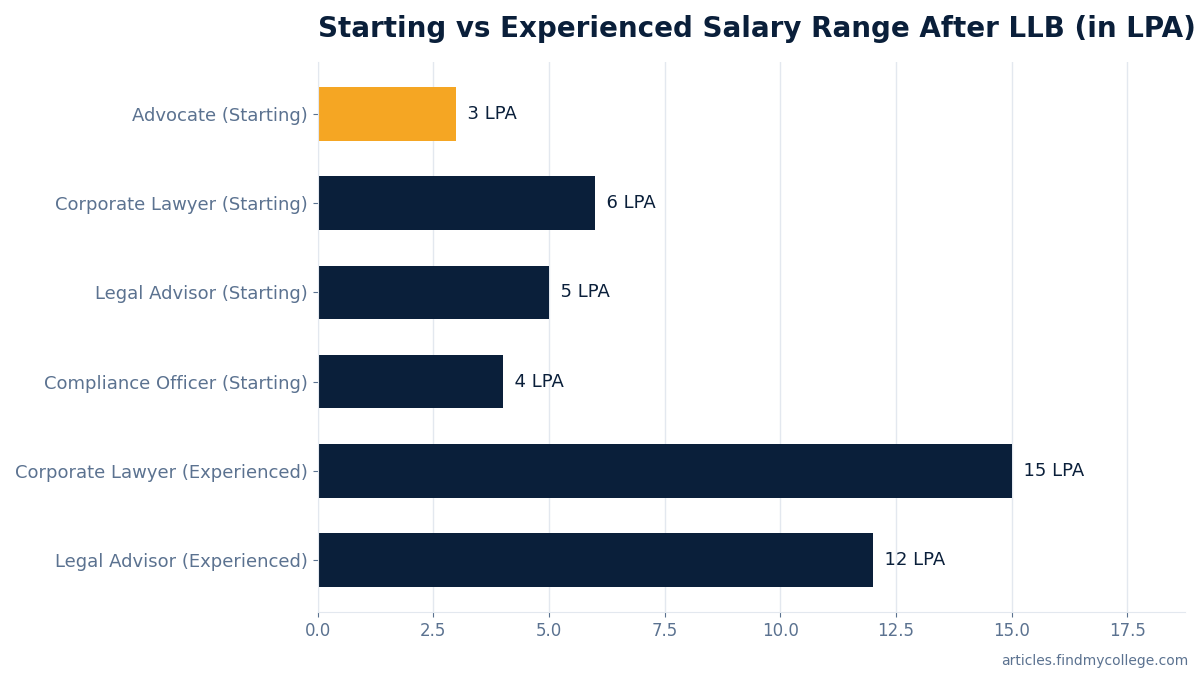
Law graduates must pass the All India Bar Examination (AIBE) conducted by the Bar Council of India to register as advocates and practice law in courts. Starting salaries for Advocates range between ₹3 LPA and ₹8 LPA, while Corporate Lawyers start at ₹6 LPA to ₹15 LPA, scaling up to ₹15–30 LPA with experience.
| Job Profile | Primary Role & Work Settings | Starting Salary Range | Experienced Salary Scale |
|---|---|---|---|
| Advocate / Litigator | Representing clients in civil, criminal, and family courts | ₹3 – ₹8 LPA | ₹8 – ₹15 LPA |
| Corporate Lawyer | Managing corporate compliance, M&A, contracts, and IP for firms | ₹6 – ₹15 LPA | ₹15 – ₹30 LPA |
| Legal Advisor / Consultant | Advising corporations, banks, and PSUs on legal matters | ₹5 – ₹12 LPA | ₹12 – ₹20 LPA |
| Compliance Officer | Ensuring adherence to regulatory laws in MNCs and financial firms | ₹4 – ₹10 LPA | ₹10 – ₹18 LPA |
| Legal Researcher / Analyst | Conducting case analysis and support research for legal cases | ₹6.8 LPA (Average) | ₹10 – ₹15 LPA |
| Legal Journalist / Writer | Reporting court proceedings, legal commentary, and publications | ₹3.1 LPA (Average) | ₹6 – ₹10 LPA |
How to Apply for 3-Year LLB Admission in 2026: Step by Step
- Check Eligibility: Verify that you have completed a bachelor’s degree (BA, B.Sc, B.Com, BBA, B.Tech) from a recognized university with at least 45% aggregate marks (40% for SC/ST candidates).
- Register for Entrance Exams: Apply for relevant national or state-level 3-year LLB entrance exams such as CUET PG (DU/BHU), NLSAT (NLSIU Bengaluru), MH CET Law (3-Year), AP LAWCET, or SLS AIAT.
- Appear for Entrance Test & Obtain Rank: Take the entrance examination testing proficiency in Legal Reasoning, Logical Reasoning, English Comprehension, and General Knowledge/Current Affairs.
- Participate in Counselling & Choice Filling: Register on centralized counselling portals (e.g., AP LAWCET Convener quota for 80% seats) and submit choice preferences for law colleges based on your rank.
- Submit Documents for Verification: Present original transcripts including Transfer Certificate (T.C.), Graduation Marksheets & Provisional Certificate, 10th & 12th Pass Certificates, Migration Certificate, Category Certificate, and Aadhaar ID.
- Pay Admission Fee & Secure Seat: Pay the admission fee (ranging from ₹10,000–₹60,000 in government colleges to ₹30,000–₹2,00,000 in private colleges) within the stipulated timeline to confirm enrolment.
| What to do | Where | Link |
|---|---|---|
| Compare colleges, fees and cutoffs | 3-Year LLB colleges in India | findmycollege.com |
FAQs
Can I join LLB after degree?
Yes, candidates who have completed any bachelor’s degree (BA, B.Sc, B.Com, BBA, B.Tech) with a minimum of 45% aggregate marks (40% for SC/ST) from a recognized university can pursue a 3-year LLB.
How long is law school in India after graduation?
Law school after graduation takes 3 years to complete, structured across 6 academic semesters focusing on law subjects and practical legal training.
Can I join LLB without CLAT?
Yes, 3-year LLB programs after graduation do not require CLAT UG. Admissions are based on exams like CUET PG (DU LLB), NLSAT, MH CET Law, AP/TS LAWCET, SLS AIAT, or direct merit.
What is the age limit to study 3-year LLB?
As per updated Bar Council of India guidelines, there is no upper age limit to enroll in a 3-year LLB program after graduation.
What are the fees for a 3-year LLB program?
Annual tuition fees range from ₹10,000 to ₹60,000 in government law colleges and from ₹30,000 to ₹2,00,000 per year in private law colleges.
What is the starting salary after completing an LLB?
Starting salaries range between ₹3 LPA and ₹8 LPA for court advocates, while corporate lawyers and legal advisors start at ₹5 LPA to ₹15 LPA.