LLB 3 Years Syllabus: Semester Wise Core Subjects and Electives
Nishit Kumar is a senior EdTech industry leader with over a decade of experience in building and scaling education platforms, shaping their product, content, and growth strategy. At…
- 22 Oct 20263-Year LLB curriculum integrates new criminal law codes BNS, BNSS, and BSA
BCI-affiliated law colleges and universities across India have updated the 3-Year LLB syllabus to replace old criminal statutes with Bharatiya Nyaya Sanhita (BNS, 2023), Bharatiya Nagarik Suraksha Sanhita (BNSS, 2023), and Bharatiya Sakshya Adhiniyam (BSA, 2023).
The 3-Year LLB syllabus is structured into 6 semesters covering core legal subjects, electives, practical clinical papers, and mandatory internships under the Bar Council of India (BCI) framework. Across the 3 years, students complete at least 30 papers—comprising 20 compulsory core papers, 4 clinical practical papers, and 6 optional electives—along with a minimum 12-week internship.
A total of 30 papers and a 50% minimum pass percentage per paper define the academic standards for law students across Indian universities. Readers will find a detailed semester-wise breakdown of core subjects, updated criminal procedural codes, clinical training modules, elective specialisations, recommended textbooks, and step-by-step admission guidelines below.
| Parameter | Details |
|---|---|
| Course Duration | 3 Years (6 Semesters) |
| Regulatory Body | Bar Council of India (BCI) |
| Minimum Required Papers (BCI Scheme) | 30 Papers (20 Compulsory Core, 4 Compulsory Clinical, 6 Optional Electives) |
| Mandatory Internship Duration | Minimum 12 Weeks across 3 Years (Max 4 continuous weeks per year) |
| Eligibility Criteria | Bachelor’s Degree in any discipline with min. 45% marks (42% for OBC, 40% for SC/ST) |
| Internal vs Written Weightage | 80% End-Semester Written Exam + 20% Internal Assessment per paper |
| Minimum Pass Criteria | 50% marks per paper and minimum 75% attendance per semester |
3-Year LLB Subjects Year-wise
First-year LLB subjects introduce foundational legal principles across Semesters I and II. Students cover core theoretical subjects such as Jurisprudence-I & Legal Methods, Principles of Contract (Contract-I), Law of Crimes-I under Bharatiya Nyaya Sanhita (BNS 2023), Law of Torts & Consumer Protection, and Family Law-I in the first semester. Semester II shifts focus to Law of Evidence under Bharatiya Sakshya Adhiniyam (BSA 2023), Family Law-II, Law of Crimes-II (BNS 2023), Property Law under Transfer of Property Act 1882, and Public International Law.
| Semester | Subject Title | Core Focus & Key Topics Covered |
|---|---|---|
| Semester I | Jurisprudence-I & Legal Methods | Nature & scope of law, legal theory, sources of law, law and morality |
| Semester I | Principles of Contract (Contract-I) | Contract formation, offer, acceptance, consideration, breach & remedies |
| Semester I | Law of Crimes-I (BNS 2023) | Bharatiya Nyaya Sanhita, criminal liability, general exceptions, offences against body & property |
| Semester I | Law of Torts & Consumer Protection | Defamation, negligence, nuisance, strict liability, vicarious liability, Consumer Protection Act |
| Semester I | Family Law-I | Hindu and Muslim personal laws, marriage, divorce, maintenance, and adoption |
| Semester II | Law of Evidence (BSA 2023) | Bharatiya Sakshya Adhiniyam, admissibility of evidence, burden of proof, witness examination |
| Semester II | Family Law-II | Inheritance, succession, joint family property, partition, and guardianship |
| Semester II | Law of Crimes-II (BNS 2023) | Specific criminal offences, punishments, sentencing principles under BNS |
| Semester II | Property Law | Transfer of Property Act 1882, sale, mortgage, lease, gift, rule against perpetuity, lis pendens |
| Semester II | Public International Law | State sovereignty, treaties, UN charter, international courts, dispute settlement |
In the second year, Semesters III and IV focus on constitutional structure, special commercial contracts, procedural rules, and regulatory administrative frameworks. Subjects include Constitutional Law-I, Code of Civil Procedure & Limitation Act, Company Law, and Special Contracts (Contract-II) in Semester III, followed by Constitutional Law-II, Administrative Law, Labour & Industrial Law, and Jurisprudence / Legal Theory in Semester IV. For the 2026-27 academic session, Panjab University offers its 3-Year LLB syllabus under a Credit Based Evaluation System.
| Semester | Subject Title | Core Focus & Key Topics Covered |
|---|---|---|
| Semester III | Constitutional Law-I | Preamble, Fundamental Rights, Directive Principles, Fundamental Duties, Citizenship |
| Semester III | Code of Civil Procedure & Limitation Act | Civil court jurisdiction, suits, plaints, appeals, decree execution, limitation periods |
| Semester III | Company Law | Corporate personality, MOA/AOA, share capital, directors, corporate governance, winding up |
| Semester III | Special Contracts (Contract-II) | Indemnity, guarantee, bailment, pledge, agency, Indian Partnership Act 1932, Sale of Goods Act 1930 |
| Semester IV | Constitutional Law-II | Executive, Legislature, Judiciary, Centre-State relations, Emergency provisions, Amendments |
| Semester IV | Administrative Law | Delegated legislation, administrative discretion, natural justice principles, remedies against administrative actions |
| Semester IV | Labour & Industrial Law | Industrial Disputes Act, trade unionism, social security, working conditions, retrenchment & strikes |
| Semester IV | Jurisprudence / Legal Theory | Schools of law (Analytical, Historical, Sociological), legal personality, ownership, possession, rights & duties |
The third year (Semesters V and VI) emphasizes criminal procedure, taxation, environmental regulations, dispute resolution mechanisms, and practical clinical legal training. Semester V covers Criminal Procedure Code under Bharatiya Nagarik Suraksha Sanhita (BNSS 2023), Drafting Pleading & Conveyancing, Environmental Law, and Principles of Taxation Law. Semester VI covers Alternative Dispute Resolution (ADR), Advocacy Professional Ethics & Accounting, Intellectual Property Rights (IPR), and Moot Court Mock Trial & Internship. Practical paper VI in the third, fourth, fifth, and sixth semesters is evaluated internally, culminating in a university Viva-Voce board examination in the sixth semester.
| Semester | Subject Title | Core Focus & Key Topics Covered |
|---|---|---|
| Semester V | Criminal Procedure Code (BNSS 2023) | Bharatiya Nagarik Suraksha Sanhita, arrest, bail, investigation, trial procedure, criminal appeals |
| Semester V | Drafting, Pleading & Conveyancing | Drafting plaints, written statements, bail applications, interlocutory petitions, sale/lease deeds |
| Semester V | Environmental Law | Environmental Protection Act, Water/Air Acts, public trust doctrine, sustainable development, judicial activism |
| Semester V | Principles of Taxation Law | Direct and indirect taxation, Income Tax Act provisions, GST framework, tax assessment |
| Semester VI | Alternative Dispute Resolution (ADR) | Arbitration and Conciliation Act, mediation techniques, Lok Adalats, negotiation strategies |
| Semester VI | Advocacy, Professional Ethics & Accounting | Bar Council standards, duties of advocates, professional misconduct, contempt rules, lawyer accounts |
| Semester VI | Intellectual Property Rights (IPR) | Patents, Trademarks, Copyrights, Industrial Designs, infringement litigation & remedies |
| Semester VI | Moot Court, Mock Trial & Internship | Simulated courtroom arguments, memorial drafting, advocate office/court attendance, practical viva-voce |
3-Year LLB Electives and Specialisations
Under BCI rules, the 3-Year LLB program mandates 6 optional elective papers alongside the 20 compulsory core papers and 4 clinical practical papers. Elective offerings in the final year allow law students to build expertise in commercial, regulatory, or public interest domains based on their career targets. Popular elective streams include Cyber Law & IT Law, Taxation Law, Intellectual Property Rights, International Trade Law, Criminology & Victimology, Human Rights & Refugee Law, and Insurance & Banking Law.
| Elective Subject | Domain / Stream | Key Areas Covered |
|---|---|---|
| Cyber Law & IT Law | Technology Law | Legal issues of internet, e-commerce regulations, data privacy, cybercrimes, digital signatures |
| Taxation Law | Commercial Law | Income Tax Act, GST Act 2017, corporate tax planning, capital gains, tax procedures |
| Intellectual Property Rights | Corporate / IP Law | Patents Act, Trademarks Act, Copyright Act, IPR licensing, digital copyright disputes |
| International Trade Law | International Law | WTO regulations, tariffs and trade agreements, import-export laws, international arbitration |
| Criminology & Victimology | Criminal Law | Penological theories, criminal psychology, prison reform, victim compensation mechanisms |
| Human Rights & Refugee Law | Public Law | UN human rights conventions, NHRC procedures, international refugee protection framework |
| Insurance & Banking Law | Commercial Law | Insurance contracts, Banking Regulation Act, Negotiable Instruments Act, debt recovery tribunals |
Books for 3-Year LLB
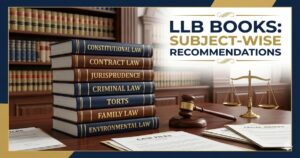
Selecting standard commentary titles and textbook authors is essential for mastering statutory provisions and case law precedents across semesters. For Legal Theory, Dr. N.V. Paranjape’s ‘Studies in Jurisprudence and Legal Theory’ serves as the primary recommended textbook. For Constitutional Law, commentary books by P.M. Bakshi and M.P. Jain provide thorough coverage of constitutional interpretations and judicial precedents.
Core statutory subjects like Contract Law and Consumer Protection rely heavily on standard works by R.K. Bangia and Avtar Singh. For civil procedural law, C.K. Takwani and M.P. Tandon are leading recommended authors for Code of Civil Procedure and Limitation Act. For criminal procedure under BNSS, Ratanlal & Dhirajlal, R.V. Kelkar, and B.B. Mitra serve as primary author references, while Mulla is the standard author for Property Law.
| Subject Title | Recommended Book Title | Author / Publisher |
|---|---|---|
| Jurisprudence & Legal Theory | Studies in Jurisprudence and Legal Theory | Dr. N.V. Paranjape (Central Law Agency) |
| Law of Contract | Indian Contract Act | R.K. Bangia (Allahabad Law Agency) / Avtar Singh |
| Law of Torts | Law of Consumer Protection: Principles & Practice | Avtar Singh (Eastern Book Company) / R.K. Bangia |
| Code of Civil Procedure | Code of Civil Procedure | C.K. Takwani / M.P. Tandon |
| Criminal Procedure / BNSS | Criminal Procedure / Code of Criminal Procedure | Ratanlal & Dhirajlal / R.V. Kelkar / B.B. Mitra |
| Property Law | Transfer of Property Act | Mulla (LexisNexis Butterworths) |
| Labour & Industrial Law | Industrial Relations and Labour Laws | S.C. Srivastava / Dr. V.G. Goswami / O.P. Malhotra |
3-Year LLB vs 5-Year Integrated BA LLB Syllabus Structure
| Feature / Parameter | 3-Year LLB Course | 5-Year Integrated BA LLB Course |
|---|---|---|
| Eligibility | Graduate degree in any discipline | Class 12th (10+2) qualification |
| Course Duration | 3 Academic Years (6 Semesters) | 5 Academic Years (10 Semesters) |
| Non-Law Subjects | Nil (Pre-requisite covered by prior degree) | 14 to 16 Humanities/Arts papers (Pol Sci, History, Sociology, English) |
| Total Law Papers | Minimum 30 Law Papers (20 Core, 4 Clinical, 6 Elective) | Minimum 30 Law Papers + 8 Honours Papers (up to 59 total papers) |
| Mandatory Internship | Minimum 12 Weeks total | Minimum 20 Weeks total |
| Ideal Candidate | Graduates looking to pivot into legal practice or corporate law | Class 12 pass-outs looking for immediate integrated law education |
Unlike 5-year integrated programs that include 14-16 humanities subjects, the 3-Year LLB focuses exclusively on legal subjects across 6 semesters. Admission to top 3-Year LLB courses is conducted through entrance exams such as NLSAT, MH CET Law, CUET PG, and PU CET.
People Also Read




How to Apply for 3-Year LLB Admission in 2026: Step by Step
- Check Eligibility Criteria: Ensure you hold a recognized Bachelor’s degree in any stream with at least 45% aggregate marks for General category (42% for OBC, 40% for SC/ST).
- Register for Entrance Examination: Apply for national or state-level 3-Year LLB entrance exams such as NLSAT (for NLSIU), MH CET Law (for Maharashtra law colleges), CUET PG (for Central Universities like DU/BHU), or PU CET.
- Prepare and Appear for Entrance Test: Prepare across core test sections: English Language & Comprehension, Logical & Analytical Reasoning, Legal Aptitude & Reasoning, and General Knowledge & Legal Current Affairs.
- Participate in Counselling and Merit Seat Allocation: Register for Centralized Admission Process (CAP) or university counseling portals based on your entrance score and submit institute preferences.
- Pay Admission Fees and Commences Semesters: Pay the admission fee to confirm your seat and start attending regular lectures, internal assessments, and mandatory internship programs.
| What to do | Where | Link |
|---|---|---|
| Compare colleges, fees and cutoffs | 3-Year LLB colleges in India | findmycollege.com |
FAQs
What is a 3 year LLB course?
How many subjects are in LLB 3 years?
Under Bar Council of India (BCI) regulations, a 3-Year LLB course comprises at least 30 papers, including 20 compulsory core papers, 4 compulsory clinical practical papers, and 6 optional elective papers.
Can I join LLB without CLAT?
Yes, CLAT is conducted primarily for 5-year integrated law and LLM courses. Admission to 3-year LLB programs is done through specific entrance exams like NLSAT, MH CET Law, CUET PG, or PU CET.
Is LLB difficult to pass?
Passing the 3-Year LLB requires consistent study of statutory provisions, landmark case laws, and drafting techniques. Most universities require a minimum 50% pass mark per paper and 75% attendance.
Which entrance exam is best for a 3 year LLB?
Which books are required for LLB?
Key textbooks include Jurisprudence by Dr. N.V. Paranjape, Constitution of India by P.M. Bakshi, Law of Contract by R.K. Bangia, Code of Civil Procedure by C.K. Takwani, and Criminal Procedure by Ratanlal & Dhirajlal.