LLB 1st Year Subjects & Syllabus 2026: Core Curriculum Breakdown
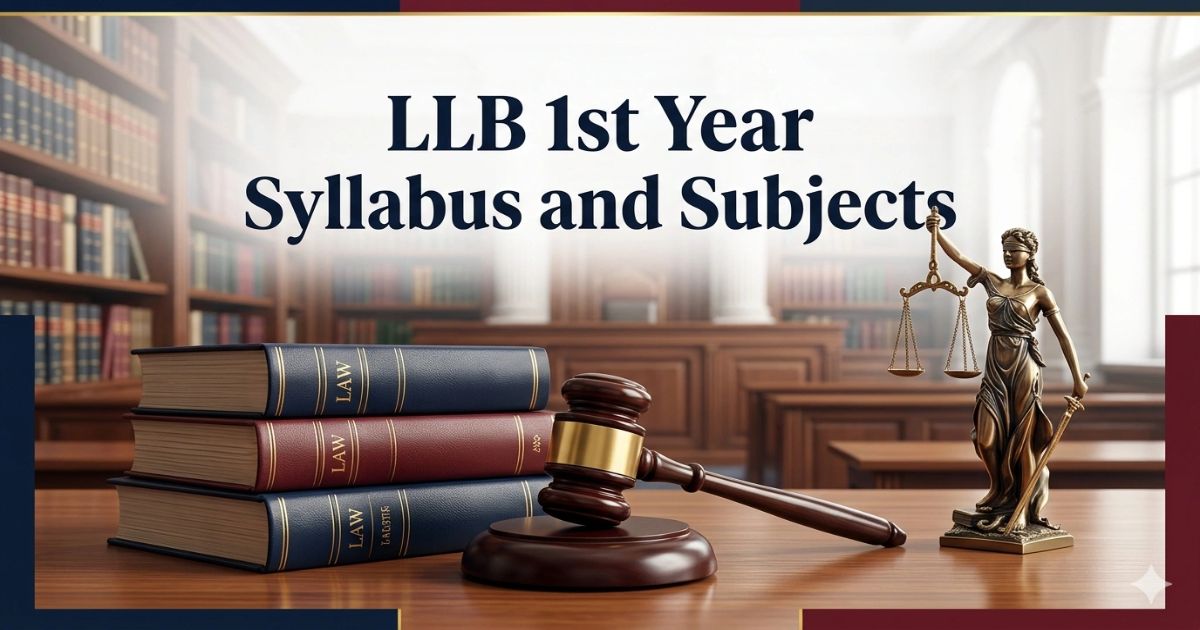
LLB 1st year syllabus includes subjects like Law of Contract, Constitutional Law, Family Law, Law of Crimes and Environment Law among others. Find detailed 1st year syllabus of both 5-year and 3-year LLB courses here.
The core LLB subjects 1st year introduces students to fundamental legal principles, laying the essential groundwork for a successful legal career. Aspiring lawyers delve into crucial areas like Constitutional Law, Law of Contract, and Jurisprudence, building a robust understanding of the Indian legal system. The 1st year of both 5-year LLB (BA LLB) and 3-year LLB (LLB) programmes is divided into two semesters. This article provides a detailed breakdown of the 2026 curriculum, essential books, and comparisons between different university syllabi to guide your academic journey.
LLB 1st Year Core Subjects & Semester-Wise Curriculum 2026
The LLB 1st year syllabus is structured over two semesters, forming the foundation of a comprehensive legal education. This curriculum applies to both 3-Year LLB and 5-Year Integrated BA LLB programmes. Core llb subjects 1st year remain consistent across universities, regulated by the Bar Council of India (BCI) and UGC-recognized colleges.
| Subject | Brief Description |
| Law of Contract & Specific Relief | Principles governing agreements, enforceability, remedies, and contractual obligations. |
| Law of Torts, Motor Accident Claims & Consumer Protection | Civil wrongs, compensation mechanisms, and consumer rights protection. |
| Labour Law & Industrial Relations | Legal framework governing employment, trade unions, and industrial disputes. |
| Constitutional Law – I | Fundamental rights, constitutional principles, and structure of Indian governance. |
| Law of Crimes | Introduction to criminal liability, offences, and punishments under IPC. |
| Family Law – I | Laws relating to marriage, divorce, maintenance, and family relationships. |
| Environmental Law | Legal provisions for environmental protection and sustainable development. |
| Legal Language | Legal terminology, interpretation, and effective legal communication. |
| Drafting, Pleading & Conveyancing – I | Basics of legal drafting, pleadings, and document preparation. |
| Professional Ethics & Accounting System | Ethical standards for advocates and basic accounting practices (practical training). |
These core llb subjects 1st year are distributed across two semesters, focusing on developing a clear conceptual understanding of key laws, the Indian legal system, and essential skills like analytical thinking and legal writing. The curriculum also includes practical subjects such as Professional Ethics and Drafting, Pleading & Conveyancing.
Essential Books for LLB 1st Year Subjects: Expert Recommendations 2026
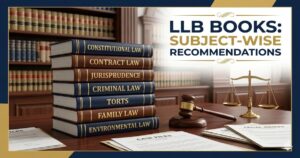
This section highlights essential and recommended books crucial for students embarking on their LLB 1st year subjects. These expert-curated selections provide a strong foundation across core legal disciplines, ensuring comprehensive understanding for academic success in your initial legal studies.
| Subject | Book Title / Author |
| Jurisprudence | Legal Theory by Dr. P. K. Padhi |
| Contract Law | Indian Contract Act by Dr. Avtar Singh |
| Torts & Consumer Protection | Law of Torts and Consumer Protection Act by Dr. R.K. Bangia |
| Family Law | Family Law by Dr. Paras Diwan |
| Constitutional Law | Constitutional Law of India by Dr. J.N. Pandey |
| Constitutional Law (Sem 1) | Introduction to the Constitution of India by D.D. Basu |
| Family Law II | Family Law II for BSL & LL.B by Mrs. Jaibala Rahatekar |
| Indian Constitutional Law | Indian Constitutional Law by M P Jain |
| Criminal Law | Investigation to Trial by Abhilash Malhotra |
| Torts (Semester 2) | The Law of Torts by R.K. Bangia |
| Indian Contract Act (Advanced) | Indian Contract Act by Avtar Singh |
| Family Law (Advanced) | Family Law Lectures by Kusum |
| Indian Penal Code | Indian Penal Code by K.D. Gaur |
People Also Read



LLB 1st Year Exam and Grading Pattern
The LLB 1st year examination system in India follows a semester-based evaluation model combining end-semester written exams and continuous internal assessment, with grading structures varying slightly across universities but broadly aligned with Bar Council of India (BCI) norms.
| Component | Details |
| Evaluation System | Semester-based system with two exams per academic year (Semester 1 & 2) |
| Exam Type | End-semester written examinations for all core and elective subjects |
| Internal Assessment | Includes class tests, assignments, presentations, attendance, and projects |
| Weightage Pattern | Commonly 75:25 or 60:40 (End-semester exam : Internal assessment), varies by university |
| Grading System | Many universities follow CBCS (Choice Based Credit System) with SGPA and CGPA grading |
| Pass Criteria | Generally 40%–50% aggregate marks (internal + external combined per subject) |
| Variation Across Universities | Marking schemes, credit distribution, and grading scales differ across institutions |
| Regulatory Framework | Broadly guided by Bar Council of India norms, implemented through university-specific regulations |
3-Year LLB 1st Year Syllabus: Detailed Overview
The 3-Year LLB programme is a postgraduate law degree designed for graduates from any discipline who want to pursue legal education. It focuses directly on core law subjects, courtroom foundations, and professional legal training from the very first year.
This structure is broadly aligned with curriculum standards set under the Bar Council of India (BCI) framework and implemented with minor variations across universities in India.
Overall Subjects
| Category | Subjects |
| Core Law Subjects | Family Law I, Law of Contract I, Law of Crimes, Constitutional Law I |
| Core Law (Continued) | Family Law II, Law of Contract II, Constitutional Law II, Law of Torts |
| Jurisprudence & Legal Theory | Jurisprudence (Introduction) |
| Professional & Practical Papers | Professional Ethics, Bar-Bench Relations & Accountancy for Lawyers |
| Electives (University-dependent) | Women and Law, Criminology and Penology, RTI & PIL, Law and Media, Election Law, Healthcare Law |
Semester-wise Subjects
| Semester | Subjects |
| Semester 1 | Family Law I, Law of Contract I, Law of Crimes, Constitutional Law I, Jurisprudence (Introduction), Legal Method / Legal Language (varies by university), Elective (e.g., Women and Law / RTI & PIL) |
| Semester 2 | Family Law II, Law of Contract II, Constitutional Law II, Law of Torts, Professional Ethics, Bar-Bench Relations & Accountancy for Lawyers, Electives (e.g., Criminology & Penology / Media Law / Election Law) |
LLB 1st Year Syllabus of 5-Year Programme
The 5-Year BA LLB programme is an integrated law degree that combines arts + foundational law subjects in the early years, gradually shifting into core legal training from Year 2 onwards. It is regulated under standards set by the Bar Council of India.
Overall Subjects
| Category | Subjects (Common Across Universities in India) |
| Legal Foundation Subjects | Legal Method / Introduction to Law, Law of Contract, Law of Torts, Introduction to Legal System |
| Humanities / Social Sciences | Political Science I, Sociology I, Economics I, History I |
| Language & Communication | English I (Law & Language / Legal Communication) |
| Introductory Law Exposure | Introduction to Indian Legal System, Basics of Legal Reasoning |
Semester-wise Subjects
| Semester | Subjects |
| Semester 1 | Legal Method / Introduction to Law, Political Science I, Sociology I, Economics I, History I, English I (Legal Language / Communication), Law of Contract I |
| Semester 2 | Law of Contract II, Law of Torts, Political Science II, Sociology II, Economics II, History II, English II (Legal Writing / Communication Skills), Introduction to Legal System / Jurisprudence Basics |
LLB 1st Year Syllabus: 3-year vs 5-year Programmes
Both the 3-Year LLB and 5-Year BA LLB follow Bar Council of India–approved legal education structures, but they differ significantly in how legal education is introduced and built in the first year.
| Aspect | 3-Year LLB (1st Year) | 5-Year BA LLB (1st Year) |
| Entry Background | Students already hold a bachelor’s degree in any discipline | Students enter directly after Class 12 |
| Learning Approach | Direct immersion into core legal subjects from Day 1 | Gradual transition: social sciences first, law introduced alongside |
| Focus in 1st Year | Heavy focus on foundational law subjects (Contract, Crime, Constitution, etc.) | Balanced focus between social sciences + introductory law |
| Academic Progression Style | Fast-track legal training with minimal non-law subjects | Progressive build-up: foundation → legal core → advanced law |
| Jurisprudence Exposure | Introduced early (often in Year 1 or 2) | Usually introduced in later part of Year 1 or Year 2 |
| Skill Development Focus | Court-oriented thinking, legal reasoning, professional readiness | Analytical + interdisciplinary thinking (law + society + politics) |
| Teaching Orientation | Case law-heavy and doctrine-focused from the beginning | Mix of conceptual + interdisciplinary + legal basics |
| Ideal For | Graduates seeking a focused legal career transition | Students aiming for long-term structured legal education after school |
University of Calcutta LLB 1st Year Syllabus: Detailed Overview
The table below highlights the comprehensive and structured curriculum, including key llb subjects 1st year and beyond, mandated by the Bar Council of India for all LLB programs at Calcutta University.
LLB Syllabus
| Category | Requirement (BCI-Mandated Structure) |
| 3-year / 5-year LLB Theoretical Subjects | 20 papers |
| 3-year / 5-year LLB Clinical Courses | 4 courses |
| 3-year / 5-year LLB Optional Papers | 6 options |
| 5-year Integrated LLB Minimum Papers | 14 papers |
| 5-year Integrated LLB Non-Law Subjects | 3 subjects |
| 5-year Integrated LLB Compulsory English | 2 papers |
Entrance Exam Syllabus
| Section | Topics Covered | Number of Questions | Total Marks |
| General English | – Vocabulary – Synonyms – Antonyms – Word Usage – Foreign Words/Phrases – Para Jumbles – Grammar – Reading Comprehension – Inference-based questions | 25 | 25 |
| General Knowledge and Current Affairs | – International events – Eminent personalities – Sports – Awards and honors – UN bodies – Major developments in geopolitics and environmental agreements | 25 | 25 |
| General Mathematics | – Average – Mensuration – Statistics – Profit and Loss – Time and Work – Geometry – Probability – Quadratic Equations – Ratios and Proportions | 25 | 25 |
| Reasoning (Verbal & Non-Verbal) | – Series – Syllogism – Arguments and Conclusions – Analogy – Blood Relations – Sequences – Directions – Critical Reasoning | 25 | 25 |
Detailed Topics Covered in LLB 1st Year Constitutional Law 2026
Constitutional Law – I is a key component of llb subjects 1st year, typically covered in the 2nd Semester. This subject explores the Indian Constitution’s philosophy, historical context, and governance framework.
The curriculum delves into foundational constitutional concepts, distribution of powers, and the roles of key constitutional organs, ensuring a comprehensive understanding of India’s legal framework.
| Category | Details |
| Detailed Topics – Unit I (Constitution) | Definition, Classification, Sources, Conventions, Salient features, Rule of Law, Separation of powers. |
| Detailed Topics – Unit II (Distribution of Powers) | Legislative, Administrative, Financial powers (Center/States), Doctrines (Territorial Nexus, Harmonious Construction, Pith and Substance, Repugnancy). |
| Detailed Topics – Unit III (Constitutional Organs) | Parliament (Sovereignty, Privileges, Anti Defection), Executive (Collective Responsibility), Judiciary (Jurisdiction, Independence, PIL, Judicial Review, Political Question). |
| Detailed Topics – Unit IV (Other Provisions) | Emergency Provisions, Amendment, Basic Structure, State Liability (Contractual/Tortious), Right to Property, Freedom of Trade & Commerce. |
| Recommended Books (General) | Introduction to the Constitution of India by D.D. Basu; Indian Constitutional Law by M.P. Jain. |
| Recommended Books (Detailed Syllabus) | D.D. Basu (Shorter Constitution of India, 2001), H.M. Seervai, V.N. Shukla, M.P. Jain, B.K. Sharma. |
Frequently Asked Questions
1. What are the core subjects in LLB 1st year (2026)?
The core LLB 1st year subjects include Constitutional Law, Law of Contract, Law of Torts, Law of Crimes, Family Law, Jurisprudence, Legal Language, Environmental Law, Labour Law, and Professional Ethics, forming the foundation of legal education.
2. Are LLB 1st year subjects the same in all universities?
No, the structure is broadly similar but not identical. While core subjects like Contract, Constitution, and Torts are common, electives and paper titles vary across universities as per Bar Council of India guidelines.
3. What is the difference between 3-year and 5-year LLB 1st year syllabus?
The 3-year LLB focuses directly on core law subjects from the first semester, while the 5-year BA LLB combines social science subjects with introductory law before moving into advanced legal studies.
4. Which books are best for LLB 1st year students?
Popular books include Avtar Singh (Contract Law), R.K. Bangia (Torts), D.D. Basu (Constitutional Law), J.N. Pandey, Paras Diwan (Family Law), and P.K. Padhi (Jurisprudence), widely used across Indian law colleges.
5. How many subjects are there in LLB 1st year?
Typically, both 3-year and 5-year LLB programmes include around 14–15 papers across two semesters, including core law subjects, electives, and practical papers like drafting and professional ethics.
6. Is Constitutional Law an important subject in LLB 1st year?
Yes, Constitutional Law is one of the most important foundational subjects. It covers fundamental rights, governance structure, separation of powers, and judicial review, forming the backbone of Indian legal studies.