LLB vs LLM: Key Differences, Eligibility, and Career Paths for 2026
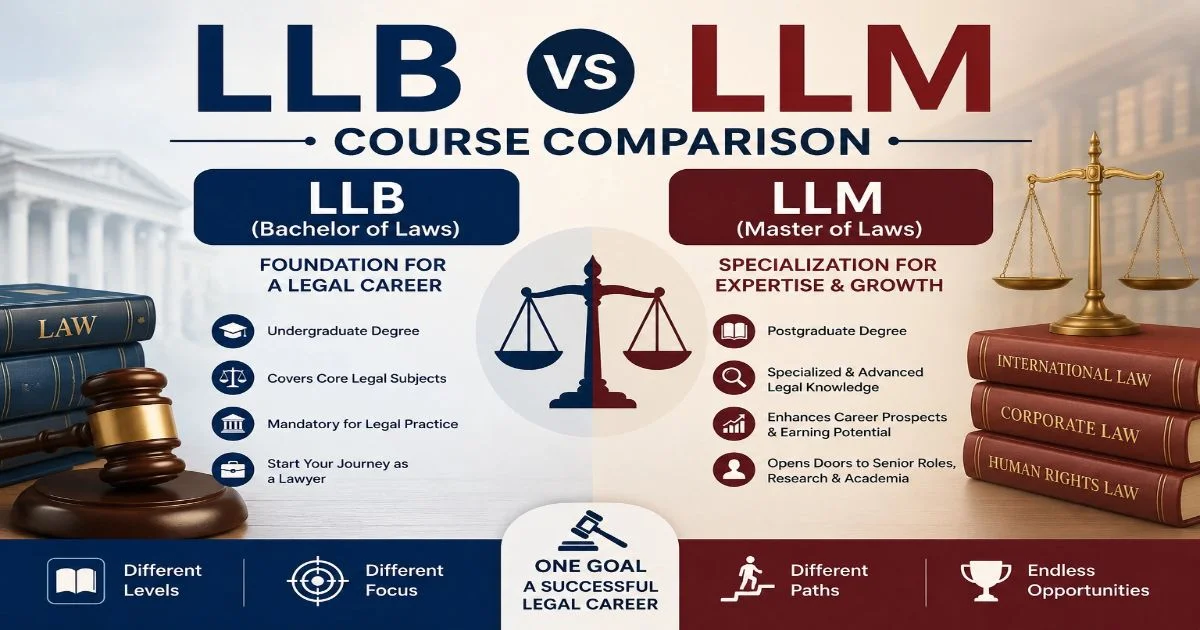
LLB is a graduation level course available in 3 and 5 year long durations. LLM is a PG level course typically lasting from 1-2 years. Find their key differences between eligibility, admission, colleges, salary and more.
Understanding the fundamental distinction between an LLB vs LLM is crucial for aspiring legal professionals, as one is an undergraduate law degree and the other a specialized postgraduate qualification. While an LLB provides foundational legal knowledge essential for practicing law, an LLM offers advanced, specialized study in a particular legal field. An LLB degree can be pursued in a 3-year or 5-year program. While an LLM degree typically is 1-2 years long. Admissions to both LLB and LLM courses are entrance based, with popular entrances being CLAT, CUET, AILET and others. LLB degrees can cost from Rs. 10,000-5 lakhs per year, while LLM degrees can cost Rs. Rs. 10,000 – 6 lakhs for the whole course. This article delves into the key differences, eligibility criteria, career prospects, and earning potential for both degrees, helping you choose the right path for your legal journey by 2026.
LLB vs LLM: Fundamental Degree Types and Purpose Explained 2026
The LLB (Bachelor of Laws) and LLM (Master of Laws) are distinct legal qualifications, with the LLB serving as the foundational degree for legal practice and the LLM providing advanced specialization. Understanding the core differences between llb vs llm is crucial for aspiring legal professionals to chart their academic and career paths effectively.
| Category | LLB (Bachelor of Laws) | LLM (Master of Laws) |
| Academic Level | Undergraduate degree (or graduate-entry in some countries like India/UK) | Postgraduate degree |
| Objective / Purpose | To provide foundational knowledge of law, legal systems, and the justice process | To provide advanced, in-depth knowledge and specialization in a particular area of law |
| Eligibility Criteria | 5-Year LLB: 10+2 in any stream with a minimum aggregate of 45–50%.
3-Year LLB: The students are required to hold a Bachelor’s degree |
The students need to hold LLB or equivalent law degree. Some universities require a minimum aggregate or work experience in the legal field. |
| Course Duration | 3 Years (standard, after graduation) / 5 Years (integrated with BA/BBA/BCom after 12th) | 1- 2 Years |
| Top Colleges | National Law Universities (NLUs), Delhi University (Faculty of Law), Government Law College Mumbai, ILS Pune, Symbiosis Law School | NLSIU Bengaluru, NALSAR Hyderabad, WBNUJS Kolkata, NLU Delhi, Symbiosis Law School, Jindal Global Law School |
| Fee Range | Government colleges: ₹10,000 – ₹50,000/year NLUs: ₹1.5 – ₹3.5 lakh/year Private universities: ₹1 – ₹5 lakh/year |
Government universities: ₹10,000 – ₹1 lakh total
NLUs: ₹1 – ₹3 lakh total Private universities: ₹2 – ₹6 lakh total |
| Curriculum Overview | Covers core legal subjects: Criminal Law, Constitutional Law, Contract Law, Family Law, and others. | Specialized legal subjects: International Law, Corporate Law, IP Law, Human Rights Law, and others. |
| Skills Developed | Legal reasoning, Argumentation, Case analysis, Legal writing, and Court procedures | Research methodology, Legal writing at a scholarly level, Policy analysis, and Expert legal advising |
| Practice Requirement | Mandatory for becoming a practising lawyer (after enrolling with the Bar Council) | Not required for legal practice, but enhances expertise and credibility |
| Outcome/Career Path | Eligible to become an Advocate, Legal Advisor, Judge, Government Jobs, and Law Officer | Eligible to become a Senior Legal Consultant, Legal Researcher, Corporate Legal Advisor, and Academician |
| Ideal For | Anyone starting a career in law | Law graduates seeking specialization or academic/research careers |
LLB vs LLM Admission Differences
LLB and LLM admissions differ in a range of aspects. Here are the key differences:
| Admission Criteria | LLB (Bachelor of Laws) | LLM (Master of Laws) |
| Academic Level | Undergraduate law program | Postgraduate law program |
| Basic Eligibility | 10+2 (any stream) from a recognized board (for 5-year LLB) OR Bachelor’s degree (for 3-year LLB) | Must have completed LLB or equivalent law degree |
| Minimum Marks Requirement | Usually 45%–50% in 10+2 (varies by college/category) | Usually 50%–55% in LLB (varies by university) |
| Entrance Exams (India) | Common exams include CLAT, AILET, MH CET Law, LSAT India | CLAT PG, AILET PG, CUET PG, SLAT AIAT LLM, Other university level entrances |
| Admission Route | Merit + entrance exam rank (highly competitive for NLUs) | Entrance exam score and/or merit in LLB marks |
| Application Timing | After Class 12 or graduation depending on course type | After completing LLB degree |
| Selection Process | Entrance exam → counseling → seat allotment | Entrance exam / merit list → interview (in some universities) → admission |
| Counselling System | Centralized counselling in NLUs (e.g., CLAT counselling) | University-specific counselling or centralized PG law counselling (limited) |
| Competition Level | Very high due to large applicant pool after 12th | Moderate to high, but fewer applicants than LLB |
| Age Restrictions | No upper age limit (as per Supreme Court ruling) | No age limit generally |
| Documents Required | 10th & 12th marksheets, ID proof, entrance scorecard | LLB marksheets, degree certificate, entrance scorecard |
LLB vs LLM: Key Entrance Exam Dates
LLB Exams
LLB entrance exams are mostly conducted between December 2025 and May 2026 for the 2026 admission cycle.
- CLAT: 7 December 2025 (for 2026 admission cycle)
- AILET: 14 December 2025
- SLAT : 20 & 28 December 2025 (two slots)
- MH CET Law: 8 May 2026 (5-year LLB)
- CUET UG: May 11 – May 31, 2026
LLM Courses
LLM (Master of Laws) entrance exams for the 2026 admission cycle are generally conducted between December 2025 and March 2026, depending on the university and exam body. These exams are primarily for admission into 1-year postgraduate law programs in India.
- CLAT PG (LLM): 7 December 2025 (for 2026 admission cycle)
- AILET PG (LLM): 14 December 2025
- CUET PG (LLM): March 6-27, 2026
- MH CET Law (LLM): 12 June 2026 (exact dates to be announced)
- University-specific LLM entrances: Varies (typically between Jan–June 2026, depending on the institution)
Career Prospects and Job Roles: LLB Graduates vs LLM Specialists 2026
As of 2026, the LLB is the mandatory undergraduate qualification for legal practice under Bar Council of India rules. This section explores the distinct career prospects and job roles for LLB graduates compared to LLM specialists, highlighting salary differences and career growth.
| Criteria | LLB Graduates | LLM Specialists |
| Entry-Level Salary | ₹3 – 7 LPA | ₹5 – 12 LPA (can vary widely by specialization and institute) |
| Mid to Senior Salary Range | ₹6 – 15 LPA (with experience in litigation/corporate law) | ₹8 – 20+ LPA (senior counsel, corporate/legal advisory roles) |
| Core Career Path | Litigation practice after enrolling with Bar Council | Specialised legal practice, research, or academic leadership |
| Primary Job Roles | Advocate, Junior Associate, Legal Officer, Public Prosecutor, Judicial Services aspirant | Senior Legal Consultant, Corporate Counsel, Policy Analyst, Legal Academic, Researcher |
| Corporate Roles | In-house legal counsel, compliance officer, junior legal advisor | Senior corporate counsel, head of legal, international legal advisor |
| Government Sector Roles | Judiciary (Civil Judge/JS), PSU Legal Officer, Regulatory Authority roles | Higher-level advisory roles, policy drafting, specialized legal commissions |
| Academic/Research Scope | Limited unless further studies pursued | Strong scope (Professor, Legal Researcher, Think Tank Expert) |
| Specialization Advantage | General legal practice across multiple domains | High specialization (IP law, Cyber law, International law, Taxation, etc.) |
Average Salary and Earning Potential: LLB vs LLM Degree Holders 2026
LLM graduates typically command significantly higher salaries than LLB degree holders, with earning potential varying based on specialisation and experience. This section explores the average salary and career prospects for both LLB vs LLM degree holders as of 2026.
| Feature | LLB Holders (2026) | LLM Holders (2026) |
| Average Salary (INR Lakhs/annum) | 5-8 | 7-10 |
| Entry-level Salary (INR Lakhs/annum) | 3-7 | 8-20 or more (in specialised academic, corporate or policy roles) |
| Salary in Indian Law Firms (INR Lakhs/annum) | 4-10 | 8-20 |
| Top Job Profiles | Advocate, Legal Researcher, Law Officer, Judicial Magistrate, Judge | Assistant Professor, Associate Professor, IPR Lawyer, Tax Attorney |
| Career Growth Impact | Mandatory to start practice | Accelerates growth, opens specialised roles, usually means higher pay faster |
Choosing Your Path: How to Decide Between an LLB and an LLM Degree
Deciding between an LLB and an LLM degree is a pivotal choice for aspiring legal professionals. This section clarifies the fundamental differences, purposes, and career implications of each qualification, helping you understand the llb vs llm landscape to align with your career aspirations and educational goals.
| Feature | LLB Degree | LLM Degree |
| Purpose | Foundational legal education for aspiring lawyers; first step toward entering the legal profession; minimum/basic qualification to practice law. | Advanced specialization in a specific area of law; to deepen legal expertise, pursue academic research, or work in international law; provides a competitive edge, offering better career prospects and higher earning potential; accelerates career growth and opens specialized roles. |
| When to Choose | If starting from scratch and want to practice law in courts or legal departments. | If you have already completed an LLB, want to master one specific area of law, are excited by teaching/research/policy/high-level advisory roles. |
Frequently Asked Questions
1. What is the main difference between LLB and LLM?
LLB is an undergraduate law degree that provides foundational legal knowledge and is required to become a practicing lawyer. LLM is a postgraduate law degree that focuses on advanced specialization in areas like corporate law, international law, or IP law.
2. Who is eligible for LLB and LLM courses?
For LLB, candidates must have completed 10+2 (for 5-year LLB) or a bachelor’s degree (for 3-year LLB). For LLM, candidates must hold an LLB or equivalent law degree from a recognized university, often with a minimum required percentage.
3. What is the average fee structure for LLB vs LLM in India?
LLB fees generally range from ₹10,000 to ₹5 lakh per year depending on the institution. LLM programs typically cost between ₹10,000 and ₹6 lakh for the entire course, with NLUs and private universities being more expensive.
4. What are the career opportunities after LLB vs LLM?
After LLB, graduates can become advocates, legal officers, judges, or work in corporate law firms and government services. After LLM, professionals often move into specialized roles such as senior legal consultant, corporate counsel, legal researcher, or academic positions.
5. Which degree offers a higher salary: LLB or LLM?
LLM graduates generally earn higher salaries due to specialization. LLB graduates earn around ₹3–8 LPA initially, while LLM graduates can earn ₹5–12 LPA or more, depending on expertise, specialization, and institution.
6. Which entrance exams are required for LLB and LLM admissions in 2026?
For LLB: CLAT, AILET, SLAT, MH CET Law, and CUET UG are the major exams. For LLM: CLAT PG, AILET PG, CUET PG, MH CET Law (LLM), and university-level entrance exams are commonly required.