DTU PhD Admission 2026: Dates, Eligibility and Entrance Test
Nishit Kumar is a senior EdTech industry leader with over a decade of experience in building and scaling education platforms, shaping their product, content, and growth strategy. At…
- 14 Jun 2026DTU extends PhD August 2026 session application deadline to June 14
Delhi Technological University extended the application deadline for its PhD August 2026 session to June 14, 2026. The written entrance test takes place on July 2-3, 2026.
DTU PhD Admission 2026 application deadline for the August session was extended to June 14, 2026, with the entrance test scheduled for July 2 and 3, 2026. Candidates holding a Master’s degree with at least 55% aggregate marks (50% for SC/ST/OBC-NCL/EWS/differently-abled) are eligible to apply at saarthi.dtu.ac.in.
This detailed guide explains the DTU PhD admission process, eligibility rules, entrance test cutoffs, application fees, required documentation, top doctoral institutions across India, and step-by-step application instructions.
| Parameter | Details |
|---|---|
| Qualifying Degree Criteria | Master’s degree in relevant discipline with minimum 55% aggregate (50% for SC/ST/OBC-NCL/EWS/PwD) |
| Last Date to Apply (Extended) | June 14, 2026 |
| DTU Entrance Test Dates | July 2 and 3, 2026 |
| Personal Interview Dates | July 8 to 10, 2026 |
| Application Fee | Rs 1,000 for General/OBC/EWS; Rs 500 for SC/ST |
| Official Portal | saarthi.dtu.ac.in/admissions2026_27 |
| PhD Program Duration in India | 3-6 years for full-time; 4-6 years for part-time |
Ph.D. Eligibility
To meet DTU Ph.D. eligibility criteria, general candidates must hold a Master’s degree in a relevant discipline with a minimum of 55% aggregate marks or an equivalent CGPA. Standard relaxations of 5% apply to candidates belonging to SC, ST, OBC-NCL, EWS, and differently-abled (PwD) categories, who require at least 50% aggregate marks.
In accordance with National Education Policy (NEP) 2020 guidelines in India, students who have completed a 4-year undergraduate degree with Research Honours can also qualify for doctoral admissions if they have secured at least 75% aggregate marks (70% for reserved categories).
Ph.D. Application Process
Application forms for DTU Ph.D. admission must be submitted online via the official university portal. The registration fee is non-refundable and must be remitted before submitting the completed form.
The registration fee is Rs 1,000 for General, OBC, and EWS applicants, and Rs 500 for SC and ST applicants. Payments are accepted online via net banking, debit card, credit card, or UPI.
Documents Required
- Valid email ID and mobile number for registration
- Scanned copies of mark sheets
- Scanned photograph and signature
- 7 to 8 slide PowerPoint presentation on the proposed research topic for the interview round
Candidates must upload scanned copies of their mark sheets, photo, and signature when registering on the official DTU admission portal. A 7 to 8 slide presentation on the proposed research topic is required for shortlisted candidates appearing for the interview.
Top Ph.D. Colleges
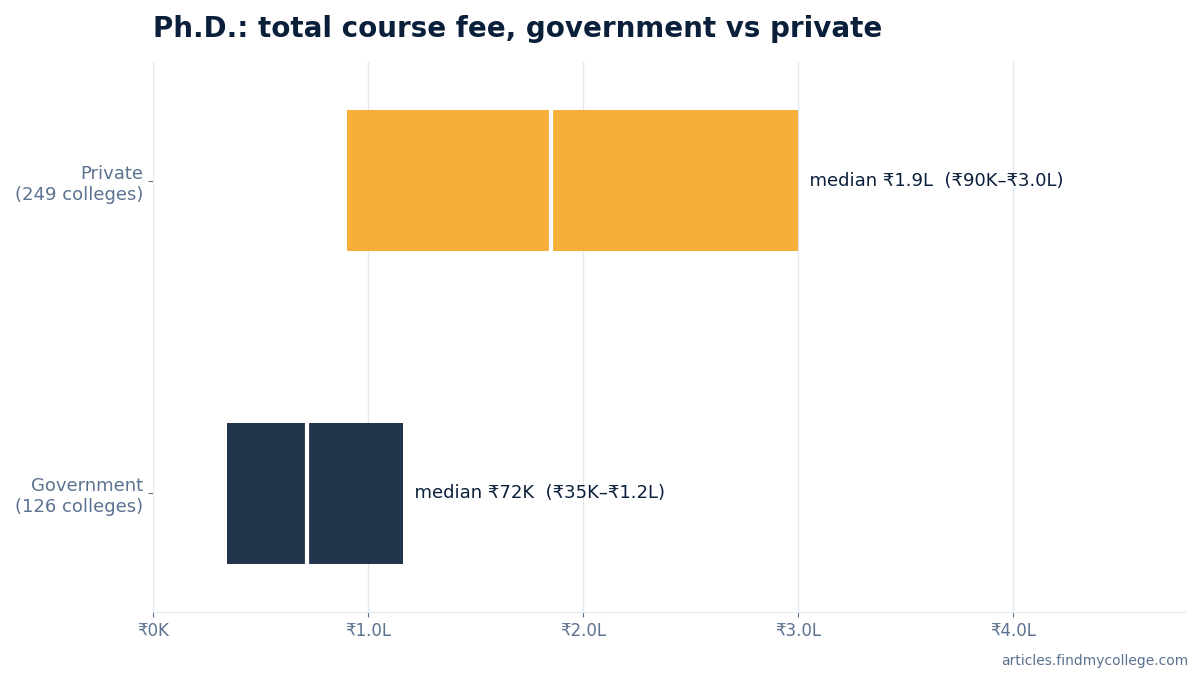
At least 3561 colleges offer Ph.D. programs, including government 287 and private 1129 institutions. For government colleges, the median total course fee is ₹71,600, with the middle half falling between ₹34,582 and ₹1.16 lakh (based on 126 colleges with fee data). Private colleges have a median total course fee of ₹1.85 lakh, with the middle half ranging from ₹90,270 to ₹3.00 lakh (based on 249 colleges with fee data).
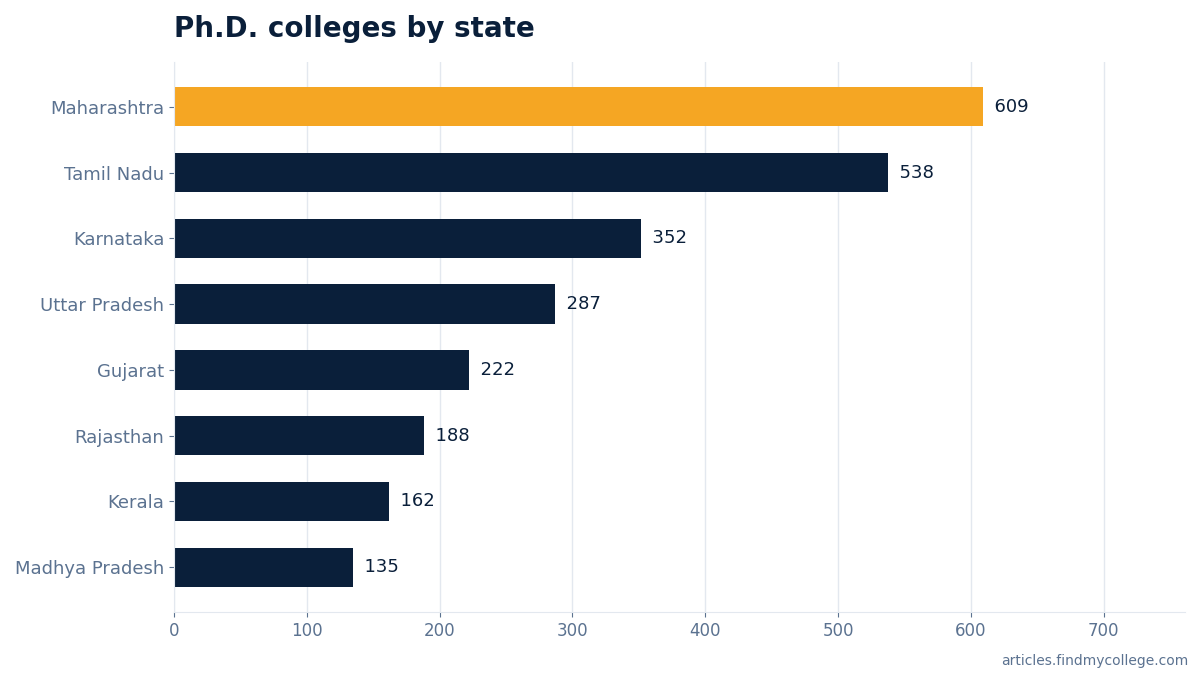
Leading states hosting Ph.D. institutions include Maharashtra with 609 colleges, Tamil Nadu with 538, Karnataka with 352, Uttar Pradesh with 287, Gujarat with 222, and Rajasthan with 188. Across 9 reported institutions, the median average placement package is 6.47 LPA.
| College | City | Ownership | Total course fee | NIRF rank |
|---|---|---|---|---|
| Indian Institute of Science | Bangalore | — | ₹89,200 | 1 (Overall, 2025) |
| Indian Institute of Technology Madras | Chennai | Government | ₹30,850 | 1 (Overall, 2025) |
| Jawaharlal Nehru University | Delhi | Government | — | 2 (Overall, 2025) |
| Indian Institute of Technology Bombay | Mumbai | Government | ₹70,200 | 3 (Overall, 2024) |
| Manipal University Manipal | Manipal | — | ₹59,000 | 3 (Overall, 2025) |
| Punjab Agricultural University | Ludhiana | — | ₹1.76 lakh | 3 (Overall, 2025) |
| Jamia Millia Islamia University | Delhi | Government | ₹27,740 | 4 (Overall, 2025) |
| Indian Institute of Technology Kanpur | Kanpur | Government | ₹52,200 | 5 (Overall, 2025) |
| Delhi University | Delhi | Government | ₹7,130 | 5 (Overall, 2025) |
| Indian Institute of Technology Roorkee | Roorkee | — | ₹85,800 | 6 (Overall, 2025) |
| College | City | Ownership | Total course fee |
|---|---|---|---|
| Indian Institute of Foreign Trade Kolkata | Kolkata | Government | ₹5,000 |
| Bharathi Women’s College | Chennai | Government | ₹5,105 |
| All India Institute of Medical Sciences New Delhi | Delhi | Government | ₹5,215 |
| Gulbarga University | Gulbarga | Government | ₹6,545 |
| Govt. Raza Post Graduate College | Rampur | Government | ₹6,810 |
| Delhi University | Delhi | Government | ₹7,130 |
| Calicut University | Calicut | Government | ₹7,130 |
| Bastar University | Bastar | Government | ₹7,170 |
| Post Graduate Institute of Medical Education & Research | Chandigarh | Government | ₹7,410 |
| Government Thakur Ranmat Singh College | Rewa | Government | ₹7,777 |
| College | City | Ownership | Total course fee |
|---|---|---|---|
| Birla Institute of Technology and Science Pilani | Pilani | Private | ₹1.84 lakh |
| Chandigarh University | Chandigarh | Private | ₹3.60 lakh |
| VIT University Chennai | Chennai | Private | ₹1.33 lakh |
| Thapar Institute of Engineering and Technology | Patiala | Private | ₹69,000 |
| Chebrolu Hanumaiah Institute of Pharmaceutical Sciences | Guntur | Private | ₹1.05 lakh |
| Indian Institute of Technology Dhanbad | Dhanbad | Private | ₹50,400 |
| Uttaranchal University | Dehradun | Private | ₹3.59 lakh |
| Marwadi University | Rajkot | Private | ₹2.25 lakh |
| SVKM’s Narsee Monjee Institute of Management Studies Navi Mumbai | Navi Mumbai | Private | ₹3.00 lakh |
| Doon Business School | Dehradun | Private | ₹3.30 lakh |
| City | Colleges | Fee range | Well-known options |
|---|---|---|---|
| Bangalore | 179 | ₹50,000 – ₹8.75 lakh | Alliance University, Christ University |
| Pune | 173 | ₹52,785 – ₹5.16 lakh | Symbiosis Law School Pune, Armed Forces Medical College |
| Mumbai | 149 | ₹7,923 – ₹33.82 lakh | Indian Institute of Technology Bombay, Jamnalal Bajaj Institute of Management Studies |
| Chennai | 135 | ₹5,105 – ₹7.50 lakh | Indian Institute of Technology Madras, Saveetha Institute of Medical and Technical Sciences |
| Coimbatore | 114 | ₹36,500 – ₹9.34 lakh | Amrita Vishwa Vidyapeetham, P.S.G College of Technology |
| Delhi | 77 | ₹5,215 – ₹7.50 lakh | All India Institute of Medical Sciences New Delhi, Jamia Millia Islamia University |
| Jaipur | 76 | ₹30,970 – ₹45.00 lakh | Manipal University Jaipur, University of Rajasthan |
| Hyderabad | 69 | ₹35,000 – ₹5.20 lakh | University of Hyderabad, Indian Institute of Technology Hyderabad |
| College | City | Total course fee |
|---|---|---|
| IIHMR University | Jaipur | ₹4.00 lakh |
| Indian School of Business Management & Administration | Kolkata | ₹69,900 |
| Indian Institute of Business Management and Studies | Mumbai | ₹75,800 |
| Indian Institute of Information Technology Sri City | Sri City | ₹1.83 lakh |
| Shyam University | Dausa | ₹3.15 lakh |
| Birla Institute of Technology Mesra | Ranchi | ₹1.99 lakh |
How to Apply for Ph.D. Admission in 2026: Step by Step
- Check eligibility criteria: Ensure you have a Master’s degree in Engineering, Technology, Sciences, Humanities, Management, Design, or Social Science with at least 55% aggregate marks (50% for SC/ST/OBC-NCL/EWS/PwD).
- Fill online application and upload documents: Fill academic, personal, and category details, and upload scanned mark sheets, photo, and signature.
- Pay application fee and submit: Pay Rs 1,000 (General/OBC/EWS) or Rs 500 (SC/ST) online via net banking, debit/credit card, or UPI before June 14, 2026.
- Appear for DTU PhD Entrance Test: Download admit card before July 2 and take the written entrance test on July 2 or 3, 2026. General candidates must score 50% (45% for reserved categories).
- Attend personal interview with research presentation: Shortlisted candidates attend the interview between July 8 and 10, 2026, presenting a 7 to 8 slide PowerPoint presentation on their proposed research topic.
| What to do | Where | Link |
|---|---|---|
| application registration | DTU Saarthi Admission Portal | saarthi.dtu.ac.in |
FAQs
What is the last date to apply for DTU PhD Admission 2026?
The extended last date to submit the online application for the DTU PhD August 2026 session is June 14, 2026, on the official portal saarthi.dtu.ac.in.
What are the eligibility criteria for DTU PhD Admission 2026?
Candidates must hold a Master’s degree in a relevant discipline with a minimum of 55% aggregate marks or equivalent CGPA. SC, ST, OBC-NCL, EWS, and PwD candidates get a 5% relaxation (50% marks).
What is the application fee for DTU PhD admission 2026?
The non-refundable application fee is Rs 1,000 for General, OBC, and EWS candidates, and Rs 500 for SC and ST candidates, payable online.
What are the entrance test and interview dates for DTU PhD 2026?
The DTU PhD written entrance test is scheduled for July 2 and 3, 2026. Personal interviews for shortlisted candidates take place from July 8 to 10, 2026.
What presentation is required for the DTU PhD interview?
Each candidate appearing for the DTU PhD personal interview round must prepare and bring a PowerPoint presentation of 7 to 8 slides covering their proposed research topic.
What is the qualifying score in the DTU PhD entrance exam?
Candidates need at least 50% marks in the written entrance test to qualify for the interview round. Reserved category candidates need 45% marks to qualify.