B.Tech Electrical Engineering Subjects and Semester Syllabus
Nishit Kumar is a senior EdTech industry leader with over a decade of experience in building and scaling education platforms, shaping their product, content, and growth strategy. At…
Students can review the complete semester-wise syllabus breakdown, year-wise theory and laboratory subjects, elective specialisations, standard reference textbooks, college fee structures, and the step-by-step admission process for 2026 below.
| Parameter | Details |
|---|---|
| Degree Duration | 4 Years (8 Semesters) |
| Total Program Credits | 168.5 Credits |
| Professional Core Credits | 69 Credits |
| Eligibility Criteria | Class 12 (10+2) with Physics, Chemistry, and Mathematics (PCM), minimum 45–50% aggregate marks |
| Regulatory Body | AICTE (All India Council for Technical Education) |
| Major Entrance Exams | JEE Main, JEE Advanced, BITSAT, VITEEE, MHT CET, KCET, WBJEE |
B.Tech Electrical Engineering Subjects Year-wise
The four-year B.Tech Electrical Engineering curriculum combines basic sciences, engineering fundamentals, and core professional subjects. Coursework progresses through theoretical principles, practical laboratory sessions, and project work across eight semesters.
B.Tech Electrical Engineering Electives and Specialisations
In the final year across Semesters 7 and 8, candidates select specialized professional and interdisciplinary open electives. Professional electives allow students to build domain expertise in areas such as high-voltage direct current (HVDC) transmission, smart grids, optimal control systems, and power generation economics. Open electives provide broader exposure to industrial management, artificial intelligence, and communication engineering.
B.Tech Electrical Engineering Practicals and Projects
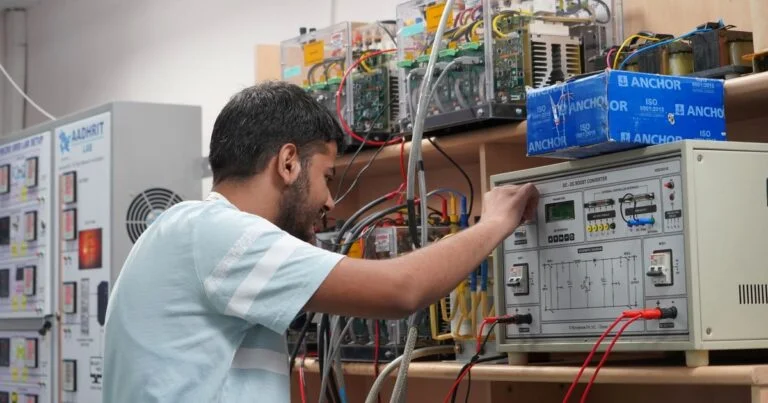
- Laboratory Sessions: Hands-on practicals in Electrical Machines, Power Electronics, Control Systems, Circuits & Networks, Microprocessors, and Transducers.
- Practical Training: Practical Training-I after Semester 4 (in Semester 5) and Practical Training-II in Semester 7.
- Projects and Seminars: Project work across Semesters 6 to 8, technical seminars, and a comprehensive viva-voce.
Practical laboratory experiments form an integral component of technical education in electrical engineering. The curriculum culminates in Semesters 7 and 8 with major project work, technical seminars, and comprehensive viva-voce assessments.
Books for B.Tech Electrical Engineering
| Subject Area | Recommended Book Title | Author(s) |
|---|---|---|
| Electric Circuits & Networks | Fundamentals of Electric Circuits | Charles K. Alexander & Matthew N.O. Sadiku |
| Electrical Machines | Electric Machines | I.J. Nagrath & D.P. Kothari |
| Control Systems | Control Systems Engineering | I.J. Nagrath & M. Gopal |
| Power Systems Analysis | Modern Power System Analysis | D.P. Kothari & I.J. Nagrath / Grainger & Stevenson |
| Power Electronics | Power Electronics: Circuits, Devices, and Applications | Muhammad H. Rashid |
High-weightage core subjects in competitive exams like GATE EE include Control Systems, Network Theory, and Electrical Machines, which account for 35–45% of technical marks.
Electrical Engineering (EE) vs Electrical and Electronics Engineering (EEE)
In practice, the first two years of coursework are nearly identical across both programs. The meaningful difference shows up in elective tracks from Year 3 onward.
B.Tech Electrical Engineering Colleges and Fees
| College | City | Ownership | Total course fee | NIRF rank |
|---|---|---|---|---|
| Indian Institute of Technology Madras | Chennai | Government | ₹9.05 lakh | 1 (Overall, 2025) |
| Indian Institute of Technology Bombay | Mumbai | Government | ₹8.75 lakh | 3 (Overall, 2024) |
| Manipal University Manipal | Manipal | — | ₹3.29 lakh | 3 (Overall, 2025) |
| Jamia Millia Islamia University | Delhi | Government | ₹77,200 | 4 (Overall, 2025) |
| Indian Institute of Technology Kanpur | Kanpur | Government | ₹7.41 lakh | 5 (Overall, 2025) |
| Delhi University | Delhi | Government | ₹5.88 lakh | 5 (Overall, 2025) |
| Indian Institute of Technology Roorkee | Roorkee | — | ₹2.48 lakh | 6 (Overall, 2025) |
| Indian Institute of Technology Kharagpur | Kharagpur | Government | ₹8.74 lakh | 6 (Overall, 2025) |
| Amrita Vishwa Vidyapeetham | Coimbatore | — | ₹14.10 lakh | 8 (Overall, 2025) |
| Indian Institute of Technology New Delhi | Delhi | Government | ₹8.63 lakh | 8 (Overall, 2025) |
| College | City | Ownership | Total course fee |
|---|---|---|---|
| Government Engineering College Rajkot | Rajkot | Government | ₹6,000 |
| Government Engineering College Bharuch | Bharuch | Government | ₹6,000 |
| Government Engineering College Bhuj | Bhuj | Government | ₹6,000 |
| Government Engineering College Valsad | Valsad | Government | ₹6,000 |
| Lukhdhirji Engineering College | Morvi | Government | ₹6,000 |
| Government Engineering College Thrissur | Thrissur | Government | ₹10,000 |
| Government Engineering College Siwan | Siwan | Government | ₹10,000 |
| Government Engineering College Banaskantha | Banaskantha | Government | ₹11,360 |
| Rashtrakavi Ramdhari Singh Dinkar College of Engineering | Begusarai | Government | ₹12,200 |
| Visvesvaraya Technological University | Belgaum | Government | ₹17,420 |
Government colleges have a median total course fee of ₹1.53 lakh (middle half between ₹62,305 and ₹2.40 lakh across 120 colleges), while private colleges have a median fee of ₹2.16 lakh (middle half between ₹1.52 lakh and ₹2.95 lakh across 950 colleges).
Across 129 reporting institutions, the median average placement package is 3.65 LPA, with state-wise college counts led by Uttar Pradesh (284), Andhra Pradesh (262), Kerala (145), Rajasthan (142), Telangana (141), and Maharashtra (112).
How to Apply for B.Tech Electrical Engineering Admission in 2026: Step by Step
- Check eligibility criteria: Pass Class 12 (10+2) with Physics, Chemistry, and Mathematics (PCM) and at least 45–50% aggregate marks, or hold a 3-year diploma for direct Year 2 lateral entry.
- Submit exam applications: Fill out application forms released between December and May for entrance tests such as JEE Main, BITSAT, VITEEE, or state CETs like MHT CET, KCET, and WBJEE.
- Take entrance examinations: Complete the computer-based entrance tests, which are typically three hours long.
- Secure admission: Gain admission into government or private colleges through entrance exam scores or merit-based selection.
| What to do | Where | Link |
|---|---|---|
| Compare colleges, fees and cutoffs | B.Tech Electrical Engineering colleges in India | findmycollege.com |
Candidates must qualify in JEE Main to attempt JEE Advanced for IIT admissions. Applicants can also target state government and private colleges through state CETs or university-specific exams like BITSAT and VITEEE.
FAQs
Is BTech 3 years or 4 years?
B.Tech in Electrical Engineering is a 4-year undergraduate degree spread across 8 semesters. Candidates entering through diploma lateral entry enter directly into the second year, completing the program in 3 years.
Is electrical engineering heavy on physics?
Yes, electrical engineering builds extensively on physics principles. The curriculum includes electromagnetism, magnetic circuits, and semiconductor physics across core theoretical and practical subjects.
Is electrical engineering have math?
Yes, engineering mathematics is foundational in electrical engineering. The curriculum includes Laplace transforms, Fourier series, numerical methods, and probability theory across multiple academic semesters.
What is the difference between Electrical Engineering (EE) and EEE?
How many subjects are there in first year engineering?