B.Tech Electrical Engineering: Course Details, Admission and Scope
Nishit Kumar is a senior EdTech industry leader with over a decade of experience in building and scaling education platforms, shaping their product, content, and growth strategy. At…
- 14 Oct 2026WBJEE 2026 Decentralised Counselling Concluded
WBJEE online decentralised counselling 2026 for vacant engineering seats concluded, while offline counselling continues up to 31 October 2027. - 1 Oct 2026LPUNEST 2027 Registrations Started
LPUNEST 2027 online registration for engineering admissions commenced on 01 October 2026 and remains open until 15 January 2027.
B.Tech Electrical Engineering (B.Tech EE) is a 4-year undergraduate degree program focusing on electricity, electromagnetism, power systems, control systems, and electronic components. Candidates who have passed 10+2 with Physics, Chemistry, and Mathematics (securing at least 50%–55% marks) are eligible, with total tuition fees ranging from ₹4,00,000 to ₹10,00,000 and starting salaries typically between ₹3.6 LPA and ₹6.5 LPA.
Choosing the right engineering degree requires understanding academic eligibility, entrance cutoffs, syllabus structure, total program costs, and career placements. Below is a complete guide covering eligibility criteria, competitive exam cutoffs, curriculum details, top engineering institutes, job roles, and step-by-step admission guidelines.
| Parameter | Details |
|---|---|
| Course Name & Level | Bachelor of Technology in Electrical Engineering (Undergraduate Degree) |
| Duration | 4 Years (8 Semesters) |
| Eligibility Criteria | Minimum 50% to 55% aggregate in 10+2 with Physics, Chemistry, and Mathematics (PCM) |
| Major Entrance Exams | JEE Main, JEE Advanced, WBJEE, MHT CET, KCET, VITEEE, BITSAT |
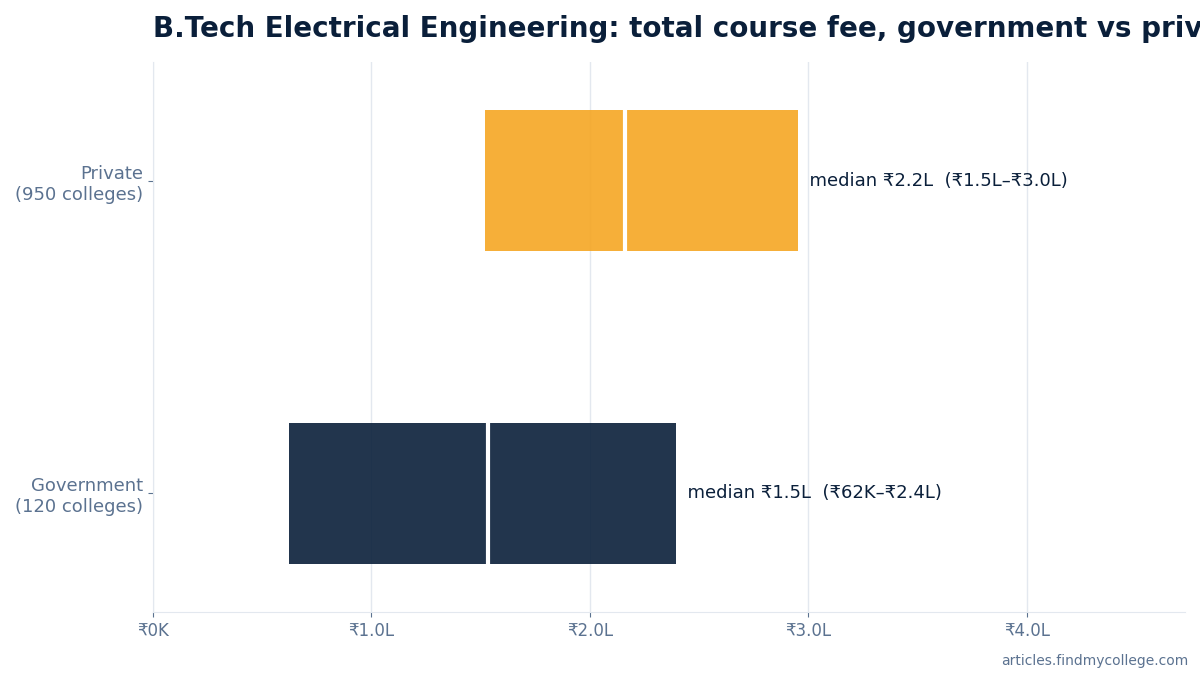
| Average Tuition Fee | ₹4,00,000 to ₹10,00,000 (Govt colleges: ₹50,000 – ₹1,00,000/yr; Private: ₹1,50,000 – ₹2,50,000/yr) |
| Average Starting Salary | ₹3.6 LPA to ₹6.5 LPA (Fresher level) |
| Top Recruiters | BHEL, PGCIL, NTPC, Tata Power, Siemens, GE, L&T, ISRO, Schneider Electric, ABB |
| Higher Study Options | M.Tech, M.E., MS in Electrical Engineering, Ph.D., MBA |
What is B.Tech Electrical Engineering
B.Tech Electrical Engineering is an intensive 4-year undergraduate degree structured across 8 academic semesters. The program provides detailed theoretical knowledge and practical training in power generation, high-voltage power transmission, distribution networks, control systems, power electronics, electromagnetism, and signal processing. Students learn to handle both heavy industrial power systems and delicate electronic circuits, bridging fundamental physics with real-world infrastructure.
The core curriculum equips students to design, analyze, and optimize electrical hardware and complex grid machinery. Specialised variations, such as B.Tech programs incorporating computer engineering or industrial automation, prepare graduates for evolving engineering fields including smart grid technology, renewable energy systems, electric vehicle powertrains, and automated manufacturing processes.
B.Tech Electrical Engineering Eligibility
To secure admission into a B.Tech Electrical Engineering program, candidates must satisfy general academic criteria established by engineering education authorities. Applicants must have completed 10+2 or an equivalent examination from a recognized board with Physics, Chemistry, and Mathematics (PCM) as core subjects, obtaining an aggregate score of at least 50% to 55%. Lateral entry admission into the second year (third semester) is available for candidates holding a 3-year diploma in a related engineering branch.
Admission to leading institutes depends heavily on performance in national or state-level entrance exams. In national exams such as JEE Main, qualifying cutoff percentiles vary across applicant categories each year.
| Category | JEE Main 2024 Cutoff Percentile | JEE Main 2023 Cutoff Percentile |
|---|---|---|
| General | 93.2362181 – 100 | 90.7788642 |
| EWS | 81.3266412 – 93.2312696 | 75.6229025 |
| OBC-NCL | 79.6757881 – 93.2312696 | 73.6114227 |
| SC | 60.0923182 – 93.2312696 | 51.9776027 |
| ST | 46.6975840 – 93.2312696 | 37.2348772 |
| PwD | 0.0018700 – 93.2041331 | 0.0013527 |
B.Tech Electrical Engineering Syllabus and Subjects
The 8-semester curriculum combines foundational science subjects with specialized engineering streams and practical laboratory workshops. Initial semesters build strong mathematical and scientific fundamentals, while later semesters focus on electrical machinery, circuit design, and automation technologies.
Curriculum design adheres to university guidelines. For instance, UTU B.Tech EE Semester III core subjects include Signals, Systems & Networks, Transformer & DC Machines, and Analog & Digital Circuits. Similarly, Sandip University NEP 2020 curriculum for B.Tech EE Semester III incorporates Electrical Machines I, Electrical Measurements & Instrumentation, and Energy Resources & Generation.
B.Tech Electrical Engineering Career Scope and Salary
| Job Profile | Key Work Responsibilities |
|---|---|
| Electrical Design Engineer | Creates blueprints and CAD layouts for electrical systems in buildings and industrial complexes. |
| Power Systems Engineer | Manages, analyzes, and optimizes electrical power grid networks and transmission infrastructure. |
| Electrical Maintenance Engineer | Troubleshoots malfunctioning equipment and performs routine upkeep in industrial plants. |
| Control Systems Engineer | Designs and regulates automated control systems in aerospace, automotive, and manufacturing processes. |
| Electrical Project Manager | Supervises engineering projects, managing timelines, safety standards, and operational budgets. |
Top public sector recruiters for B.Tech EE graduates include BHEL, PGCIL, NTPC, and ISRO, with core responsibilities including designing components, troubleshooting equipment, evaluating project costs, and improving energy efficiency.
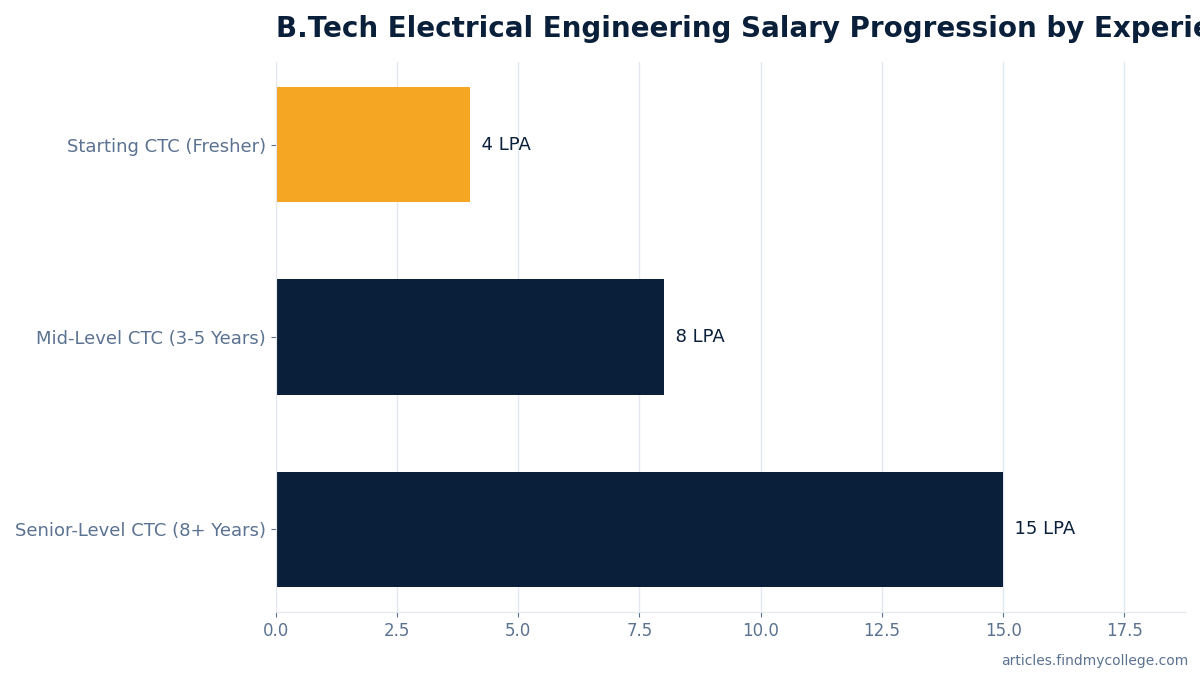
Starting salaries range between ₹3.6 LPA and ₹6.5 LPA, with a median average placement package of 3.65 LPA across 129 colleges, while Bangalore tech hub roles pay ₹4–7 LPA at entry-level and ₹15–20+ LPA at senior levels.
B.Tech Electrical Engineering vs Electronics and Communication Engineering
Students often compare B.Tech Electrical Engineering (EE) with B.Tech Electronics & Communication Engineering (ECE).
In terms of employment, EE graduates hold direct eligibility for heavy power utility roles and government Public Sector Undertakings (PSUs) such as BHEL, NTPC, and PGCIL. Starting salaries across both fields remain highly competitive, with freshers typically receiving starting packages between ₹3.6 LPA and ₹6.5 LPA.
How to Choose the Right B.Tech Electrical Engineering College
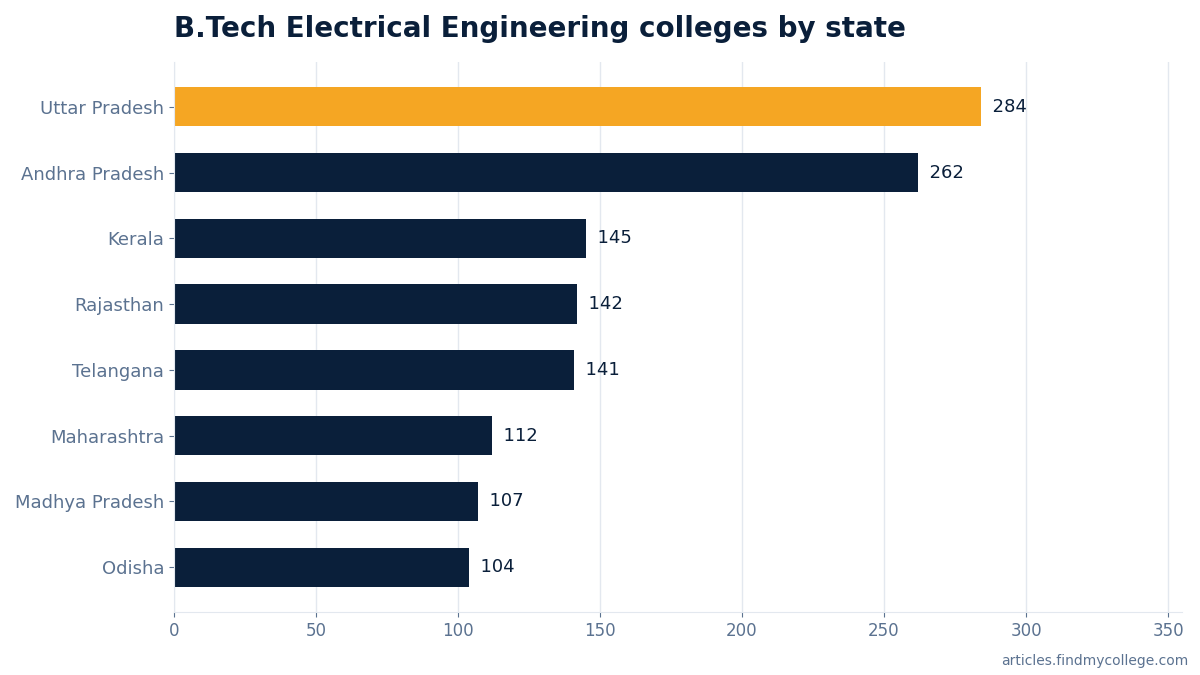
- Placement Benchmarks: Compare program costs against graduate outcomes, keeping in mind that the median average placement package across 129 reporting colleges is 3.65 LPA.
- PSU Recruitment Opportunities: Check for track records with major employers, as top public sector recruiters for B.Tech EE graduates include BHEL, PGCIL, NTPC, and ISRO.
- Core Curriculum Coverage: Ensure the course covers essential technical areas such as electrical machines, power electronics, power system analysis, and control system engineering.
Evaluating total tuition fees alongside placement metrics across government and private institutions helps candidates select the right program. Factoring in public sector recruitment opportunities ensures alignment with long-term career plans.
How to Apply for B.Tech Electrical Engineering Admission in 2026: Step by Step
- Check Academic Eligibility: Verify completion of 10+2 or equivalent examination with Physics, Chemistry, and Mathematics (PCM) as core subjects, achieving a minimum aggregate of 50% to 55%.
- Register for Entrance Exams: Apply online for national or state-level engineering entrance exams such as JEE Main, JEE Advanced, WBJEE, KCET, or MHT CET during their respective registration windows.
- Appear for Entrance Examination: Sit for the scheduled exam to secure a competitive rank or percentile above the target institute’s cutoff.
- Participate in Counselling & Choice Filling: Register on official counselling portals (e.g., JoSAA, WBJEE counselling, KEA) and lock college/branch preferences based on merit ranks.
- Document Verification & Seat Allotment: Submit required documents (10+2 mark sheet, admit card, scorecard, category certificate) for verification upon receiving seat allotment.
- Pay Admission Fee & Securing Seat: Pay the required institute tuition fee (ranging from ₹50,000 for government seats to ₹2.5 Lakhs/year for private colleges) to finalize enrolment.
| What to do | Where | Link |
|---|---|---|
| Compare colleges, fees and cutoffs | B.Tech Electrical Engineering colleges in India | findmycollege.com |
FAQs
What is the syllabus of B Tech electrical engineering?
The syllabus spans 8 semesters covering core subjects such as Signals & Systems, Transformer & DC Machines, Analog & Digital Circuits, AC Rotating Machines, Electrical Measurements, Power System Analysis, Control Systems, and Power Electronics.
What are 5 things electrical engineers do?
Electrical engineers design electrical equipment, improve energy efficiency, troubleshoot malfunctioning systems, evaluate project cost feasibility, and develop sustainable eco-friendly technologies while ensuring safety standard compliance.
Which is better, ECE or EEE salary?
Both branches command competitive packages. B.Tech Electrical/EEE graduates start between ₹3.6 LPA and ₹6.5 LPA, advancing to ₹8–12 LPA in mid-level roles and ₹15–20+ LPA at senior levels.
How to get a job after B. Tech EEE?
Graduates can get jobs via campus placement drives, recruitment by top public sector companies like BHEL, PGCIL, NTPC, and ISRO, or directly applying for private industrial roles in power systems, robotics, and electrical design.
What are the subjects in the UTU syllabus for electrical engineering?
UTU core subjects include Data Structures, Signals & Systems, Transformer & DC Machines, Analog & Digital Circuits, AC Rotating Machines, Electromagnetic Field Theory, Power System Generation & Transmission, Control Systems, and Power Electronics.
Is B. Tech in electrical engineering good?
Yes, B.Tech Electrical Engineering offers strong long-term career stability across growing sectors such as electric vehicles, renewable energy, automation, and smart grids, alongside core government PSU opportunities.