Best Food Technology Courses After 12th in India — Eligibility, Fees, Career Path (2026)
Nishit Kumar is a senior EdTech industry leader with over a decade of experience in building and scaling education platforms, shaping their product, content, and growth strategy. At…
Does a B.Tech in Food Technology truly lead to innovation roles at companies like Nestle, or is it mostly about quality control? Many 12th-
TL;DR — Who This Guide Is For
This guide is for 12th-passing students interested in food science, processing, and safety, especially suitable for those from PCB and PCM streams.
- Streams needed: PCM, PCB, Commerce
- Shortest path: 1 year (diploma/PG diploma)
- Longest path: 4 years (UG + PG)
- Salary band: 2-25 LPA
Eligibility — Can You Apply?
| Requirement | What it means |
|---|---|
| Streams allowed | PCM, PCB, Commerce |
| Minimum 12th marks | 45-60% aggregate in 12th |
| Subjects required | Physics, Chemistry, Biology, Mathematics |
Course Options at a Glance
Here are the routes you can take after 12th, ranked by how long they take and what they cost:
| Type | Duration | Fees Range | Entry Route | Best For |
|---|---|---|---|---|
| Certificate | Short-term | — | Merit-based | Students who want to learn a specific skill more deeply and quickly. |
| Diploma | 1-2 years | ₹30,000-₹2,00,000 total | Merit-based or university-specific tests | Students seeking quick entry to the job market with specific skills. |
| UG Degree | 3 years | ₹22,000-₹1,42,000 total | Merit-based or university-specific tests | Students preferring a science-based course focusing on food science and nutrition. |
| UG Degree | 4 years | ₹22,000-₹2,00,000 total | JEE Main, state-level engineering entrance exams, university-specific tests | Students interested in scientific and technical aspects of food production, processing, and preservation. |
Top 7 Specific Courses to Consider
Each course below has a distinct career outcome. Pick by the kind of job you want at the end, not by the name.
B.Tech Food Technology
Bachelor
4 years
- Eligibility: 10+2 with Physics, Chemistry, and Mathematics, minimum 50-60% aggregate marks.
- Fees: ₹22,000-₹2,00,000 total
- Career focus: Food manufacturing, quality control, and research labs.
- Top institutes: IIT Kharagpur, Jadavpur University, IIT Guwahati, NIT Rourkela, CFTRI
B.Sc Food Technology
Bachelor
3 years
- Eligibility: 10+2 with Physics, Chemistry, and Biology/Mathematics, minimum 45-50% aggregate marks.
- Fees: ₹22,000-₹1,42,000 total
- Career focus: Food science, processing, and safety roles.
- Top institutes:
B.Sc Food Science & Nutrition
Bachelor
3 years
- Eligibility: 10+2 with science background, minimum 45-50% aggregate marks.
- Fees: ₹22,000-₹1,42,000 total
- Career focus: Enhancing nutrition and health of target population.
- Top institutes:
Diploma in Food Technology
Diploma
1-2 years
- Eligibility: 10+2 with science/commerce background, minimum 45-50% aggregate marks.
- Fees: ₹30,000-₹2,00,000 total
- Career focus: Quick entry to job market in specific food industry areas.
- Top institutes:
Certificate in Food Preservation
Certificate
Short-term
- Eligibility: 10+2 with any stream.
- Career focus: Learning specific skills in food preservation.
- Top institutes:
Certificate in Bakery Science
Certificate
Short-term
- Eligibility: 10+2 with any stream.
- Career focus: Learning specific skills in bakery science.
- Top institutes:
Certificate in Dairy Technology
Certificate
Short-term
- Eligibility: 10+2 with any stream.
- Career focus: Learning specific skills in dairy technology.
- Top institutes:
Entrance Exams You Should Know
| Exam | Authority | Frequency | Next Window | Eligibility |
|---|---|---|---|---|
| JEE Main | — | — | March 2026 | 10+2 with Physics, Chemistry, and Mathematics. |
| ICAR AIEEA | — | — | — | 10+2 with science stream. |
| MHT CET | — | — | — | 10+2 with science stream. |
| CUET | — | — | — | 10+2 with science stream. |
| KEAM | — | — | — | 10+2 with science stream. |
| V-SAT | — | — | — | 10+2 with Physics, Chemistry, and Mathematics. |
Top Food Technology Colleges in India — State-Wise List with Admission & Fees
Below are 6 Food Technology colleges in India grouped by state, so you can shortlist options close to home. Each entry shows the exact admission route (entrance exam + cutoff signal or merit-based), complete fees breakdown (tuition + hostel where available), and the specific Food Technology course offered:
📍 Maharashtra (5 colleges)
| College | Course Offered | Admission Process | Complete Fees | NIRF / Notable |
|---|---|---|---|---|
| Sandip University Nashik · Private University |
B.Sc. Food Technology / Processing | Merit-based on 12th (CBSE/HSC) or university entrance exam | ₹11,000 – ₹92,000 per year (Science courses) | 4.4 (78 Reviews), Shortlisted by 100832+ students |
| SNDT Women’s University Pune · State University |
B.Sc. Food Technology / Processing | Merit-based on 12th marks or university-specific entrance exam | ₹12,000 – ₹1,20,000 per year (Science courses) | 4.8 (4 Reviews), Shortlisted by 1343+ students |
| Maharashtra Institute of Technology Aurangabad Aurangabad · Autonomous Institute |
B.Sc. Food Technology / Processing | JEE Main or MHT-CET, or merit-based on 12th (CBSE/HSC) | ₹60,000 per year (Science courses) | 4.8 (15 Reviews), Shortlisted by 245+ students |
| MIT ADT University Pune · Private University |
B.Sc. Food Technology / Processing | JEE Main, MHT-CET, PERA CET, or Uni GAUGE entrance exams | ₹75,000 – ₹6,00,000 per year (Science courses) | 4.4 (19 Reviews) |
| College of Food Technology, Ashti Ashti · Private |
B.E./B.Tech. Food Technology | JEE Main and other entrance exams | ₹3.40 Lakhs total course fees |
📍 Other States (1 colleges)
| College | Course Offered | Admission Process | Complete Fees | NIRF / Notable |
|---|---|---|---|---|
| National Institute of Food Technology, Entrepreneurship and Management, Thanjavur Thanjavur · Central University |
B.Tech. Food Technology | JEE Main | ₹6.21 Lakhs total course fees (4 years); annual tuition approx. ₹1.03 Lakhs; hostel room rent ₹6,000/semester | Ranked #43 among Engineering colleges in India by NIRF; Highest Package 1.3 CR, 100% Placements |
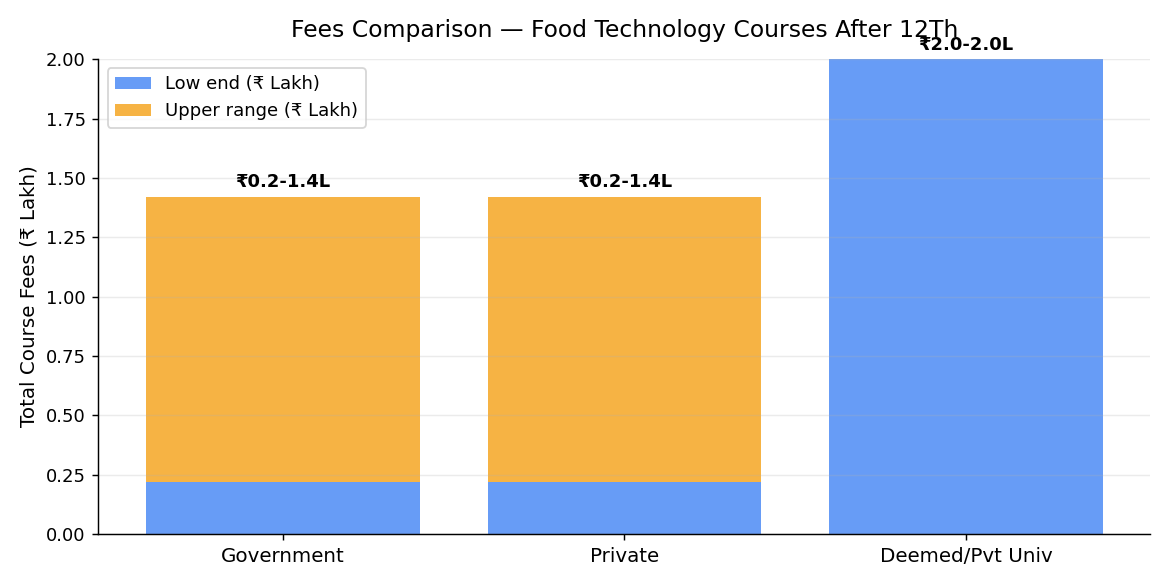
Fees Breakdown — What You’ll Actually Pay
| College Type | Total Course Fees |
|---|---|
| Government colleges | ₹22,000-₹1,42,000 total |
| Private colleges | ₹22,000-₹1,42,000 total |
| Deemed / Pvt Universities | ₹2,00,000 total |
| Average total fees | ₹82,000 |
Career Progression — Where You’ll Be in 10 Years
This is the realistic trajectory for graduates who stay in the field. Salary bands reflect Indian market data; relocate to a Tier-1 metro and the upper band moves up 20-40%.
Career Progression — Food Technology
Entry (0-2 yrs)
2-4 LPA
Food Technologist
Quality Control Assistant
Food Inspector
Applying scientific methods to enhance food quality, nutriti
Mid (3-7 yrs)
5.4-15 LPA
Food Technologist
Scientist
Plant Manager
Managing food production processes, ensuring quality control
Senior (8+ yrs)
12-25 LPA
Senior R&D Position
Professor
Leading research and development initiatives or academic pro
- Entry (0-2 yrs) — 2-4 LPA · Roles: Food Technologist, Quality Control Assistant, Food Inspector. Applying scientific methods to enhance food quality, nutrition, and safety.
- Mid (3-7 yrs) — 5.4-15 LPA · Roles: Food Technologist, Scientist, Plant Manager, Research and Development Executive, Assistant Manager. Managing food production processes, ensuring quality control, or conducting research.
- Senior (8+ yrs) — 12-25 LPA · Roles: Senior R&D Position, Professor. Leading research and development initiatives or academic programs in food technology.
Skills to Build (and How to Build Them)
A degree gets you to the interview; these skills get you the offer. Start in your first semester:
- Food Chemistry — Through B.Sc/B.Tech Food Technology courses.
- Food Microbiology — Through B.Sc/B.Tech Food Technology courses.
- Food Processing Techniques — Through B.Tech Food Technology curriculum.
- Quality Control — Through practical training and coursework in food safety.
- Nutrition Science — Through B.Sc Food Science & Nutrition courses.
- Research Skills — Engaging in research projects during degree programs.
- Food Preservation — Through certificate courses or B.Tech curriculum.
- Food Packaging — Through B.Tech Food Technology curriculum.
Higher Studies — Where You Can Go After UG
If you want to specialize further or move into research, these are the PG routes that pay off:
| PG Course | Duration | Entry Exam | Career Uplift |
|---|---|---|---|
| M.Tech Food Technology | — | GATE | Advanced roles in food manufacturing, quality control, and research. |
| MBA in Food Business Management | — | SRMJEEM, CAT, TANCET, MAT | Leadership and management roles in the food industry. |
| M.Sc Food Technology | — | CUET PG | Specialized roles in food science and research. |
Common Mistakes Students Make
These are the decision-level errors that cost a year (or a career switch):
- ❌ Mistake: Opting for only a diploma course if long-term career growth is a priority.
✅ Do this instead: Consider pursuing a Bachelor’s degree (B.Sc or B.Tech) for broader career prospects. - ❌ Mistake: Not exploring management or entrepreneurship roles within the food industry.
✅ Do this instead: Look into postgraduate options like an MBA to gain business and management skills. - ❌ Mistake: Underestimating the importance of entrance exams for top colleges.
✅ Do this instead: Prepare thoroughly for exams like JEE Main, ICAR AIEEA, and university-specific tests. - ❌ Mistake: Choosing a job without considering long-term career goals and personal preferences.
✅ Do this instead: Evaluate job roles based on interest, growth potential, and alignment with your aspirations. - ❌ Mistake: Attempting to pursue a degree in Food Technology without a science background in 10+2.
✅ Do this instead: Ensure you have Physics, Chemistry, and Biology/Mathematics in 10+2 with minimum required marks.
Frequently Asked Questions
What are the main courses in Food Technology after 12th?
After 12th, you can pursue B.Tech Food Technology (4 years), B.Sc Food Technology (3 years), B.Sc Food Science & Nutrition (3 years), Diploma courses (1-2 years), and short-term Certificate courses. These cover food science, processing, and safety.
What is the eligibility for Food Technology courses after 12th?
Eligibility generally requires Class 12 with Physics, Chemistry, and Biology or Mathematics, with a minimum of 45-60% aggregate marks from a recognised board. Some diploma and certificate courses may also be open to Commerce students.
What is the fee range for Food Technology courses?
The total course fees for Food Technology programs can range from ₹22,000 to ₹2,00,000. Diploma courses typically cost ₹30,000 to ₹1,00,000 per year, while some B.Tech programs in deemed universities can be around ₹2,00,000 total.
What are the career prospects after Food Technology courses?
Graduates can find roles as Food Technologists, Quality Control Assistants, and Food Inspectors at entry-level. With experience, roles like Plant Manager, Research and Development Executive, and Senior Scientist are available in both private and government sectors.
Which entrance exams are required for Food Technology?
Admission to top Food Technology colleges often requires clearing national or state-level entrance exams. Key exams include JEE Main, ICAR AIEEA, MHT CET, CUET, KEAM, V-SAT, and TNEA, along with university-specific tests.
What is the salary for Food Technology graduates?
Entry-level salaries for Food Technology graduates typically range from 2-4 LPA. With 5+ years of experience, salaries can go up to 15 LPA. Senior R&D positions or professorships can offer salaries exceeding 12 LPA.
Can Commerce students pursue Food Technology?
Yes, while science students have a distinct advantage for degree programs, there are a few growing Food Technology programs available for Commerce students, especially diploma and certificate courses.
What is the duration of B.Tech Food Technology?
B.Tech in Food Technology is a four-year engineering program. It focuses on the scientific and technical aspects of food production, processing, preservation, packaging, and delivery.
What is the role of a Food Technologist?
A Food Technologist is responsible for improving food quality by analyzing its physical, chemical, and biological properties. They apply scientific methods to enhance the nutrition and health of the target population, working in areas like processing, preservation, and quality control.
What to Do Next
Now that you’ve mapped the Food Technology landscape, your next 2 steps are concrete:
- Shortlist 5 colleges using the Top Colleges table above — apply to a mix of govt and private to hedge fees.
- Register for the relevant entrance exam(s) from the Exams table — most close registration 2-3 months before the test date.