

Highest Ranking University in India 2026: Top NIRF Rankings
Nishit Kumar is a senior EdTech industry leader with over a decade of experience in building and scaling education platforms, shaping their product, content, and growth strategy. At…
The Indian Institute of Science (IISc), Bengaluru, is ranked as the #1 university in India by the NIRF rankings, followed by Jawaharlal Nehru University (JNU), New Delhi at #2, and Manipal Academy of Higher Education (MAHE), Manipal at #3.
With 54 institutions featured in global QS rankings, understanding institutional benchmarks helps prospective students choose the right academic path. The analysis below covers NIRF scores, government and private institutional rankings, global standing, evaluation criteria, and step-by-step admission timelines.
| Parameter | Details |
|---|---|
| NIRF Rank 1 University | Indian Institute of Science (IISc), Bengaluru |
| NIRF Rank 2 University | Jawaharlal Nehru University (JNU), Delhi |
| NIRF Rank 3 University | Manipal Academy of Higher Education, Manipal |
| NIRF Ranking Body | Ministry of Education, Govt. of India |
| Top Ranked Indian Institution in QS Asia 2026 | IIT Delhi (Global Rank #59 in Asia) |
| Top Ranked Indian Institution in QS World 2026 | IIT Delhi (Global Rank #123) |
| NIRF Core Parameters | TLR, RP, GO, OI, PR |
Top Top Universities Colleges
The Ministry of Education releases NIRF rankings annually at nirfindia.com evaluating top universities across public, private, state, deemed, and central categories.
Indian Institute of Science (IISc), Bangalore holds the #1 NIRF ranking among universities in India. Jawaharlal Nehru University (JNU), Delhi is ranked #2 in the NIRF university category. Manipal Academy of Higher Education (MAHE), Manipal holds NIRF Rank 3 among universities.
Jamia Millia Islamia, New Delhi holds NIRF Rank 4, followed by University of Delhi (DU) at #5, Banaras Hindu University (BHU) at #6, Birla Institute of Technology & Science (BITS) Pilani at #7, Amrita Vishwa Vidyapeetham at #8, Jadavpur University at #9, and Aligarh Muslim University (AMU) at #10.
| NIRF Rank | University Name | State |
|---|---|---|
| 1 | Indian Institute of Science (IISc) | Karnataka |
| 2 | Jawaharlal Nehru University (JNU) | Delhi |
| 3 | Manipal Academy of Higher Education (MAHE) | Karnataka |
| 4 | Jamia Millia Islamia | New Delhi |
| 5 | University of Delhi (DU) | New Delhi |
| 6 | Banaras Hindu University (BHU) | Uttar Pradesh |
| 7 | Birla Institute of Technology & Science (BITS) – Pilani | Rajasthan |
| 8 | Amrita Vishwa Vidyapeetham | Tamil Nadu |
| 9 | Jadavpur University | West Bengal |
| 10 | Aligarh Muslim University (AMU) | Uttar Pradesh |
How to Choose a Top Universities College
Evaluating institutional quality requires understanding the core frameworks used by official ranking bodies. The National Institutional Ranking Framework assesses institutions across five distinct metrics to generate objective performance scores.
NIRF ranks institutions based on 5 parameters: Teaching, Learning & Resources (TLR), Research & Professional Practice (RP), Graduation Outcomes (GO), Outreach & Inclusivity (OI), and Peer Perception (PR).
| Parameter Abbreviation | Parameter Full Name |
|---|---|
| TLR | Teaching, Learning and Resources |
| RP | Research and Professional Practice |
| GO | Graduation Outcomes |
| OI | Outreach and Inclusivity |
| PR | Peer Perception |
Government Top Universities Colleges
Public institutions lead the national ranking tables due to substantial research infrastructure and academic output. Indian Institute of Science (IISc), Bangalore holds the #1 NIRF ranking among universities in India, while Jawaharlal Nehru University (JNU), Delhi is ranked #2.
Other top-ranked public institutions include Jamia Millia Islamia in New Delhi at NIRF Rank 4 and University of Delhi (DU) at #5. Banaras Hindu University (BHU) in Uttar Pradesh ranks #6, Jadavpur University in West Bengal holds Rank 9, and Aligarh Muslim University (AMU) in Uttar Pradesh is ranked #10.
Private Top Universities Colleges
- Manipal Academy of Higher Education (MAHE), Manipal holds NIRF Rank 3 among universities.
- Birla Institute of Technology & Science (BITS) Pilani holds NIRF Rank 7 among universities.
- Amrita Vishwa Vidyapeetham, Tamil Nadu holds NIRF Rank 8 among universities.
The Ministry of Education releases NIRF rankings annually evaluating top universities in India. These institutions hold top 10 positions in the university category.
Indian Universities in QS World & QS Asia Rankings 2026
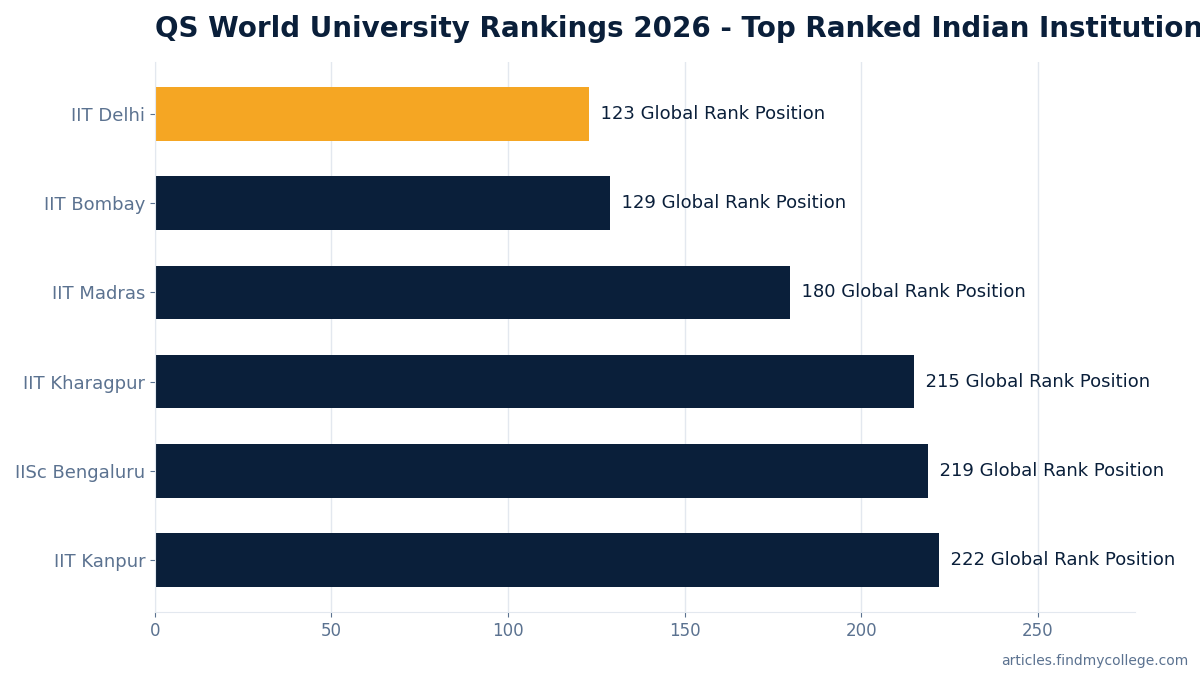
In global higher education metrics, Indian institutions continue to expand their presence. In the QS World University Rankings 2026, no Indian university is ranked within the global top 100. However, India has 54 ranked universities in global QS rankings, making it the 4th most represented country globally.
In regional evaluations, seven Indian universities are ranked among the top 100 in Asia in the QS Asia University Rankings 2026. Furthermore, IIT Delhi jumped from rank 150 to 123 globally in the QS World University Rankings 2026.
| Institution | QS Asia 2026 Ranking |
|---|---|
| IIT Delhi | #59 |
| IISc Bengaluru | #64 |
| IIT Madras | #70 |
| IIT Bombay | #71 |
| IIT Kanpur | #77 |
| University of Delhi | #95 |
| IIT Kharagpur | #100= |
THE Sustainability and Impact Rankings 2026 for Indian Universities
| Institution | THE Impact Rank 2026 |
|---|---|
| Amrita Vishwa Vidyapeetham | 41 |
| Lovely Professional University (LPU) | 48 |
| JSS Academy of Higher Education | 96 |
| Shoolini University | 96 |
Amrita Vishwa Vidyapeetham ranked 41st globally in the THE Sustainability and Impact Rankings 2026. Lovely Professional University achieved rank 48, while JSS Academy of Higher Education and Shoolini University both ranked 96.
Top Universities Admission Process
Admissions across premier universities depend on standard entrance examinations and national schemes. For foreign/NRI students, applications to technical institutions like NITs and IIITs can be submitted via the DASA scheme using SAT subject scores.
NEET is mandatory for admission into MBBS and BDS courses in India for both domestic and NRI/international applicants. Candidates must monitor specific application windows across undergraduate, postgraduate, and international channels.
| Admission Pathway | Application Start | Application Deadline | Results / Seat Allotment |
|---|---|---|---|
| UG General Admission | December to February | April to June | June to July |
| PG General Admission | January to March | April to June | July to August |
| DASA Scheme (NRI/International) | March | May | June to July |
| ICCR Scholarship Programme | January | April | May to June |
How to Apply for Top Universities Admission in 2026: Step by Step
| Admission Pathway | Application Start | Application Deadline | Results / Seat Allotment |
|---|---|---|---|
| UG General Admission | December to February | April to June | June to July |
| PG General Admission | January to March | April to June | July to August |
| DASA Scheme (NRI/International) | March | May | June to July |
| ICCR Scholarship Programme | January | April | May to June |
- Check Eligibility Requirements: Candidates must have completed 12 years of schooling (Class 12) for undergraduate programmes or a relevant undergraduate degree for postgraduate programmes.
- Register for Entrance Examinations: Appear for mandatory entrance exams like NEET for MBBS and BDS courses, JEE Advanced for IITs, or submit SAT subject scores under the DASA scheme.
- Track General Application Timelines: Submit online applications between December and February for UG admissions, or January and March for PG admissions, with deadlines extending through June.
- Apply via Dedicated International Pathways: Foreign and NRI students can apply through the DASA scheme from March to May or the ICCR Scholarship Programme between January and April.
- Review Results and Seat Allotments: Check seat allotment outcomes published between June and July for UG courses, July and August for PG courses, or May and June for ICCR scholarships.
- Apply for Student Visa: International candidates needing a Category S student visa must apply online through the Indian embassy at least two months before their intended travel date.
Application schedules and entrance requirements depend on the chosen admission pathway. Candidates should verify exact details on official institution websites prior to applying.
FAQs
Who are the top 3 universities in India according to NIRF rankings?
According to NIRF rankings, the top 3 universities in India are Indian Institute of Science (IISc), Bengaluru (#1), Jawaharlal Nehru University (JNU), New Delhi (#2), and Manipal Academy of Higher Education (MAHE), Manipal (#3).
Why is NIRF ranking important?
NIRF rankings provide objective, data-driven evaluations of Indian institutions based on key parameters like Teaching, Learning and Resources, Research and Professional Practice, Graduation Outcomes, Outreach and Inclusivity, and Peer Perception, helping students select top-quality colleges.
Are any Indian universities ranked in the global top 100 QS World Rankings 2026?
No Indian university is ranked in the global top 100 in QS World University Rankings 2026. However, seven Indian institutions rank in the top 100 of the QS Asia University Rankings 2026, led by IIT Delhi at #59.
Which Indian university ranks highest in THE Sustainability and Impact Rankings 2026?
Amrita Vishwa Vidyapeetham is the highest-ranked Indian university in THE Sustainability and Impact Rankings 2026, securing rank #41 globally.
How can foreign or NRI students apply to top technical universities in India?
Foreign and NRI students can apply to premier technical institutions like NITs and IIITs through the DASA (Direct Admission of Students Abroad) scheme using SAT scores, while IIT admissions require passing JEE Advanced.