IIT Madras vs IIT Bombay: Key Comparison Factors for 2026 Admissions
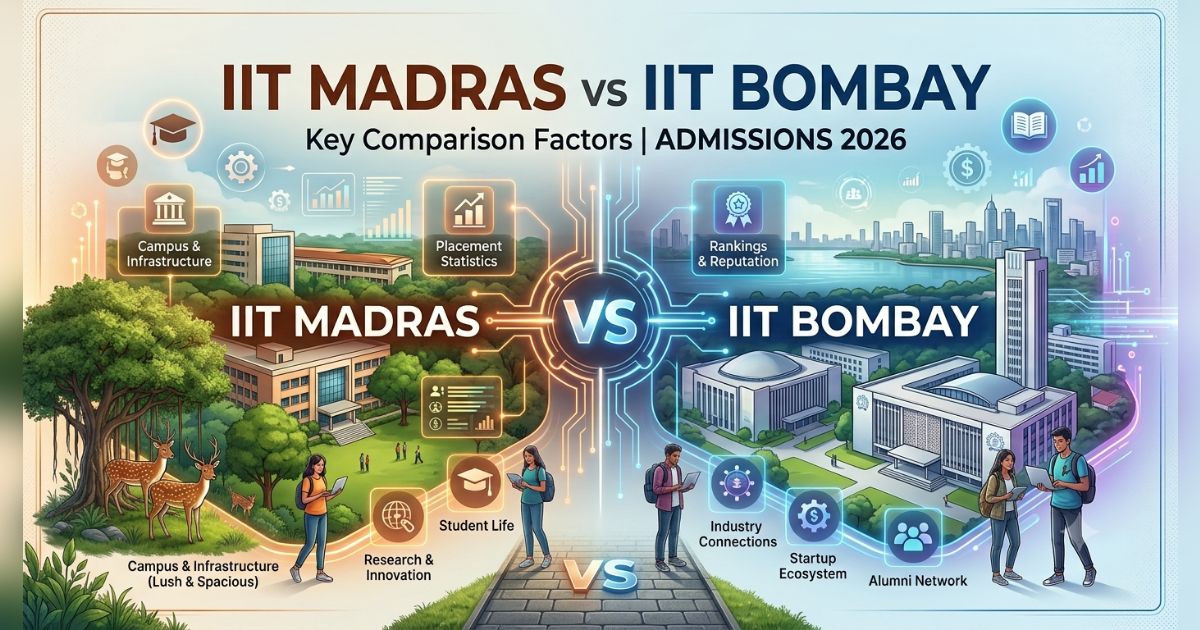
Choosing between IIT Madras and IIT Bombay for 2026 admissions comes down to a handful of concrete factors: national rankings, global reputation, placement outcomes, fee structures, and campus environment. IIT Madras has held the top NIRF Engineering rank for ten consecutive years, while IIT Bombay leads IIT Madras on the QS World University Rankings, making the “better” institute depend heavily on which metric matters most to you.
For B.Tech admissions, the minimum qualifying marks in JEE Advanced serve as the initial eligibility benchmark, after which the Joint Seat Allocation Authority (JoSAA) determines the precise closing ranks for seat allocation at both institutes. For M.Tech and M.A. programmes, IIT Madras requires a qualifying GATE 2024, 2025, or 2026 score, followed by department-specific admission cutoffs, while IIT Bombay follows a similar GATE-based process with its own branch-wise cutoffs.
NIRF Engineering Rankings 2026: IIT Bombay vs IIT Madras
The NIRF Engineering Rankings show a clear and consistent pattern between these two institutes, with IIT Madras holding the top position for ten consecutive years, while IIT Bombay has settled into a stable third place. Both institutes have already submitted their data for the NIRF 2026 cycle, and current data trends suggest the gap between them will likely persist unless there is a major shift in scoring parameters.
| Year | IIT Madras Engineering Rank | IIT Madras Score | IIT Bombay Engineering Rank | IIT Bombay Score |
| 2023 | 1st | Not disclosed | 3rd | Not disclosed |
| 2024 | 1st | 90.60 | 3rd | 88.47 |
| 2025 | 1st | 91.10 | 3rd | 88.47 |
| 2026 | Data submitted, results pending | Awaited | Data submitted, results pending | Awaited |
Historical performance pattern
IIT Madras has held the number one Engineering rank for ten consecutive years, including both the 2024 and 2025 cycles, making it the most consistently top-ranked engineering institute under NIRF. IIT Bombay, meanwhile, has remained steady at 3rd place across the same period, with IIT Delhi actually occupying the 2nd position in 2025 after climbing up from 3rd in 2024, which pushed IIT Bombay to hold its position rather than move up.
Overall category comparison
Beyond Engineering-specific rankings, IIT Madras also leads the Overall NIRF category, ranking 1st with a score of 89.93 in 2025, up slightly from 89.43 in 2024. IIT Bombay’s Overall NIRF rank in 2025 stood at 3rd, with a score of 81.62, reflecting a similar pattern where it trails both IIT Madras and IIT Delhi in the combined institutional assessment.
Why IIT Madras keeps its lead
IIT Madras’s sustained top position largely comes from its strong scores in research and professional practice, along with its graduation outcomes parameter, which have consistently outperformed peer institutes over the past decade. IIT Bombay remains extremely close in absolute score terms, but the sustained multi-year gap suggests IIT Madras has built a structural advantage in specific NIRF parameters that IIT Bombay has not yet closed.
What to expect for NIRF 2026
Given the ten-year unbroken streak, IIT Madras is widely expected to retain the top Engineering rank in the NIRF 2026 results as well, while IIT Bombay is likely to continue holding a top-three position, competing closely with IIT Delhi and IIT Kanpur for the second and third spots. Readers should treat this as historical continuity rather than a confirmed outcome, since final 2026 scores have not yet been published by NIRF.
IIT Bombay vs IIT Madras Placements 2026: Median CTC & Recruiters
For aspirants targeting the 2026 batch, the 2024–25 placement season remains the most complete verified benchmark, since full 2025-26 data is still being compiled at both institutes. Overall, IIT Bombay reports a higher institute-wide average CTC, while IIT Madras stands out for its exceptionally high CSE-specific packages and a distinct strength in core engineering placements.
| Parameter | IIT Madras | IIT Bombay |
| Overall placement rate | Around 81 percent | Around 69.3 percent, down from 75 percent the previous year |
| Overall average CTC | ₹23 to 24.2 LPA | ₹26.45 LPA |
| Overall median CTC | ₹18.5 to 20 LPA | ₹20.21 LPA, per NIRF data |
| Highest package | ₹1.31 crore domestic, ₹4.3 crore reported in an earlier cycle | ₹72 LPA in one reported cycle, with international CSE offers reaching ₹2.4 crore |
| CSE average CTC | ₹42 to 53.2 LPA | ₹38 to 45 LPA |
| CSE median CTC | ₹30 to 46 LPA | ₹28 LPA |
| Total participating companies | 331 companies, 1,109 offers | 417 companies |
| International offers | Moderate, growing steadily | Strong, especially from quant trading firms |
| Finance and quant roles | Present, led by Goldman Sachs, JP Morgan, DE Shaw, American Express | Very strong, led by Goldman Sachs, DE Shaw, Optiver, Jane Street |
| Core engineering roles | Very strong, around 40 percent of placements, the highest among the top IITs | Present but comparatively smaller share |
| Product and tech roles | Strong, led by Google, Microsoft, Amazon, Adobe, Oracle | Very strong, led by Google, Microsoft, Rubrik, Amazon, Adobe |
IIT Madras vs IIT Branch-wise CTC snapshot
| Branch | IIT Madras Median CTC (LPA) | IIT Bombay Average CTC (LPA) |
| Computer Science | 30 to 46 | 42 to 53.2 |
| Data Science and AI | 22 | 28 |
| Electrical Engineering | 20 to 22.5 | 24 to 28.8 |
| Engineering Design | 18 | 22 |
| Aerospace Engineering | 15 to 16.2 | 17.1 to 22 |
| Mechanical Engineering | 14 to 15 | 16.9 to 18 |
| Civil Engineering | 14 to 17.2 | 17 to 17.5 |
| Physics | 15 to 18 | 28 to 34.1 |
Recruiter and sector strengths
IIT Bombay’s Mumbai location continues to give it an edge in finance and quant recruitment, with firms like Optiver, Jane Street, DE Shaw, and Goldman Sachs consistently offering some of the highest individual packages, often pushing international CSE offers above ₹2 crore. IIT Madras, by contrast, has built a distinctive strength in core engineering placements, drawing nearly 40 percent of its offers from semiconductor, automotive, and manufacturing recruiters such as Texas Instruments, Intel, Qualcomm, Tata Steel, and Bajaj Auto, a profile that sets it apart from most other top IITs.
Practical takeaway for 2026 aspirants
If your priority is the highest possible CSE-specific package and strong quant or finance exposure, IIT Bombay’s numbers remain marginally stronger, especially through its international offer pipeline. If your priority is a more consistent overall placement rate along with genuine strength in core engineering sectors alongside computer science, IIT Madras currently presents a more balanced and statistically steadier placement outcome for the 2026 admission cycle.
IIT Bombay vs IIT Madras: Which has better ROI?
Return on investment depends on comparing what students actually pay in total fees against what they realistically earn, not just against the highest headline package. On this basis, both IIT Bombay and IIT Madras deliver exceptional ROI, but a closer look at their CSE-specific data, overall placement consistency, and employment outcome scores reveals meaningful differences between the two.
| ROI Metric | IIT Bombay | IIT Madras |
| Total B.Tech fees, 4 years | Approximately ₹16 to 20 lakh | Approximately ₹16 to 20 lakh |
| Overall placement rate, 2024-25 | Around 69.3 percent, down from 75 percent | Around 81 percent |
| Overall average CTC | ₹26.45 LPA | ₹23 to 24.2 LPA |
| Overall median CTC | ₹20.21 LPA | ₹18.5 to 20 LPA |
| CSE median CTC, 2024-25 | ₹28 LPA | ₹46 lakh, up from ₹37.5 lakh in 2023-24 and ₹30.36 lakh in 2022-23 |
| CSE average CTC, 2024-25 | ₹38 to 45 LPA | ₹53.2 lakh, up from ₹52.32 lakh the year before |
| CSE’s highest package | ₹2.4 crore, largely international, quant-driven | ₹1.31 crore domestic in the most recent verified cycle |
| QS Employment Outcomes score, 2026 | 72.6 | 45.8 |
| Payback period for CSE fees against starting salary | Roughly 6 to 8 months | Slightly longer, but still under 12 months given rising CSE medians |
The CSE ROI picture
Contrary to the general assumption that IIT Bombay always leads on package numbers, IIT Madras CSE has actually posted a higher median CTC in the most recent cycle, at ₹46 lakh compared to IIT Bombay’s ₹28 lakh, with a three-year upward trend from ₹30.36 lakh in 2022-23 to ₹37.5 lakh in 2023-24 and now ₹46 lakh in 2024-25. This means that for computer science specifically, IIT Madras currently shows a stronger and more consistently rising median outcome, even though IIT Bombay retains the edge in absolute peak packages due to its stronger international quant finance pipeline.
Overall employability and consistency
Where IIT Bombay pulls ahead decisively is in the QS Employment Outcomes score, where it scores 72.6 against IIT Madras’s 45.8, reflecting stronger overall graduate employability signals as measured by QS methodology. However, IIT Bombay’s institute-wide placement rate has been declining, falling from 75 percent to 69.3 percent in the latest reported cycle, while IIT Madras has maintained a steadier 81 percent placement rate across its batch, which matters significantly for students who do not end up in the top-paying CSE or quant roles.
Payback period analysis
Since both institutes charge nearly identical total fees of ₹16 to 20 lakh across four years, the ROI comparison ultimately comes down to how quickly a graduate’s starting salary recovers that cost. For CSE graduates at both institutes, the fee is typically recovered within 6 to 12 months of starting salary, making both programmes the best ROI performers among all engineering degrees in India, with virtually no other undergraduate degree matching this payback speed.
Verdict
If your priority is the highest possible peak package, particularly through international quant trading and finance roles, IIT Bombay retains a real, if narrowing, edge due to its Mumbai-based recruiter ecosystem and stronger QS Employment Outcomes score. If your priority is a strong and increasingly higher CSE median salary combined with a steadier overall placement rate across the wider student body, IIT Madras currently presents the more consistent and, by recent CSE median data, arguably the stronger ROI performer for the 2026 admission cycle.
For most students who will land in the median range rather than the outlier top offers, IIT Madras’s rising CSE median and higher overall placement consistency make it the statistically safer ROI bet, while IIT Bombay remains the stronger choice specifically for students targeting the extremely high end of quant finance and international tech recruitment.
IIT Madras vs IIT Bombay: BTech & MTech Tuition Fees Comparison 2026
| Fee Component | IIT Bombay, per year, GE/OBC/EWS | IIT Madras, per year, GE/OBC/EWS |
| Tuition fee | Around ₹2,00,000 | Around ₹2,00,000 |
| Hostel and mess charges | Around ₹60,000 to ₹70,000 | Around ₹55,000 to ₹65,000 |
| Other institute charges, including registration, medical, and student activities | Around ₹30,000 to ₹40,000 | Around ₹25,000 to ₹35,000 |
| Total approximate annual cost, GE/OBC/EWS | Around ₹2.9 to ₹3.0 lakh | Around ₹2.8 to ₹2.9 lakh |
| Total approximate cost, 4 years, GE/OBC/EWS | Around ₹11.5 to ₹12 lakh | Around ₹11 to ₹11.5 lakh |
| Tuition fee, SC/ST/PwD candidates | Fully exempted | Fully exempted |
| Total approximate cost, 4 years, SC/ST/PwD | Around ₹3.5 to ₹4 lakh, mainly hostel and other charges | Around ₹3.2 to ₹3.8 lakh, mainly hostel and other charges |
IIT Madras vs IIT Bombay: MTech Fees & Cutoff
GATE-based M.Tech admissions at IIT Bombay and IIT Madras follow different cutoff scales and fee structures, and both institutes have updated their processes for the 2026 admission cycle. The most important shift to note is that GATE scores are now benchmarked on a much higher scale following the revised normalization formula, which is why 2026 cutoffs look significantly higher than pre-2023 figures.
| Parameter | IIT Bombay | IIT Madras |
| M.Tech CSE GATE cutoff, General category | Around 892 | Comparable range among top CSE applicants, varies by specialization |
| M.Tech Artificial Intelligence GATE cutoff | Around 925 | Not separately listed, folded under CSE-related specializations |
| M.Tech Structural Engineering GATE cutoff | Around 813 | Comparable range for Civil specializations |
| M.Tech Mechanical Engineering GATE cutoff | Generally, in the 700 to 850 range, depending on specialization | Comparable range depending on specialization |
| GATE validity for 2026 admission | GATE 2024, 2025, or 2026 scorecards accepted | GATE 2024, 2025, or 2026 scorecards accepted |
| Application fee | Not uniformly published, varies by department | SC, ST, PwD, and female candidates: ₹300, all others: ₹600 |
| Application window, 2026 | Institute-specific, generally aligned with COAP timeline | Opened 28 March 2026, closed 27 April 2026 |
| Assistantship for M.Tech scholars | Institute-standard HTTA rates apply | ₹12,400 per month for 22 months under Ministry of Education Half-Time Teaching Assistantship |
IIT Madras vs IIT Bombay Fees Comparison
| Fee Component | IIT Bombay, per semester | IIT Madras, per semester |
| Tuition fee | Varies by category, SC, ST, and PwD students generally exempted | ₹5,000 for M.S. and PhD scholars, M.Tech fees structured separately |
| Enrolment fee | Included in composite fee | ₹1,500 |
| Medical fee | Included in composite fee | ₹1,500 |
| Seat rent, hostel | Charged separately | ₹7,500 |
| Student welfare and wellness charges | Included in composite fee | Around ₹2,000 to ₹3,500 combined |
| One-time admission fee | Charged at entry | ₹3,000 |
| Approximate total per semester, GE, OBC, EWS | Comparable overall cost structure | Around ₹20,400 for M.S. and PhD scholars |
| Approximate total per semester, SC, ST, PwD | Lower due to tuition exemption | Around ₹15,400 |
Both institutes follow the standard IIT-wide tuition structure set by the Ministry of Education, which means B.Tech tuition fees are nearly identical across IIT Bombay and IIT Madras, with the main cost variation coming from hostel, mess, and miscellaneous institute charges rather than academic fees. SC, ST, and PwD candidates at both institutes continue to receive full tuition fee exemption, making their total four-year cost significantly lower than General, OBC, and EWS category students.
Campus Life & Academic Environment: IIT Bombay vs IIT Madras
This section provides a detailed comparison of IIT Bombay and IIT Madras, focusing on their campus life, academic environment, and key institutional metrics. IIT Madras achieved the #1 NIRF 2024 Rank, while IIT Bombay secured #3, indicating their distinct positions in national rankings.
| Parameter | IIT Madras | IIT Bombay |
| Established | 1959 | 1958 |
| NIRF 2024 Rank | #1 | #3 |
| QS World Rank 2024 | #227 | #118 |
| Location | Chennai (Adyar/Guindy) | Mumbai (Powai) |
| Campus Size | 617 acres | 550 acres |
| Research Index (NIRF) | Highest among IITs | High (top 3) |
| PhD Graduates/Year | ~400+ | ~350+ |
| International Collaborations | 250+ MoUs | 200+ MoUs |
This head-to-head comparison highlights that IIT Madras consistently leads in national rankings and research output, producing more PhD graduates and holding the highest NIRF Research Index. Conversely, IIT Bombay achieved a stronger QS World Ranking and maintains a slightly larger number of international collaborations.
Frequently Asked Questions
What is IIT Madras vs IIT Bombay?
IIT Bombay currently hosts a higher number of female students than IIT Madras, with IIT Bombay having 1,677 women.
What are the eligibility requirements for IIT Madras vs IIT Bombay?
IIT Madras requires valid scores in JEE Advanced, GATE, JAM, and CAT. IIT Bombay primarily requires JEE Advanced scores for B.Tech admissions.
How do I apply for IIT Madras vs IIT Bombay?
Admission to both IIT Madras and IIT Bombay is through JEE Advanced, after qualifying JEE Main. The application process is centralized for all IITs.
What is the application timeline for IIT Madras vs IIT Bombay?
The application deadline for IIT Madras and IIT Bombay is May 31, 2026.
What is the expected cutoff for IIT Madras vs IIT Bombay?
IIT Bombay typically has higher cutoffs than IIT Madras, particularly for popular branches like CSE. Specific ranks depend on the candidate’s category and quota.