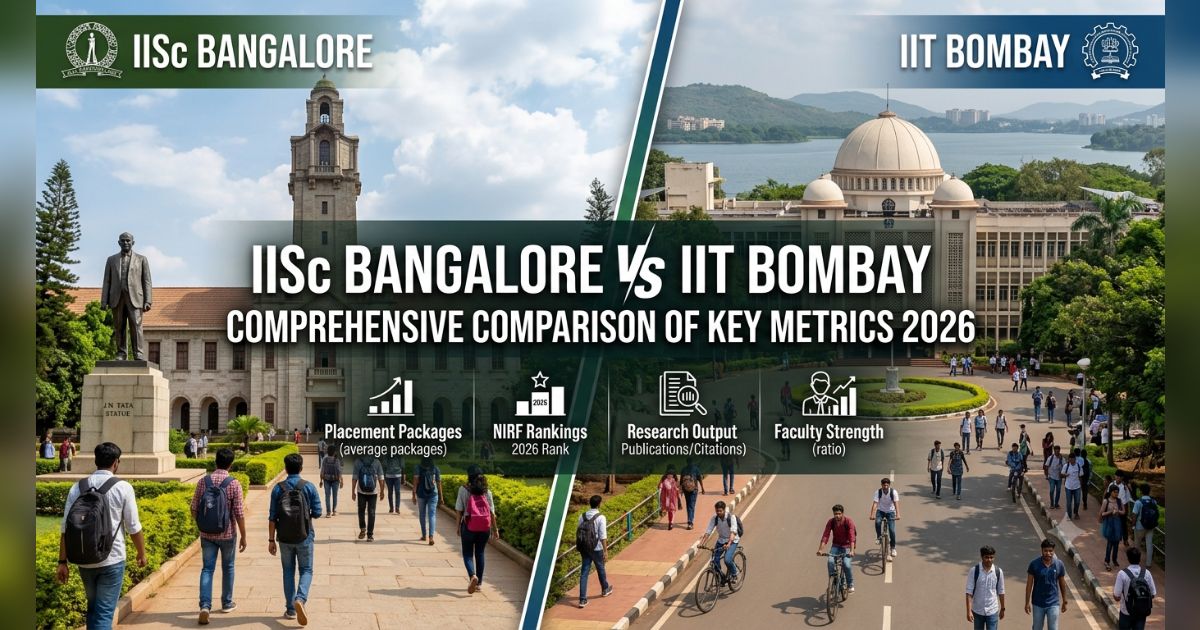
IISc Bangalore vs IIT Bombay: Comprehensive Comparison of Key Metrics 2026
The Ministry of Education, Government of India, through its National Institutional Ranking Framework (NIRF), establishes a comprehensive ranking for institutions, with IISc Bangalore securing the 1st position in the University Category for 2025. This benchmark, distinct from institution-reported performance data, offers a government-backed evaluation. For instance, IIT Bombay’s median B.Tech salary reached ₹20–30 LPA in 2025, while IISc Bangalore reported ₹17.9–20 LPA, highlighting direct placement outcomes. This article provides an in-depth IISc Bangalore vs IIT Bombay comparison of key metrics for 2026.
NIRF 2026 Rankings: IISc Bangalore vs IIT Bombay Engineering & Research
The NIRF 2025 rankings highlighted strong performances from both IISc Bangalore and IIT Bombay. IISc Bangalore secured the 2nd overall rank, while IIT Bombay followed closely at 3rd. This section details their performance across various categories and parameters, offering a comprehensive comparison of these top institutions.
| Institution | Overall Rank (2025) | Overall Score (2025) | University Category Rank (2025) | Engineering Category Rank (2025) | Research Category Rank (2025) | Innovation Category Rank (2025) | TLR Score (30%) | RP Score (30%) | GO Score (20%) | OI Score (10%) | PR Score (10%) |
| Indian Institute of Science | 2 | 85.00 | 1 | – | – | – | 86.47 | 88.16 | 83.69 | 60.29 | 98.41 |
| Indian Institute of Technology Bombay | 3 | 81.62 | – | 3 | 4 | 2 | 83.79 | 83.05 | 86.04 | 60.13 | 83.35 |
IISc Bangalore vs IIT Bombay: Which has better ROI?
Return on investment for these two institutes must be evaluated separately by programme level, since IISc is overwhelmingly a postgraduate and research institution while IIT Bombay runs a full-scale B.Tech-to-industry pipeline. Comparing total fees paid against realistic earning outcomes at both the undergraduate and M.Tech level reveals that IISc actually delivers a stronger fee-to-earnings ratio at the postgraduate level, while IIT Bombay retains the edge in absolute peak packages and B.Tech-level outcomes.
| ROI Metric | IISc Bangalore | IIT Bombay |
| B.Tech total fees, full duration | Around ₹8 lakh | Around ₹11.5 to 12 lakh |
| B.Tech highest package | Around ₹1.5 crore | Around ₹1.68 crore to ₹2.4 crore, largely international and quant-driven |
| B.Tech average package | Around ₹28 LPA | ₹26.45 LPA institute-wide, ₹38 to 45 LPA for CSE |
| B.Tech CSE average package | Around ₹35 LPA | ₹38 to 45 LPA |
| M.Tech total fees, 2 years | Around ₹70,000 to ₹90,000 | Around ₹2 to 2.5 lakh |
| M.Tech stipend, 2 years | Around ₹2.98 lakh, MoE HTTA | Around ₹2.98 lakh, MoE HTTA |
| M.Tech net cost after stipend | Net positive, stipend exceeds fees | Near zero, stipend roughly offsets fees |
| M.Tech CSA/CSE average CTC | ₹30 to 38 LPA | ₹30.53 LPA reported average, ₹30 LPA median |
| M.Tech CSA/CSE highest package | Around ₹80 LPA | Around ₹67 LPA reported |
| PhD average starting package | ₹25 to 35 LPA, higher than IISc’s own M.Tech average | Not typically distinguished separately from M.Tech |
| Placement rate | Around 69 percent, many opt for a PhD or research instead of jobs | Around 69.3 percent, down from 75 percent the previous year |
The M.Tech ROI advantage at IISc
The single most striking ROI data point is that IISc’s M.Tech is effectively a net-positive investment, since its total two-year fee of roughly ₹70,000 to ₹90,000 is fully covered, and then some, by the ₹2.98 lakh Ministry of Education Half-Time Teaching Assistantship stipend paid over the same period. IIT Bombay’s M.Tech, by contrast, charges a notably higher two-year fee of around ₹2 to 2.5 lakh, which the same ₹2.98 lakh stipend only roughly breaks even against, making IISc’s M.Tech the more capital-efficient postgraduate option on pure fee arithmetic.
On earning outcomes, IISc’s CSA M.Tech students report an average CTC of ₹30 to 38 LPA against IIT Bombay’s CSE M.Tech reported average of ₹30.53 LPA and median of ₹30 LPA, meaning the two are nearly identical in earning potential at the postgraduate computer science level, but IISc reaches that outcome on a dramatically lower fee base.
The B.Tech picture favors IIT Bombay on the scale
At the undergraduate level, IIT Bombay clearly retains the advantage for students focused purely on maximizing peak earning potential, with the highest reported package of ₹1.68 crore to ₹2.4 crore, largely fueled by its strong pipeline into international quant trading and finance roles. IISc’s B.Tech programme, offered only through its small Mathematics and Computing cohort, is far more limited in scale, though it still posts a competitive highest package of around ₹1.5 crore and a similar average package of around ₹28 LPA, showing that on a per-student basis the outcomes are comparable despite the vastly smaller class size at IISc.
The unique PhD earnings premium at IISc
A distinctive feature that sets IISc apart from IIT Bombay is the unusually high earning outcome for its PhD graduates, who report an average starting package of ₹25 to 35 LPA, a premium that is unique among Indian institutions since PhD graduates elsewhere typically earn less than their B.Tech or M.Tech peers. This reflects IISc’s strong pipeline into industry research roles at organizations like Google Research, NVIDIA Research, and DRDO labs, which specifically seek doctoral-level expertise and pay accordingly, a pathway that is far less pronounced at IIT Bombay given its comparatively smaller PhD cohort relative to its B.Tech and M.Tech intake.
Placement rate context
Both institutes report broadly similar overall placement percentages, hovering around 69 percent, but the underlying reason differs significantly: IIT Bombay’s dip from 75 percent to 69.3 percent reflects a genuine placement slowdown in a difficult recruitment year, while IISc’s comparable figure largely reflects a structural choice, since a substantial share of its M.Tech and PhD students voluntarily opt out of the job market to pursue further research, academia, or postdoctoral positions rather than failing to secure offers.
Verdict
For undergraduate students chasing the highest possible peak package and the widest recruiter base, particularly in international finance and quant roles, IIT Bombay remains the stronger ROI choice given its larger scale and stronger absolute package ceiling. For postgraduate and research-track students, however, IISc delivers a genuinely superior ROI profile, combining a near-zero or net-positive fee structure after stipend, comparable or higher M.Tech CSA earning outcomes, and a unique PhD salary premium that IIT Bombay simply does not replicate at the same scale, making IISc the more capital-efficient option for anyone pursuing M.Tech, M.Tech Research, or PhD study in engineering or computer science.
Placements 2026: IISc Bangalore vs IIT Bombay Median Salary & Roles
Placement figures for the 2025-26 season show IIT Bombay pulling further ahead on peak international packages, while IISc Bangalore continues to post strong and more evenly distributed outcomes across its research-heavy postgraduate cohort. Reported highest packages at IIT Bombay for 2026 range widely across sources, from ₹1.48 crore to as high as ₹3.67 crore for international AI lab offers, reflecting how much variance exists depending on which placement phase and offer category is counted.
| Feature | IISc Bangalore | IIT Bombay |
| Highest B.Tech-equivalent package | Around ₹1.5 crore | ₹2.2 crore to ₹3.67 crore, largely international AI and quant roles |
| Average package, overall | Around ₹28 LPA | ₹23.5 to ₹26.45 LPA, depending on reporting cycle |
| Average CSE-equivalent package | Around ₹35 LPA | ₹35 to ₹50 LPA |
| Median CSE package | Not separately disclosed, generally tracks close to average | Around ₹28 LPA |
| Overall placement rate | Around 69 percent, with many opting for PhD or research over jobs | Around 69.3 to 78 percent, varying by source and reporting cycle |
| M.Tech and PG median salary | ₹13.25 LPA to ₹22.50 LPA, depending on programme | Around ₹20.21 LPA, per NIRF-reported data |
| M.Mgt (Business Analytics) average package, 2026 | ₹30.51 LPA | Not applicable, comparable MBA data not disclosed here |
| M.Mgt (Business Analytics) median package, 2026 | ₹27.3 LPA, up from ₹24 LPA in 2025 | Not applicable |
| Total companies participating | Not comprehensively disclosed | 417 companies in 2024-25, 42 companies on Day 1 of the 2025-26 season |
| Total offers | Not comprehensively disclosed | Around 1,475 plus offers reported in one 2026 cycle |
| Key recruiters | Tata, Microsoft, Wells Fargo, D E Shaw, J.P. Morgan, Goldman Sachs, Mastercard, Uber, eBay, Flipkart, Honeywell | Google, Microsoft, Amazon, Meta, Apple, Nvidia, Qualcomm, Goldman Sachs, DE Shaw, Jane Street, Optiver, Tower Research |
Placement rate nuance
IIT Bombay’s placement rate figures vary noticeably across reporting sources, ranging from around 69.3 percent in one verified NIRF-linked dataset to as high as 78 percent in another placement report, a discrepancy that likely reflects differences in how “eligible” versus “registered” students are counted. IISc’s roughly 69 percent placement rate, by contrast, is structurally different in nature, since a large share of its non-placed students are not actively seeking industry jobs at all, having instead chosen to continue into PhD, postdoctoral research, or academic positions.
Sector and role trends for 2026
Across the broader IIT placement season, artificial intelligence and machine learning roles have become the dominant hiring category, accounting for roughly one in three offers in 2026, the highest share recorded in any placement cycle to date, with median offers across older IITs including Bombay rising to around ₹22 LPA, up from ₹19.6 LPA the previous year. IISc’s recruiter base leans more heavily toward research-intensive roles and traditional technology and finance recruiters such as Tata, Microsoft, and Wells Fargo, while IIT Bombay’s recruiter list is now dominated by AI-focused giants like Nvidia and Qualcomm alongside its longstanding quant finance pipeline of Jane Street, Optiver, and Tower Research.
Research Focus & Opportunities: IISc Bangalore vs IIT Bombay 2026
When considering research-track B.Tech programs, IISc Bangalore is the conventional choice, while IIT Bombay typically attracts those pursuing industry or entrepreneurship. This IISC Bangalore vs IIT Bombay comparison highlights their distinct strengths and opportunities for students in 2026.
| Course | IISc Bangalore | IIT Bombay |
| M.Sc. in Life Sciences | ✓ | ✓ |
| M.Sc.in Biological Sciences | ✓ | ✓ |
| M.Sc. in Mathematical Sciences | ✓ | ✓ |
| M.Sc. in Chemical Sciences | ✓ | ✓ |
| M.Sc. in Physical Sciences | ✓ | ✓ |
| M.Sc in Operations Research | – | ✓ |
| M.Tech. in Computer Science and Engineering | ✓ | ✓ |
| M.Tech. in Computational and Data Science | ✓ | ✓ |
| M.Tech. in Microelectronics and VLSI Design | ✓ | – |
| M.Tech. in Quantum Technology | ✓ | – |
| M.Tech. in Mechanical Engineering | ✓ | ✓ |
| M.Tech. in Bioengineering | ✓ | ✓ |
| M.Tech. in Industrial Engineering and Operations Research | – | ✓ |
| M.Tech. in Civil Engineering | ✓ | ✓ |
| M.Tech. in Electronic Systems Engineering | ✓ | ✓ |
| M.Tech. in Electrical Engineering | ✓ | ✓ |
| M.Tech. in Aerospace Engineering | ✓ | ✓ |
| M.Tech. in Chemical Engineering | ✓ | ✓ |
| M.Tech. in Instrumentation Systems | ✓ | ✓ |
| M.Tech. in Materials Engineering | ✓ | ✓ |
| M.Tech. in Earth and Climate Sciences | ✓ | ✓ |
| M.Tech. in Electronic Product Design | ✓ | ✓ |
| Online M.Tech. in Artificial Intelligence | ✓ | ✓ |
| M.Tech in Centre For Technology Alternatives For Rural Areas(CTARA) | – | ✓ |
| M.Des | ✓ | ✓ |
| MBA | ✓ | ✓ |
- IISc Bangalore Core Focus: Leads in scientific research and postgraduate education, emphasizing research.
- IIT Bombay Core Focus: Excels in engineering, technology, entrepreneurship, and industry partnerships.
- IISc Bangalore Research Fellowships: Offers extensive fellowships for research students.
- IIT Bombay Research Fellowships: Provides limited fellowships.
- IISc Bangalore Rankings (2025): Ranked 1st and 2nd nationally, 185th globally, strong in research and PG science.
- IIT Bombay Rankings (2025): Ranked 4th and 3rd nationally, 118th globally, strong in technology and entrepreneurship.
| Program | IISc Bangalore | IIT Bombay |
| Mathematics | ✓ | ✓ |
| Materials Science | ✓ | ✓ |
| Economics | – | ✓ |
| Biochemistry | ✓ | ✓ |
| Environmental Science | – | ✓ |
| Energy | – | ✓ |
| Microbiology and Cell Biology | ✓ | ✓ |
| Physical Science | ✓ | ✓ |
| Biological Sciences | ✓ | ✓ |
| Molecular Biophysics | ✓ | – |
| Philosophy | – | ✓ |
| Operations Research | – | ✓ |
| Computer Science and Engineering | – | ✓ |
| Electrical Engineering | – | ✓ |
| Ph.D. in Design | – | ✓ |
| Biomedical Engineering | – | ✓ |
| Geoinformatics and Natural Resources Engineering | – | ✓ |
| Earth Sciences | – | ✓ |
| Metallurgical Engineering and Materials Science | – | ✓ |
This table highlights the diverse doctoral opportunities, with IIT Bombay offering a broader range of Ph.D. programs in fields like Economics, Environmental Science, and Design, while IISc Bangalore specializes in areas such as Molecular Biophysics.
- Purpose of Establishment (IISc Bangalore): Promotes scientific research and uplifts India’s research capabilities.
- Top Recruiters (IISc Bangalore Research): Tata, Microsoft, Wells Fargo, and leading R&D firms offer strong academic and research career pathways.
- High-Demand Research Programmes (IISc Bangalore): Include Biological, Chemical, Physical, Electrical, Mechanical, Interdisciplinary Sciences, and Mathematics.
- Main Course Focus (IISc Bangalore): Primarily B.Sc, M.Tech/PhD (Research).
- New Programmes (IISc Bangalore 2024): Introduced BTech in Mathematics and Computing and BSc (Research) in Engineering and Mathematics streams.
- B.Tech and Research Intake (IISc Bangalore): Sanctioned 120 seats across various engineering and computing disciplines; total B.Sc and B.Tech seats were 190 in 2025.
M.E./M.Tech Fees, Duration & Accepted Exams: IISc vs IIT Bombay 2026
To help you plan your postgraduate studies, this section details the M.Tech./M.Des. program specifics for IISc Bangalore and IIT Bombay, focusing on accepted entrance exams, program durations, and fee structures for the upcoming 2026-27 academic year. Understanding these differences is crucial for your application strategy.
| Institute | Program | Accepted Exams | Score Card Validity |
| IISc Bangalore | M.Tech. | GATE | Valid as on 1st August 2026 |
| IISc Bangalore | M.Des. | GATE/CEED/CAT | Valid as on 1st August 2026 |
| IIT Bombay | M.Tech. | GATE | Implied for M.Tech admission through GATE score |
| IISc Bangalore M.Tech./M.Des. Annual Fees for Academic Year 2026-27 | ||
| Category | Total Annual Fee | Tuition Fee |
| General/OBC/EWS | ₹36,840 | ₹21,840 |
| SC/ST/PwD | ₹21,090 | ₹6,090 |
| Sponsored (DRDO/ISRO/NAL etc.) | ₹61,410 | ₹46,410 |
These annual fees for IISc Bangalore reflect the structure for the upcoming academic year, with the institute applying a 5% annual increase rate. You also receive a monthly scholarship of ₹12,400 during the program.
- Program Duration: IISc M.Tech./M.Des. programs span 2 years, based on scholarship duration.
- Admission Process: IISc M.Tech./M.Des. admissions for GATE-qualified candidates use the Common Offer Acceptance Portal (COAP).
- Online Application Fee (General/OBC/EWS): ₹800 for IISc M.Tech./M.Des.
- Online Application Fee (SC/ST/PwD): ₹400 for IISc M.Tech./M.Des.
- M.Tech. (Online) Application Fee: ₹2,000 for IISc.
Student Experience & Campus Vibe: IISc vs IIT Bombay Insights 2026
Understanding the distinct student experiences and campus vibes is crucial when considering your B.Tech journey. This section offers insights into the core differences between IISc Bangalore and IIT Bombay, focusing on student life, academic intensity, and overall campus atmosphere, which significantly shape your four years.
- IISc Student Focus: Conventional first choice for research-track B.Tech students, strongest path to top global PhD programmes.
- IIT Bombay Student Focus: Conventional first choice for industry-track and entrepreneurship-track B.Tech students.
- IISc Courseware Vibe: Pretty hectic.
- IIT Bombay Courseware Vibe: Pretty chill.
- IISc Batch Size: Approximately 9 percent of IIT Bombay’s intake.
- IIT Bombay Campus Life: Students rate campus life 4.7 out of 5.
These points highlight a fundamental divergence in academic culture and student aspirations. While one institution cultivates a highly focused, research-intensive environment, the other offers a more relaxed academic pace alongside a vibrant social scene, as reflected in its high student rating for campus life.
| Aspect | IISc Bangalore | IIT Bombay |
| Campus Size & Location | 444-acre forest campus in north Bangalore, strong research-park presence. | 550 acres in Powai with two adjacent lakes. |
| Sanctioned Intake | 120 across CSE, EE, EE-Research, Mechanical, Materials, Mathematics, and Computing. | Approximately 1,360 across full-spectrum engineering branches. |
| Flagship Cultural Fest | Pravega | Mood Indigo |
Frequently Asked Questions
Which is better, IISc or IIT Bombay?
IISc excels in a research focus and core research roles. IIT Bombay offers a broader undergrad experience and dominates in general undergrad placements. Both institutions provide strong career outcomes.
Is IIT Bombay better for placements?
IIT Bombay is a foremost industrial leadership development institution. UG students secured a median package of Rs 20,20,860 in the 2024-25 placement drive.
What are the eligibility requirements for IISC Bangalore and IIT Bombay?
IIT Bombay primarily requires JEE Advanced scores. IISc Bangalore accepts JEE Main/Advanced, NEET, or KVPY for undergraduate admissions, and various national exams for postgraduate programs.
How do I apply for IISC Bangalore and IIT Bombay?
IIT Bombay admissions are primarily via JEE Advanced. IISc Bangalore accepts JEE Main/Advanced, KVPY, and other national exams for its undergraduate programs.