Journalism in India: Courses, Fees, Eligibility and Scope
Nishit Kumar is a senior EdTech industry leader with over a decade of experience in building and scaling education platforms, shaping their product, content, and growth strategy. At…
At least 803 colleges offer Journalism courses across India, including 62 government institutions and 228 private colleges.
What is Journalism
Journalism is the discipline of gathering, assessing, creating, and presenting news and information to the public. In India, academic programs in journalism train students in print reporting, broadcast news production, digital media creation, media ethics, and communication theory. Students learn to investigate stories, verify facts, write news scripts, and operate modern media technology across various newsroom roles.
With the expansion of digital platforms alongside traditional television and print outlets, media education equips graduates to work in news agency reporting, digital content writing, editing, broadcasting, and public relations.
Journalism Fees
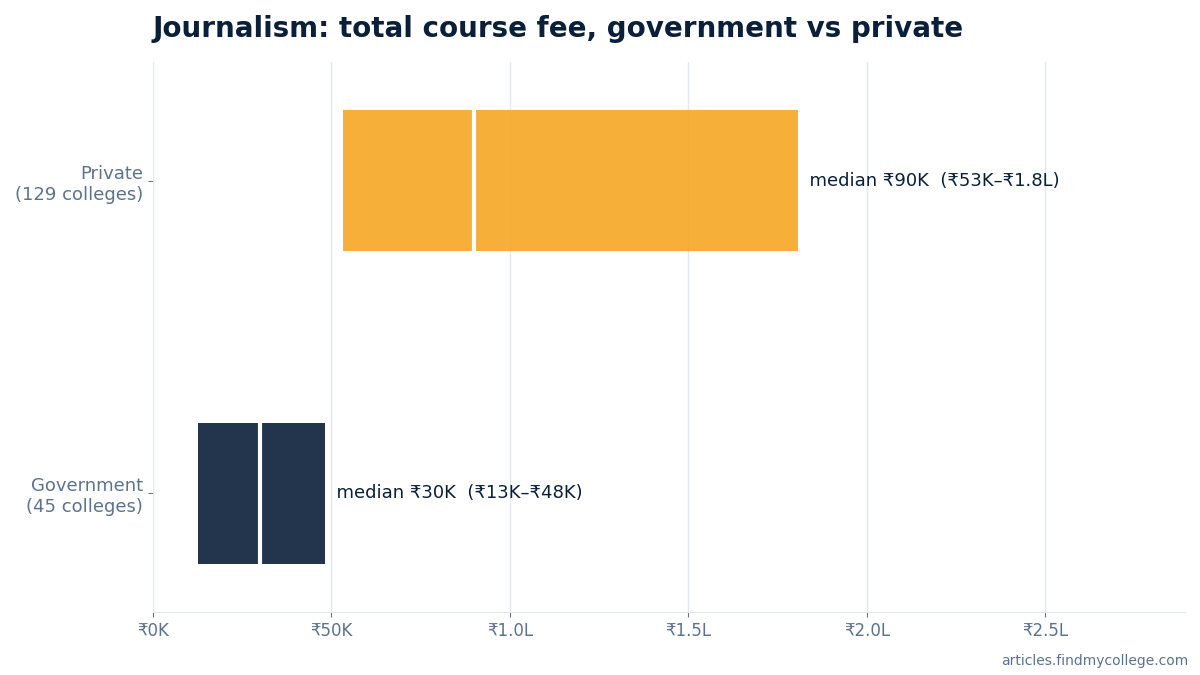
Course fees for journalism programs vary significantly between government institutions and private colleges. Government colleges offer affordable tuition rates, with a median total course fee of ₹30,000 and the middle half of colleges charging between ₹12,720 and ₹48,190 based on data from 45 government colleges.
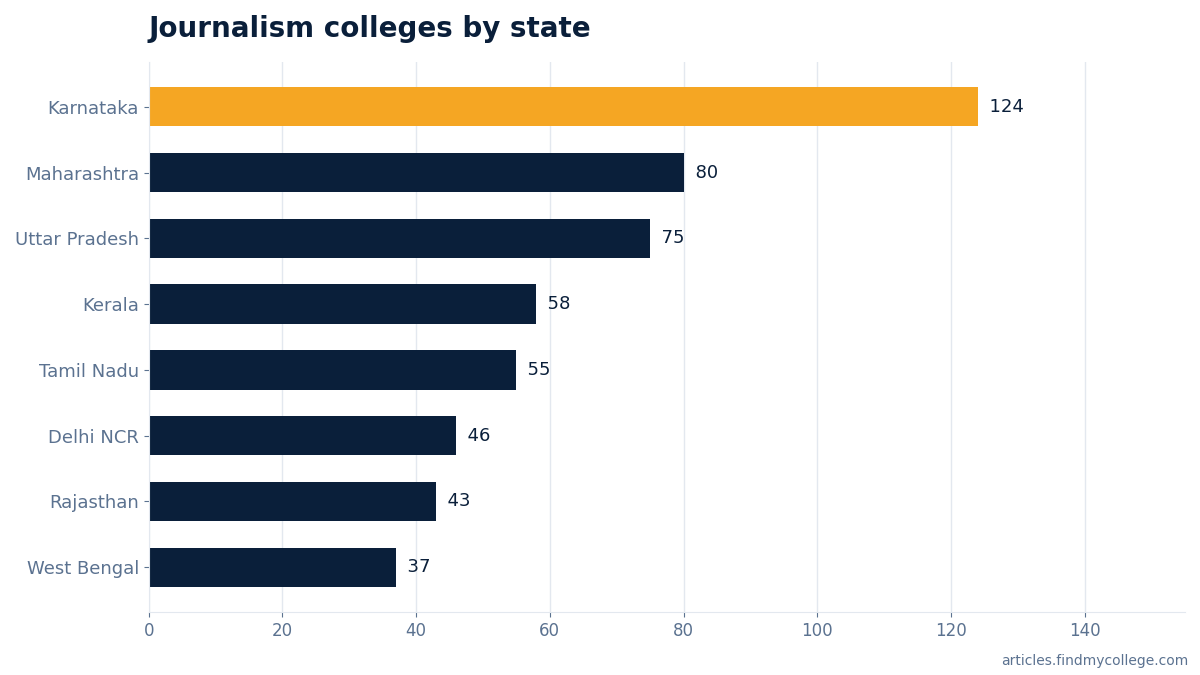
In contrast, private colleges have a median total course fee of ₹90,000, with the middle half ranging between ₹53,250 and ₹1.81 lakh based on data from 129 private institutions. State distribution shows at least 124 colleges in Karnataka, 80 in Maharashtra, 75 in Uttar Pradesh, 58 in Kerala, 55 in Tamil Nadu, and 46 in Delhi NCR.
| College | City | Ownership | Total course fee |
|---|---|---|---|
| Calicut University | Calicut | Government | ₹5,255 |
| Institute for Excellence in Higher Education | Bhopal | Government | ₹6,000 |
| Magadh University | Gaya | Government | ₹6,192 |
| Baruipur College | South 24 Parganas | Government | ₹6,210 |
| Shri Atal Bihari Vajpai Govt. Arts and Commerce College | Indore | Government | ₹7,066 |
| T.M. Jacob Memorial Government College Manimalakunnu | Ernakulam | Government | ₹7,190 |
| Gujarat University | Ahmedabad | Government | ₹7,860 |
| IDSG Government College | Chikmagalur | Government | ₹10,500 |
| Indira Gandhi National Open University | Delhi | Government | ₹12,000 |
| Government Jamuna Prasad Verma Post Graduate Arts and Commerce College | Bilaspur | Government | ₹12,000 |
Top Journalism Colleges
| College | City | Ownership | Total course fee | NIRF rank |
|---|---|---|---|---|
| Jamia Millia Islamia University | Delhi | Government | ₹20,710 | 4 (Overall, 2025) |
| Delhi University | Delhi | Government | ₹21,390 | 5 (Overall, 2025) |
| Banaras Hindu University | Varanasi | Government | ₹30,000 | 6 (Overall, 2025) |
| Presidency College Bangalore | Bangalore | Private | ₹2.00 lakh | 7 (Overall, 2021) |
| St. Xavier’s College Kolkata | Kolkata | Private (aided) | ₹1.93 lakh | 8 (Overall, 2025) |
| Jadavpur University | Kolkata | Government | ₹26,200 | 9 (Overall, 2025) |
| SRM Institute of Technology | Kanchipuram | Private | ₹1.60 lakh | 11 (Overall, 2025) |
| Loyola College | Chennai | Private | ₹1.86 lakh | 14 (Overall, 2025) |
| Madras Christian College | Chennai | Private (aided) | ₹1.15 lakh | 16 (Overall, 2025) |
At least 803 colleges offer journalism in India, including NIRF-ranked institutions like Jamia Millia Islamia University and Delhi University. Total course fees among NIRF-ranked options range from ₹20,710 at Jamia Millia Islamia University to ₹2.00 lakh at Presidency College Bangalore.
| College | City | Ownership | Total course fee | Average package |
|---|---|---|---|---|
| Kishinchand Chellaram College | Mumbai | Private (aided) | ₹1.16 lakh | 4 LPA |
| Pillai College of Arts, Commerce and Science | Navi Mumbai | Private (aided) | ₹99,484 | 3.6 LPA |
| Agra College | Agra | Private (aided) | ₹32,420 | 3.5 LPA |
| St. Francis College for Women | Hyderabad | Private (aided) | ₹1.83 lakh | 3.46 LPA |
| Jyoti Nivas College | Bangalore | Private (aided) | ₹2.28 lakh | 3.38 LPA |
| Fergusson College | Pune | Private (aided) | ₹2.95 lakh | 3 LPA |
| Madras Christian College | Chennai | Private (aided) | ₹1.15 lakh | 3 LPA |
| Ethiraj College for Women | Chennai | Private (aided) | ₹82,184 | 2.67 LPA |
| Farook College | Kozhikode | Private (aided) | — | 2.4 LPA |
| Christ Academy Institute for Advanced Studies | Bangalore | Private | ₹1.50 lakh | 2 LPA |
Among private and aided colleges with placement data, Kishinchand Chellaram College reports an average package of 4 LPA. Across 22 evaluated journalism colleges, the overall median average placement package is 3.0 LPA.
| City | Colleges | Fee range | Well-known options |
|---|---|---|---|
| Bangalore | 72 | ₹27,040 – ₹10.64 lakh | Christ University, Jain University |
| Delhi | 46 | ₹12,000 – ₹5.10 lakh | Jamia Millia Islamia University, Delhi University |
| Mumbai | 30 | ₹30,000 – ₹4.35 lakh | Tata Institute of Social Sciences Mumbai, Mumbai University |
| Chennai | 28 | ₹20,000 – ₹7.08 lakh | University of Madras, Loyola College |
| Kolkata | 27 | ₹19,050 – ₹7.53 lakh | Jadavpur University, Amity University Kolkata |
| Jaipur | 24 | ₹30,000 – ₹2.48 lakh | Manipal University Jaipur, University of Rajasthan |
| Pune | 22 | ₹30,000 – ₹9.17 lakh | Fergusson College, Symbiosis International University Pune |
| Noida | 19 | ₹25,000 – ₹4.68 lakh | Amity University Noida, Sharda University |
Bangalore leads major cities with 72 journalism colleges, followed by Delhi with 46 and Mumbai with 30. Total course fees across these cities range from ₹12,000 in Delhi to ₹10.64 lakh in Bangalore.
| College | City | Ownership | Total course fee |
|---|---|---|---|
| Gujarat Forensic Sciences University | Gandhi Nagar | — | ₹40,000 |
| School of Distance Learning, Jagan Nath University | Jaipur | — | ₹55,000 |
| Institute of Open and Distance Education, Barkatullah Vishwavidyalaya | Bhopal | — | ₹19,145 |
| Directorate of Distance Education, I.K Gujral Punjab Technical University | Jalandhar | — | ₹2.06 lakh |
| College of Food Technology, Kerala Veterinary and Animal Sciences University | Thrissur | University | — |
How to Apply for Journalism Admission in: Step by Step
- Select location and target state: Compare options across states including Karnataka with 124 colleges, Maharashtra with 80, Uttar Pradesh with 75, Kerala with 58, Tamil Nadu with 55, and Delhi NCR with 46.
- Evaluate fee structures: Review government colleges with a median total fee of ₹30,000 or private colleges with a median total fee of ₹90,000.
- Compare top NIRF-ranked colleges: Consider options like Jamia Millia Islamia University in Delhi (₹20,710 total fee) and Delhi University (₹21,390 total fee).
- Check city fee ranges: Review cities like Bangalore with 72 colleges (₹27,040 – ₹10.64 lakh) and Delhi with 46 colleges (₹12,000 – ₹5.10 lakh).
- Review placement packages: Note that the median average placement package across 22 journalism colleges is 3.0 LPA.
| What to do | Where | Link |
|---|---|---|
| Compare colleges, fees and cutoffs | Journalism colleges in India | findmycollege.com |
Government colleges offer a median total fee of ₹30,000, while private institutions have a median total fee of ₹90,000. Across 22 journalism colleges, the median average placement package is 3.0 LPA.
People Also Read


Related Guides
- Journalist Salary in India 2026: Pay, Career Growth, and Perks Guide
- Courses Journalism after Graduation in 2026: Full List, Eligibility, Fees, Scope & Salary
- BA in Journalism Salary in India 2026: A Comprehensive Guide
- B. Mass Communication vs BBA vs BA Journalism (2026)
- Explore Leading Travel Photography Courses: Online, Diploma & Workshops 2026
- Editing Course Near Me: Top Institutes, Fees and Duration
FAQs
What is the fee structure for journalism courses in private colleges?
Private colleges offering journalism courses have a median total course fee of ₹90,000, with the middle half ranging between ₹53,250 and ₹1.81 lakh.
What is the average fee for journalism courses in government colleges?
Government colleges offering journalism programs have a median total course fee of ₹30,000, with the middle half ranging between ₹12,720 and ₹48,190.
What salary package can a journalism graduate expect during campus placements?
The median average placement package across 22 reporting colleges is 3.0 LPA, with top private aided institutions recording average packages reaching up to 4 LPA.